The Second Law: Why Time Has a Direction
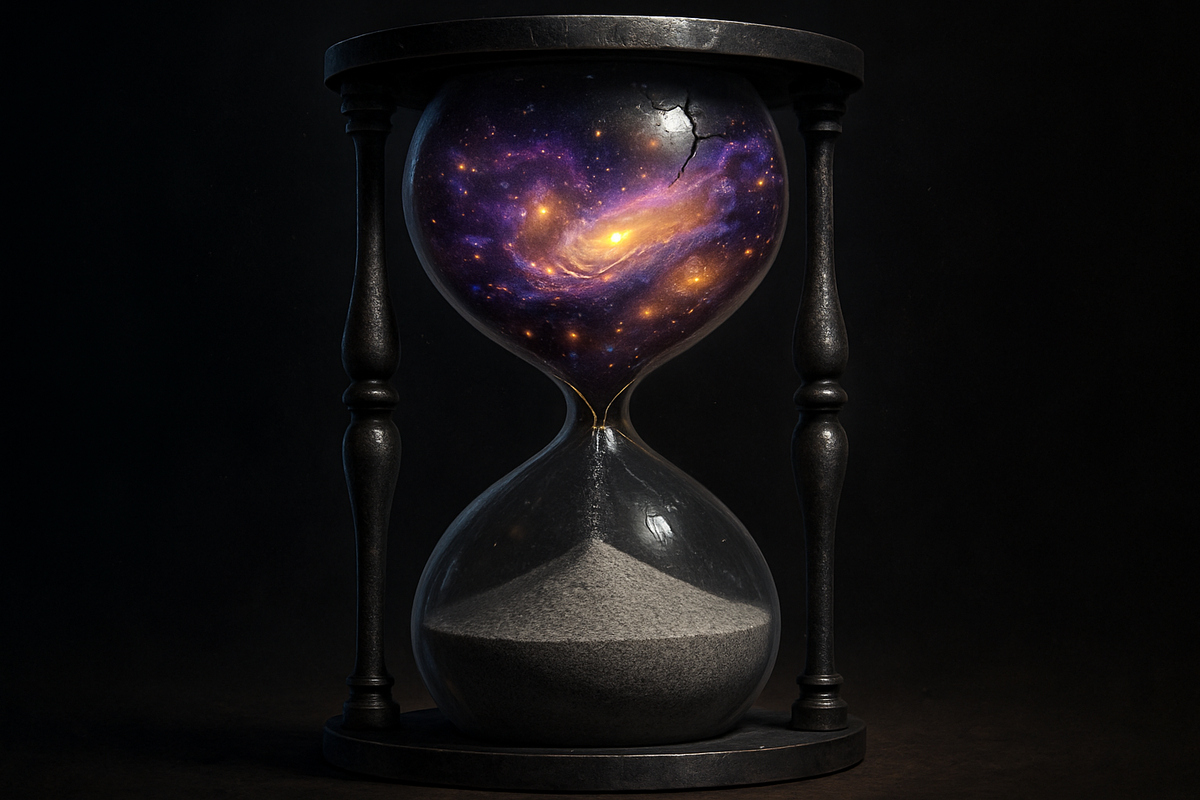
Every other law of physics is time-symmetric. Run the equations backward and they still work. The Second Law is the exception — entropy increases, and that asymmetry is the only reason the past differs from the future.
The Second Law: Why Time Has a Direction
Here's a video: an egg falls off a counter, hits the floor, and splatters. Now play it backward: fragments leap up, yolk reconstitutes, shell reassembles, the intact egg rises to the counter.
The backward video violates no laws of mechanics. Every particle follows Newton's equations. Energy is conserved. Momentum is conserved. And yet you know instantly it's fake. Eggs don't unscramble.
Why not?
The answer is the Second Law of Thermodynamics. It's the law that makes time feel like time—the reason the universe has a direction, the reason you age, the reason you can't undo anything. And despite 150 years of attacks by clever physicists, it has never broken.
The Law
The Second Law of Thermodynamics states: In an isolated system, entropy never decreases. It either increases or stays the same.
Mathematically: ΔS ≥ 0 for isolated systems.
Where S is entropy—a measure we'll unpack shortly. The "≥" is crucial: entropy can stay constant (reversible processes) or increase (irreversible processes), but it can never decrease on its own.
The pebble: Entropy is the universe's ratchet. It only clicks one way.
What Is Entropy?
Entropy is the most misunderstood concept in physics. It's often called "disorder," but that's misleading. A better definition: entropy is a measure of how many microscopic arrangements are consistent with a macroscopic state.
Consider a box of gas. Macroscopically, you see pressure and temperature. Microscopically, 10²³ molecules are bouncing around with specific positions and velocities. Entropy measures how many different microscopic configurations give the same macroscopic appearance.
A gas spread evenly through a box has high entropy—many arrangements look the same. A gas compressed into one corner has low entropy—fewer arrangements give that appearance. The Second Law says systems evolve toward higher entropy because there are more ways to be high-entropy than low-entropy.
The pebble: Entropy isn't about messiness. It's about probability. Systems evolve toward more probable configurations. High entropy just means "lots of ways to arrange the parts."
Boltzmann's Insight
Ludwig Boltzmann revolutionized physics in the 1870s by connecting entropy to counting.
His equation, carved on his tombstone: S = k ln W
Where: - S is entropy - k is Boltzmann's constant (1.38×10⁻²³ J/K) - W is the number of microstates (microscopic arrangements) - ln is the natural logarithm
This equation says entropy is proportional to the logarithm of the number of ways to arrange the microscopic parts. More arrangements = higher entropy.
The logarithm is crucial: it makes entropy additive. Combine two systems, and their entropies add. Without the log, you'd have to multiply, which is messier.
The pebble: Boltzmann unified thermodynamics with statistics. Entropy isn't a mystical property—it's just counting, scaled logarithmically.
Why Entropy Increases
If you shuffle a deck of cards, you're unlikely to end up with them perfectly ordered by suit and rank. Not because physics forbids order, but because there's only one "perfectly ordered" arrangement and millions of disordered ones. Shuffle enough, and you'll land on disorder—not by magic, but by probability.
The Second Law is the same principle at cosmic scale. There are vastly more high-entropy configurations than low-entropy ones. As systems evolve through random molecular collisions, they migrate toward more probable states. More probable = higher entropy.
The key insight: the Second Law isn't a fundamental law—it's a probability statement. Entropy decrease isn't forbidden; it's just vanishingly unlikely when you're dealing with 10²³ particles.
An egg could spontaneously unscramble if every molecule happened to move backward simultaneously. The probability of this is not zero—it's just so small that you'd have to wait longer than the age of the universe for it to happen once.
The pebble: The Second Law is probability in disguise. It holds not because nature forbids violations, but because violations require cosmic coincidences.
The Arrow of Time
Here's the deep mystery: the fundamental laws of physics are time-symmetric.
Newton's equations work forward and backward. Quantum mechanics is time-reversible. Even general relativity doesn't privilege a direction. If you filmed particles interacting and played it backward, both videos would obey physics.
So why does macroscopic reality have a direction? Why do eggs break but not unbreak, ice melt but not freeze spontaneously, people age but not youth?
The answer is the Second Law. Entropy increase defines time's arrow. "The future" is the direction of higher entropy. This isn't a metaphor—it's the physical basis for why time feels different from space.
The pebble: Time has a direction because entropy has a direction. Without the Second Law, past and future would be indistinguishable.
The Clausius Formulation
Rudolf Clausius gave the original statement of the Second Law in 1850: Heat cannot spontaneously flow from a colder body to a hotter body.
This seems obvious—ice cubes don't heat up rooms. But it's logically equivalent to entropy increase. If heat could flow from cold to hot spontaneously, you could concentrate thermal energy without work, decreasing entropy. The Second Law forbids this.
Refrigerators and heat pumps do move heat from cold to hot—but they require work input. They're not violating the Second Law; they're paying the entropy tax somewhere else (usually at the power plant).
Heat Engines and Carnot's Limit
Sadi Carnot discovered in 1824 that no heat engine can be 100% efficient. Some heat must always be rejected to a cold reservoir. This is a direct consequence of the Second Law.
The maximum possible efficiency (Carnot efficiency) is: η = 1 - T_cold/T_hot
Where temperatures are in Kelvin. A steam engine with 100°C steam (373 K) and 20°C exhaust (293 K) can be at most 21% efficient. Real engines are less.
The pebble: The Second Law limits all heat engines—cars, power plants, your metabolism. Some energy must always be "wasted" as low-temperature heat. Perfect efficiency is thermodynamically impossible.
Perpetual Motion Machines of the Second Kind
The First Law forbids machines that create energy from nothing (perpetual motion of the first kind). The Second Law forbids a different impossibility: machines that convert heat entirely into work without any cold reservoir.
Such a device—perpetual motion of the second kind—would violate entropy increase. You'd be concentrating dispersed thermal energy into organized work without paying an entropy cost. Every such design has failed.
The ocean contains enormous thermal energy. You cannot extract it efficiently because there's no colder reservoir to dump waste heat. Energy is there; entropy won't let you use it.
Life and Entropy
Living things are highly ordered—low entropy structures. Does life violate the Second Law?
No. Life is an open system, not an isolated one. We take in low-entropy matter (food, oxygen), use it for organization, and expel high-entropy waste (heat, CO₂, excrement). The total entropy of organism plus environment increases. We're just locally decreasing our entropy by increasing environmental entropy faster.
The pebble: Life is a dissipative structure—a temporary island of order maintained by a constant throughput of entropy export. When you stop eating and breathing, entropy claims you. That's called death.
Erwin Schrödinger put it beautifully in 1944: organisms "feed on negative entropy." We don't violate the Second Law; we exploit it. We surf the entropy gradient created by the sun's low-entropy light hitting Earth and being re-radiated as high-entropy heat.
The Heat Death of the Universe
Take the Second Law to its endpoint: entropy increases until it can't increase anymore. This is heat death—a universe at maximum entropy, uniform temperature everywhere, no gradients to drive processes, no change, no time (in any meaningful sense).
Heat death isn't burning or freezing—it's temperature equilibrium. Every star burned out, every black hole evaporated, every structure dissipated. The universe would still exist, but nothing would happen.
Current estimates put heat death at 10¹⁰⁰ years or more. It's not imminent. But it's where the Second Law points.
The pebble: The universe is running down. Everything that happens—stars, life, consciousness—is just the cosmos finding more probable configurations on its way to equilibrium.
Objections and Paradoxes
Loschmidt's Paradox
If mechanics is time-reversible, how can entropy increase irreversibly? Answer: the Second Law is statistical. Individual particles can move "backward," but for 10²³ particles to simultaneously coordinate a reversal is overwhelmingly improbable.
The Fluctuation Theorem
In very small systems, entropy can briefly decrease. The fluctuation theorem quantifies these statistical deviations. For macroscopic systems, the probability of observable decrease is effectively zero.
Cosmological Puzzle
If entropy always increases, why was the early universe low-entropy? This is the Past Hypothesis—the assumption that the Big Bang state was extraordinarily ordered. Why? We don't know. It's one of the deepest unsolved problems in physics.
The Information Connection
There's a deep connection between entropy and information. Claude Shannon, founder of information theory, deliberately named his measure of information "entropy" because it has the same mathematical form.
High entropy = more uncertainty = more information needed to specify the exact microstate.
This connection becomes physical through Landauer's principle: erasing one bit of information requires dissipating at least kT ln 2 joules of energy. Information is physical. Computation has thermodynamic costs. Your brain burning glucose to think? That's the Second Law.
Why This Matters
The Second Law is arguably the most universal law in physics:
- It explains why we age - It explains why machines can't be perfectly efficient - It explains why time has a direction - It limits what computation can achieve - It constrains the fate of the universe
Eddington famously said: "If your theory is found to be against the second law of thermodynamics I can give you no hope; there is nothing for it but to collapse in deepest humiliation."
170 years. No exceptions.
Further Reading
- Carroll, S. (2010). From Eternity to Here: The Quest for the Ultimate Theory of Time. Dutton. - Penrose, R. (2004). The Road to Reality. Knopf. (Chapters 27-28) - Ben-Naim, A. (2008). A Farewell to Entropy: Statistical Thermodynamics Based on Information. World Scientific.
This is Part 4 of the Laws of Thermodynamics series. Next: "[The Third Law: Absolute Zero and the Unreachable Floor](/third-law-thermodynamics/)"
Comments ()