Secular Divination: Personality Tests and Algorithms
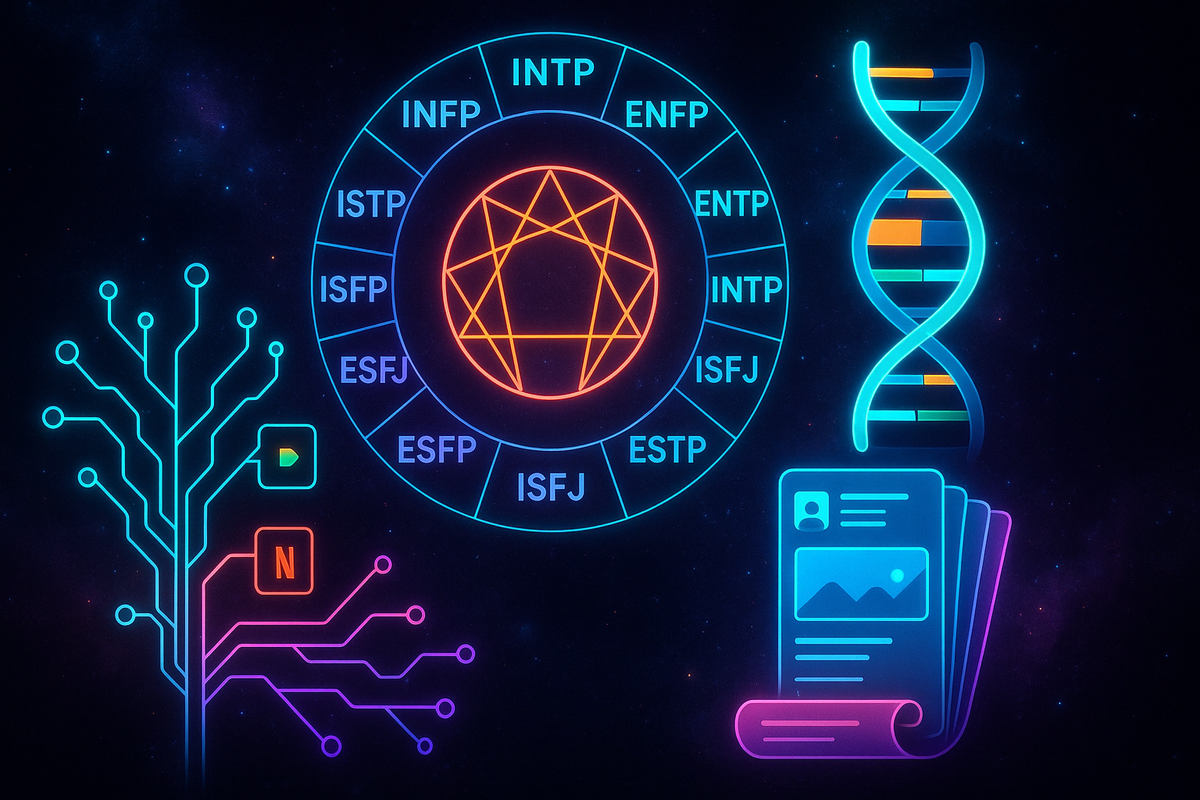
We replaced the oracle with a 16-type personality grid. MBTI, the enneagram, and algorithmic feeds all promise the same thing ancient divination did — a map of yourself and a hint about what comes next. The ritual changed; the need didn't.
Secular Divination: Personality Tests and Algorithms
In 2018, the Myers-Briggs Type Indicator generated an estimated $20 million in revenue.
Approximately 2 million people take the MBTI annually. 89 of the Fortune 100 companies use it. It's deployed for hiring, team building, leadership development, and career counseling. It shapes marriages, friendships, and hiring decisions.
There's just one problem: the MBTI has essentially no scientific validity.
Test-retest reliability is poor—about half of people get a different type when they retake the test. The dichotomous categories (Introvert vs. Extrovert, etc.) don't match how personality actually distributes. Studies consistently fail to find the predicted correlations between type and job performance.
Yet the MBTI thrives. It's the world's most popular personality assessment.
It thrives because it functions as secular divination—a modern system that serves the same psychological purposes as tarot or astrology, just without the supernatural framing.
The Personality Test as Oracle
Consider what happens when you take the MBTI.
You answer questions about yourself. The system processes your answers and outputs a type: INTJ, ENFP, ISTJ, whatever. You read the type description. You feel recognized.
"Oh my god, this is so me. I am always analyzing everything. I do prefer concepts to details."
The experience is identical to reading your horoscope and feeling it's accurate. The mechanism is identical—the Barnum effect, projection, confirmation.
But it feels different. It feels scientific. There are questionnaires and acronyms and the whole apparatus of psychological testing. It doesn't invoke the stars or the cards. It invokes personality theory.
The scientific veneer makes the Barnum effect more powerful. When astrology tells you you're analytical, you can dismiss it as superstition. When a personality assessment tells you the same thing, you've been measured.
The Four-Letter Identity
The MBTI gives you a four-letter identity code.
INFJ. ESTP. ENFP.
This is remarkably clever marketing. It creates in-group membership (I'm an INTJ; other INTJs understand me), it provides a conversation starter (what's your type?), and it gives you a shorthand for self-description.
Just like sun signs, the four letters become an identity label. People put their type in their social media bios. They seek romantic partners with compatible types. They explain behavior through type ("he's being such a J right now").
The psychology is identical to astrological identity. The content is different. The function is the same.
Both systems give you: - A category to belong to - A vocabulary for describing yourself - An explanation for your tendencies and quirks - A framework for understanding others - A community of people who share your label
Whether that category is Virgo or INTJ, the psychological payload is identical.
The Enneagram
The Enneagram is even more explicitly structured like a divination system.
Nine personality types, arranged in a circle, with lines connecting them to show relationships. Type 4 is "The Individualist." Type 8 is "The Challenger." Type 2 is "The Helper."
The types come with wing variations (4w3, 4w5), stress and growth directions, and levels of health. The system has elaborate internal structure.
And essentially zero scientific validation. The types don't reliably emerge from factor analysis. The stress/growth predictions aren't empirically supported. The whole framework is unfalsifiable in practice.
But the Enneagram community is fervent. People identify deeply with their type. They use it for spiritual development, relationship counseling, personal growth. Bestselling books explain how to leverage your type.
The Enneagram succeeds because it provides rich narratives. Unlike the relatively spare MBTI descriptions, Enneagram types come with detailed stories about childhood origins, defense mechanisms, paths of development. There's so much detail that everyone can find themselves reflected.
More detail means more projection surface. More projection means more perceived accuracy. More perceived accuracy means more engaged users.
The Recommendation Algorithm
Here's a divination system you use daily: algorithmic recommendations.
Netflix suggests what to watch. Spotify suggests what to listen to. Amazon suggests what to buy. TikTok surfaces what to scroll.
These algorithms observe your behavior and produce outputs you didn't consciously request. The outputs feel relevant—sometimes eerily so. "How did the algorithm know I wanted to hear this song?"
The mechanism is statistical pattern matching. The algorithm noticed that people who liked X also liked Y, and you liked X, so here's Y. No magic. Just math.
But the experience feels like being known. The algorithm seems to understand you. It provides things that fit—sometimes things you didn't know you wanted.
This is the same psychological experience as a psychic reading. Something external appears to know your inner state and provides relevant content.
The difference is that algorithms actually work. They do have information about your preferences, derived from your behavior. But the feeling of being known—the experience of meaning—is psychologically identical.
Algorithms as Oracles
Increasingly, people use algorithms for divination-like purposes.
"What should I watch tonight?" (Netflix) "What music fits my mood?" (Spotify) "What should I read?" (Goodreads) "Who should I date?" (Tinder)
These are genuinely difficult decisions. What you want is often unclear to you. The options are overwhelming. Analysis leads to paralysis.
Enter the algorithm. It takes the burden of decision. It provides options that feel relevant. It breaks the deliberation loop.
This is the oracle function—resolution of uncertainty, commitment through external authority, permission to stop analyzing and just choose.
The mechanism is technological rather than mystical. But the psychological function converges.
The Feed as Divination
Social media feeds are algorithmically curated environments that constantly present you with content you didn't request.
You scroll. Something appears. It resonates—or it disturbs, or it inspires, or it angers. You react.
This is remarkably similar to the process of drawing a card. You didn't choose what would appear. You interpret what appeared. Your reaction reveals something about you.
Heavy social media users often develop parasocial divinatory practices—treating the feed as meaningful. "The algorithm showed me this for a reason." "That post appeared right when I needed to see it."
This is superstitious thinking applied to a deterministic process. The algorithm showed you that post because of engagement metrics, not cosmic alignment. But the experience of meaningful coincidence is identical to the experience in traditional divination.
The feed becomes an oracle. Not by design—but by psychological function.
The DNA Test as Destiny
23andMe and Ancestry.com offer another form of secular divination: genetic identity discovery.
Spit in a tube. Mail it away. Receive your results. You are 42% British, 28% German, 15% Scandinavian, 8% Jewish, 7% unassigned.
These percentages become identity. People adjust their self-concept based on the results. They feel connected to cultures they never participated in. They reframe family narratives.
The science is real—genetic ancestry testing works—but the psychological response often exceeds what the science supports. A 5% result doesn't mean you have meaningful connection to that culture. It means some ancestors, generations back, likely originated in that region.
People treat genetic ancestry as revelation of essential self. The test told me who I really am.
This is the divination function applied to biotechnology. The output becomes identity-defining. The external authority (the test) provides information that feels more true than self-knowledge.
Why Secular Divination Works
The secular systems work for the same reasons traditional systems work:
Identity scaffolding: They provide frameworks for self-understanding that feel externally validated.
Social currency: They give you things to talk about, communities to join, in-groups to belong to.
Decision support: They help resolve uncertainty, especially identity uncertainty ("who am I?") and choice uncertainty ("what should I do?").
Narrative structure: They provide stories about yourself that feel meaningful.
External validation: The results come from outside, which feels more objective than self-assessment.
The supernatural framing is gone. The psychological payload is identical.
The Corporation as Oracle
When a company tells you your personality type, there's an authority transfer.
You might doubt your own self-assessment. You wouldn't confidently say "I'm an analytical introvert who prefers concepts to details." That sounds arrogant or presumptuous.
But if the test says you're an INTJ, that's different. The assessment determined it. You're just reporting results.
Institutional authority launders self-knowledge into external validation. The test didn't discover anything you didn't already know (the test was based on your self-report answers). But by repackaging your answers as a type, it makes your self-knowledge feel objective.
This is why personality tests are so popular in corporate settings. They provide permission structures for discussing personality differences without making claims feel personal or presumptuous.
The Sincere and the Ironic
Modern users of secular divination exist on a spectrum.
Some are sincere believers. They think MBTI types are real psychological categories. They think the algorithm genuinely knows them. They take the outputs as revealed truth.
Some are ironic users. They know the MBTI lacks validity. They know the algorithm is just pattern matching. They use the systems anyway—for fun, for conversation, for loose guidance that they don't take literally.
Many are in between. They're not sure what they believe, but they engage because the systems are useful.
This parallels traditional divination. Sincere astrology believers, ironic horoscope readers, and people who aren't sure but find it helpful—the distribution is similar.
The Convergence
Traditional and secular divination are converging.
Modern tarot readers emphasize the psychological function over the supernatural mechanism. "The cards don't predict the future—they help you access your intuition."
Modern algorithm users talk about the technology in quasi-mystical terms. "The algorithm knows me better than I know myself."
Both are meeting in the middle: tools for psychological exploration with ambiguous metaphysical status.
The secular systems have the advantage of not requiring supernatural belief. You can use the MBTI without believing in Myers or Briggs. You can use the algorithm without believing in algorithmic consciousness.
The traditional systems have the advantage of accumulated cultural technology. Thousands of years of tarot symbolism. Three thousand years of I Ching commentary. The depth of meaning in traditional systems exceeds what any app can provide.
But the function converges: structured frameworks for self-understanding in an uncertain world.
What This Reveals
The proliferation of secular divination reveals a persistent human need.
We want to be known—especially by something external that isn't just reflecting our own biases.
We want categories—identities that simplify the complexity of selfhood.
We want permission—external validation for what we already sense about ourselves.
We want resolution—frameworks that turn overwhelming choice into manageable options.
These needs don't go away because we live in a scientific age. They just find new expressions—some wrapped in science-like packaging, some delivered by algorithm, some emerging from genetic testing.
The technology changes. The psychology persists.
Further Reading
- Pittenger, D. J. (2005). "Cautionary comments regarding the Myers-Briggs Type Indicator." Consulting Psychology Journal. - Riso, D. R. & Hudson, R. (1999). The Wisdom of the Enneagram. Bantam. - Christian, B. & Griffiths, T. (2016). Algorithms to Live By. Henry Holt.
This is Part 8 of the Divination Systems series. Next: "[Synthesis: Divination as Coherence Technology](/divination-coherence-technology/)."

Comments ()