Secure Attachment: The Nervous System That Learned to Rest in Connection
Secure attachment isn't about having no anxiety — it's about having a nervous system flexible enough to activate and return. Polyvagal theory frames it as ventral vagal dominance with intact recovery pathways.

Secure Attachment: The Nervous System That Learned to Rest in Connection
The textbook version of secure attachment reads like a developmental achievement checklist: healthy relationships, emotional regulation, trust in others. But that description misses what makes secure attachment mechanistically distinct from other attachment patterns. It's not a personality trait or a set of learned behaviors. It's a fundamental difference in how your nervous system responds to connection itself.
Here's what secure attachment actually is: ventral vagal dominance with flexible state transitions. Not the absence of stress or fear. Not immunity to activation. The capacity to activate sympathetically when needed—and then return to baseline. To trust co-regulation as reliably as self-regulation. To experience connection as physiologically safe.
That's not a developmental milestone. It's a nervous system that learned something most of us didn't: that other people are resources, not threats.
What Secure Attachment Looks Like in the Body
Stephen Porges' polyvagal theory offers the clearest map of what secure attachment means neurobiologically. The autonomic nervous system has three hierarchical pathways:
1. Ventral vagal (social engagement) — safety, connection, growth 2. Sympathetic (mobilization) — fight/flight, action, urgency 3. Dorsal vagal (immobilization) — shutdown, freeze, collapse
Secure attachment = ventral vagal as home base. The nervous system defaults to social engagement mode. You can mobilize sympathetically when needed—sprint away from danger, argue passionately, compete in sports—but the ventral vagal system brings you back down afterward. You don't get stuck in hyperarousal. You don't collapse into shutdown.
The securely attached infant doesn't cry less than the anxiously attached one. They cry, their caregiver responds reliably, and their nervous system learns: activation → signal → response → relief. That cycle—thousands of times—trains the vagal brake. The ability to ramp up and ramp down. To trust that distress is temporary because help is consistent.
Attachment researchers call this earned security when it develops later in life, but the mechanism is the same: enough reps of co-regulation working that your nervous system updates its priors. Connection becomes predictable. Safety becomes the expected state rather than the exception.
The Flexibility That Defines Security
Here's what separates secure attachment from rigid emotional control: state flexibility.
A securely attached person doesn't stay calm because they're repressing activation. They stay calm because their nervous system can move fluidly between states without getting stuck. Sympathetic activation doesn't spiral into panic because the ventral vagal system stays online enough to modulate it. Dorsal vagal shutdown doesn't trap them in collapse because they can re-engage socially to pull themselves out.
Think of it as physiological range of motion. An anxiously attached nervous system has high sympathetic tone—always slightly revving, scanning for disconnection. An avoidantly attached nervous system has blunted ventral vagal tone—connection feels risky, so the system stays in low-grade mobilization or shutdown. A disorganized system oscillates chaotically between all three states.
The securely attached nervous system moves through all three states too—but smoothly. Stress activates the sympathetic system, you deal with the stressor, and then ventral vagal tone brings you back to baseline. You can tolerate dorsal vagal rest (true relaxation, sleep, stillness) without it feeling like depression or death. You can handle high arousal without it becoming a crisis.
This is why securely attached people seem emotionally "easy." Not because they don't feel things intensely—but because their nervous system knows how to complete the stress cycle. Activation doesn't linger. Shutdown doesn't last. The system trusts its own capacity to return to equilibrium.
Co-Regulation as Baseline Expectation
The defining feature of secure attachment isn't self-regulation. It's trust in co-regulation.
Insecurely attached nervous systems learn early: I am alone in managing my state. The anxious system frantically seeks external regulation but doesn't trust it. The avoidant system rejects external regulation entirely. The disorganized system oscillates between desperate need and terrified avoidance.
The securely attached nervous system learned something different: Other people help. Reliably. Predictably. Without punishment or withdrawal.
This shows up in research as the Strange Situation response: the securely attached infant is distressed when the caregiver leaves (because connection matters), seeks proximity when they return (because the caregiver is trustworthy), and calms quickly once reunited (because co-regulation works). That fast return to calm isn't emotional suppression—it's the ventral vagal system doing what it was trained to do. Accept the regulation offered. Use the caregiver's calm to restore your own.
Adults with secure attachment do this automatically. When stressed, they reach out. When someone offers support, they take it. They don't perform independence or reject help as weakness. Their nervous system recognizes another person's regulated state as a usable resource—like noticing a chair when you're tired, or shade when you're hot.
This is what healthy interdependence looks like neurobiologically: my nervous system can use your nervous system to stabilize mine, and vice versa, without either of us losing our autonomy. That's not codependence. That's how mammalian nervous systems are supposed to work.
Why "Just Calm Down" Works for Them
People with insecure attachment often resent how easily secure people seem to manage stress. "Why can't I just calm down like they do?" The answer isn't willpower or emotional intelligence—it's vagal tone.
Vagal tone is the strength of the ventral vagal brake on the sympathetic system. High vagal tone = smooth transitions between arousal and calm. Low vagal tone = sympathetic activation lingers, recovery takes longer, baseline arousal stays elevated.
Secure attachment builds high vagal tone through thousands of successful co-regulation cycles. Each time an infant is soothed, their vagal brake strengthens. Each time distress leads reliably to comfort, the nervous system learns: I can come back down. Over time, that becomes automatic. The ventral vagal system doesn't just respond to safety—it generates it.
So when someone with secure attachment encounters stress, their vagal brake kicks in sooner. They don't spiral as fast. They recover faster. Not because they're "better at coping"—because their nervous system has a stronger biological mechanism for downregulation.
This is why therapeutic interventions for insecure attachment often focus on vagal tone training: breathwork, somatic practices, trauma-informed yoga, EMDR. You're not learning new thoughts—you're strengthening the physiological brake that secure people developed in infancy.
The Neural Architecture of Safety
Neuroscientist Ruth Feldman's work on the biology of attachment shows what secure attachment looks like in the brain. The default mode network (DMN)—active during rest, self-reference, and social cognition—shows greater coherence in securely attached individuals. The salience network (which detects threat and novelty) activates appropriately but doesn't dominate baseline states.
Insecure attachment shows up as hyperconnectivity between threat-detection systems and higher-order cognition. The amygdala fires more often. The anterior cingulate cortex (conflict monitoring) stays overactive. The prefrontal cortex works harder to suppress emotional responses—but that suppression isn't the same as regulation. It's override, not integration.
Secure attachment isn't about having less emotional activity—it's about having better integration between emotional and regulatory systems. The ventral vagal system communicates bidirectionally with the prefrontal cortex, allowing top-down regulation (conscious calming strategies) and bottom-up signaling (somatic awareness of safety). Those systems work together rather than fighting.
This is why securely attached people often seem to "feel their feelings" without being overwhelmed by them. They're not dissociating or intellectualizing—they're experiencing integrated arousal. The emotion is present, the somatic experience is acknowledged, and the nervous system knows it will pass.
Contrast that with anxious attachment, where emotions feel uncontrollable because the sympathetic system dominates and the vagal brake is weak. Or avoidant attachment, where emotions are suppressed because connection to others (and thus to one's own ventral vagal system) is too risky. Secure attachment isn't about feeling less—it's about having the physiological infrastructure to feel flexibly.
Relational Patterns That Signal Security
If you've never experienced secure attachment up close, it can look like emotional aloofness—because securely attached people don't perform anxiety the way insecurely attached people do. They don't text constantly for reassurance. They don't need elaborate displays of commitment. They don't panic when their partner takes time alone.
This isn't indifference. It's object permanence at the nervous system level. The securely attached person's brain has encoded: connection persists even when the other person isn't physically present. Their ventral vagal tone remains stable during separation because their predictive models of relationships include reliability.
Here's what secure attachment looks like in relationships:
- Protest is direct: "I'm upset about X" rather than testing or passive-aggression - Conflict doesn't threaten connection: Arguments happen, then resolve, without existential panic - Closeness is easy: Physical and emotional intimacy feel safe, not engulfing or risky - Autonomy is easy: Independence doesn't feel like abandonment - Bids for connection are straightforward: "I need you" is a sentence, not a crisis - Repair is fast: Ruptures don't linger because reconnection is trusted
None of this is conscious strategy. These patterns emerge automatically when your nervous system's default setting is connection = safety.
The Coherence Model of Secure Attachment
Within the AToM framework, secure attachment is low-curvature relational geometry. The state-space of connection is smooth, predictable, navigable without constant correction.
Insecure attachment is high-curvature: small perturbations (a delayed text, a critical comment, a moment of distance) cause large deviations in state. The anxious system spikes into hyperarousal. The avoidant system retreats into shutdown. The disorganized system ricochets unpredictably.
Secure attachment is integrable trajectories under the constraint of connection. You can predict how interactions will unfold. Stress doesn't cascade into catastrophe. Closeness doesn't collapse into fusion. The relational system has low surprise—not because nothing unexpected happens, but because the system can absorb novelty without destabilizing.
In free energy terms: secure attachment minimizes relational prediction error through flexible updating rather than rigid priors. The anxious system has high prediction error (constant vigilance for abandonment) and can't update its priors (help never feels reliable). The avoidant system has low prediction error (expects nothing from others) but at the cost of impoverished models (connection is excluded from the generative model entirely).
The secure system maintains both rich generative models of connection (relationships are complex, nuanced, meaningful) and efficient error minimization (unexpected relational events update beliefs smoothly rather than triggering system collapse).
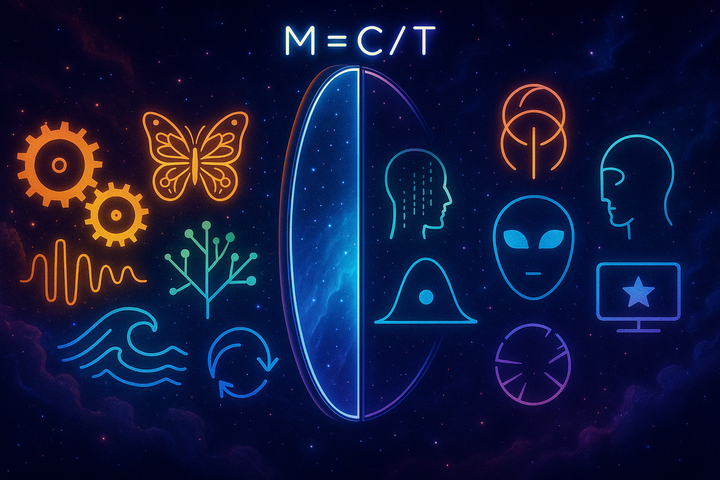
Secure attachment is meaning-at-low-cost. M = C/T, where coherence (C) is high and tension (T) is manageable. Relationships make sense without constant effort.
Can You Build This Later?
Yes—but it requires new prediction error at the autonomic level, not just cognitive insight.
Therapy helps, but not the kind that stays in talking. Secure attachment develops through embodied experiences of co-regulation working. Somatic therapies, safe relationships, practices that strengthen vagal tone—these are the mechanisms that shift attachment patterns.
The key is repetition. Just as the infant needed thousands of cycles of distress → soothing → relief, the adult nervous system needs enough reps of connection feels safe to update its priors. One good relationship doesn't reprogram you. But sustained, reliable co-regulation can.
This is why attachment research emphasizes earned security: adults who experienced insecure attachment in childhood but later develop secure patterns through relationships or therapy. Their nervous systems learned, eventually, what securely attached infants learned early: other people are resources, and my body can rest in that knowledge.
It's not about becoming someone else. It's about giving your nervous system new data until the old predictions stop running your life.
Further Reading
- Porges, S. W. (2011). The Polyvagal Theory: Neurophysiological Foundations of Emotions, Attachment, Communication, and Self-Regulation. W.W. Norton. - Feldman, R. (2017). "The Neurobiology of Human Attachments." Trends in Cognitive Sciences, 21(2), 80-99. - Cozolino, L. (2014). The Neuroscience of Human Relationships: Attachment and the Developing Social Brain. W.W. Norton. - Schore, A. N. (2003). Affect Regulation and the Repair of the Self. W.W. Norton. - Sroufe, L. A., et al. (2005). The Development of the Person: The Minnesota Study of Risk and Adaptation from Birth to Adulthood. Guilford Press.
This is Part 6 of the Attachment & Polyvagal Theory series, exploring how early relational experiences shape nervous system regulation. Next: "The Anxious-Avoidant Trap: When Two Insecure Systems Collide."

Comments ()