Set Theory Explained
In 1901, Bertrand Russell found a paradox that threatened to unravel the logical foundations of all mathematics. The fix required building set theory from scratch — axiom by careful axiom. What emerged became the bedrock every other branch of math now stands on.

In 1901, Bertrand Russell sent a letter to Gottlob Frege that contained a single question. Frege had just published his life's work—a book claiming to ground all of mathematics in pure logic. Russell's question destroyed it.
"Consider the set of all sets that don't contain themselves. Does it contain itself?"
If it does, it doesn't. If it doesn't, it does. Paradox.
This wasn't a trick. It was a crack in the foundation of mathematics itself. And fixing it required rebuilding set theory from the ground up—which mathematicians spent the next fifty years doing.
Set theory is where math confronts its own foundations. It's not just about collections and membership. It's about what we're allowed to say, what we're allowed to build, and why some infinities are bigger than others.
Why Sets Matter
Almost everything in mathematics is built from sets.
- Numbers? Sets. (The number 3 is formally defined as a set containing three elements.)
- Functions? Sets. (A function is a set of ordered pairs.)
- Geometric spaces? Sets of points.
- Probability? Sets of outcomes.
- Logic itself? Operations on sets.
When mathematicians from different fields need to communicate, they speak in sets. It's the universal vocabulary—the language math uses to talk to itself.
What This Series Covers
This series builds set theory from the ground up—not as abstract formalism, but as the machinery that makes the rest of mathematics possible.
The Foundations:
- What Is Set Theory? — The language mathematics speaks to itself
- Set Notation — The symbols that define collections
- Subsets and Supersets — When one set lives inside another
The Operations:
- Union and Intersection — Combining sets
- Complement and Difference — What's not in a set
- De Morgan's Laws — The strange duality of and and or
- Venn Diagrams — Making set operations visible
The Structures:
- Cartesian Products — Ordered pairs and the birth of coordinates
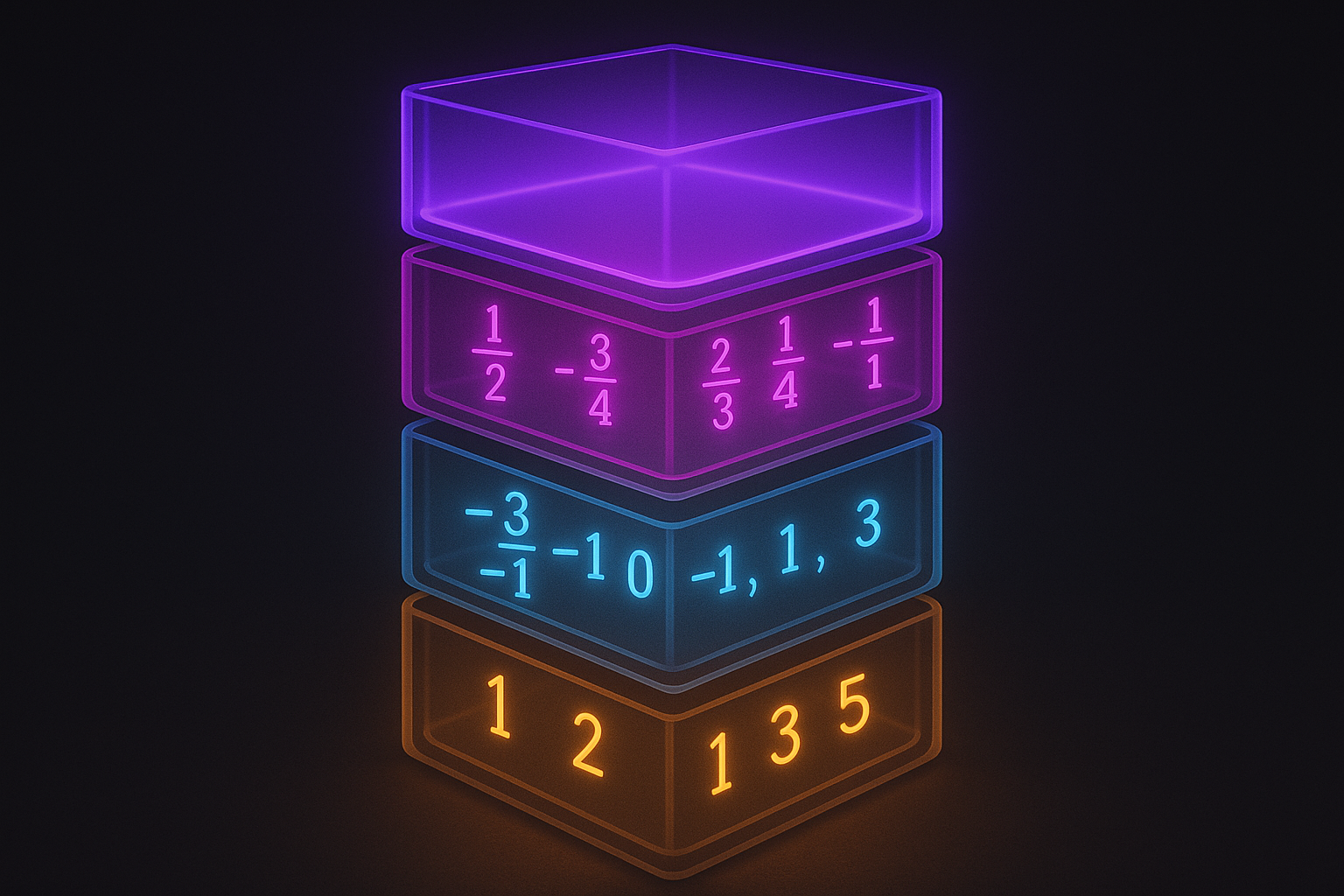
- Number Sets — ℕ, ℤ, ℚ, ℝ, ℂ — the hierarchy of numbers
- Functions as Sets — Every function is secretly a set of pairs
The Deep End:
- Cardinality and Infinity — Why some infinities are bigger than others
- Synthesis — Set theory as the foundation of everything
The Mind-Bending Part
Here's the thing nobody tells you in high school math: infinity comes in sizes.
The natural numbers (1, 2, 3, ...) are infinite. The real numbers (all points on a line) are also infinite. But the real numbers are more infinite. There's no way to match them up one-to-one. Cantor proved this in 1891, and it shook mathematics to its core.
Set theory is where you learn to count the uncountable.
This is the hub page for the Set Theory series, exploring the foundational structures that underlie all of modern mathematics.
The Series




Comments ()