Synthesis: Set Theory as the Foundation of Mathematics
Numbers don't exist outside mathematics — they're defined as sets. Functions are sets of ordered pairs. Even logic can be encoded as set operations. Once you see set theory as the operating system of math, everything else looks different.
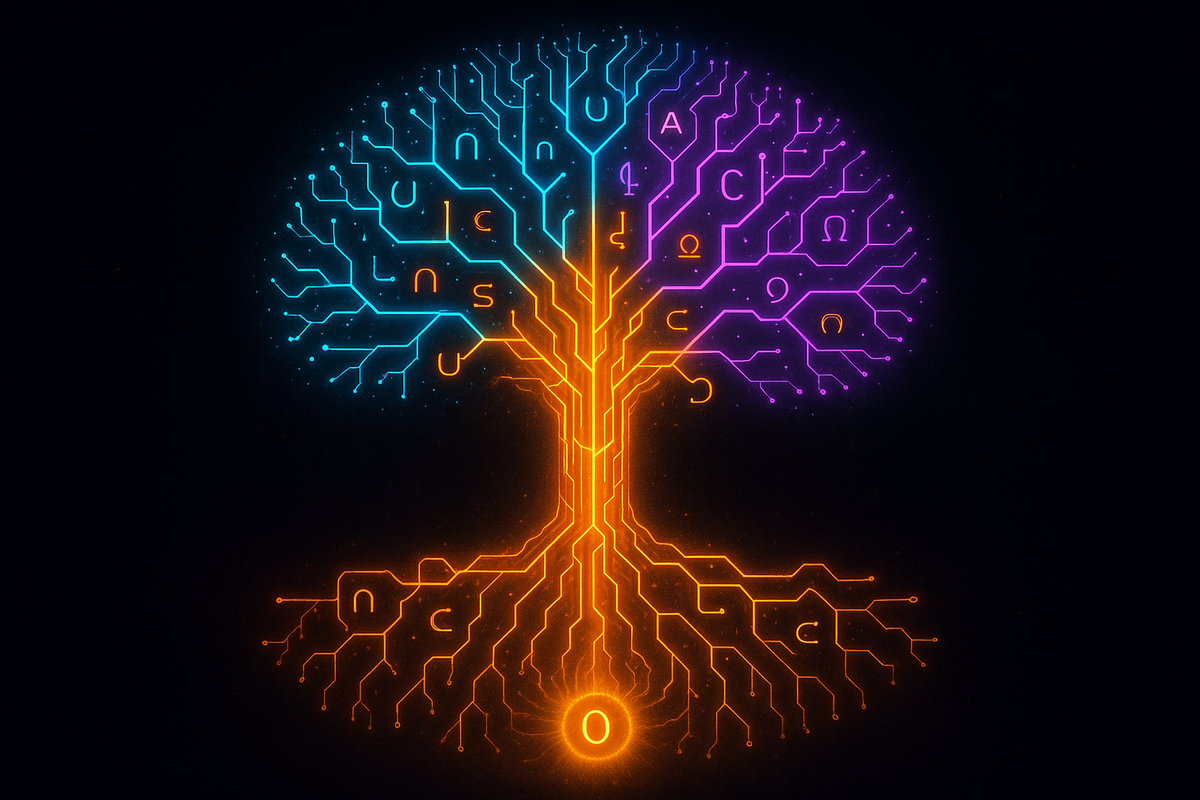
Almost all of mathematics can be built from sets.
Numbers? Sets. Functions? Sets. Spaces? Sets. Groups, rings, graphs, manifolds? All sets with structure. In the early twentieth century, mathematicians discovered that virtually every mathematical object could be defined in terms of sets and membership.
Set theory is the foundation not because it's the simplest — but because it's the most universal.
That's the unlock. When mathematicians wanted rigorous foundations, they needed a language that could describe everything: numbers, functions, relations, proofs, infinity itself. Set theory provided that language. The axioms of set theory (typically ZFC) became the bedrock on which modern mathematics stands.
What We Built in This Series
The vocabulary: Sets, elements, membership (∈).
Combining sets: Union (∪), intersection (∩), difference (\), complement (ᶜ).
Comparing sets: Subsets (⊆), equality (=).
Building structure: Cartesian products (×), ordered pairs, relations, functions.
Measuring size: Cardinality, finite and infinite, countable and uncountable.
The number systems: ℕ ⊆ ℤ ⊆ ℚ ⊆ ℝ ⊆ ℂ, each extending the previous.
Numbers from Sets
You can define numbers purely in terms of sets.
The von Neumann construction:
- 0 = ∅
- 1 = {∅} = {0}
- 2 = {∅, {∅}} = {0, 1}
- 3 = {∅, {∅}, {∅, {∅}}} = {0, 1, 2}
- n = {0, 1, 2, ..., n-1}
Each natural number is the set of all smaller natural numbers. Ingenious — and it works. Addition, multiplication, and order all emerge from set operations.
Functions from Sets
A function f : A → B is a subset of A × B such that every element of A appears exactly once as a first component.
No mystical "input-output process." Just a collection of pairs satisfying a condition.
Function composition? An operation on sets. Inverse functions? Swapping pairs. The abstraction reveals the structure.
Relations from Sets
A relation R on set A is a subset of A × A.
- The equality relation: {(a, a) : a ∈ A}
- The less-than relation on ℕ: {(m, n) : m < n}
- Equivalence relations, partial orders, graphs — all subsets of Cartesian products.
Spaces from Sets
A topological space is a set X together with a collection τ of subsets (the "open sets") satisfying certain axioms.
A metric space is a set X with a function d : X × X → ℝ (the "distance function") satisfying certain axioms.
The "space" is the set. The "structure" is additional data defined on top.
Algebra from Sets
A group is a set G with a binary operation · : G × G → G satisfying axioms (closure, associativity, identity, inverses).
A ring is a set with two operations.
A vector space is a set with an addition and scalar multiplication.
The algebraic structure is always: a set plus operations plus axioms.
The Axiomatic Foundation: ZFC
Modern mathematics typically rests on the Zermelo-Fraenkel axioms with the Axiom of Choice (ZFC).
Key axioms:
- Extensionality: Sets with the same elements are equal.
- Pairing: From any two sets, you can form {a, b}.
- Union: From any collection, you can form its union.
- Power Set: From any set A, you can form 𝒫(A).
- Infinity: There exists an infinite set.
- Replacement: Images of sets under functions are sets.
- Regularity: No set contains itself (no infinite descent).
- Choice: From any collection of nonempty sets, you can choose one element from each.
These axioms define what "set" means and what operations are allowed.
Why ZFC?
ZFC avoids paradoxes like Russell's paradox ("the set of all sets that don't contain themselves").
It's consistent (as far as we know) and powerful enough to develop all of standard mathematics.
Some questions (like the Continuum Hypothesis) are independent of ZFC — neither provable nor disprovable from these axioms.
Set Theory and Logic
Set theory and logic are deeply intertwined.
- ∪ corresponds to logical "or" (∨)
- ∩ corresponds to logical "and" (∧)
- ᶜ corresponds to logical "not" (¬)
- ⊆ corresponds to logical implication (→)
- De Morgan's laws work identically in both
Proofs about sets are proofs about logical statements. The algebra of sets is Boolean algebra.
Limitations and Alternatives
Set theory isn't the only possible foundation.
Category theory emphasizes relationships (morphisms) over objects. Some mathematicians prefer it for certain fields (algebraic geometry, homotopy theory).
Type theory underlies many computer proof assistants. Types replace sets, with built-in restrictions that prevent paradoxes.
But for most of mathematics, set theory remains the default. It's the lingua franca — the shared language mathematicians use when precision matters.
What Set Theory Teaches
Abstraction: Treat collections as single objects. Work with "all solutions" without listing them.
Rigor: Every mathematical object has a precise definition. No hand-waving.
Structure: Complex objects (numbers, functions, spaces) are built from simple ones (sets and membership).
Infinity: Infinite sets are legitimate objects with measurable sizes.
The Core Insight
Set theory is the vocabulary mathematics uses to talk about itself.
When mathematicians want to be precise about what something is — a number, a function, a space — they define it in terms of sets. When they want to prove something holds for all cases, they reason about sets.
Set theory isn't the most exciting branch of mathematics. It's the foundation that makes the exciting branches possible. Like grammar for a language, you need it even when you're not thinking about it.
Every mathematical structure, at bottom, is sets all the way down.
Part 12 of the Set Theory series.
Comments ()