Waves and Oscillation: Why Sine Shows Up Everywhere
Sine waves aren't just a convenient model. They're the natural output of any system with a linear restoring force — springs, pendulums, electromagnetic fields. Fourier's theorem goes further: any periodic signal can be decomposed into sine waves. They're the atoms of oscillation.
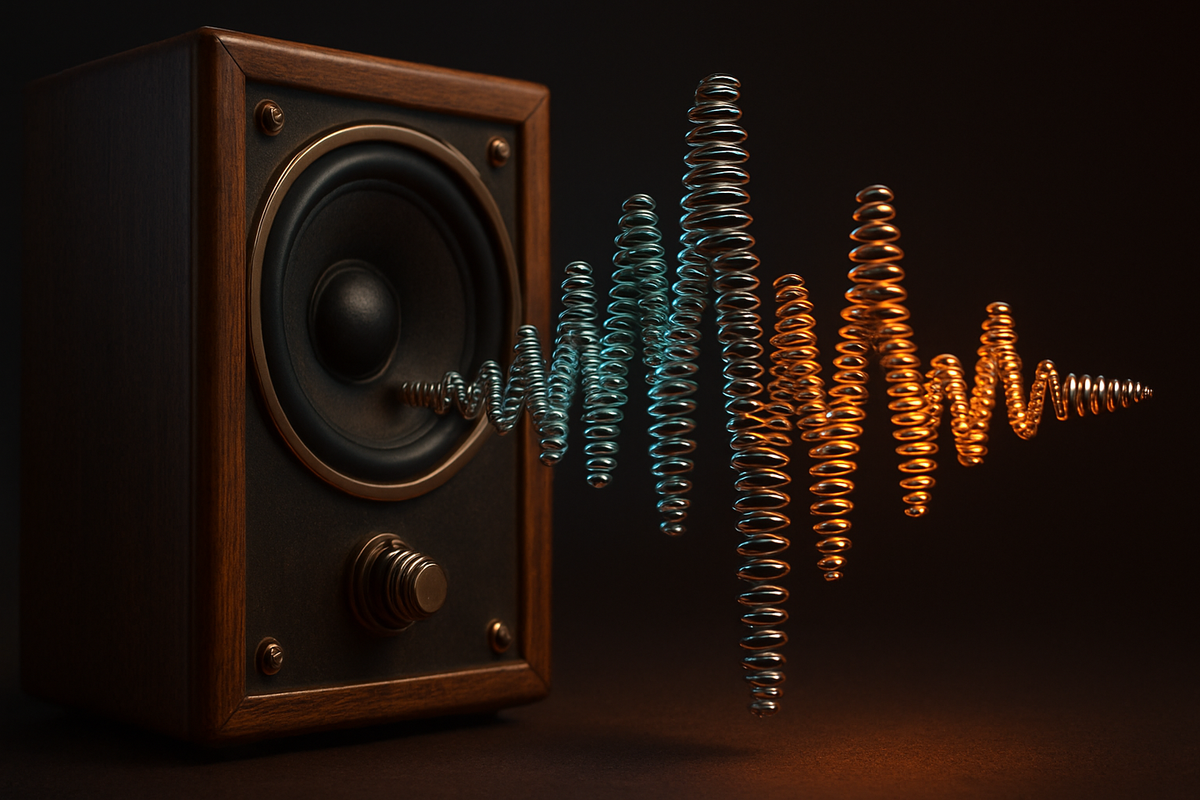
Every smooth oscillation is a sine wave.
That's not an approximation — it's a theorem. When something bounces, swings, or vibrates with a restoring force proportional to displacement, it moves sinusoidally. Pendulums. Springs. Guitar strings. Sound waves. Light waves. Quantum wavefunctions.
Here's the unlock: sine doesn't just describe circles. It describes any smooth repetition. The universe chose one function to encode all its cycles, and that function is sine.
From Circle to Wave
Watch a point rotating around a circle. Its vertical position traces out a sine wave.
- At the top, position is maximum (sin = 1)
- Coming down, position decreases
- At the middle, position is zero (sin = 0)
- At the bottom, position is minimum (sin = -1)
- Coming back up, returning to start
Plot that vertical position against time. You get the classic sine wave: smooth, undulating, periodic.
A sine wave is circular motion viewed from the side.
The Anatomy of a Sine Wave
y = A sin(Bt + C) + D
A = Amplitude: How tall the wave is. Distance from centerline to peak.
B = Angular frequency: How fast the wave oscillates. Related to period by T = 2π/B.
C = Phase shift: Where in the cycle the wave starts. Shifts the wave left or right.
D = Vertical shift: Moves the centerline up or down.
Frequency and Period
Period (T): Time for one complete cycle.
Frequency (f): Cycles per unit time. f = 1/T.
Angular frequency (ω): Radians per unit time. ω = 2πf = 2π/T.
For y = sin(ωt):
- Period = 2π/ω
- Frequency = ω/2π
Higher frequency means faster oscillation. Shorter period means more cycles per second.
Simple Harmonic Motion
When a restoring force is proportional to displacement:
F = -kx
The object oscillates sinusoidally:
x(t) = A cos(ωt + φ)
where ω = √(k/m)
This is simple harmonic motion. Springs, pendulums (for small angles), and many other systems follow this pattern.
Why sine/cosine? Because the second derivative of sine is negative sine: d²/dt² sin(ωt) = -ω² sin(ωt). This matches F = ma = -kx exactly.
Sound Waves
Sound is pressure variation in air.
A pure tone (single frequency) is a sine wave of pressure:
p(t) = A sin(2πft)
Real sounds are combinations of sine waves at different frequencies. A piano note has a fundamental frequency plus harmonics (integer multiples of the fundamental).
This is Fourier's insight: any periodic sound can be decomposed into sine waves.
Light Waves
Light is an electromagnetic wave. The electric and magnetic fields oscillate sinusoidally:
E(x,t) = E₀ sin(kx - ωt)
where k = 2π/λ is the wave number and λ is the wavelength.
Different frequencies mean different colors:
- Low frequency (long wavelength): red
- High frequency (short wavelength): violet
AC Electricity
Household electricity is alternating current — the voltage oscillates sinusoidally:
V(t) = V₀ sin(2πft)
In the US, f = 60 Hz. In Europe, f = 50 Hz.
The RMS (root mean square) voltage is V₀/√2, which is why 120V outlets actually peak at about 170V.
Why Sine Waves Are Fundamental
Mathematical reason: Sine waves are eigenfunctions of the derivative operator. d²/dx² sin(kx) = -k² sin(kx). They're unchanged in shape by differentiation.
Physical reason: Linear systems preserve sine waves. Put a sine wave into a linear filter, and you get a sine wave out (possibly with different amplitude and phase, but same frequency).
Fourier reason: Any periodic function can be written as a sum of sine waves. Sine waves are the "atoms" of periodicity.
Superposition of Waves
When waves combine, their displacements add.
Constructive interference: Waves in phase reinforce each other. Destructive interference: Waves out of phase cancel each other.
Beat frequencies occur when two slightly different frequencies combine: f_beat = |f₁ - f₂|
You hear this as a pulsing or "wah-wah" effect.
Standing Waves
A vibrating string has fixed endpoints. Only certain wavelengths "fit":
λₙ = 2L/n for n = 1, 2, 3, ...
These create standing waves — patterns that vibrate in place rather than traveling.
The fundamental (n=1) has one antinode. Harmonics (n>1) have multiple antinodes.
This is why musical instruments have discrete pitches, not a continuous range.
Damped Oscillations
Real oscillations lose energy to friction:
x(t) = A e^(-γt) sin(ωt)
The amplitude decays exponentially while the oscillation continues.
The envelope e^(-γt) controls how fast the wave dies out. A bell rings for seconds; a plucked string dies in milliseconds.
Driven Oscillations and Resonance
Push a swing at its natural frequency, and it swings higher and higher.
Resonance occurs when the driving frequency matches the natural frequency. The system absorbs energy efficiently, and amplitude grows large.
Resonance explains:
- Why opera singers can shatter glass
- Why bridges can oscillate dangerously in wind
- Why radio receivers can tune to specific stations
Quantum Waves
Quantum mechanics describes particles as waves. The wavefunction ψ(x,t) oscillates sinusoidally in time:
ψ(x,t) = ψ(x) e^(-iωt) = ψ(x)[cos(ωt) - i sin(ωt)]
The energy of a quantum state is E = ℏω, where ω is the angular frequency.
Even at the most fundamental level, nature uses sine waves.
The Core Insight
Sine waves are the universe's language for repetition.
Every smooth oscillation — mechanical, acoustic, electromagnetic, quantum — is built from sine waves. Not because we chose to describe it that way, but because the mathematics of linear systems and periodicity demands it.
Fourier showed that any periodic signal can be decomposed into sines. This means sine isn't just one way to describe oscillation — it's the fundamental way.
When something repeats, it speaks in sines. Learning trigonometry is learning to hear that language.
Part 11 of the Trigonometry series.
Previous: Radians vs Degrees: Why Mathematicians Prefer Radians Next: Synthesis: Trigonometry as the Language of Cycles
Comments ()