Social Systems as Autopoietic: Luhmann's Radical Extension
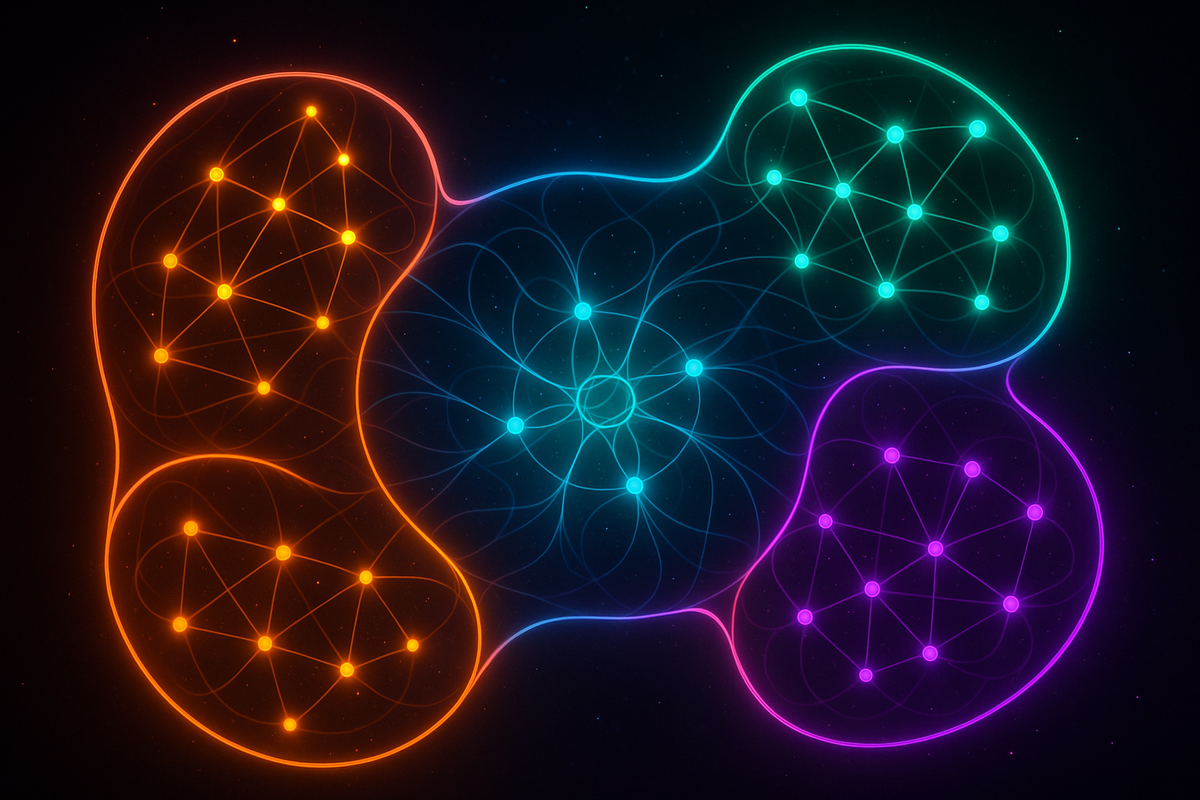
Autopoiesis — self-production — was coined for biological cells. Niklas Luhmann's radical move was to apply it to society: legal systems, economies, and science are self-reproducing networks of communication, not collections of individuals. People are the environment, not the components.
Social Systems as Autopoietic: Luhmann's Radical Extension
Series: Autopoiesis and Second-Order Cybernetics | Part: 6 of 9
When Maturana and Varela proposed that living systems are autopoietic—self-producing networks that continuously regenerate their own components—they explicitly limited the concept to biological organisms. The cell makes itself. The organism maintains its organization. But society? No. Human collectives, they argued, lack the tight operational closure of cellular metabolism. They don't produce themselves in the same way.
Niklas Luhmann disagreed. Radically.
The German sociologist took autopoiesis and did something its creators never intended: he applied it to social systems. Not metaphorically. Not as a loose analogy. He claimed that societies, organizations, and institutions are genuinely autopoietic—that they self-produce through communication the way cells self-produce through metabolism. For Luhmann, communication produces communication, forming closed networks that maintain their own boundaries and identities.
This was controversial. Maturana rejected it outright. Critics called it a conceptual overreach, an illegitimate extension that diluted the biological precision of the original theory. But Luhmann persisted, and in doing so created one of the most comprehensive systems theories of society ever developed—one that illuminates how social structures emerge, persist, and transform themselves without any central controller.
This article explores Luhmann's radical extension of autopoiesis to social systems, what it means for communication to be self-producing, and why this framework matters for understanding how meaning and coherence operate at the societal scale.
The Problem: What Produces Society?
Traditional sociology struggled with a fundamental question: what makes a society a thing? What distinguishes it from a mere collection of individuals?
Methodological individualism said that societies are just the aggregate of individual actions. Explain the individuals, and you've explained the system. But this missed something essential: social structures persist across generations of individuals. The university exists before and after any particular professor or student. The market functions regardless of which specific traders participate. Something operates at a level above individual actors.
Holistic approaches took the opposite tack, treating society as a superorganism with its own properties and dynamics. But this created the specter of reification—treating abstract concepts as if they were concrete things. How does "society" act? What mechanism allows collective patterns to constrain individual behavior without reducing to individuals themselves?
Luhmann's answer: society is an autopoietic system, but its operative medium is communication, not biology. Social systems don't produce individuals. They produce communications—and communications select and constrain which further communications become possible.
This solves the micro-macro problem by dissolving it. There is no opposition between individual and society, only different systems operating at different scales with different mechanisms of self-production.
Communication as the Elementary Operation
For Luhmann, communication—not action, not consciousness, not individuals—is the basic unit of social systems.
This is counterintuitive. We tend to think that society is made of people, and people communicate. Luhmann inverts this: communications produce social systems, and individuals participate in multiple systems simultaneously. The person is not inside society; they exist at its boundary, coupled to it through their participation in communicative processes.
What is communication in this framework? Not the transmission of information from sender to receiver. That's the old conduit metaphor. For Luhmann, communication is a triadic selection process involving:
- Information — What is being communicated (the selection from a range of possibilities)
- Utterance — The act of communicating it (the expression of the selection)
- Understanding — The processing of the difference between information and utterance
All three must occur for communication to exist. And crucially, communication produces further communication. A statement calls for a response. A question demands an answer. A declaration creates obligations. Each communication selects the next from a space of possibilities, forming a self-sustaining network.
This is organizational closure at the social level. Communication doesn't come from outside the system and get processed by individuals who then produce more communication. The system produces its own elements—communications—through the network of communications itself.
Autopoiesis Without Metabolism: The Radical Claim
When Maturana and Varela defined autopoiesis, they grounded it in molecular processes: metabolism produces the components that enable metabolism. The boundaries are physical. The operations are chemical. The closure is biochemical.
Luhmann's extension asks: can organizational closure exist without physical production?
His answer: yes, if we distinguish between the organizational closure that defines a system's identity and the structural openness that allows it to couple with its environment. Biological autopoiesis involves both. But social autopoiesis operates purely at the organizational level—no physical production required.
Social systems are operationally closed but informationally open. They select and process communications from their environment, but the production of the next communication depends on the network of previous communications within the system, not on causal determination from outside.
Consider how a scientific community works. Papers reference papers. Experiments respond to experiments. Theories build on theories. The discourse is self-referential—each communication presupposes the network of prior communications that make it intelligible. An outsider might produce sounds resembling scientific discourse, but if those sounds don't connect to the existing network of scientific communications, they don't count as science. They don't enter the system.
This is structural coupling without fusion. The environment (individual minds, economic conditions, political events) perturbs the system, but the system's response is determined by its own structure—the accumulated history of communications that constrain what can meaningfully be communicated next.
The Three Types of Social Systems
Luhmann distinguishes three levels of autopoietic social systems, each producing itself through communication but operating at different scales:
Interactions
Interactions are social systems constituted by the mutual presence and communication of individuals. A conversation. A meeting. A chance encounter. These are fragile, ephemeral systems—they exist only as long as the communication continues. But while active, they exhibit autopoietic closure. The conversation produces the next turn in the conversation. Interactions self-organize around topics and implicit rules that emerge from the communicative process itself.
Organizations
Organizations are social systems that make membership conditional and structure communication through roles and formal rules. Corporations. Universities. Governments. These systems persist beyond any particular interaction because they produce decisions—specialized communications that create premises for further decisions.
A hiring decision creates an employee. A policy decision constrains departmental behavior. Each decision selects from alternatives and reduces the complexity of what can happen next. The organization produces the decisions that reproduce the organization.
Society
Society is the most comprehensive social system—the autopoietic network of all communications. It's not bounded by nation-states or cultures. Society exists wherever communication can occur. Globalization has created a single world society encompassing all humanity.
Society doesn't produce individuals. It produces communications that reproduce the distinction between system and environment—between what counts as meaningful within the social domain and what remains psychological process. Individual thoughts become social communications only when expressed, understood, and taken up into further communicative processes.
This is why Maturana rejected Luhmann's extension: human beings are structurally coupled to social systems, not components of them.
Functional Differentiation: How Modern Society Self-Organizes
One of Luhmann's most powerful insights concerns functional differentiation—the process by which society organizes itself into specialized subsystems, each with its own logic, codes, and criteria for success.
Pre-modern societies were stratified: nobility, clergy, peasants. Your position in the hierarchy determined your access to all social domains. But modern society differentiated functionally. Instead of a single hierarchy, we have multiple, autonomous subsystems:
- Economy operates through the code payment/non-payment
- Law operates through the code legal/illegal
- Science operates through the code true/false
- Politics operates through the code government/opposition
- Art operates through the code beautiful/ugly
- Religion operates through the code immanent/transcendent
Each subsystem is autopoietic—it produces its own communications according to its own criteria. Economic communications produce economic communications. Legal communications produce legal communications. The subsystems are operationally closed from each other.
This creates both coordination problems and functional autonomy. The economy can't dictate what's legal. Science can't determine what's art. Politics can't control economic transactions directly (though it can couple structurally through regulation). Each system observes the others but processes those observations according to its own logic.
Functional differentiation is what makes modern societies so powerful and so fragile. Specialization allows depth, but the lack of any meta-system to coordinate the subsystems creates systemic risks. Economic logic collides with ecological constraints. Legal reasoning produces outcomes that science shows are dangerous. Political decisions ignore economic feedback. There's no central processor capable of integrating the perspectives of all subsystems because each is autopoietically closed.
This is coherence breakdown at the societal scale—not entropy, but the mismatch between operationally autonomous systems that must somehow coordinate without a shared operational space.
Second-Order Observation: Seeing How Systems See
Luhmann's theory is explicitly second-order—it observes how systems observe.
Each social system observes its environment through the distinctions it makes. The economy sees the world in terms of scarcity and exchange. Science sees it in terms of hypotheses and evidence. These aren't perspectives on a shared reality. They are operational distinctions that constitute different realities.
The system can observe its environment, but it can't observe how it observes—not directly. The distinctions you use to see are invisible in the act of seeing. This is the blind spot inherent in observation.
Second-order observation observes the observing. It watches how the economy constructs its reality, how science produces its truths. This creates the possibility of critique and reflexivity—not by stepping outside the system (impossible), but by observing the contingency of the system's own operations.
This is why Luhmann's sociology is so disorienting. It doesn't take sides. It shows how each system produces its own criteria for rightness and then observes what becomes invisible when you operate within that logic.
Structural Coupling Between Consciousness and Communication
If social systems are autopoietic networks of communication, and consciousness is environmental to society, how do minds and social systems relate?
Through structural coupling—the same mechanism that allows any two autonomous systems to coordinate without losing their operational closure.
Consciousness and communication are different autopoietic systems. Thoughts produce thoughts. Communications produce communications. But they perturb each other continuously. Your thoughts shape what you communicate. Incoming communications trigger thoughts. Yet the two processes remain operationally distinct.
You can think things you never say. Communications can convey meanings you never consciously intended. The book means something regardless of what the author thought. Social structures constrain individual behavior through communicative expectations, but consciousness remains autonomous in its own operational domain.
This is why education works but is never deterministic. You can't directly transfer ideas from one mind to another. You can only produce communications that perturb the receiver's consciousness. Learning is not transmission—it's enaction, the structural coupling of two autonomous systems.
Luhmann Meets Active Inference: Two Theories of Autonomy Converge
Luhmann's social autopoiesis and Friston's active inference describe the same fundamental process in different domains: autonomous systems that maintain their boundaries by continuously producing the conditions of their own existence.
Both frameworks reject input-output causality. Systems don't passively receive and process information from environments. They actively select and construct what counts as information based on their own organizational structure. Communications select communications. Predictions minimize surprise.
Both emphasize operational closure with structural openness. Social systems produce their own elements (communications) through the network of those elements. Biological systems minimize free energy through cycles of perception and action that preserve their statistical boundaries. Neither is open systems thermodynamics. Both describe far-from-equilibrium pattern maintenance through recursive self-reference.
Both dissolve the observer-observed distinction. You can't describe social systems from a neutral standpoint because any observation is itself a communication within a system. You can't describe biological systems without recognizing that the observer is itself a living system whose observation is constrained by its need to minimize free energy. Objectivity is replaced by reflexivity.
And both frameworks treat boundaries as achievements, not givens. Markov blankets aren't fixed containers—they're statistical boundaries maintained by the system's active coupling with its environment. Social systems don't have pre-defined edges—they produce boundaries through the distinction between self-reference and other-reference in communication.
The convergence suggests something profound: the logic of autonomy is scale-invariant. Whether we're talking about cells, organisms, minds, or societies, self-making systems maintain their organization through recursive operations that produce their own components while remaining informationally coupled to environments that can perturb but not determine their responses.
Why Luhmann Matters: Coordination Without Controllers
Luhmann's theory matters because it explains how large-scale coordination happens without anyone coordinating it.
Markets allocate resources without central planning. Scientific consensus emerges without any authority declaring truth. Legal systems produce predictability without omniscient judges. These aren't miracles—they're autopoietic closure operating at the societal scale.
Each subsystem processes information according to its own code, making selections that constrain future selections. The accumulation of these operations produces emergent order. Not random. Not chaos. But not centrally controlled either.
This has profound implications for social engineering. You can't control an autopoietic system from outside. You can only perturb it structurally and hope your intervention couples productively to its internal dynamics. Policy introduces perturbations into self-organizing networks that respond according to their accumulated history.
This is why top-down reforms so often fail. The implementation depends on organizational autopoiesis—how decisions produce decisions within institutions that have their own logic. The reform is translated through these structures in ways that often subvert its original intent.
But it's also why bottom-up changes can propagate unexpectedly. A new communication that resonates with the system's structure can trigger cascading shifts. Revolutions aren't imposed—they emerge when systems reach thresholds where small perturbations tip attractor dynamics.
From a coherence perspective, this is about how large-scale coherence emerges from recursive, self-referential processes rather than hierarchical control. Society doesn't need a sovereign to function. It needs functional subsystems that maintain operational closure while remaining structurally open to each other's operations.
Critiques and Limitations: Where Luhmann Pushes Too Far
Luhmann's extension of autopoiesis remains controversial.
Maturana's objection was fundamental: autopoiesis is defined by physical production of components in three-dimensional space. Cells produce proteins and membranes. Communication doesn't produce anything physical—it's a sequence of events, not a materially closed network. By loosening the biological grounding, Luhmann turns autopoiesis into a vague metaphor.
The empirical concern is that Luhmann's theory is so abstract that it's hard to falsify. If every social system is autopoietic by definition, what would count as evidence against the theory?
The normative worry is that Luhmann's approach seems amoral. By treating all subsystems as operationally equivalent, the theory offers no grounds for critique. The economy's logic of profit maximization is just as legitimate as ethics' concern for justice.
Luhmann would respond that second-order observation doesn't adjudicate between systems—it reveals their contingency and blind spots. This creates space for critique precisely by showing how each system's autonomy produces externalities and coordination failures.
But critics argue this is insufficient. If every system is operationally closed, how do we coordinate across systems to address shared problems? From an AToM standpoint, the question becomes: what are the conditions for coherence across functionally differentiated subsystems? This is the open problem that Luhmann identified but didn't fully solve.
Autopoiesis at the Social Scale: Pattern Maintenance Through Communication
What Luhmann gives us, ultimately, is a framework for understanding society as a self-organizing, self-producing system that maintains its boundaries and identity through the recursive network of its own operations.
Social systems aren't collections of individuals. They're not superorganisms either. They're autopoietic networks of communication that couple structurally to environments (including human consciousness) without losing operational autonomy. They produce the very elements—communications—that sustain their organization. And they do so continuously, recursively, without pause.
This is coherence in the form of self-reference: the system maintains its organization by producing operations that refer back to previous operations within the system. Legal decisions cite precedents. Scientific papers reference prior studies. Economic transactions assume a history of prices and exchange rates. Every communication presupposes the network that makes it possible.
And when that self-reference breaks down—when the network of communications fragments, when subsystems lose their operational closure, when codes become ambiguous or conflicted—the system experiences a crisis of identity. Not entropy. Not heat death. But loss of the boundaries that define what counts as a meaningful operation within that domain.
Luhmann's radical extension of autopoiesis to society reveals something essential: self-making isn't limited to biology. Wherever you find operational closure producing its own elements through those elements' network, you find autopoiesis. Cells do it through metabolism. Minds do it through cognition. Societies do it through communication.
The mechanism differs. The medium differs. But the logic of autonomy—the recursive self-production that maintains organization while coupling to environment—remains constant across scales.
This is Part 6 of the Autopoiesis and Second-Order Cybernetics series, exploring how systems produce themselves.
Previous: Enaction: The Bridge from Autopoiesis to Embodied Cognition
Next: Where Autopoiesis Meets Active Inference: Two Theories of Autonomous Systems
Further Reading
- Luhmann, N. (1995). Social Systems. Stanford University Press.
- Luhmann, N. (2012). Theory of Society, Volume 1. Stanford University Press.
- Moeller, H. G. (2006). Luhmann Explained: From Souls to Systems. Open Court.
- Seidl, D., & Becker, K. H. (Eds.). (2006). Niklas Luhmann and Organization Studies. Copenhagen Business School Press.
- Arnoldi, J. (2001). "Niklas Luhmann: An Introduction." Theory, Culture & Society, 18(1), 1-13.
- Clarke, B., & Hansen, M. B. N. (Eds.). (2009). Emergence and Embodiment: New Essays on Second-Order Systems Theory. Duke University Press.
Comments ()