SOH CAH TOA: The Mnemonic That Hides the Meaning
The mnemonic gets you through the test. But sine and cosine aren't really about triangles — they're about where a point ends up after rotating around a circle. Once you see that, the right triangle is just a special case.
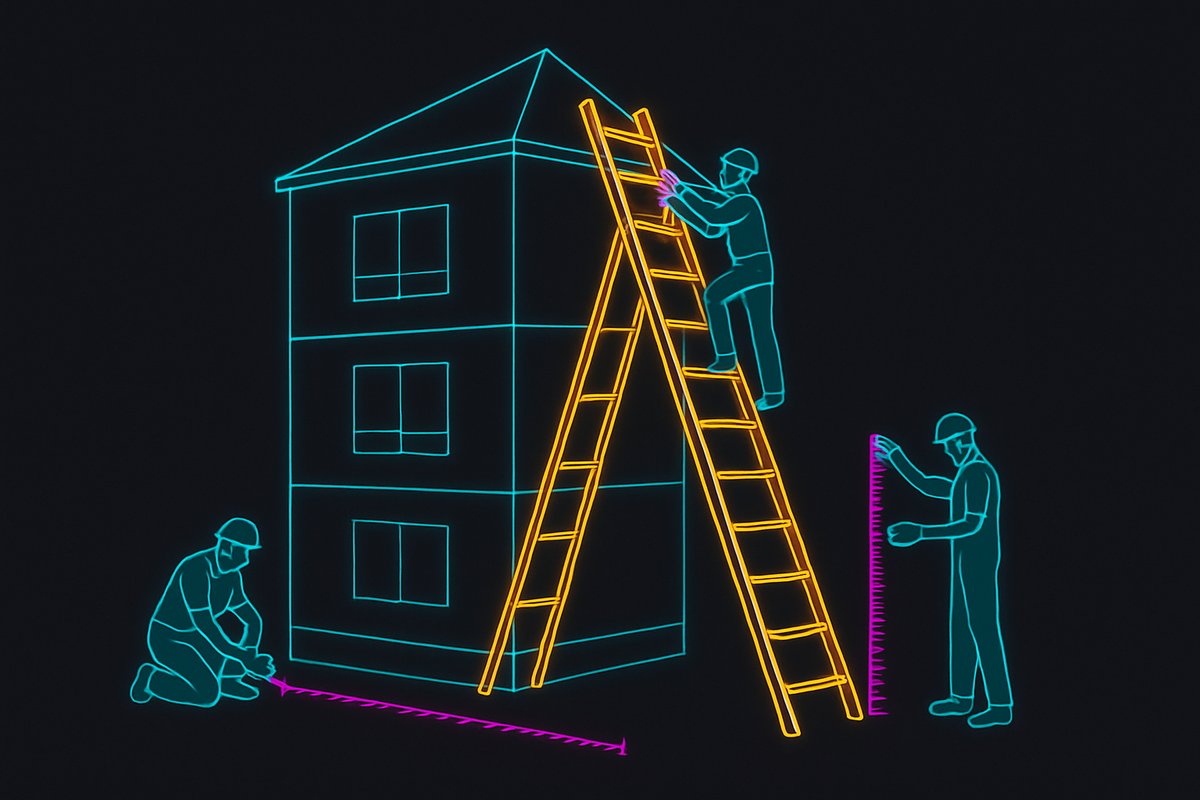
SOH CAH TOA helps you remember but not understand.
Sine = Opposite / Hypotenuse Cosine = Adjacent / Hypotenuse Tangent = Opposite / Adjacent
These formulas work for right triangles. Students memorize them, pass tests, and then forget what sine and cosine actually mean.
Here's what SOH CAH TOA doesn't tell you: these ratios exist because every right triangle is a snapshot of a point on a circle. The hypotenuse is the radius. The opposite and adjacent are the coordinates. The ratios are just rescaling to a unit circle.
SOH CAH TOA is the recipe. The unit circle is the explanation.
What the Letters Mean
In a right triangle with angle θ:
Opposite: The side across from θ (not touching θ) Adjacent: The side next to θ (touching θ, but not the hypotenuse) Hypotenuse: The longest side, opposite the right angle
Important: opposite and adjacent depend on which angle you're using. The same side can be "opposite" for one angle and "adjacent" for another.
The Three Ratios
Sine (SOH): sin θ = Opposite / Hypotenuse
Cosine (CAH): cos θ = Adjacent / Hypotenuse
Tangent (TOA): tan θ = Opposite / Adjacent
Notice: tan θ = sin θ / cos θ. If you divide the first equation by the second: (O/H) / (A/H) = O/A
Using SOH CAH TOA
Problem: A ladder leans against a wall at 70° to the ground. The ladder is 10 feet long. How high up the wall does it reach?
Draw it: The ladder is the hypotenuse (10 ft). The wall is opposite the 70° angle. The ground is adjacent.
Need opposite, have hypotenuse → use sine.
sin 70° = Opposite / 10 Opposite = 10 × sin 70° = 10 × 0.94 ≈ 9.4 feet
Which Ratio to Use?
Ask: What do I have? What do I need?
| Have | Need | Use |
|---|---|---|
| Hypotenuse | Opposite | Sine |
| Hypotenuse | Adjacent | Cosine |
| Adjacent | Opposite | Tangent |
| Opposite | Hypotenuse | Sine |
| Adjacent | Hypotenuse | Cosine |
| Opposite | Adjacent | Tangent |
If you have two sides and need the angle, use the inverse function (arcsin, arccos, arctan).
Finding Angles
Problem: A ramp rises 3 feet over a horizontal distance of 12 feet. What angle does it make with the ground?
Have opposite (3) and adjacent (12). Need the angle. Use tangent: tan θ = 3/12 = 0.25 θ = arctan(0.25) ≈ 14°
Why These Ratios Work
Place the triangle inside a circle with the hypotenuse as radius.
The opposite side is the y-coordinate (vertical height). The adjacent side is the x-coordinate (horizontal distance).
On a unit circle (radius 1):
- sin θ = y-coordinate = opposite (when hypotenuse = 1)
- cos θ = x-coordinate = adjacent (when hypotenuse = 1)
For a triangle with hypotenuse h:
- opposite = h × sin θ
- adjacent = h × cos θ
Dividing by the hypotenuse rescales to the unit circle:
- opposite/hypotenuse = sin θ
- adjacent/hypotenuse = cos θ
SOH CAH TOA is unit circle coordinates divided out.
The Limitations
SOH CAH TOA only works for:
- Right triangles
- Angles between 0° and 90°
It doesn't explain:
- Why sin 120° = sin 60°
- Why sin²θ + cos²θ = 1
- How trig functions describe waves
For these, you need the unit circle definition.
Common Mistakes
Mixing up opposite and adjacent: Always identify them relative to your specific angle, not the right angle.
Using the wrong function: Double-check which sides you have before choosing sin, cos, or tan.
Calculator in wrong mode: Make sure it's in degrees if you're using degrees, radians if radians.
Forgetting the inverse: If you have the ratio and need the angle, use arcsin, arccos, or arctan.
Beyond Right Triangles
SOH CAH TOA can't solve non-right triangles directly.
For those, you need:
- Law of Sines: a/sin A = b/sin B = c/sin C
- Law of Cosines: c² = a² + b² - 2ab cos C
These generalize Pythagoras and SOH CAH TOA to all triangles.
Practice Problem Set
- A tree casts a shadow 20 feet long when the sun is 35° above the horizon. How tall is the tree? (Use tangent: tan 35° = height/20)
- A plane takes off at a 15° angle and travels 2 miles. What altitude did it reach? (Use sine: sin 15° = altitude/2)
- A 25-foot wire is anchored 15 feet from the base of a pole. What angle does it make with the ground? (Use cosine: cos θ = 15/25)
The Core Insight
SOH CAH TOA is a calculation tool, not an understanding tool.
It tells you which buttons to press for right triangle problems. It doesn't tell you why sine means height, why cosine means horizontal distance, or why these ratios appear in waves and oscillations.
The mnemonic works for tests. The unit circle works for understanding. Learn both: SOH CAH TOA for quick calculations, the unit circle for everything else.
Eventually, you won't need the mnemonic at all. You'll see the coordinates directly.
Part 8 of the Trigonometry series.
Previous: The Law of Cosines: Pythagoras Generalized for Any Triangle Next: Trigonometric Identities: Why sin²θ + cos²θ = 1 Had to Be True
Comments ()