The Physics of Space and Time
Space and time were separate in Newton's universe. Einstein fused them, made them dynamic, showed that matter curves them. Now we're asking whether they're fundamental at all — or emergent from something stranger. This series tracks that story.
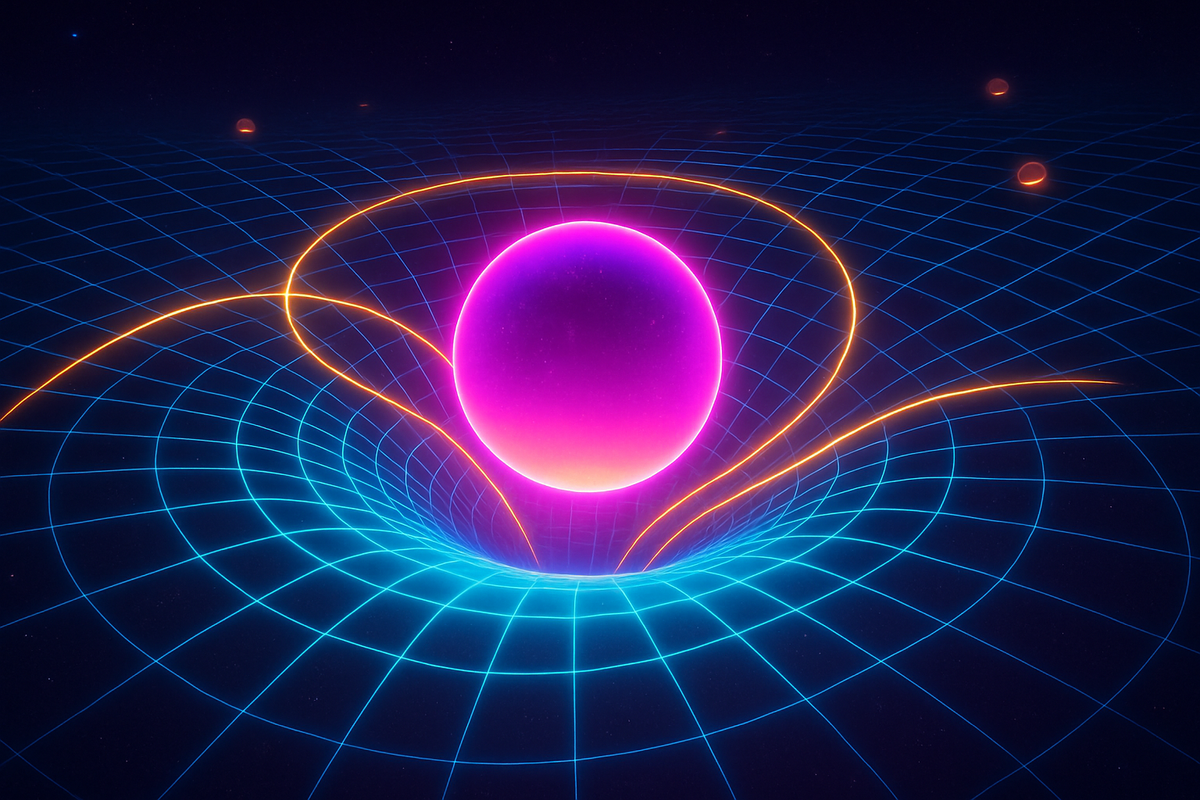
The Physics of Space and Time
Primary Tag: FRONTIER SCIENCE Keywords: spacetime, relativity, Einstein, gravity, wormholes, time travel, quantum gravity
We live in space and time. We move through space. We age through time. These seem like the most basic facts of existence—so obvious they barely need stating.
But physics has revealed that space and time are strange. They're not the fixed stage on which events happen; they're dynamic, flexible, intertwined. Space can curve. Time can slow. The geometry of the universe responds to what's in it.
This series explores what physics actually tells us about spacetime—from Einstein's twin revolutions of special and general relativity, through black holes and their singularities, to speculative possibilities like wormholes and warp drives, and finally to the unfinished project of quantum gravity.
Some of this is settled science. Some is active research. Some is informed speculation about what might be possible.
The goal isn't to make you a physicist. It's to give you an accurate picture of our best current understanding—where we have solid knowledge, where we have good guesses, and where we're genuinely confused.
The Series
Foundations
1. [Special Relativity: Why Nothing Outruns Light](/special-relativity-explained/) — Einstein's 1905 revolution: time dilation, length contraction, and the speed limit of the universe
2. [General Relativity: Gravity Is Geometry](/general-relativity-gravity-geometry/) — Einstein's 1915 masterwork: spacetime curves, and that curvature is what we call gravity
Extreme Objects
3. [Black Holes: Where Spacetime Breaks](/black-holes-spacetime/) — Event horizons, singularities, and the places where our physics fails
Theoretical Possibilities
4. [Wormholes: Tunnels Through Spacetime](/wormholes-spacetime-tunnels/) — Einstein-Rosen bridges and the question of traversability
5. [Time Travel: What Physics Actually Allows](/time-travel-physics/) — Closed timelike curves, grandfather paradoxes, and what general relativity permits
6. [The Alcubierre Drive: Warp Speed Without Breaking Laws](/alcubierre-warp-drive/) — The theoretical loophole for faster-than-light travel
Open Questions
7. [The Multiverse: Many Worlds or Many Nonsense?](/multiverse-many-worlds/) — The testability problem and whether multiverse theories count as science
8. [Quantum Gravity: The Unfinished Revolution](/quantum-gravity-unfinished/) — Why our two best theories don't work together, and the approaches to fixing that
Synthesis
9. [What We Know About Spacetime](/spacetime-synthesis/) — Current understanding, open questions, and future directions
Why This Matters
Spacetime physics isn't just abstract theory. GPS satellites have to account for relativistic time dilation or they'd give wrong positions. Black holes have been directly imaged. Gravitational waves—ripples in spacetime itself—are now routinely detected.
Understanding spacetime also reshapes how we think about fundamental questions. What is time? Could time travel ever be possible? Is our universe the only one? These are physics questions with philosophical implications.
And there's the unfinished business: we know that general relativity (our theory of gravity and spacetime) and quantum mechanics (our theory of particles and forces) are both correct in their domains. But they're mathematically incompatible. Resolving that tension is one of the great open problems in physics.
Begin with [Special Relativity](/special-relativity-explained/) to understand the first revolution.
Comments ()