Synthesis: What We Know About Spacetime
We have two theories of physics that each work better than anything before them, and they contradict each other on the nature of spacetime. This synthesis maps what we know, what's contested, and what unification would actually require.
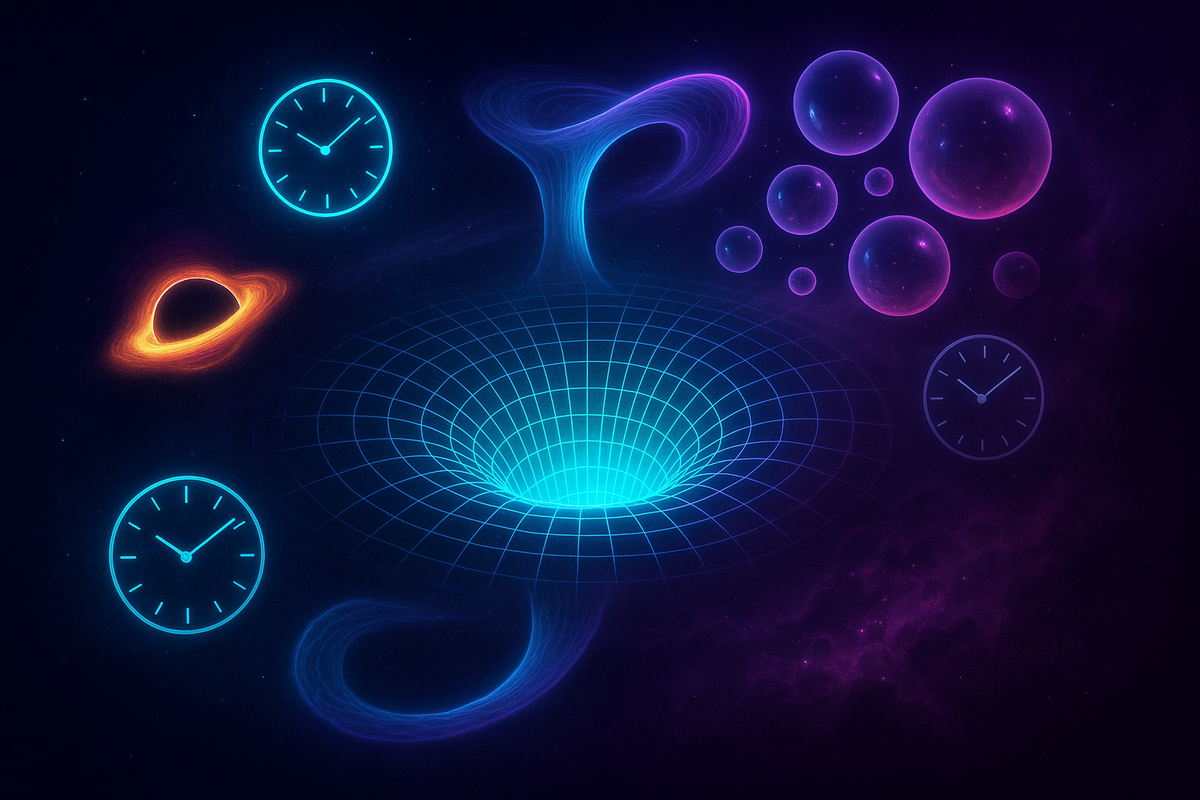
What We Know About Spacetime: A Synthesis
Series: Spacetime Physics | Part: 9 of 9 Primary Tag: FRONTIER SCIENCE Keywords: spacetime, physics synthesis, relativity, cosmology, future directions
Over eight articles, we've explored the physics of space and time—from Einstein's foundational revolutions through black holes and wormholes to the speculative frontiers of quantum gravity.
Now let's step back and ask: what do we actually know? What's settled, what's contested, and what remains genuinely unknown?
What We Know (High Confidence)
Special relativity is correct. Time dilates. Length contracts. Mass and energy are equivalent. The speed of light is a universal limit. These aren't hypotheses; they're facts confirmed by countless experiments. GPS, particle accelerators, nuclear reactors—all depend on relativistic physics working exactly as Einstein described.
General relativity is correct. Gravity is spacetime curvature. Mass tells spacetime how to curve; curved spacetime tells mass how to move. Gravitational time dilation is real. Gravitational waves exist. Black holes exist. All predicted by the theory, all confirmed by observation.
Black holes are real. We've detected them through X-ray emissions, stellar orbits, gravitational waves, and direct imaging. The Event Horizon Telescope photographed the shadow of a black hole. LIGO detects black hole mergers regularly. Their existence is not in doubt.
The universe is expanding. Galaxies are receding from us. The further away, the faster they recede. Space itself is stretching. This was predicted by general relativity and confirmed by observation. The expansion is accelerating (dark energy), which is observed but not explained.
Our physics is incomplete. General relativity and quantum mechanics don't combine. Black hole singularities and the Big Bang require physics we don't have. Dark matter and dark energy are observed but unexplained. We know our current theories are approximations to something deeper.
What We Think We Know (Moderate Confidence)
Cosmic inflation probably happened. The universe is flat, uniform, and has the fluctuation pattern inflation predicts. The theory is well-supported but not proven. Alternative explanations exist.
Black holes have information paradoxes. Hawking radiation seems to destroy information, violating quantum mechanics. Most physicists believe information is preserved somehow (holography, firewall, some other mechanism), but no consensus resolution exists.
The Big Bang was a real event. The cosmic microwave background, nucleosynthesis ratios, and expansion all point to an early hot dense state. But "what came before" or "what caused it" remain unknown. The singularity is a breakdown of theory, not a description of reality.
Time has a direction. The second law of thermodynamics gives time an arrow. But why initial conditions were low-entropy remains mysterious. And at fundamental levels, physics equations are time-symmetric.
What We Speculate About (Low Confidence)
Wormholes might be possible. General relativity permits them. Whether exotic matter exists to keep them open, whether they're stable, whether they connect to time travel—unknown.
Time travel to the past might be possible. The equations allow closed timelike curves. Chronology protection might forbid them. We don't know.
The Alcubierre warp drive might be achievable. The math works. The exotic matter requirements are enormous. It might be possible for advanced civilizations or impossible for anyone.
The multiverse might be real. Several theoretical frameworks suggest it. We can't observe it. Whether this counts as science is debated.
Quantum gravity might be string theory, loop quantum gravity, or something else entirely. No experimental evidence distinguishes the candidates. We might be decades or centuries from resolution.
What We Don't Know At All
What happens at singularities. The Big Bang singularity, black hole singularities—our theories give infinities, which means they're breaking down, not describing reality.
What spacetime is made of. Is it continuous or discrete? Fundamental or emergent? Is there a smallest unit of space and time? We don't know.
Why the constants have the values they do. Why is the speed of light what it is? Why is the gravitational constant what it is? Fine-tuning is observed; explanation is absent.
What dark energy is. The universe's expansion is accelerating. Something is causing this. We call it "dark energy" but have no idea what it actually is.
What dark matter is. Most of the universe's matter is invisible and interacts only gravitationally. We've never detected a dark matter particle directly.
Whether we're asking the right questions. Our concepts of space, time, matter, and causation might be approximations that fail at deeper levels. The next revolution might require abandoning assumptions we don't even notice we're making.
The Epistemological Landscape
Physics operates at different levels of certainty:
Established physics: Special and general relativity, quantum mechanics. Extraordinarily well-tested. The foundation everything else builds on.
Mainstream extensions: Black hole thermodynamics, cosmic inflation, the standard model of particle physics. Well-supported but with some gaps and puzzles.
Active research frontiers: Quantum gravity approaches, dark matter candidates, dark energy models. Serious work by serious people with no consensus yet.
Speculative possibilities: Wormholes, time travel, warp drives, multiverse. Permitted by the math, not supported by observation, possibly impossible.
The further you go from established physics, the more uncertainty you accept. This is appropriate. The edge of knowledge should be fuzzy.
What Would Change Everything
Certain discoveries would revolutionize our understanding:
Detection of Planck-scale physics. Any observation of quantum gravity effects—discrete spacetime, Lorentz violation, graviton detection—would constrain theories dramatically.
Understanding dark energy. If we knew what's accelerating the expansion, it might reveal new physics beyond general relativity.
Direct dark matter detection. Identifying the particle would constrain cosmology and potentially reveal new forces.
Signals from other universes. Evidence of cosmic collisions or other multiverse signatures would transform cosmology and philosophy of science.
Resolution of the black hole information paradox. A convincing solution would likely require insights applicable far beyond black holes.
A working theory of quantum gravity. This would unify physics at the deepest known level and likely reveal new phenomena we can't currently imagine.
The Philosophical Coda
What does physics tell us about the nature of space and time?
Space and time are intertwined. Not separate entities but aspects of a single manifold. The division is observer-dependent.
Spacetime is dynamic. It curves, stretches, waves, expands. It's not a fixed stage but an active participant in physics.
Spacetime might be discrete. At the smallest scales, the continuum might be an approximation. Reality might be granular.
Spacetime might be emergent. Some approaches suggest spacetime arises from more fundamental quantum information. It might not be the bottom level of reality.
Our intuitions are unreliable. The physics of spacetime violates human intuition at every turn. Time runs at different rates. Space can curve. Simultaneity is relative. The universe doesn't match our evolved expectations.
We're mapping the territory. Physics is humanity's attempt to understand the structure of reality using mathematics and observation. We've made stunning progress. We have far to go.
The Honest Summary
What we know well: Special and general relativity work. Black holes exist. The universe is expanding. Our physics is incomplete.
What we suspect: Inflation happened. Information is preserved in black holes somehow. Quantum gravity is needed at Planck scales.
What we don't know: What's at singularities. What spacetime is made of. What dark energy and dark matter are. Whether advanced possibilities like wormholes and time travel are realizable.
What we should remember: Physics is not finished. The current theories are the best we have, not the final word. Future discoveries will surprise us. Intellectual humility is appropriate.
Where This Leaves You
If you've followed this series, you now understand spacetime physics better than most people ever will. Not at the mathematical level of working physicists—but at the conceptual level where the real insights live.
You know: - Why nothing outruns light - Why gravity is geometry - What black holes actually are - What's real, speculative, and unknown about wormholes and time travel - Why physics needs quantum gravity - What the multiverse debate is actually about
This knowledge is a gift and a responsibility. You understand enough to recognize when popular accounts oversimplify, when science fiction invents nonsense, and when genuine mysteries remain.
The universe is stranger and more beautiful than common sense suggests. Spacetime physics is how we've learned to see it clearly.
Further Reading
For deeper exploration:
- Carroll, S. (2010). From Eternity to Here. Dutton. (Time's arrow and cosmology) - Thorne, K. (1994). Black Holes and Time Warps. W.W. Norton. (Comprehensive and accessible) - Susskind, L. & Hrabovsky, G. (2013). The Theoretical Minimum: Special Relativity and Classical Field Theory. Basic Books. (Mathematical introduction) - Smolin, L. (2013). Time Reborn. Houghton Mifflin. (Alternative perspective on time) - Hossenfelder, S. (2018). Lost in Math. Basic Books. (Critical view of theoretical physics)
This concludes the Spacetime Physics series. For more Frontier Science explorations, visit the [Series Hub](/spacetime-physics/).
Comments ()