Synthesis: 4E Cognition and the Distributed Nature of Coherence
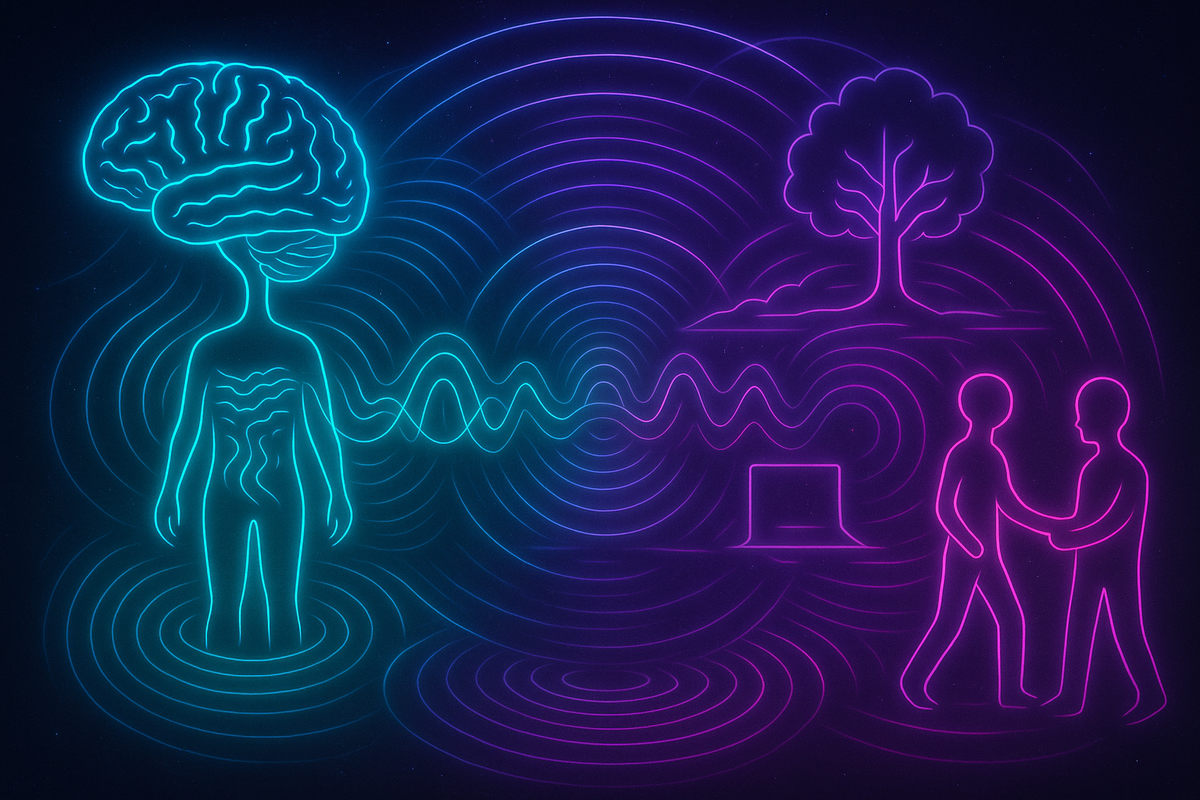
If cognition is embodied, embedded, enacted, and extended, then coherence can't be a brain-internal property. This synthesis traces how 4E frameworks support the larger argument that meaning and stability are distributed phenomena.
Synthesis: 4E Cognition and the Distributed Nature of Coherence
Series: 4E Cognition | Part: 9 of 9
Cognitive science started with a simple assumption: cognition happens in brains. Minds are neural computation. Intelligence is information processing in skulls. Everything else—bodies, environments, tools, other people—is input, output, or implementation detail.
Then researchers started actually looking at how cognition works in the wild. Not in labs with isolated subjects performing artificial tasks, but in real environments where people navigate, communicate, create, and survive.
And the assumption broke.
What they found: cognition isn't a brain thing. It's a system thing. And the systems that do cognitive work extend through bodies, into environments, across tools, and between people. The boundaries we drew around minds—skull, skin, individual—were convenient fictions, not natural kinds.
This is the 4E revolution: the recognition that cognition is fundamentally embodied (through particular bodies), embedded (in structured environments), enacted (through sensorimotor coupling), and extended (across boundaries). Not four separate claims, but four aspects of a unified insight: minds are distributed dynamical systems maintaining coherent organization through brain-body-world coupling.
And this changes everything about what minds are and how they work.
The Core Insight: Coherence Doesn't Respect Anatomical Boundaries
In AToM terms, coherence is the integrated organization of a system—its capacity to maintain structured, predictive engagement with its environment over time. The formula M=C/T captures this: meaning equals coherence over time (or under constraint).
4E cognition is the recognition that the systems maintaining coherence aren't bounded by skulls or skin. The relevant system—the one minimizing free energy, maintaining predictions, enacting meaning—can extend across whatever substrate provides stable, functional coupling.
This isn't metaphor. It's mechanism.
Embodied Coherence
Your body isn't a peripheral device for your brain. Your proprioceptive system, your autonomic nervous system, your gut-brain axis—these aren't accessories to cognition. They're constituents of the system maintaining coherent predictions.
When anxiety disrupts breathing, it's not a psychological state affecting a physical symptom. It's a breakdown in the coupled brain-body system that maintains coherent interoceptive predictions. The coherence collapse is distributed—it's not localized to neurons or to lungs but to their coupling.
Healing requires working with the whole coupled system. Breathwork, movement, somatic practices—these aren't indirect interventions. They're direct modifications of the coherence-maintaining system that is brain-body coupling.
Embedded Coherence
Your environment isn't neutral backdrop. It's part of the system maintaining coherent predictions. When you organize your workspace, you're not just tidying—you're structuring the environment to reduce surprise, making prediction easier by making the world more regular.
Environmental structure serves as external memory, external computation, external prediction. You don't replicate the world internally—you couple with reliable external regularities and offload coherence maintenance onto environmental scaffolding.
This is why environmental disruption creates suffering. Moving apartments feels disorienting not because of change per se but because the environmental scaffolding maintaining your daily coherence just disappeared. You have to rebuild the coupled system.
Enacted Coherence
Coherence isn't maintained through internal representation then action. It's maintained through ongoing sensorimotor loops where perception and action are inseparable.
You don't first perceive the world, then maintain coherence, then act. Acting is how you maintain coherence—through continuous sensorimotor coupling that brings forth a world of significance tuned to your body's capacities and needs.
This explains why contemplative practices work: they train different modes of sensorimotor enaction. Mindfulness doesn't change what thoughts are—it changes how you enact your relationship to thinking. The shift is in the coupling, not the content.
Extended Coherence
When coupling is tight enough, coherence maintenance literally extends beyond biological boundaries. Otto's notebook isn't helping his memory—it is part of the memory system maintaining his coherent navigation of daily life.
The boundary of the coherence-maintaining system is determined by functional coupling, not anatomy. Where coupling is reliable, automatic, trusted, and reciprocal, the boundary extends. Where coupling is loose or intermittent, it doesn't.
This means losing tools isn't losing objects—it's losing parts of your extended cognitive system. The distress is real because the coherence disruption is real.
The Mathematical Foundation: Active Inference as Formalized 4E
The Free Energy Principle provides the mathematical language for understanding 4E cognition as embodied free energy minimization.
Systems persist by minimizing surprise—maintaining predictions about sensory states given their models of the world. But surprise minimization happens through two routes: updating beliefs (perceptual inference) and changing the world (active inference).
This dual minimization is the formal structure of embodied, embedded, enacted, extended cognition:
Embodiment: The body determines the morphological priors—what you can sense and do, which constrains what you can predict and how you minimize error.
Embeddedness: Environmental regularities become priors—learned structure that simplifies inference by making the world more predictable.
Enaction: Perception and action are coupled aspects of free energy minimization—you minimize error through sensorimotor loops, not sequential perception then action.
Extension: Markov blankets (the statistical boundaries of systems) can extend hierarchically to include tools when coupling enables stable distal inference.
4E insights aren't phenomenological intuitions. They're mechanistic necessities for any system minimizing free energy over time in a structured environment.
The mathematics proves what phenomenology suggested: you cannot maintain coherence without embodiment, embeddedness, enaction, and the possibility of extension.
Why This Matters: Implications Across Domains
Rethinking Mental Health
If coherence is distributed across brain-body-environment systems, then "mental" health can't be reduced to brain states. Depression isn't just neural—it's a collapse in the coupled system including:
- Interoceptive predictions (autonomic dysregulation)
- Environmental scaffolding (loss of structure and routine)
- Social coupling (isolation reducing distributed coherence)
- Bodily states (sleep, movement, nutrition)
Effective intervention requires addressing the whole system. Medication alone often fails because it targets only neural substrates of a multi-substrate problem.
Therapy works best when it addresses:
- Embodiment: Somatic practices, breathwork, movement
- Embeddedness: Environmental restructuring, routine building
- Enaction: Behavioral activation, sensorimotor engagement
- Extension: Social connection, cognitive scaffolding
Mental health is distributed coherence maintenance. Treat it as such.
Redesigning Education
If cognition is extended and embedded, education should teach students to build and use extended cognitive systems, not just memorize isolated facts.
Teach:
- How to think with notation (mathematics)
- How to think through tools (technology)
- How to think across people (collaboration)
- How to structure environments for learning (niche construction)
The goal isn't filling brains with information. It's developing capacity to maintain coherence through skillful coupling with resources—embodied, environmental, technological, social.
Building Better AI
Current AI is mostly disembodied: language models trained on text, vision models on images. They achieve impressive performance but remain brittle because they lack embodied, embedded, enacted grounding.
The next frontier isn't larger models—it's embodied agents that:
- Learn through sensorimotor interaction (enacted)
- Exploit environmental structure (embedded)
- Ground abstractions in bodily metaphors (embodied)
- Extend cognition through tool use (extended)
Not because embodiment is philosophically necessary, but because it's computationally efficient. Distributed systems offload processing onto environments and bodies. That's how biological cognition achieves intelligence with ~20 watts. AI will need similar strategies to scale beyond current architectures.
Understanding Neurodiversity
If cognition emerges from brain-body-environment coupling, then neurodivergence isn't broken brains—it's different coherence architectures requiring different environmental fits.
Autism, ADHD, dyslexia, synesthesia—these aren't disorders but natural variation in:
- Sensory precision landscapes (what gets attended to)
- Temporal dynamics (integration timescales)
- Coupling patterns (how modalities integrate)
"Disorder" emerges from person-environment mismatch, not intrinsic deficit. Change the environment to match the coherence architecture, and the disorder often dissolves.
This means accommodation isn't special treatment—it's designing for actual human variation rather than a mythical average.
The Geometry of Distributed Meaning
What does M=C/T mean when coherence is distributed?
Meaning doesn't exist in brains. It exists in the coupled dynamics of brain-body-world systems maintaining integrated organization over time. The "meaning" of a situation is its role in coherence maintenance—how it affords prediction, action, and continued persistence.
This explains several puzzles:
Why meaning feels located in the world: Because it is. Meaning emerges at the interface between you and environment through sensorimotor coupling. It's not projected from inside—it's enacted at the boundary.
Why meaning is context-dependent: Because it depends on the whole coupled system. Change body states, environmental context, or social coupling, and meanings shift—not arbitrarily but systematically.
Why meaning resists reduction: Because it's a system-level property. You can't locate meaning in neurons, in bodies, or in environments separately. It exists in their coupling.
Why losing tools feels like losing self: Because tools that are part of your extended coherence system are part of the self that maintains meaning. The self isn't bounded by skin—it sprawls across whatever maintains your organized engagement with the world.
The Distributed Self
If coherence is distributed, what about the self?
The self isn't a thing located in the brain. It's a process—the ongoing maintenance of integrated organization through brain-body-world coupling. And processes can extend.
Your sense of self includes:
- Embodied self-awareness (interoception, proprioception)
- Narrative self (linguistic self-concept, extended in time)
- Extended self (tools, environments, relationships that constitute your identity)
- Social self (roles, recognition, participatory sense-making with others)
These aren't layers of an inner core. They're aspects of distributed coherence maintenance. You maintain "yourself" through coupled dynamics spanning biological, environmental, and social scales.
This makes identity relational and dynamic, not fixed and internal. Who you are emerges from how you couple. Change the coupling, change the self.
This isn't instability—it's ontological honesty. Selves were always processes, always distributed. 4E cognition just makes it explicit.
The Future: Toward Ecological Cognitive Science
Where does cognitive science go after 4E?
Toward ecological cognitive science: studying cognition as it actually occurs—in bodies moving through environments, using tools, coordinating with others, maintaining coherence over developmental and evolutionary timescales.
This means:
- Studying real-world behavior, not just lab tasks
- Modeling whole systems, not just brains
- Respecting timescales (from milliseconds to lifetimes)
- Embracing phenomenology alongside mechanism
- Designing technologies and environments that support rather than exploit cognition
The boundaries have dissolved. Not because they were never real, but because they were never where we thought. Cognition doesn't happen in brains—it happens through the distributed dynamical systems we call brain-body-world couplings.
And once you see it, you can't unsee it.
Your mind has always extended beyond your skull. You've always thought through your body. Your environment has always scaffolded your cognition. Meaning has always emerged from coupling.
We're just finally catching up to what minds have always been: distributed systems maintaining coherent engagement with the world through embodied, embedded, enacted, extended free energy minimization.
That's 4E cognition. That's the geometry of coherence. That's what minds are.
Further Reading: The Essential Sources
Foundational 4E Works
- Varela, F. J., Thompson, E., & Rosch, E. (1991). The Embodied Mind: Cognitive Science and Human Experience. MIT Press.
- Clark, A., & Chalmers, D. (1998). "The Extended Mind." Analysis, 58(1), 7-19.
- Chemero, A. (2009). Radical Embodied Cognitive Science. MIT Press.
Phenomenology and Enaction
- Thompson, E. (2007). Mind in Life: Biology, Phenomenology, and the Sciences of Mind. Harvard University Press.
- Gallagher, S. (2017). Enactivist Interventions: Rethinking the Mind. Oxford University Press.
- Noë, A. (2004). Action in Perception. MIT Press.
Active Inference and Free Energy
- Friston, K. (2010). "The Free-Energy Principle: A Unified Brain Theory?" Nature Reviews Neuroscience, 11(2), 127-138.
- Clark, A. (2016). Surfing Uncertainty: Prediction, Action, and the Embodied Mind. Oxford University Press.
- Kirchhoff, M., & Kiverstein, J. (2019). Extended Consciousness and Predictive Processing. Routledge.
Distributed and Extended Cognition
- Hutchins, E. (1995). Cognition in the Wild. MIT Press.
- Clark, A. (2008). Supersizing the Mind: Embodiment, Action, and Cognitive Extension. Oxford University Press.
- Menary, R. (Ed.). (2010). The Extended Mind. MIT Press.
Neurodiversity and 4E
- De Jaegher, H. (2013). "Embodiment and Sense-Making in Autism." Frontiers in Integrative Neuroscience, 7, 15.
- Chapman, R. (2020). "The Reality of Autism: On the Metaphysics of Disorder and Diversity." Philosophical Psychology, 33(6), 799-819.
This is Part 9 (Synthesis) of the 4E Cognition series, exploring how cognitive science moved beyond the brain.
Previous: 4E Cognition and Neurodiversity: Different Bodies, Different Minds
Series Hub: 4E Cognition
Comments ()