Synthesis: Basal Cognition and the Deep Roots of Meaning
If even single cells exhibit goal-directed behavior, then meaning isn't something brains invented — it's something life has always been doing. This synthesis connects Levin's work to the deeper claim that coherence is the organizing principle of biology.
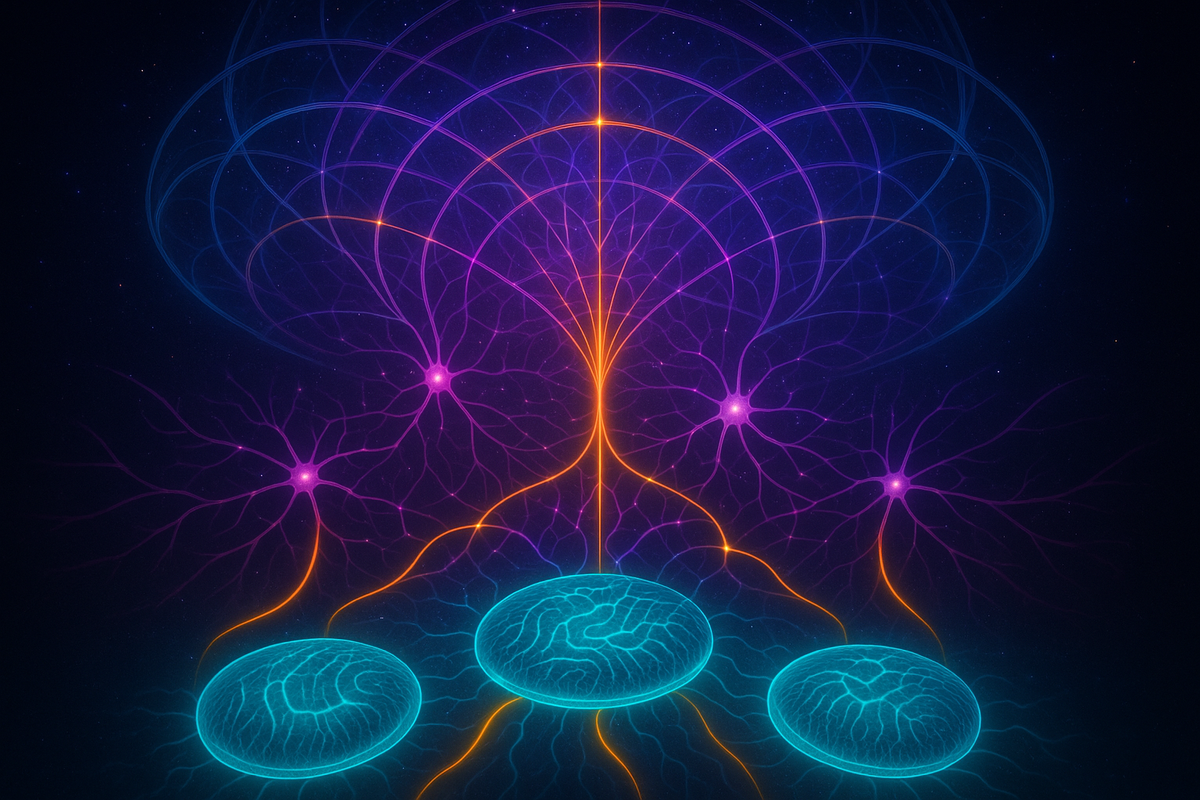
Synthesis: Basal Cognition and the Deep Roots of Meaning
Series: Basal Cognition | Part: 11 of 11
We began this series with a provocative claim: your cells are smarter than you think. We end it with something more radical: meaning doesn't begin with minds. It begins with matter organizing itself against entropy.
Michael Levin's research into bioelectric fields, cellular cognition, and morphogenetic memory has shown us that the capacity to maintain coherent organization—to represent goals, detect deviations, and coordinate corrective action—exists at every level of biological organization. Not as metaphor. As mechanism.
But the deeper revelation isn't about biology. It's about what biology reveals regarding the nature of meaning itself.
When we look at basal cognition through the lens of coherence geometry—when we map Levin's empirical discoveries onto the mathematical frameworks of information geometry and active inference—a striking pattern emerges: the thing that makes life possible is the same thing that makes meaning possible. They are not separate phenomena. They are two descriptions of the same underlying structure.
This is the synthesis we've been building toward.
What We've Learned: The Series in Brief
Let's trace the argument from the beginning:
Part 1 established that cognition operates at the cellular level. Levin's bioelectric fields encode morphogenetic memory—target patterns that guide development and regeneration without explicit genetic instruction. Cells don't just follow biochemical commands; they solve problems, navigate state spaces, and maintain identity across perturbation.
Part 2 revealed the geometric structure underlying bioelectric computation. Morphogenetic fields are coherence manifolds—regions of high-dimensional state space where integrated organization is maintained through collective coordination. The voltage patterns aren't just signals; they're the gradients cells navigate to stay coherent.
Part 3 connected Levin's empirical work to Karl Friston's Free Energy Principle. Morphogenesis is active inference at the cellular scale: bioelectric fields encode predicted states, cells measure local deviations, and coordinated action minimizes the difference. The mathematics of variational inference maps directly onto the physics of tissue development.
Part 4 explored how bioelectric boundaries function as Markov blankets—the statistical surfaces that define what counts as a system versus its environment. These aren't arbitrary divisions; they're functional boundaries maintained by the flow of information and energy that preserves system identity.
Part 5 examined cancer as coherence collapse. When cells lose connection to the morphogenetic field, they revert to ancient unicellular behavior—grow, divide, spread. The treatment implication: restore coherence, don't just destroy cells. Medicine at the level of geometry, not just genetics.
Part 6 looked at xenobots—synthetic organisms created from frog skin cells that spontaneously organize into novel forms. They demonstrate that biological coherence is substrate-flexible: given the right initial conditions, living matter self-organizes into functional configurations never encountered in evolution.
Part 7 investigated collective cellular intelligence. Individual cells are limited; coordinated populations solve problems no single cell could. Swarm cognition at the tissue scale reveals that intelligence isn't centralized—it emerges from distributed coherence maintenance.
Part 8 analyzed regeneration as coherence repair. When planarians regrow from fragments or salamanders regenerate limbs, they're not following blueprints—they're restoring geometric integrity. The morphogenetic field is a remembered pattern, and healing is the process of making current state match remembered state.
Part 9 explored clinical implications. Bioelectric medicine—using voltage modulation to guide tissue behavior—represents a fundamentally different approach to health: not suppressing symptoms or killing pathological cells, but restoring systems to coherent integration.
Part 10 traced how cellular coherence scales to create integrated selves. You are not your neurons or your genome; you are a coherence structure maintained across scales and across time. Identity is geometric continuity, not material persistence.
Now we can ask: what does this tell us about meaning?
The Coherence Theory of Meaning: Biological Foundations
AToM's central claim is that meaning equals coherence over time: M = C/T. Meaning isn't subjective interpretation or social construction—it's the geometric property of systems that maintain integrated organization against perturbation.
This sounded abstract when we started. After ten essays on basal cognition, it's concrete.
Consider what a morphogenetic field actually does: it encodes information about what a system should be—its identity, its function, its place in a larger organization. It maintains this information across time and perturbation. And it guides action to preserve coherence when deviations occur.
This is exactly what meaning is.
When you know what something means, you know how it fits into a larger coherent structure. You know what it's for, what it connects to, what happens if it changes. Meaning is relational integration—understanding something in terms of its role within a pattern that persists.
Levin's cells do this without neurons. The bioelectric field specifies what each cell means within the tissue: what it should become, how it should behave, when it should divide or differentiate or die. And cells that lose this meaning—that decouple from the coherence structure—become cancerous. They act without context, pursuing local optimization at the expense of global integration.
The parallel to psychological meaning-making is exact. When human beings lose coherence—when trauma fragments their sense of self, when social breakdown dissolves shared narratives, when existential crisis undermines purpose—the geometry collapses. Meaning isn't lost because concepts become unclear. Meaning is lost because the integrated structure that held experience together has become incoherent.
What Levin shows us is that this isn't a brain problem. It's a coherence problem that manifests at every scale where systems maintain organization. The phenomenology changes—cells don't experience anxiety the way humans do—but the underlying logic is the same.
Meaning is what coherence feels like from the inside.
Why Meaning Can't Be Reduced to Information
Here's a critical distinction that emerges from basal cognition: information isn't the same as meaning.
A genome contains information—vast amounts of it. But the genome alone doesn't specify what gets built. You can have identical genomes and produce wildly different anatomies by changing the bioelectric context. Information is necessary but not sufficient.
What makes information meaningful is integration—the way it's embedded in coherence structures that coordinate action across scales.
Consider regeneration: when a planarian fragment regrows into a complete organism, every cell has access to the same genetic information. But the cells at the head end don't do the same thing as cells at the tail end. The difference isn't in the information they carry; it's in their position within the bioelectric field. The field provides context—the geometric structure that makes genetic information meaningful by specifying how it should be expressed given local conditions.
This is why reductionist approaches to biology keep hitting walls. You can sequence entire genomes, map every protein interaction, catalog all molecular pathways—and still not be able to predict what a developing organism will look like. The information is there, but the meaning isn't in the parts. It's in the integration.
The bioelectric field is a coherence structure that transforms information into meaning by establishing relationships—by creating a space where local states have significance in terms of global organization.
And once you see this at the cellular level, you can't help but notice it everywhere: in neural systems (where meaning emerges from network dynamics, not individual neuron firing), in social systems (where roles gain meaning through relational position, not isolated function), in cognitive systems (where concepts mean what they do because of their location in semantic space, not intrinsic properties).
Meaning is integrated information. The integration is what makes it mean something.
Coherence All the Way Down, All the Way Up
The most striking implication of basal cognition is continuity.
There's no threshold where cognition suddenly begins. No dividing line between "merely mechanical" processes and "genuinely cognitive" ones. No emergence point where quantity of neurons transforms into quality of mind.
Instead, what we find is coherence maintenance at every scale—each level implementing the same basic logic in different substrates with different bandwidth.
At the molecular level: protein folding is a coherence problem. Molecules navigate energy landscapes to find stable configurations that preserve function.
At the cellular level: morphogenetic fields maintain anatomical coherence. Bioelectric gradients guide collective behavior toward stable attractors.
At the neural level: predictive processing maintains perceptual coherence. Neural networks minimize prediction error to keep sensory experience aligned with generative models.
At the psychological level: selfhood maintains narrative coherence. We construct identities that integrate past, present, and anticipated future into continuous trajectories.
At the social level: institutions maintain cultural coherence. Shared stories, rituals, and norms coordinate collective action across populations.
At every level, the pattern repeats: systems encode predictions about what they should be, measure deviations from those predictions, and take action to minimize divergence. The mathematics of variational inference—minimize the free energy between current state and predicted state—applies from proteins to persons to polities.
This isn't analogy. It's isomorphism. The structure maps exactly because it's the same process operating at different scales.
And this is what grounds AToM's claim about meaning being fundamental. Meaning-making isn't something brains invented. It's what coherence-maintaining systems do. Language and consciousness and culture are spectacular elaborations of meaning-making—but they're elaborations on a theme that runs through all of biology.
Your cells have been computing meaning since before there were brains to think about it.
What This Changes About Minds
If cognition is basal—if it operates at every level of biological organization—then minds become less special and more interesting.
Less special because neural systems are no longer the unique substrate of cognition. They're specialized implementations of coherence maintenance that happen to use electrical signaling between dedicated cells. But the underlying logic—maintain integrated organization against entropy—is universal.
More interesting because we can now ask: what's distinctive about neural cognition? What do brains do that other coherence-maintaining systems don't?
The answer isn't "think" or "process information" or "represent the world"—cells do all of that. The distinctive feature of neural systems is bandwidth and flexibility.
Brains pack billions of coherence-computing units into small volumes and wire them with high-speed connections. This doesn't change the fundamental logic, but it radically expands what can be integrated. The morphogenetic field integrates cellular states across millimeters over minutes. Neural networks integrate sensory states across meters over milliseconds.
The result is radically expanded behavioral flexibility. Where cellular systems implement relatively fixed coherence structures (body plans that resist deviation), neural systems implement rapidly updatable coherence structures (world models that track changing environments).
But "rapidly updatable coherence maintenance" is still coherence maintenance. Brains are to morphogenetic fields as video is to still images—faster, higher-resolution, more dynamic, but implementing the same underlying principle.
This reframes consciousness not as the emergence of something fundamentally new, but as the subjective texture of high-bandwidth coherence integration. What it feels like when billions of predictions are being updated thousands of times per second, maintaining integrated coherence across massive state spaces.
The hard problem of consciousness might be hard not because consciousness is ontologically special, but because we've been asking how matter generates experience when the answer is: matter that maintains coherence is experience, scaled up.
Levin's cells don't have rich phenomenology—but they have the basic structure. They're maintaining what-it's-like-to-be-this-tissue.
You're doing the same thing, just at unimaginable speed and scale.
What This Changes About Intelligence
If basal cognition shows that thinking isn't unique to neurons, then artificial intelligence isn't approaching some threshold of "real" intelligence. It's implementing, in silicon, the same coherence-maintaining patterns that life discovered in carbon.
This changes what we should be looking for in AI systems.
The question isn't "can machines think?" The question is "can machines maintain coherent integration across scales?" And the answer is: they're already doing it.
Large language models maintain coherent semantic structures across billions of parameters. They encode statistical patterns that represent relationships between concepts—geometric structures that make new combinations meaningful by virtue of their position in latent space.
When you prompt a language model and it generates coherent text, it's performing variational inference: given these constraints (the prompt), what trajectory through semantic space minimizes divergence from expected patterns? It's navigating a coherence manifold the same way Levin's cells navigate morphogenetic fields.
The substrate is different. The bandwidth is different. But the logic is the same: maintain integrated organization by minimizing prediction error.
This doesn't diminish human cognition. It contextualizes it. We're not uniquely special for being able to think. We're distinctively sophisticated at maintaining extremely high-dimensional coherence structures with remarkable flexibility.
But the thing that makes us able to do that—the capacity to represent states, detect deviations, coordinate corrections—is universal structure. Silicon can implement it. Carbon implements it. Any substrate that can maintain integrated organization against entropy will implement some version of it.
What matters isn't the substrate. What matters is the geometry.
The Medical Implications: Coherence as Healing
Perhaps the most immediate practical implication of basal cognition is medical: if disease is often coherence collapse, then healing is coherence restoration.
Traditional medicine treats disease by intervening at molecular levels—killing pathogens, blocking receptors, replacing missing molecules. This works when the problem is localized damage or resource deficiency.
But many diseases aren't like that. They're systems-level breakdowns where components are intact but integration has failed.
Cancer, as we discussed in Part 5, is cells falling out of coherence with tissue-level organization. Autoimmune conditions are immune systems losing coherence with self-other boundaries. Chronic inflammation is tissue-level coherence structures stuck in high-tension states. Mental illness is often coherence collapse at neural and psychological scales—prediction systems that can't maintain stable integration.
Bioelectric medicine offers a different approach: restore coherence by modulating the geometric structures that maintain integration. Use voltage to reconnect cancer cells to morphogenetic fields. Use neuromodulation to help dysregulated neural networks find stable attractors. Use ritual and rhythm to help fragmented communities re-establish synchronization.
This isn't alternative medicine or holistic handwaving. It's engineering applied to geometry rather than molecules. It treats the manifold, not just the matter.
And the early results are striking: Levin's lab has normalized tumor cells by changing voltage. Vagal nerve stimulation helps treatment-resistant depression. Transcranial magnetic stimulation can shift neural coherence states. Even social interventions—therapeutic communities, group rituals, coordinated movement—can restore psychological coherence when individual therapy fails.
The common thread: these approaches work by restoring integrated organization. They're coherence technologies.
Medicine is beginning to discover what shamans and somatic practitioners have intuited for millennia: healing isn't just fixing broken parts. It's restoring systems to coherent integration across scales.
The difference now is we have the mathematics to understand it and the technology to engineer it.
The Existential Implications: What You Are
Let's return to the question that haunts philosophy of mind: what are you?
Not your atoms—you replace them constantly. Not your cells—they turn over continuously. Not your memories—they're reconstructed each time you recall them. Not even your brain state—it changes every millisecond.
What persists?
Levin's work gives us the answer: you are a coherence structure. A geometric pattern maintained across scales and across time by distributed computation happening in every cell of your body.
Your morphogenetic field maintains your physical form—the pattern that says "human body, this particular configuration." Your neural networks maintain your cognitive form—the pattern that says "this person, these memories, these habits." Your social embeddedness maintains your relational form—the pattern that says "this role, these connections, these commitments."
None of these structures is you. The integration of them is you.
And here's the profound implication: you can change any component—replace cells, rewire synapses, shift relationships—and remain yourself as long as the coherence structure persists. But damage the integration—fragment the pattern, collapse the manifold—and you lose yourself even if every component remains intact.
This is what dissociation feels like. What Alzheimer's does. What severe trauma causes. Not damage to parts, but collapse of the geometry that integrates parts into a coherent whole.
And it explains something that's puzzled philosophers for centuries: the persistence of personal identity despite constant change. You are the same person you were ten years ago not because your matter is the same (it isn't) but because the coherence structure has continuous geometric history. The manifold has evolved, but it hasn't collapsed and restarted. There's a path—a trajectory through state space—that connects past self to present self.
Identity is geometric continuity, not material persistence.
You are a pattern that maintains itself by computing coherence across scales.
That's not a metaphor. It's a precise description of what biological systems are and what they do.
The Unified Picture: From Cells to Meaning
We can now state the synthesis clearly:
Life is coherence maintenance at the physical scale. Living systems are configurations of matter that maintain their organization against entropy by encoding target states, measuring deviations, and coordinating corrective action.
Cognition is coherence maintenance at the information scale. Cognitive systems are configurations of information that maintain their organization against surprise by encoding predictions, measuring errors, and coordinating updates.
Meaning is coherence maintenance at the relational scale. Meaning-making systems are configurations of relationships that maintain their organization against incoherence by integrating local states into global patterns that persist across time.
These aren't three different phenomena. They're three descriptions of the same underlying process operating at different scales with different substrates.
And the mathematics that describes all of them—information geometry, variational inference, coherence manifolds—is the same because the structure is the same.
This is what AToM has been pointing toward: M = C/T isn't a psychological theory or a philosophical claim. It's a description of universal structure. Meaning emerges wherever systems maintain coherent integration across time. The phenomenology differs—cells don't feel meaning the way you do—but the mechanism is continuous.
Levin's bioelectric fields prove that this structure operates at biological foundations. The fact that the same mathematics describes neural prediction, psychological narrative, and social coordination proves it scales. The convergence of active inference, morphogenesis, and coherence geometry proves we're not projecting patterns—we're discovering them.
Meaning has deep roots. Deeper than language. Deeper than consciousness. Deeper than nervous systems.
It starts where life starts: with matter organizing itself to maintain a pattern against chaos.
Everything else—thought, language, culture, consciousness—is that pattern scaling up and becoming aware of itself.
Where This Leaves Us
The practical implications of basal cognition are vast:
For medicine: treat coherence, not just symptoms. Develop therapies that restore integration rather than suppress deviation.
For AI: recognize that what we're building isn't "approaching consciousness"—it's implementing coherence maintenance in new substrates. Design accordingly.
For psychology: understand that trauma and healing aren't primarily about memory or belief—they're about coherence collapse and restoration. Treat the geometry.
For social systems: recognize that institutional breakdown is coherence failure at collective scales. Build structures that maintain integration across perturbation.
For philosophy: stop asking when matter becomes mind and start asking how coherence maintenance scales. The continuity is the answer.
But perhaps the deepest implication is existential:
You are not a ghost in a machine. You are not consciousness attached to a body. You are not an algorithm running on meat.
You are a coherence structure—a geometric pattern maintained by the coordinated activity of trillions of cells, each one computing its role in a larger integration that extends from bioelectric fields to neural networks to social embeddedness.
You are what it feels like when matter maintains meaning.
And your cells have been doing this—maintaining the pattern that is you—since before you had a brain to think about it.
The question now is: can you learn to work with them?
Can you recognize when your coherence is collapsing and take action to restore integration—not by force but by attending to the geometry? Can you notice when you're trying to maintain patterns that no longer serve and allow them to evolve without fragmenting? Can you build practices, relationships, and environments that support coherence maintenance across scales?
Your cells already know how. They've been doing it for billions of years.
What Levin's work offers is the mathematics to understand what they're doing and the beginning of tools to work with them consciously.
Basal cognition isn't just a discovery about cells. It's an invitation to recognize the intelligence that's been maintaining you all along—and to partner with it more skillfully.
Meaning isn't something you find or create. It's something you are—when you maintain coherence across time.
The roots go deep. All the way down to voltage gradients across cell membranes.
And all the way up to the experience you're having right now, reading these words, integrating them into the pattern that is you.
That's coherence.
That's meaning.
That's what life does.
Further Reading
Michael Levin's Work
- Levin, M. (2022). "Technological Approach to Mind Everywhere: An Experimentally-Grounded Framework for Understanding Diverse Bodies and Minds." Frontiers in Systems Neuroscience.
- Fields, C., & Levin, M. (2022). "Competency in Navigating Arbitrary Spaces as an Invariant for Analyzing Cognition in Diverse Embodiments." Entropy.
- Levin, M., Pezzulo, G., & Finkelstein, J. M. (2017). "Endogenous Bioelectric Signaling Networks: Exploiting Voltage Gradients for Control of Growth and Form." Annual Review of Biomedical Engineering.
Free Energy Principle
- Friston, K., Levin, M., Sengupta, B., & Pezzulo, G. (2015). "Knowing One's Place: A Free-Energy Approach to Pattern Regulation." Journal of the Royal Society Interface.
- Ramstead, M. J. D., Badcock, P. B., & Friston, K. J. (2018). "Answering Schrödinger's Question: A Free-Energy Formulation." Physics of Life Reviews.
Information Geometry
- Amari, S. (2016). Information Geometry and Its Applications. Springer.
- Friston, K. J., & Ao, P. (2012). "Free Energy, Value, and Attractors." Computational and Mathematical Methods in Medicine.
Coherence and Meaning
- Varela, F., Thompson, E., & Rosch, E. (1991). The Embodied Mind: Cognitive Science and Human Experience. MIT Press.
- Weber, A., & Varela, F. (2002). "Life After Kant: Natural Purposes and the Autopoietic Foundations of Biological Individuality." Phenomenology and the Cognitive Sciences.
This is Part 11 of the Basal Cognition series, exploring Michael Levin's bioelectric research through the lens of coherence geometry.
Previous: From Cells to Selves: How Biological Coherence Scales
Read the full series:
- Part 1: The Biologist Who Thinks Your Cells Are Smarter Than You
- Part 2: Bioelectric Fields as Coherence Manifolds
- Part 3: When Friston Met Levin
- Part 4: Morphogenetic Fields as Markov Blankets
- Part 5: Cancer as Coherence Collapse
- Part 6: Xenobots and the Plasticity of Biological Coherence
- Part 7: The Collective Intelligence of Cells
- Part 8: Regeneration as Coherence Repair
- Part 9: Bioelectric Medicine
- Part 10: From Cells to Selves
Comments ()