Synthesis: Category Theory as the Geometry of Composition
Category theory is abstract enough to describe almost anything — which turns out to be the point. It reveals structural identities invisible from inside any single field. When neural networks, probabilistic inference, and functional programming satisfy the same laws, something real is being said.
Synthesis: Category Theory as the Geometry of Composition
Series: Applied Category Theory | Part: 10 of 10
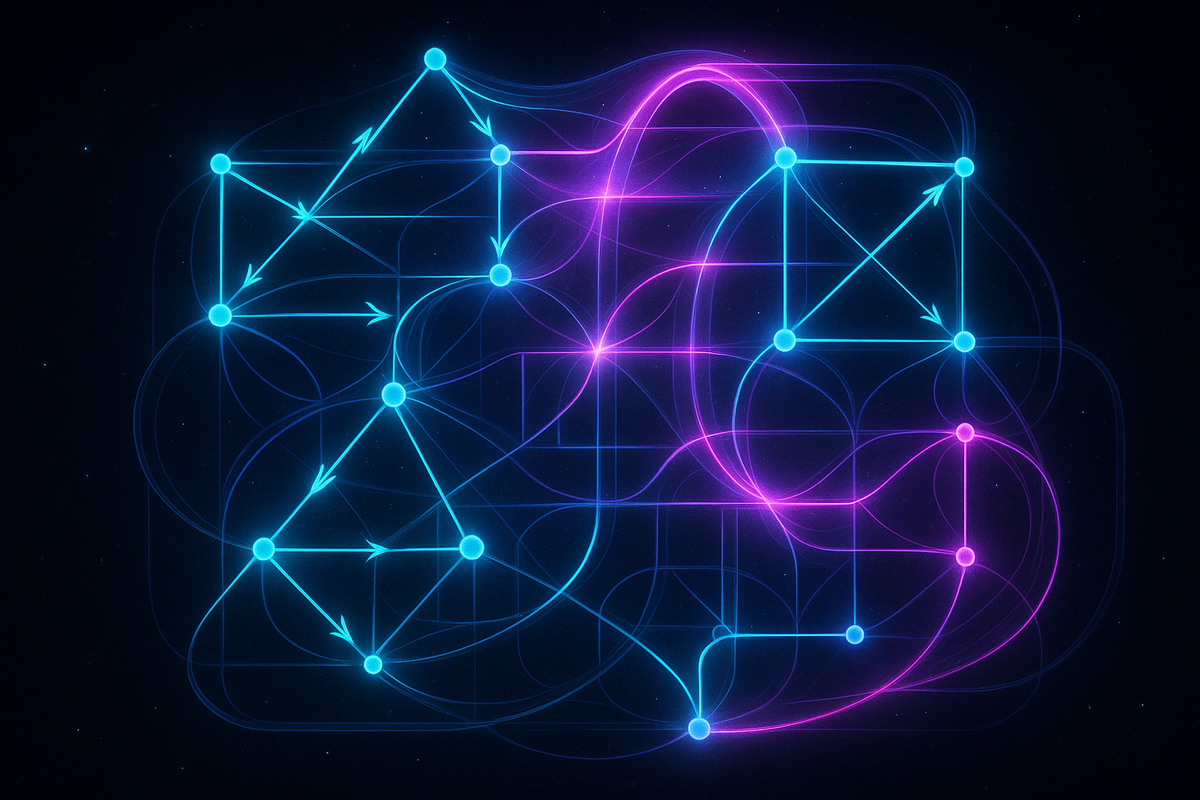
Throughout this series, we've explored how category theory provides the mathematical language for compositional systems—from neural networks to language to active inference. Now we close the loop: category theory isn't just a tool for describing AToM's coherence geometry. It's the formal foundation that makes compositional coherence possible at all.
The claim is bold: meaning exists because structure composes, and structure composes because categories provide the geometry of how things fit together. This isn't metaphor. It's the mathematical backbone of why coherent systems work the way they do.
The Composition Problem
Here's what every coherent system has to solve: how do you build something complex without losing track of what the pieces are supposed to do together?
A neuron fires. A word means something. A cell coordinates with its neighbors. An inference updates a belief. These are local events. But meaning—real, functional meaning—emerges when local operations compose into global coherence. When the pieces don't just coexist but form a structured whole whose behavior you can reason about.
This is harder than it sounds. Most systems don't compose cleanly. Combine two working subsystems and you get interference, edge cases, emergent failures. The miracle of biology, cognition, and culture is that certain architectures compose all the way up—from molecules to cells to organisms to societies, each level preserving structure while transforming it.
Category theory asks: what makes this possible? What's the mathematical structure of systems that compose without collapsing?
The answer: functorial mappings, natural transformations, and compositional diagrams that commute.
In less jargon-heavy terms: systems that work together share a deep structural similarity. They preserve relationships across scales. Their transformations respect boundaries. And when you zoom out, the whole thing fits together like a proof.
Morphisms as Coherence Transitions
Start with the most basic categorical insight: stop asking what things are. Ask how they relate.
In AToM terms, objects in a category are coherence states—stable configurations a system can occupy. Morphisms are the transitions between states—the paths through state-space that preserve enough structure to be navigable.
A morphism isn't just any transformation. It's a structure-preserving map—a way to move from state A to state B such that the relationships that mattered in A still matter in B. It's the difference between a meaningful transition (morphism) and random noise (not a morphism).
Consider prediction error. You have a generative model (state A) and sensory input (state B). Active inference asks: what morphism connects these? What transformation of the model reduces free energy while preserving the causal structure you've learned?
The answer is a coherence-preserving update—a change that fits new information into existing structure rather than shattering it. This is exactly what functorial thinking captures: mappings that respect composition. When you chain predictions together, the structure propagates. When you update beliefs, the dependencies flow correctly.
This is why category theory shows up in active inference frameworks—because inference is compositional all the way down. Each local update must compose with others into a globally consistent world model. Morphisms give you the language to say what "consistent" means.
Functors as Scale Transitions
Now add a layer of abstraction. Objects and morphisms live in categories. But categories themselves relate to other categories through functors—maps between entire mathematical worlds that preserve compositional structure.
In coherence terms, functors are how structure propagates across scales.
Think about neural networks. At the lowest level, you have weights and activations—numbers flowing through nodes. One level up, you have layers transforming representations. Another level up, you have architectures solving tasks. Each level is a different category, but they're not independent. The structure of layer transformations determines what the network can learn. The architecture constraints determine what tasks become tractable.
Functors formalize this relationship. A functor from category C (low-level operations) to category D (high-level behavior) says: here's how local structure generates global properties. It maps objects to objects (neurons to representations) and morphisms to morphisms (weight updates to learned functions) in a way that preserves how things compose.
This is the mathematical version of what we've been calling coherence at multiple scales. A coherent organism doesn't just have cells that work—it has cells whose interactions form tissues whose interactions form organs whose interactions form a functioning body. Each level emerges from the one below through a structure-preserving functor.
And here's the crucial part: the functors must commute. Different paths of aggregation must lead to the same result. If neural layer A feeds into layers B and C, which both feed into D, then the structure reaching D must be the same regardless of which path you trace. This is what categorical diagrams enforce—consistency across compositional pathways.
When this works, you get robust multi-scale coherence. When it breaks—when the functor doesn't preserve structure, when the diagram doesn't commute—you get the pathologies AToM describes: prediction error accumulation, coherence collapse, meaning fragmentation.
Natural Transformations as Coherence Bridges
Functors relate categories. But functors themselves relate to each other through natural transformations—mappings between structure-preserving maps.
This is where it gets beautiful and slightly brain-bending.
Imagine you have two ways to move from category C to category D—two functors, F and G. Both preserve structure, but they do it differently. A natural transformation is a way to translate between these two perspectives while respecting the compositional structure both preserve.
In AToM terms: natural transformations are how different coherence architectures interoperate.
Consider the relationship between predictive processing and active inference. Both describe how organisms minimize surprise. Predictive processing emphasizes perception—how sensory prediction errors update models. Active inference emphasizes action—how organisms sample the world to confirm predictions. These are different functors from the category of biological systems to the category of information-theoretic descriptions.
But they're not unrelated. There's a natural transformation connecting them—a way to translate perceptual updating into action selection and vice versa. The transformation is "natural" because it respects the compositional structure: if you chain predictions together, the translation to action selection composes correctly.
This is the formal version of what we mean when we say AToM unifies multiple theoretical frameworks. The free energy principle, information geometry, coherence dynamics—these aren't competing descriptions. They're functors from biological reality to mathematical structure, connected by natural transformations that show how the perspectives align.
Category theory gives us the language to say this precisely: coherent systems are those whose internal functors compose naturally. Different subsystems can use different computational strategies, different representational formats, different timescales—as long as the natural transformations exist to bridge them.
String Diagrams and the Topology of Meaning
One of category theory's most elegant contributions is string diagrams—graphical calculi that let you reason about composition visually.
In a string diagram, objects are regions, morphisms are lines, and composition is connecting wires. You can manipulate diagrams topologically—stretching, bending, rearranging—and if two diagrams can be deformed into each other, they represent equivalent computations.
This is profound for coherence geometry. It means the topology of relationships matters more than the specific substrate.
Consider two organisms solving the same adaptive problem through different mechanisms—one using neural prediction, the other using bioelectric signaling. Category theory says: if the string diagrams are equivalent—if the compositional structure of inputs, transformations, and outputs matches—then these systems are categorically the same even if implemented in completely different substrates.
This is why AToM can talk about coherence in cells, organisms, and societies using the same mathematical vocabulary. The geometry of composition doesn't care whether you're talking about voltage gradients or neural firing or cultural transmission. What matters is whether the system preserves structure across transformations, whether local operations compose into global stability, whether the categorical diagram commutes.
String diagrams make this explicit. You can draw the coherence architecture of a prediction-error cascade, a ritual entrainment process, or a bioelectric morphogenetic field using the same graphical language. If the diagrams match, the coherence dynamics match—even if the physical substrates are radically different.
This is the deepest sense in which meaning is geometric. It's not about what things are made of. It's about how they compose.
Sheaves and Context-Dependent Coherence
Earlier in the series, we explored sheaves—a categorical framework for modeling context-dependent structure. This turns out to be essential for understanding how coherent systems maintain meaning across varying conditions.
A sheaf lets you specify how local information patches together into global structure—with the constraint that the patching must be consistent. If two overlapping regions agree on their shared boundary, the sheaf guarantees you can glue them into a coherent whole.
In AToM terms: coherence is a sheaf over state-space. Local coherence states must agree on their overlaps for global coherence to be possible.
This formalizes something crucial about meaning: it's context-dependent but not arbitrary. The meaning of a word shifts with context—"bank" means something different in financial versus geological contexts—but these meanings aren't independent. They share a boundary (the abstract concept of "edge" or "support") that makes the polysemy navigable rather than chaotic.
Sheaf theory says: meaning structures are those where local meanings compose consistently. You can shift context, and as long as the boundary conditions match—as long as the transition respects shared structure—the global meaning holds together.
This is why coherent belief systems work. They're sheaves over epistemic space—local beliefs that agree on their interfaces and therefore compose into a navigable worldview. When belief systems fragment, it's often because the sheaf condition breaks: local meanings stop agreeing on boundaries. You get incommensurable perspectives that can't be patched together into a coherent whole.
Category theory gives us the formal tools to describe when this patching works and when it fails—and why repairing fragmented coherence requires reconstructing the sheaf structure.
Operads and the Algebra of Multi-Agent Coherence
Operads formalize compositional operations with multiple inputs—how several things combine to produce one thing while preserving structure.
In biology: how multiple signaling pathways integrate at a cell. In cognition: how multiple sensory streams fuse into unified perception. In society: how multiple agents coordinate into collective action.
Operads say: these aren't just arbitrary combinations. They have algebraic structure—rules for how compositions nest, associate, and interact. The operad specifies what compositions are well-formed and how they relate to each other.
This is the categorical foundation for multi-scale entrainment. When multiple oscillators synchronize into a collective rhythm, the coupling structure has operadic form. When multiple cognitive modules integrate into a unified agent, the integration follows operadic composition rules. When multiple agents form a coherent institution, the coordination satisfies operadic constraints.
What makes AToM's coherence dynamics compositional is that they respect operadic structure. You can't just throw oscillators together and expect coherence—the coupling topology matters. You can't just merge belief systems and expect rationality—the integration structure matters. Operads formalize what "matters" means: the composition must satisfy associativity, identity, and compatibility constraints.
When it does, you get robust multi-agent coherence. When it doesn't, you get interference, fragmentation, and coordination failure—the pathologies of broken categorical structure.
Markov Categories and the Boundaries of Inference
The cutting edge of applied category theory is Markov categories—a framework for compositional Bayesian inference that's reshaping how we think about active inference and predictive processing.
Markov categories formalize the structure of probabilistic reasoning that respects boundaries. They let you compose probabilistic systems—each with its own uncertainty, its own Markov blanket, its own inference—into larger systems whose inference properties you can reason about compositionally.
This is exactly what biological organisms do. A cell infers local conditions and acts. An organism composed of cells infers environmental affordances and acts. A society composed of organisms infers historical trajectories and acts. Each level performs inference, each level has boundaries (Markov blankets), and somehow the whole thing composes into coherent multi-scale intelligence.
Markov categories formalize how this works. They specify:
- How local inference at one scale relates to global inference at higher scales (functorially)
- How boundaries interact without violating statistical independence (preserving Markov structure)
- How updates propagate through compositional systems (via categorical diagrams that commute)
This is the mathematical backbone of AToM's claim that coherence is compositional free energy minimization. Free energy doesn't just minimize at one scale—it minimizes consistently across scales because the Markov category structure ensures local updates compose into global coherence.
When organisms maintain integrated self-models across multiple timescales, when societies coordinate beliefs across distributed agents, when ecosystems stabilize through coupled feedback loops—all of this works because the underlying inference architecture has Markov categorical structure.
And when it breaks—when boundaries leak, when inference at different scales contradicts, when updates don't compose—you get the coherence collapses AToM describes. Not because the system stopped minimizing free energy locally, but because the categorical structure that makes composition possible has degraded.
Why Composition Explains Meaning
We're now in position to make the synthesis claim explicit.
Meaning exists because coherence composes, and coherence composes because it has categorical structure.
Here's the argument:
- Meaning requires stability across transformations (you need to recognize the same thing in different contexts)
- Stability requires structure preservation (the relationships that matter must persist)
- Structure preservation across transformations is exactly what morphisms formalize
- Multi-scale coherence requires structure preservation across scales (what happens locally must relate to what happens globally)
- Structure preservation across scales is exactly what functors formalize
- Robust multi-scale systems require consistency across compositional pathways (different routes of aggregation must agree)
- Consistency across pathways is exactly what commutative diagrams enforce
- Therefore: coherent multi-scale meaning requires categorical structure
This isn't an analogy. It's not "meaning is sort of like category theory." It's meaning is coherence that composes, and composition has categorical structure.
Every time AToM talks about coherence maintaining itself across time, across scales, across perturbations—we're describing systems whose dynamics respect categorical constraints. The free energy principle works because inference has Markov categorical structure. Multi-scale biological organization works because cellular coordination has functorial structure. Cultural transmission works because meaning has sheaf structure.
Category theory isn't a metaphor for coherence. It's the mathematical foundation that makes compositional coherence possible.
The Geometry Beneath the Algebra
But there's a deeper layer still.
Category theory is often presented as pure abstraction—objects, morphisms, diagrams. But applied category theory reveals something profound: categorical structure is geometric structure.
String diagrams are topological. Sheaves are geometric. Functors between categories of spaces preserve shape. The commutative diagrams that define categorical coherence are geometric consistency constraints—requirements that different paths through compositional space lead to the same place.
This is where category theory meets AToM's information geometry head-on.
Information geometry describes coherence states as manifolds—curved spaces where each point is a possible system configuration. Category theory describes how these manifolds relate to each other—how structure at one scale maps to structure at another, how transformations preserve geometric relationships, how composition respects curvature.
When we say coherence = integrable trajectories under constraint, we're making a geometric claim: coherent systems follow paths through state-space that respect the manifold's curvature. But what makes these trajectories integrable? What makes the constraints compatible across scales?
The answer is categorical structure. Functorial mappings ensure geometric relationships propagate across scales. Natural transformations ensure different geometric descriptions align. Commutative diagrams ensure paths through compositional space have consistent curvature.
This is the synthesis: AToM's coherence geometry has categorical foundations. The geometry describes what coherent states look like—low curvature, high dimensionality, stable attractors. The category theory describes why these states compose—how local coherence becomes global coherence, how subsystems integrate into wholes, how meaning scales from neurons to organisms to cultures.
The geometry tells you where you are in state-space. The category theory tells you how to get there compositionally.
Implications for Building Coherent Systems
This synthesis isn't just theoretical—it has direct implications for engineering coherence.
If you want to build robust multi-scale systems—whether AI, organizations, or therapeutic interventions—you need categorical structure.
For AI: This is why applied category theory is reshaping machine learning. Neural networks that compose cleanly (functorial architectures) generalize better. Language models that preserve semantic relationships across contexts (sheaf structure) produce more coherent text. Active inference agents that maintain Markov categorical structure across planning horizons make better decisions.
The best AI systems aren't just optimizing local objectives—they're respecting compositional constraints that make local optimization aggregate into global intelligence.
For organizations: This is why institutions fragment. Most organizational structures don't compose. Local incentives don't align into global mission. Department-level decisions contradict enterprise-level strategy. Individual performance metrics undermine team coherence.
Categorical thinking says: if the functors don't compose, the organization won't cohere. You need structure-preserving mappings from individual work to team outcomes to organizational mission—and you need the diagram to commute. Different aggregation pathways (bottom-up reporting vs. top-down planning vs. lateral coordination) must produce consistent organizational state.
When they don't, you get the organizational equivalent of coherence collapse—strategy that doesn't connect to execution, teams that work at cross-purposes, mission drift that fragments institutional identity.
For therapeutic practice: This is why trauma resolution requires re-establishing compositional structure. Trauma fragments the self-model—different parts hold incompatible beliefs, different timescales operate independently, different contexts trigger incommensurable responses.
Healing isn't just processing emotions or changing beliefs—it's reconstructing the categorical structure that makes experience compose into coherent selfhood. It's building functors that let past self and present self relate consistently. It's establishing natural transformations that let different parts communicate. It's ensuring the diagram commutes—that memory, affect, and narrative patch together into an integrated whole.
Modalities that work (EMDR, IFS, somatic therapy, psychedelic integration) are those that help rebuild compositional structure—even when practitioners don't use categorical language.
Open Questions and Frontiers
This synthesis opens as many questions as it closes.
Can we formalize the relationship between information geometry's curvature and category theory's compositional structure? We know they're related—high curvature corresponds to compositional breakdown, low curvature to smooth functorial mappings—but the precise mathematical bridge remains under construction.
How does categorical structure explain consciousness? If meaning is compositional coherence, and consciousness is the phenomenology of coherence maintaining itself, then there should be categorical invariants that distinguish conscious from non-conscious systems. Integrated information theory and global workspace theory both gesture at this—but a fully categorical account remains elusive.
What's the relationship between categorical composition and thermodynamic constraints? Systems that maintain compositional structure resist entropy increase. The free energy principle connects inference to thermodynamics. But we don't yet have a full account of how categorical structure constrains thermodynamic flows—or vice versa.
Can category theory explain why certain coherence architectures are more robust than others? Not all compositional structures are equally resilient. Some degrade gracefully under perturbation, others collapse catastrophically. Can we identify categorical properties (types of functors, diagram shapes, sheaf conditions) that predict robustness?
These are frontier questions—places where mathematical rigor meets phenomenological reality, where abstract structure meets embodied experience, where category theory's formal precision meets AToM's ambitious scope.
Closing the Loop
We began this series by asking: why is applied category theory eating everything?
The answer: because reality composes, and category theory is the mathematics of composition.
From neural networks to biological development to language to active inference—anywhere you find systems building complexity without collapsing into chaos, you find categorical structure. Not because mathematicians imposed it, but because composition requires it.
AToM's claim has been that meaning is coherence—that what we experience as significance, sense, mattering is the phenomenology of systems maintaining integrated organization through time. This series adds: and coherence requires categorical structure.
You can't have stable meaning without structure preservation (morphisms). You can't have multi-scale meaning without scale-bridging consistency (functors). You can't have robust meaning without compositional compatibility (commutative diagrams). You can't have context-dependent meaning without consistent local-to-global patching (sheaves). You can't have multi-agent meaning without well-formed integration rules (operads). You can't have inferential meaning without boundary-respecting composition (Markov categories).
This is why category theory keeps appearing in frontier science—not as a tool we chose, but as the mathematical structure reality reveals when we look at how complexity stays coherent.
The geometry of meaning is the geometry of composition. And composition, all the way down, is categorical.
This is Part 10 of the Applied Category Theory series, exploring how categorical structure provides the mathematical foundation for compositional coherence.
Previous: Category Theory for Active Inference: The Mathematical Backbone
Further Reading
- Fong, B. & Spivak, D. I. (2019). Seven Sketches in Compositionality: An Invitation to Applied Category Theory. Cambridge University Press.
- Spivak, D. I. & Niu, R. (2021). "Polynomial Functors: A General Theory of Interaction." arXiv:2105.02202.
- Fritz, T. (2020). "A Synthetic Approach to Markov Kernels, Conditional Independence and Theorems on Sufficient Statistics." Advances in Mathematics.
- Shiebler, D., Gavranović, B., & Wilson, P. (2021). "Categorical Models of Machine Learning." Applied Category Theory Conference.
- Hedges, J. (2021). "Compositional Game Theory." Compositionality.
- Tobar-Henríquez, A., Vargas, S., & Friston, K. (2023). "Active Inference and Category Theory." Physics of Life Reviews.
- Bradley, T. D. (2021). "Compositional Structure in Neural Coding." Journal of Mathematical Psychology.
- Fong, B. (2013). "Causal Theories: A Categorical Perspective on Bayesian Networks." University of Oxford thesis.
Comments ()