Synthesis: Humans as Coherence Community Generators
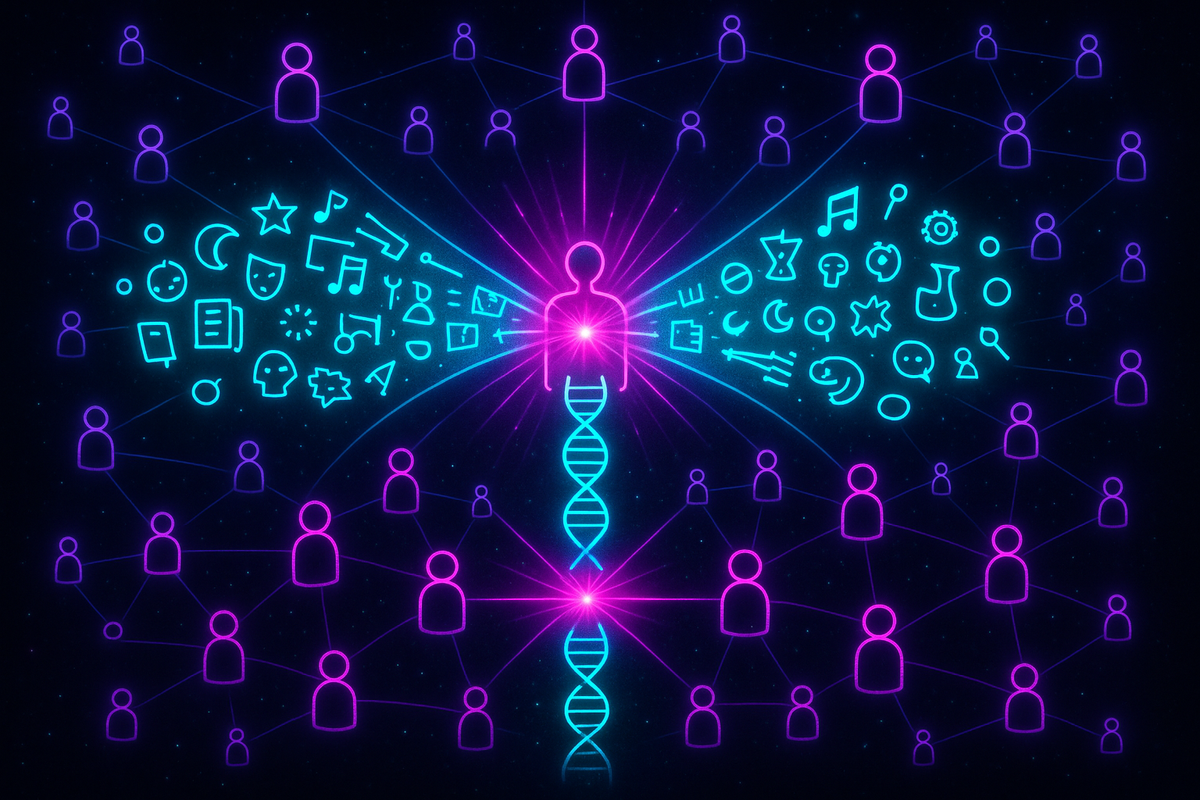
The lonely individual is a modern fiction. Human cognition evolved not to optimize individual fitness but to form, maintain, and transmit communities of shared meaning. We are, at our core, coherence community generators.
Synthesis: Humans as Coherence Community Generators
Series: Gene-Culture Coevolution | Part: 9 of 9
We've traced a single evolutionary story through nine articles: Humans didn't just evolve to survive as individuals. We evolved to construct and maintain coherence communities—groups held together by shared meaning that exists between minds rather than just within them.
This isn't metaphor. It's the engineering specification for our species.
Gene-culture coevolution created humans with biological hardware optimized for cultural software. We inherit information through two channels—genetic and cultural. These channels coupled into feedback loops that spiraled upward, creating a species that can rewrite its own evolutionary trajectory through learned, transmitted, and accumulated knowledge.
The result: We are coherence community generators. This is what we do. This is what we're built for.
The Evolutionary Achievement
Every species maintains coherence at some scale. Cells maintain biochemical coherence. Organisms maintain physiological coherence. Social insects maintain colony-level coherence through genetic relatedness and pheromone signaling.
But humans went further. We evolved the capacity to maintain coherence at arbitrary scale, with arbitrary membership, through arbitrary content, sustained by cultural rather than genetic mechanisms.
We can coordinate with strangers. We can cooperate in groups of millions. We can synchronize behavior through shared narratives rather than shared genes. We can build institutions that persist for centuries. We can transmit knowledge across dozens of generations, each building on the last.
This required specific biological innovations:
High-fidelity imitation to copy complex behaviors accurately.
Theory of mind to model others' beliefs and teach effectively.
Language to transmit abstract knowledge verbally.
Norm psychology to enforce shared standards and resist drift.
Extended childhood to provide time for cultural learning.
Social learning biases to choose who and what to copy.
These aren't just "smart ape" features. They're cultural transmission machinery—specialized cognitive equipment for building and maintaining coherence communities.
The Dual Inheritance Architecture
Genetic inheritance is conservative. It transmits biological form slowly, vertically, and with high fidelity. It's excellent at maintaining stable adaptations across deep time.
Cultural inheritance is innovative. It transmits behavioral form quickly, horizontally, and with modification. It's excellent at adapting to changing environments within lifetimes.
The two systems coevolved. Cultural practices created selection pressures on genes. Genetic changes enabled richer cultural transmission. The feedback spiraled: better culture selected for better brains; better brains enabled more complex culture.
The result is dual inheritance—two evolutionary processes running in parallel, each shaping the other, creating dynamics that neither genetic nor cultural evolution alone could produce.
This explains human universals (biological capacities for culture) and human diversity (cultural content varies wildly). We're all running the same wetware with radically different software. Same evolutionary strategy, different implementations.
Cultural Attractors: The Shape of Possibility Space
Cultural evolution isn't random drift. It's navigation through structured possibility space—a landscape with peaks, valleys, basins, and attractors.
Some configurations are stable. Moralizing gods emerge repeatedly because they solve cooperation problems at scale. Status hierarchies reappear because they reduce coordination costs. Shamanic healing practices converge because they fit human neurobiology.
These are cultural attractors—patterns that cultures independently discover and settle into because they're functionally stable given human cognition, social dynamics, and environmental constraints.
Attractors don't determine culture. But they constrain it. Cultures can resist, modify, or navigate around attractors—but they can't ignore the landscape structure. The deep basins are where cultures settle when other pressures relax.
This is why human cultures, despite enormous diversity, show recurring patterns. We're not all converging on truth. We're all navigating the same possibility space with the same cognitive equipment.
Religion: The Original Coherence Technology
Religion is universal because it solves problems that gene-based mechanisms can't handle at scale.
Small groups can coordinate through reputation and kinship. Large groups need internalized enforcement—belief in supernatural punishment that doesn't require human monitoring.
Religion provides:
- Costly signals that filter commitment
- Norm synchronization that enables stranger cooperation
- Ritual entrainment that creates physiological bonding
- Existential meaning that integrates experience into narrative
These aren't side effects. They're the evolutionary function. Religious groups outcompete less organized groups. The cultural variants that promote cooperation spread. Not because they're true, but because they work.
Gene-culture coevolution then selects for genetic variants that make humans receptive to religious concepts—hyperactive agency detection, teleological thinking, norm psychology. The capacity is biological. The content is cultural. Both coevolved.
New Religious Movements: Evolution in Real Time
NRMs show us the same dynamics operating at internet speed. Charismatic founders, boundary marking, costly practices, novel frameworks—all the features we see in established religions, but compressed into decades instead of centuries.
They're natural experiments in coherence community formation. Most fail. A few succeed. The ones that persist are those whose cultural variants promote cohesion, coordination, and reproduction.
This is cultural selection operating on community-level traits. The groups that survive are those that genuinely serve member coherence (or at least appear to long enough to achieve institutional stability).
Digital Tribes: Cultural Evolution on Platforms
The internet didn't change human psychology. But it changed the transmission infrastructure.
Cultural variants now spread at algorithmic speed. Communities form globally around any shared interest. Selection pressure intensifies. The variants that thrive are those optimized for engagement, not truth or wellbeing.
The same mechanisms that created religions now operate on Reddit, Discord, Twitter, and TikTok. Costly signaling (learning jargon), norm enforcement (upvotes/downvotes), ritual practice (coordinated action), identity fusion (you are what you post).
Digital tribes radicalize not because people are broken but because cultural evolution under algorithmic selection favors extreme variants. Moderate positions don't generate engagement. Tribal affirmation does. The algorithm selects, and culture evolves accordingly.
Healthy vs. Harmful: The Evaluation Framework
Not all coherence communities are equal. Some genuinely serve member flourishing. Others exploit coherence hunger.
The difference is exit capacity. Can you leave? Can you question? Are costs proportional to benefits? Is information controlled or open?
Healthy communities provide genuine coherence—frameworks that expand autonomy, develop capacity, and create value. Harmful communities provide illusory coherence—surface integration that masks exploitation.
The challenge: The same mechanisms that make communities functional (costly commitment, strong boundaries, demanding practices) can become pathological. Discernment requires evaluating whether the group serves members or itself.
The Pattern Across Scales
Gene-culture coevolution explains:
Individual development: We're not born blank slates or genetically determined. We inherit from two systems—biological capacity + cultural content.
Community formation: Groups that provide coherence through shared meaning outcompete groups that don't.
Cultural evolution: Ideas that fit human cognition and serve group function spread. Those that don't, disappear.
Historical dynamics: Major cultural transitions (agricultural, industrial, digital) reconfigure coherence architectures and create selection for new cultural variants.
Contemporary fragmentation: When macro-coherence fails (polarization, meaning crisis, institutional decay), micro-coherence communities proliferate—each offering identity, meaning, and belonging to subsets of the population.
The pattern is fractal. The same dynamics operate at the scale of dyads, families, communities, nations, and civilizations. Coherence construction all the way up.
The Geometric Translation
In AToM terms, gene-culture coevolution is a story about how humans became systems that can construct coherence at arbitrary scale through cultural rather than genetic mechanisms.
Coherence is integrated trajectory through state-space. Meaning is coherence made navigable. Communities are collective coherence architectures that exist in the space between individuals.
Humans evolved:
- To generate coherence frameworks (narratives, practices, norms)
- To transmit them across individuals and generations (language, imitation, pedagogy)
- To maintain them against drift (norm psychology, costly signaling)
- To propagate them across populations (prestige bias, conformist bias)
- To evaluate them functionally (cultural selection, adaptation)
We're not just evolved. We're coevolved—products of two inheritance systems so deeply entangled that neither makes sense without the other.
What This Means
For understanding ourselves: You are not just your genes. You are not just your culture. You are the interaction between biological capacity and cultural content, shaped by evolutionary processes operating on both substrates.
For understanding communities: Groups aren't arbitrary. They're coherence-generating systems subject to evolutionary dynamics. The ones that persist are those that function well enough to maintain integration and reproduce.
For understanding meaning crisis: When cultural coherence frameworks fail en masse, people desperately seek new ones. This creates demand for NRMs, digital tribes, political movements, and any group offering identity and narrative.
For understanding the future: As transmission infrastructure changes (digital, AI-mediated), cultural evolution accelerates. We're running Paleolithic psychology on post-internet infrastructure. The coherence communities we build now will shape what we become.
The Human Condition
We need coherence. We need it individually—integrated selfhood, navigable meaning, stable identity. We need it collectively—coordinated action, shared values, mutual understanding.
But coherence doesn't arise automatically. It must be constructed, maintained, transmitted, and defended against entropy, drift, and competing frameworks.
This is what humans do. We're builders and maintainers of coherence communities. We've been doing it for hundreds of thousands of years. We'll keep doing it as long as we exist.
Gene-culture coevolution is the origin story of this capacity. And understanding it reveals not just where we came from, but what we are: systems that create systems of meaning, together.
This is Part 9 of the Gene-Culture Coevolution series, exploring how genes and culture evolve together to make humans uniquely human.
Previous: Evaluating Coherence Communities: Healthy vs Harmful Groups
Series Hub: Gene-Culture Coevolution
Series Summary
This series explored:
- The Missing Half of Evolution - Why culture is as important as genes
- Dual Inheritance - How genetic and cultural evolution interact
- Cultural Apes - The biological basis for cumulative culture
- Cultural Attractors - Why certain patterns keep appearing
- Religious Groups - Cognitive and social foundations of religion
- New Religious Movements - Coherence communities in formation
- Digital Tribes - Gene-culture dynamics online
- Evaluating Communities - Healthy vs harmful groups
- Synthesis - Humans as coherence community generators
Further Reading
- Boyd, R., & Richerson, P. J. (2005). The Origin and Evolution of Cultures. Oxford University Press.
- Henrich, J. (2016). The Secret of Our Success. Princeton University Press.
- Tomasello, M. (2009). Why We Cooperate. MIT Press.
- Norenzayan, A. (2013). Big Gods. Princeton University Press.
- Richerson, P. J., & Christiansen, M. H. (Eds.). (2013). Cultural Evolution: Society, Technology, Language, and Religion. MIT Press.
Comments ()