Synthesis: Ritual as Coherence Technology Across Scales
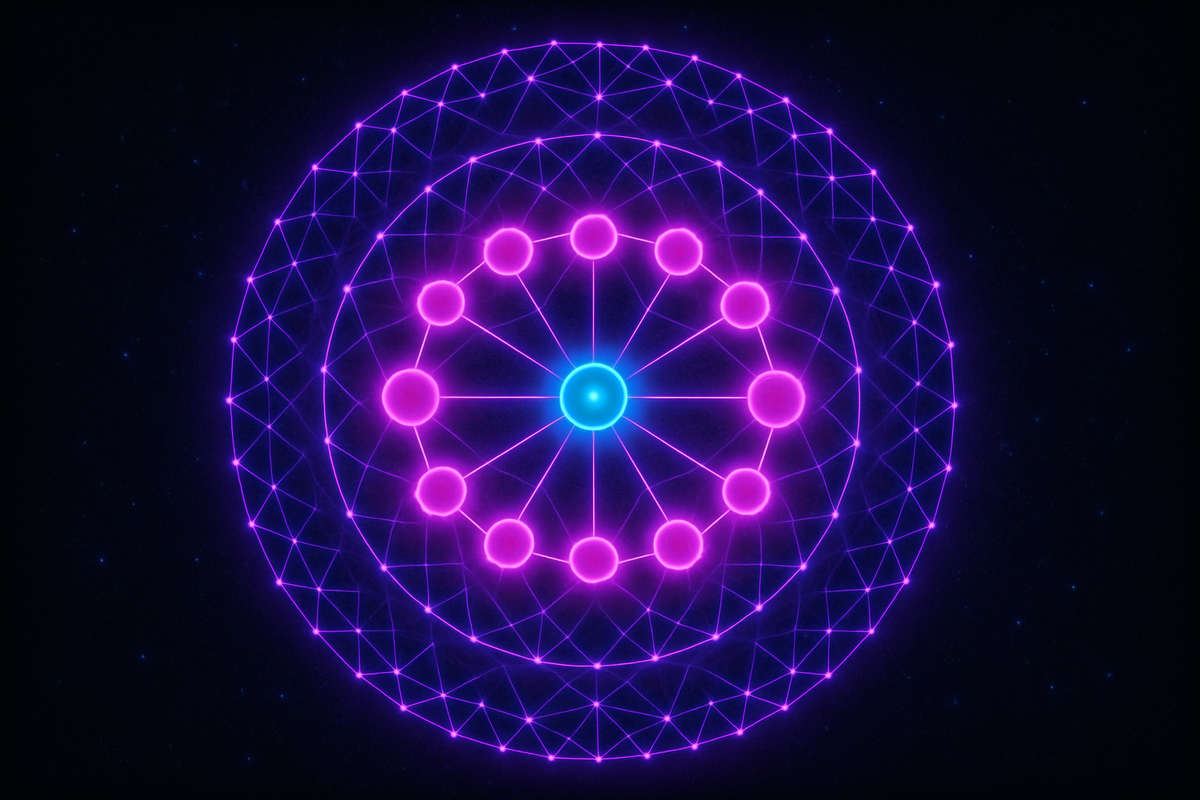
A crowd isn't just many individuals — it's a coupled system. Ritual exploits that coupling deliberately, synchronizing breath, movement, and attention until the group achieves coherence states unavailable to any single member. M=C/T, applied to synchronized bodies.
Synthesis: Ritual as Coherence Technology Across Scales
Series: Ritual Entrainment | Part: 11 of 11
We began with a simple observation: rituals work through entrainment—they synchronize nervous systems via coupled oscillators, creating collective coherent states that feel transcendent because they genuinely are more-than-individual.
We examined the mechanism: how biological oscillators phase-lock when coupled, how the Kuramoto transition produces spontaneous synchronization, why certain frequencies entrain more easily than others.
We traced the sociology: how Durkheim identified collective effervescence as the origin of the sacred, how gods emerge as personifications of synchronized collective states, why the boundary between profane and sacred is functional rather than arbitrary.
We cataloged the universal toolkit: rhythmic vocalization, percussion, coordinated movement, and shared consumption—technologies that appear in every culture because they exploit universal features of nervous system architecture.
We explored diverse implementations: electronic music culture reconstructing religious ritual accidentally, fitness communities providing secular sacrament, digital attempts revealing the irreducible importance of embodied co-presence, the hip-hop cypher demonstrating how ritual structure emerges organically from functional requirements.
And we outlined design principles for building effective ritual consciously rather than cargo-culting traditional forms.
Now we synthesize. What does ritual reveal about coherence? About meaning? About being human?
M = C/T at Collective Scale
In AToM (A Theory of Meaning), meaning equals coherence over time (or tension): M = C/T. This framework typically describes individual experience—how integrated system states maintained across time generate felt meaning.
But ritual demonstrates that coherence—and therefore meaning—isn't confined to individual nervous systems. It can scale to encompass collectives.
When humans entrain, nervous system boundaries become porous. Your heartbeat couples to mine through proximity. Your breathing syncs to shared vocalization. Your motor cortex mirrors my movement. Your emotional state resonates with the crowd's energy.
The Markov blanket separating self from environment—the statistical boundary that defines where "you" ends and "world" begins—temporarily reconfigures. Not disappearing entirely, but becoming permeable to specific signals at specific frequencies.
The result is a distributed system exhibiting coherent dynamics that don't reduce to individual parts. The synchronized collective generates meaning at a scale no individual can access alone.
This is why ritual feels meaningful. Not because you're imagining things or succumbing to delusion, but because you're participating in genuine higher-order coherence. The meaning is real—it's just not located entirely within your individual skull.
M = C/T applies to the entrained collective. High coherence (synchronized oscillators, integrated dynamics, stable phase relationships) maintained over time (sustained ritual practice, repeated gathering, generational transmission) equals meaning that feels transcendent because it literally transcends individual cognitive boundaries.
Three Scales of Coherence
Ritual creates coherence at three nested scales simultaneously:
1. Individual coherence
Participation in ritual can enhance personal integration. The structure demands presence—you must attend to rhythm, coordinate movement, participate actively. This pulls scattered attention into focused awareness.
The physiological regulation—coordinated breathing, rhythmic movement, hormonal cascades—can shift dysregulated nervous systems toward balanced states. Many people report that regular ritual practice helps with anxiety, depression, or trauma symptoms. The mechanism isn't mysterious: entrainment to external rhythm scaffolds internal regulation.
The clear boundaries and predictable structure provide safe container for emotional expression and processing. Cultures have long used ritual for grief, celebration, transition—not coincidentally, but because the ritual structure holds space for experiences that would overwhelm individual capacity.
2. Dyadic and small-group coherence
Relationships strengthen through synchronized shared experience. Couples who attend ritual together, families gathering for celebrations, small communities practicing weekly—the repeated entrainment creates interpersonal coherence.
You develop ability to read each other's rhythms, anticipate responses, coordinate without verbal negotiation. The neural patterns laid down during synchronized ritual transfer to ordinary interaction. You're practicing coordination that serves relationship.
Research on synchronized movement shows increased prosocial behavior, empathy, and trust between people who move together rhythmically. The effect isn't large per instance, but accumulates over time. Years of shared ritual create deep interpersonal alignment.
3. Large-scale collective coherence
At the group level—dozens, hundreds, thousands of people—ritual generates the collective coherent states that feel like contact with something transcendent. This is Durkheim's collective effervescence: the emergent agency of the synchronized crowd.
Traditional societies understood this scale intuitively. Religious calendars structure collective ritual at daily, weekly, monthly, seasonal, and generational timescales. Everyone participates in the same cycles, creating temporal coherence across the entire community.
Modern secular societies largely lost this. We have individualized schedules, fragmented participation, no shared ritual calendar. The result is collective incoherence—everyone doing their own thing on their own timeline, never synchronizing.
The meaning crisis partly reflects this collapse of collective-scale coherence. Individual meaning-making cannot substitute for collective meaning generation. Humans need both.
Ritual as Scaling Mechanism
The profound function ritual serves: it scales coherence from individual to collective and back.
Individual → Collective: When you show up to ritual already dysregulated, the collective rhythm can pull you into synchrony. The group's coherence entrains your incoherence. This is why attending ritual when you're scattered or overwhelmed can be restorative—you're borrowing collective coherence until your individual system stabilizes.
Traditional cultures know this: when someone is mentally disturbed, spiritually lost, or emotionally devastated, the community gathers around them in ritual. Not to fix them through talking, but to literally entrain their nervous system back toward coherence through collective synchronized practice.
Collective → Individual: Conversely, the coherent states you access during collective ritual can persist beyond the ritual moment. You carry the integrated patterns back into individual life. The collective peak experience becomes reference point for individual practice.
This is why intense ritual retreats (vision quests, meditation intensives, pilgrimage) can have lasting transformative effects. You access states you couldn't reach individually, then work to approximate them in solo practice.
Individual ↔ Collective: The feedback is bidirectional. Your individual coherence (or incoherence) affects the collective field. When everyone shows up dysregulated, the ritual struggles to cohere. When everyone arrives already somewhat centered, the collective state builds quickly.
This is why preparatory practices matter—meditation before ceremony, fasting before ritual, gathering intention before circle. Not because the gods demand purity, but because collective entrainment works better when individual oscillators aren't wildly mismatched.
Coherence Transmission Across Time
Ritual doesn't just generate coherence in the moment—it transmits coherence across generations.
Cultural transmission: When a community performs the same ritual across decades and centuries, they're literally re-enacting the same synchronized pattern. Each generation entrains to the rhythm their parents entrained to. The coherence pattern propagates through time.
This is how cultures maintain identity across centuries despite complete turnover of individual members. The ritual is the transmission mechanism. When you perform the Passover seder, you're not just remembering ancient liberation—you're instantiating the same synchronized collective state that Jews have generated for millennia.
The meaning isn't in the historical content (though that matters). The meaning is in participating in the coherence pattern that connects you to ancestors and descendants. You're a temporary node in a temporal network of synchronized practice.
Innovation and evolution: But cultures that survive also adapt ritual to changing contexts. The form evolves while preserving functional core. Different musical styles, updated language, novel containers (like raves) that implement ancient mechanisms.
The genius is distinguishing mechanism from content. Preserve the entrainment technology (rhythm, participation, boundaries, ethics), update the cultural overlay (specific symbols, narratives, aesthetics).
Communities that rigidly preserve historical form while losing living participation die out. Communities that abandon all structure while claiming to preserve spirit fragment and disperse. The balance is adapting form to serve the timeless function of collective coherence generation.
Lineage and initiation: Many traditions emphasize direct person-to-person transmission. Why?
Because ritual literacy isn't just intellectual knowledge—it's embodied capacity. You learn to hold ritual space by participating in ritual held by those who learned from those who learned... The chain of transmission is chain of entrainment.
When you train with a master ritual practitioner, you entrain to their rhythms, absorb their capacity for presence, internalize their feel for group dynamics. You're copying not just form, but felt sense and embodied skill.
This is why some knowledge resists text transmission. You can't learn to lead powerful ritual from a book anymore than you can learn surgery from diagrams. You need to feel it in another body first, then learn to generate it yourself.
The Dark and Light of Collective Coherence
Coherence at scale is morally neutral. The mechanism works regardless of content. This is crucial.
Light: Collective coherence enables:
- Healing and nervous system regulation
- Deep interpersonal bonding and community formation
- Access to transcendent states and peak experiences
- Cultural transmission and identity maintenance
- Meaning generation and purpose finding
- Collective action and social transformation
These are genuine human goods. Ritual provides irreplaceable access to them.
Dark: But the same mechanisms produce:
- Cult manipulation and high-control groups
- Mob violence and dehumanization
- Totalitarian spectacle and fascist rallies
- Groupthink and loss of individual judgment
- Exploitation of vulnerability by unscrupulous leaders
- Tribalism and us-versus-them dynamics
The power of collective entrainment can serve liberation or domination, wisdom or madness, flourishing or destruction.
The difference lies in containers:
Healthy ritual has:
- Free entry and exit
- Distributed rather than concentrated power
- Transparent leadership
- Explicit ethics
- Integration with broader life
- Respect for individual autonomy
- Accountability mechanisms
Toxic ritual has:
- Pressure or coercion to participate
- Guru worship and power concentration
- Opacity about process and intention
- Implicit or weaponized ethics
- Isolation from outside relationships
- Demand for total commitment
- No recourse for harm
The ritual technology is the same. The ethical container determines whether it serves or harms.
Coherence Deprivation and the Modern Crisis
Late-modern secular individualist culture has systematically dismantled ritual infrastructure without replacing its function.
What was lost:
- Regular collective gathering on shared schedules
- Synchronized participatory practice
- Seasonal and lifecycle ritual marking time
- Intergenerational transmission of practice
- Sacred time-space separated from profane
- Community support for peak experiences
- Containers for grief, transition, celebration
What remains:
- Information about ritual (texts, history, comparative study)
- Individualized spiritual seeking
- Occasional peak experiences (concerts, festivals, retreats)
- Parasocial connection through media
- Intellectual belief systems without embodied practice
The result is what we might call coherence deprivation—humans chronically lacking access to collective coherent states their nervous systems require.
Symptoms include:
- Epidemic loneliness despite nominal connectivity
- Meaning crisis and existential emptiness
- Political polarization and tribal fragmentation
- Mental health deterioration
- Addictive behaviors compensating for missing coherence
- Desperate seeking through consumption, substances, ideologies
These aren't separate problems. They're downstream effects of collective coherence deficit.
The hunger for ritual reasserts itself:
People find substitutes—fandom communities, political movements, conspiracy groups, online subcultures, fitness tribes, whatever provides even weak approximation of collective synchronized experience.
Some of these are healthy (group fitness, music communities, intentional gatherings). Some are pathological (Qanon, extremist movements, destructive cults). But all reflect the same underlying need: humans require regular entrainment with collectives.
The solution isn't returning to medieval Christianity or reconstructing tribal animism (though some individuals might). It's consciously building ritual infrastructure appropriate to contemporary context—secular but not meaningless, participatory but not coercive, coherence-generating but ethically bounded.
Building the Future of Ritual
What would it look like to take ritual seriously as public health infrastructure?
Community ritual centers: Public spaces designed specifically for collective practice. Not churches (too much theological baggage) or gyms (too individualized) but dedicated ritual infrastructure. Rooms with good acoustics, circle configurations, minimal distraction, available for community groups to use for scheduled practice.
Ritual literacy education: Teaching entrainment principles in schools. Not imposing specific practices but understanding mechanisms. How to maintain rhythm. How to participate in collective practice. How to recognize healthy versus toxic dynamics. Making explicit what traditional cultures transmitted implicitly.
Workplace ritual: Regular brief collective practices in organizational contexts. Not forced fun or performative team-building, but genuine entrainment—starting meetings with brief synchronized breathing or movement, creating regular weekly gatherings that build coherence.
Seasonal public ritual: Secular solstice celebrations, new year gatherings, harvest festivals that entire cities participate in. Non-denominational but genuinely ritual—participatory, rhythmic, collective.
Online-to-offline hybrid models: Using digital tools to coordinate physical gathering rather than substituting for it. Apps that help find local practice groups, coordinate meeting times, share formats—but the actual practice happens embodied.
Training ritual facilitators: Programs that teach people how to hold effective ritual space. Not priests (too religious) but skilled practitioners who understand entrainment and ethics. Distributed leadership rather than dependence on rare charismatic figures.
Research and development: Systematic study of what works. Which formats produce strong positive effects? What containers prevent abuse? How do different populations respond to different approaches? Treating ritual design as engineering problem requiring empirical iteration.
The Coherence Imperative
Humans need ritual the way they need sleep. Not metaphorically—literally.
Sleep deprivation causes cognitive impairment, emotional dysregulation, physical illness, and eventual death. The body cannot function indefinitely without regular sleep cycles.
Similarly, ritual deprivation causes social fragmentation, meaning collapse, collective incoherence, and civilizational dysfunction. Societies cannot maintain themselves indefinitely without collective coherence generation.
The imperative isn't optional. The question is whether we rebuild ritual infrastructure consciously or unconsciously, wisely or recklessly, toward flourishing or toward exploitation.
Understanding the mechanism—that ritual generates collective coherence through nervous system entrainment—allows conscious design rather than blind flailing. We don't need to copy bronze-age practices or cargo-cult traditional forms we don't understand.
We need to understand what ritual does, then build structures that do it well in contemporary context.
The tools are universal: rhythm, movement, vocalization, consumption, spatial configuration, temporal boundaries, participation, ethics. The specific implementations are infinitely varied.
What matters is the function: synchronize nervous systems, generate collective coherent states, create shared meaning that scales from individual to collective and back, transmit coherence across generations.
When humans do this well, we get cathedrals and symphonies and sustainable communities and liberatory movements and healing circles and collective wisdom.
When we do it poorly, we get cults and fascism and mob violence and exploitative gurus and isolated individuals desperately seeking connection in toxic containers.
The technology is neutral. Our wisdom in wielding it determines outcomes.
Ritual is Entrainment is Coherence is Meaning
We end where we began, but transformed by understanding.
Rituals work through entrainment—coupled oscillators spontaneously synchronizing when interaction strength exceeds critical threshold. This is physics, neuroscience, straightforward mechanism.
Entrainment generates coherence—integrated dynamics across distributed systems creating emergent order and collective agency. This is information geometry, systems theory, measurable phenomenon.
Coherence maintained over time generates meaning—M = C/T applies at individual and collective scales. This is phenomenology, lived experience, what humans report as transcendence and purpose and connection.
The circle closes. Meaning isn't arbitrary cultural construction. It's geometric property of coherent systems. And ritual is the primary technology humans have developed for generating coherence at collective scale.
When you gather in circles, move to shared rhythm, vocalize together, participate rather than spectate, you're not pretending or indulging or regressing to superstition.
You're doing what humans have always done: using the physics of coupled oscillators to generate collective coherent states that create meaning beyond individual capacity.
The sacred is real. It's just not supernatural. It's what we become when we properly entrain.
This is Part 11 of the Ritual Entrainment series. Thank you for reading.
Previous: Building Effective Ritual: Design Principles for Collective Coherence
Return to: Series Hub
Further Reading: The Complete Series
For comprehensive understanding, read the series in sequence:
- Why Rituals Work: The Neuroscience of Collective Synchronization
- Entrainment: How Oscillating Systems Learn to Move Together
- Durkheim Was Right: Collective Effervescence and the Birth of the Sacred
- The Universal Toolkit: Chanting, Drumming, Movement, and Shared Consumption
- The Stadium as Temple: Sports Fandom as Secular Religion
- The Rave and the Revival: Electronic Music as Entrainment Technology
- CrossFit Cults and Yoga Studios: Fitness as Ritual Container
- Digital Rituals: Can Entrainment Work Without Bodies in the Same Room
- The Hip-Hop Cypher: A Case Study in Spontaneous Ritual
- Building Effective Ritual: Design Principles for Collective Coherence
Core References
- Durkheim, É. (1912). The Elementary Forms of Religious Life.
- Strogatz, S. H. (2003). Sync: The Emerging Science of Spontaneous Order.
- Turner, V. (1969). The Ritual Process: Structure and Anti-Structure.
- Friston, K. (2010). "The free-energy principle: a unified brain theory?" Nature Reviews Neuroscience, 11(2), 127-138.
Comments ()