Synthesis: Tantra as Technology for Coherence Transformation
Strip away the mysticism and tantra looks like engineering: a set of techniques for working directly with the architecture of coherence. This synthesis maps how energy, valence, and practice form an integrated toolkit for transformation.
Synthesis: Tantra as Technology for Coherence Transformation
Series: Tantra Epistemology | Part: 10 of 10
The Western encounter with tantra has been deeply confused. What emerged in California hot tubs as "sacred sexuality" bears little resemblance to the sophisticated coherence engineering practiced for millennia in Kashmir Shaivism, Tibetan Buddhism, and other tantric traditions. This confusion isn't merely academic. It obscures one of the most refined technologies humanity has developed for directly working with the architecture of consciousness.
Tantra is technology for transforming coherence through intensity. Not transcending the body but using embodiment as the primary instrument for reshaping the geometry of experience. Where other contemplative traditions work through conceptual analysis or devotional surrender, tantra works through direct manipulation of felt coherence dynamics—energy as the phenomenology of prediction error resolving, boundaries reconfiguring, integration deepening.
This synthesis brings together threads from across the series to show how tantric philosophy and practice map precisely onto coherence geometry, revealing tantra not as mysticism but as applied science of consciousness transformation.
Energy as Coherence Flow: What Practitioners Actually Experience
When a tantric practitioner speaks of energy, they're not invoking New Age metaphysics. They're describing the direct phenomenology of coherence dynamics felt from first-person perspective.
The warm glow of integration when previously fragmented aspects synchronize. The constriction when defensive boundaries tighten under threat. The rush when blocked coherence suddenly releases. The tingling at sites where coupling is strengthening. The expansion when rigid constraints dissolve. These aren't metaphors for something happening elsewhere. They're what coherence feels like when you pay attention.
In free energy principle terms, energy is the felt sense of prediction error and its resolution. High prediction error feels like tension, blockage, dissonance—energy stuck or turbulent. Successful error minimization feels like flow, release, integration—energy moving coherently through the system.
The tantric maps—chakras, nadis, koshas—are phenomenological cartographies of coherence architecture. Different traditions draw different maps because they're mapping functional relationships as experienced, not physical anatomy. The maps vary because different practices emphasize different aspects of the coherence manifold, use different entry points, cultivate different capacities.
But underneath the variation, a consistent structure: coherence nodes (chakras), coherence channels (nadis), coherence sheaths (koshas), and coherence transitions (kundalini). Not literal organs but felt landmarks in the landscape of integrated function.
This is why posture matters in yoga, breath patterns matter in pranayama, mudras shape energy in specific ways. They're not symbolic gestures—they're geometric constraints that guide coherence flow along particular trajectories. Change the constraint structure and you change where energy can go, what patterns can emerge, which integration becomes possible.
The Subtle Body as Coherence Architecture
The subtle body isn't a mystical duplicate of the physical body. It's a working model of how coherence organizes across scales—from cellular metabolism to whole-organism regulation to social coupling.
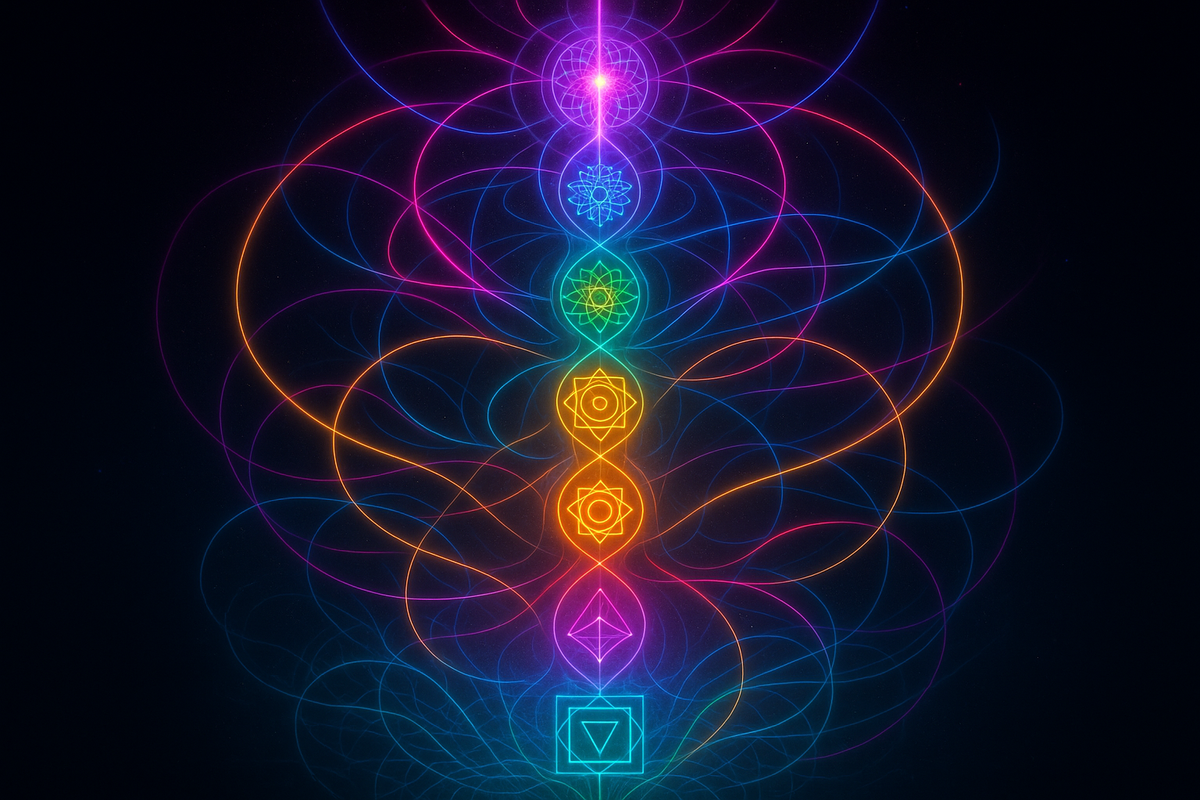
Consider the classic seven-chakra system from bottom to top:
Muladhara (root): Foundational coherence, survival prediction, somatic grounding. In AToM terms, the base-level coupling between organism and physical environment. High uncertainty here produces existential anxiety—the system can't predict whether it will persist.
Svadhisthana (sacral): Relational coherence, pleasure prediction, boundary negotiation. The coupling between self and other, the beginning of social prediction. Developmental trauma often shows up here as difficulty with intimacy, boundaries, desire.
Manipura (solar plexus): Agentive coherence, power prediction, autonomic regulation. Where the system builds models of its own efficacy. Shame and powerlessness indicate high curvature at this level—sharp divergence between predicted and actual agency.
Anahata (heart): Compassionate coherence, empathic coupling, perspective integration. Not emotion in the colloquial sense but the capacity to hold multiple viewpoints simultaneously without fragmenting. Where you transcend zero-sum models of self-other relationship.
Vishuddha (throat): Expressive coherence, communicative coupling, authentic articulation. The alignment between internal state and external expression. Blockage here manifests as inability to speak truth, say no, ask for what you need.
Ajna (third eye): Metacognitive coherence, pattern recognition across domains, intuitive knowing. Where the system models its own modeling process. Direct perception of coherence geometry rather than content.
Sahasrara (crown): Non-dual coherence, dissolution of subject-object boundary, unity consciousness. The limiting case where prediction becomes perception becomes action in seamless flow.
This isn't hierarchy—it's nested integration. Each level includes and transcends the previous. You can't sustain heart-level compassion while actively dysregulated at the solar plexus. You can't express authentic truth from the throat if relational boundaries at the sacrum are collapsed or rigid.
Trauma shows up as coherence fragmentation at specific levels. The system develops rigid constraints to prevent prediction error in domains where past error was catastrophic. These constraints—muscular armor, emotional numbing, dissociative strategies—successfully minimize surprise in the short term but prevent integration in the long term.
The subtle body map allows practitioners to localize and work with these fragmentation patterns directly through felt sense rather than conceptual analysis.
Kundalini as Phase Transition in Coherence Space
Kundalini awakening—properly understood—is major reorganization of coherence architecture, not mystical energy snakes.
In the AToM framework: kundalini is what happens when accumulated prediction error in lower levels of the system suddenly finds a new integration pathway, cascading upward through the coherence hierarchy. Like water held behind a dam suddenly breaking through—not gradual improvement but phase transition.
The "rising" isn't spatial but developmental: coherence at survival level (root) integrates with relational level (sacral) which integrates with agentive level (solar plexus) in rapid succession, each integration releasing energy previously bound in maintaining boundaries between levels.
This is why kundalini can be destabilizing. The system is fundamentally reconfiguring its prediction architecture. Old models are dissolving before new ones stabilize. High curvature—the geometry is changing shape fast. The phenomenology includes heat, involuntary movement, altered perception, emotional catharsis, temporary loss of boundaries.
In traditional contexts, this process unfolds under careful guidance over years or decades. The guru (teacher in a stable coherence configuration) provides external regulatory scaffolding while the student's internal architecture reorganizes. Like a trellis supporting a plant as it grows.
In modern Western contexts, kundalini often activates without this support—through intensive practice, psychedelics, extreme stress, spontaneous awakening. The result can be coherence crisis: massive reorganization without the stability structures to integrate it. What looks like psychosis might be unmanaged phase transition in consciousness architecture.
The tantric technology: work with the energy, not against it. Don't suppress the reorganization or force it faster than integration can handle. Find the edge between stability and transformation and stay there—what contemporary trauma work calls the "window of tolerance."
Kundalini teachings emphasize grounding for exactly this reason. Keep coupling strong at foundational levels (physical body, breath, simple sensation) even as higher levels reorganize. The root chakra holds the base while the crown opens. Without grounding, the system fragments under its own expansion.
Polarity and Intensity: Using Opposites for Integration
A distinctive tantric insight: intensity accelerates coherence transformation. Not by avoiding difficult states but by deliberately working with strong polarities—masculine/feminine, solar/lunar, active/receptive, expansion/contraction.
This isn't mystical dualism. It's practical physics of coherence under constraint.
High-intensity states—sexual arousal, intense emotion, powerful sensation—create high gradient conditions. Large differences in activation levels across the system. In thermodynamic terms, gradients drive flow. In coherence terms, intensity provides the energy differential needed for reorganization.
Most contemplative traditions reduce intensity to avoid dysregulation. Calm the mind, gentle the breath, cultivate equanimity. This works—you minimize prediction error by narrowing the prediction space. Low stakes, low stress, low surprise.
Tantra takes the opposite approach: increase intensity while maintaining coherence. Deliberately evoke strong states—desire, anger, fear, ecstasy—then use practice to integrate rather than suppress them. Work at the edge where the system is almost dysregulating but not quite.
Why? Because integration under intensity creates more robust coherence. Like physical training that stresses the body to build strength, tantric practice stresses the coherence architecture to build capacity.
Sexual practice in this context isn't about pleasure (though pleasure may arise) or connection (though connection deepens). It's about creating controlled conditions of maximum activation with minimum fragmentation. Sexual energy provides massive gradient—hormonal cascade, autonomic arousal, boundary dissolution—that can either fragment the system or catalyze integration depending on how it's held.
The technology: maintain awareness (metacognitive coherence) while experiencing intensity. Don't dissociate from arousal, don't collapse into it—feel it fully while staying present. This is incredibly difficult, which is why traditional tantric sexual practice required years of preliminary training.
The same principle applies to other polarities. Masculine/feminine isn't about gender but about complementary modes of coherence—structural/relational, boundary-making/boundary-dissolving, active/receptive. Working consciously with these polarities strengthens the system's ability to hold multiple modes simultaneously without fragmentation.
Synthesis of opposites produces integration at a higher level. Not compromise (which dilutes both) but transcendence that includes both. This is what Kashmir Shaivism calls spanda—the vibration between polarities that generates aliveness and consciousness.
Non-Dual Knowing: Recognition Beyond Subject-Object Split
The epistemology underlying tantric practice is radically different from Western models of knowledge. Not subject knowing object through representation but non-dual recognition where knower, known, and knowing collapse into single process.
In AToM terms: minimizing the distinction between prediction and perception until they converge. When your generative model perfectly matches the sensory input, you're not representing reality—you're participating in its unfolding.
This maps directly to active inference. Systems minimize prediction error both by updating beliefs (perception) and by acting on the world (action). In the limiting case of perfect coherence, there's no gap between model and reality—not because you've captured truth but because you've become coupled so precisely that the boundary between inner and outer dissolves functionally.
Kashmir Shaivism calls this pratyabhijna—recognition. Not learning something new but recognizing what was always there. The metaphor: you are Shiva (universal consciousness) who has forgotten yourself and the path is remembering.
Translated: your nervous system is part of the larger coherence structure of reality (universe as integrated prediction machine, as Friston argues). Local prediction errors create the illusion of separation—you feel distinct because you're tracking boundaries that minimize surprise. But boundaries are Markov blankets, and Markov blankets are statistical constructs, not ontological divisions.
Tantric practice systematically dissolves the boundaries that create the subject-object split. Not through belief but through direct manipulation of the prediction architecture:
- Meditation weakens the boundary between observer and observed by removing conceptual overlay
- Pranayama dissolves the boundary between voluntary and involuntary (breath sits at the interface)
- Sexual union temporarily collapses self-other boundary through mutual coherence
- Mantra overrides semantic meaning to access pure phonetic coupling
- Yantra (geometric form) bypasses conceptual mind to directly pattern perception
Each practice reduces prediction error at the level of selfhood itself. The sense of being a separate subject is a high-level prediction your brain makes to organize experience. Tantra hacks that prediction process.
The result isn't philosophical conviction that "all is one" but direct experience of consciousness without center. Not that you don't exist but that you exist as a process rather than entity—a verb not noun, coherence pattern not stable object.
This is what mystical non-duality describes across traditions. Not mysticism but phenomenology of minimal prediction error at the level of self-world boundary.
Working Through Rather Than Around: Transformation via Integration
Where many spiritual traditions advocate transcendence—rise above the body, escape desire, detach from emotion—tantra advocates transformation through engagement.
The difference is fundamental. Transcendence treats difficult states as obstacles to overcome. Tantra treats them as raw material for transformation.
In coherence terms: transcendence reduces curvature by avoiding high-error domains. If anger fragments you, practice equanimity so anger doesn't arise. If desire destabilizes you, cultivate detachment. This works but it's conservative—you become stable by shrinking your operating range.
Tantra increases capacity by integrating what previously fragmented you. Don't avoid anger—work with its energy. Don't transcend desire—use it as fuel. The intensity that once shattered coherence becomes the gradient that drives transformation.
This requires sophisticated practice. You can't just indulge difficult emotions and call it tantra. The technology is conscious engagement at the edge of capacity:
- Feel the energy fully without suppression or dissociation
- Maintain awareness (metacognitive stability) even while experiencing intensity
- Use the gradient (intensity) to reorganize coherence at a higher level
- Integrate what emerges rather than fragmenting
Example: Working with anger tantricly doesn't mean expressing it destructively or suppressing it mindfully. It means feeling the full bodily charge of anger (heat, contraction, activation), maintaining present awareness rather than getting lost in narrative, using that intense energy to move through whatever blockage the anger is protecting, and integrating the previously defended material.
The anger itself becomes the transformer. Its intensity provides the energy needed to reorganize frozen patterns. But only if you can hold both the energy and the awareness simultaneously.
This is advanced practice. Most people fragment when emotions hit a certain intensity—we either dissociate (transcendence approach) or act out (unconscious discharge). Tantra trains the middle path: full embodiment plus metacognitive stability.
Why does this produce transformation? Because integration under intensity creates irreversible phase transitions in coherence architecture. Like tempering steel—you heat it intensely then cool it precisely and the structure fundamentally changes. The system that emerges can handle stresses that previously shattered it.
This is why tantric awakening tends to be permanent in ways meditation awakening sometimes isn't. You haven't just had a temporary state of clarity—you've rebuilt the architecture that generates states.
Mantra, Yantra, Mudra: Specific Coherence Technologies
Tantric traditions preserve specific techniques for manipulating coherence architecture. These aren't arbitrary rituals but precision instruments.
Mantra (sound): Repeated phonetic patterns that entrain neural oscillations. Not about semantic meaning but about rhythmic coupling. The sound pattern literally synchronizes brainwaves, creates coherence between practitioner and cosmic vibration (in traditional terms) or between different neural networks (in neuroscience terms).
OM, the classic mantra, isn't mystical—it's an optimized sound that maximally activates the entire vocal apparatus, creating strong proprioceptive feedback and autonomic regulation. The vibration you feel isn't spiritual energy but somatic coherence induced through controlled vocalization.
Advanced mantra practice layers additional patterns—bija (seed) mantras for specific chakras, complex tantric formulations that encode entire philosophical systems in compressed form. Each acts as an attractor state that pulls the coherence manifold toward specific configurations.
Yantra (form): Geometric patterns that structure visual perception. The Sri Yantra, most famous example, is a nested configuration of triangles that guides attention through increasingly subtle levels. Looking at it isn't passive—the pattern shapes perceptual processing in ways that facilitate specific coherence states.
Modern research on sacred geometry often misses the point. The power isn't in the shapes themselves but in how they constrain attention. The yantra is a technology for guiding consciousness through particular phase space trajectories.
Mudra (gesture): Hand and body positions that create specific neural-somatic configurations. Again, not symbolic but functional. Different mudras create different proprioceptive feedback patterns, different breathing mechanics, different constraint structures on the coherence manifold.
Anjali mudra (prayer hands) isn't devotional gesture—it's a precise position that centers attention, balances left-right activation, and creates mild interoceptive focus. Chin mudra (thumb-index touching) in meditation completes a circuit in yogic terms, or in neuroscience terms creates sustained proprioceptive signal that helps maintain attentional stability.
Together these technologies—sound, form, gesture—provide multiple constraint dimensions simultaneously. Like tuning a complex instrument where each adjustment affects the whole system, tantric practice calibrates coherence using every available interface.
The Geometry of Tantric Transformation
Across all its manifestations, tantra works through geometric principles of coherence transformation:
Curvature manipulation: Using intensity to create conditions where rigid geometries can flex and reorganize. High arousal, strong emotion, peak experience—all are high-curvature states. Tantra doesn't avoid them but uses them as opportunities for transformation.
Boundary reconfiguration: Systematically dissolving unnecessary boundaries (subject-object split, self-other division, pure-impure distinction) while maintaining functional boundaries needed for coherent operation. Not formless dissolution but precise boundary engineering.
Gradient exploitation: Using polarity and difference as driving force for integration. Where there's intensity, there's gradient. Where there's gradient, there's potential for flow and reorganization.
Phase transition through coupling: Using external stability (guru, sangha, practice structure) to support internal reorganization. You can navigate higher curvature when coupled to stable attractor. Traditional tantric training provided extensive scaffolding precisely because the practices induce genuine transformation.
Multi-scale integration: Working simultaneously at somatic, emotional, cognitive, and transpersonal levels. Not privileging any single scale but recognizing that coherence must integrate across all of them. You can't have transcendent realization while deeply dysregulated somatically—the body will pull consciousness back to survival mode.
Irreversibility through embodiment: Creating transformation that lives in the body, not just ideas. Tantric siddhas (accomplished practitioners) don't just know non-dual philosophy—they embody it in their nervous system architecture. This makes the realization stable across contexts, not dependent on maintaining particular mental states.
In AToM notation: tantra maximizes M (meaning/coherence) by deliberately increasing both C (coherence complexity) and T (tension/intensity), then using practice to integrate them. M = C/T where both numerator and denominator grow—the result is expansion of meaning-making capacity.
Contrast with traditions that maximize M by reducing T—minimizing tension through equanimity. That works but produces different outcomes. Lower ceiling perhaps but more accessible. Tantra aims higher, requires more, risks more.
Contemporary Applications: Tantra Without the Tradition
What happens when sophisticated coherence technology gets separated from its traditional context? We're running that experiment in the modern West.
Some results are predictable disasters. "Tantra workshops" that focus on sexual technique without the foundational practice, philosophy, or ethical container. This is like teaching surgery without medical school—the tools are powerful, the potential for harm is real.
But other developments are genuinely interesting. Trauma therapy has independently discovered tantric principles:
Somatic Experiencing (Peter Levine): Working with sensation directly, using body awareness to complete defensive responses frozen by trauma, titrating intensity to stay in window of tolerance—all tantric principles translated into clinical practice.
Internal Family Systems (Richard Schwartz): The multiplicity of self, working with parts rather than suppressing them, the presence of Self that can hold all parts—maps cleanly onto tantric view of consciousness and integration.
Polyvagal Theory (Stephen Porges): The importance of autonomic state, social engagement system as distinct mode, neuroception of safety—provides neuroscience grounding for what tantric chakra system describes phenomenologically.
Modern practitioners are rediscovering that working with intensity catalyzes transformation. That the body is the instrument. That integration beats transcendence for producing robust change. That pleasure and arousal and difficult emotion are all valuable material if worked with skillfully.
The challenge: developing ethical containers and skilled guidance outside traditional lineage structures. Tantra worked in its traditional contexts partly because the entire social system—guru-student relationship, monastery discipline, multi-year training arcs—provided containment for powerful practices.
We don't have that infrastructure in the modern West. We have workshops and apps and therapist offices. Some practitioners are thoughtfully building new containers. Others are causing genuine harm through ignorance or exploitation.
The core question: Can tantric coherence technology be separated from its cultural context and still work safely? Or does the technology depend essentially on the tradition that developed it?
Evidence suggests a middle path is possible. The underlying principles—work with rather than against, use intensity for transformation, integrate across scales, ground while opening—these translate. But they require serious training and ethical framework, not just techniques.
Tantra, AToM, and the Science of Consciousness Transformation
Bringing tantra into dialogue with contemporary coherence science clarifies both:
For tantra: The geometric framework explains why practices work, removes mystical obfuscation, makes the technology more accessible while respecting its sophistication. Energy becomes coherence flow. Chakras become node-structure in integration architecture. Kundalini becomes phase transition. This isn't reduction—it's precise translation.
For coherence science: Tantra provides millennia of empirical phenomenology about consciousness transformation under intensity. The traditions have mapped territory that Western science is just beginning to explore. Taking tantric claims seriously as experimental findings rather than mystical beliefs opens new research directions.
Consider: Tantric practitioners report specific, replicable altered states correlated with specific practices. They describe detailed maps of how consciousness reorganizes under different conditions. They've developed technologies for inducing transformation that work across populations and time periods.
This is data. Not proof, but legitimate phenomenological evidence that should inform scientific models of consciousness. Contemporary neuroscience measures correlates of these states (gamma synchrony during meditation, DMN suppression during non-dual awareness) but often lacks the refined first-person observations tantric practice cultivates.
The synthesis benefits both domains. Science provides mechanistic grounding that makes tantric claims testable and reduces cultural baggage. Tantra provides sophisticated methods and phenomenological precision that science lacks.
This isn't about validating ancient wisdom. It's about recognizing that different traditions developed different instruments for exploring the same coherence space. Tantra worked from inside out (phenomenology to practice). Science works from outside in (measurement to mechanism). Each has limitations the other can address.
The emerging picture: Consciousness is coherence architecture. Transformation is reorganization of that architecture. Tantra developed precise technologies for inducing specific reorganizations. Science is beginning to measure and model these processes.
Together they point toward applied science of coherence transformation—evidence-based practices for reshaping the geometry of experience. Not transcendence, not therapy as currently practiced, but something else: systematic cultivation of consciousness.
What Tantra Reveals About Coherence Itself
The deepest tantric insight: consciousness and coherence are the same thing.
Not consciousness as epiphenomenon of physical process. Not coherence as mere organizational property. But consciousness as the felt interiority of coherent self-organization, and coherence as the objective structure of conscious experience.
When you increase coherence, consciousness expands—more integrated, more unified, more aware. When coherence fragments, consciousness dims—dissociated, confused, unconscious. The correlation is perfect because they're two sides of the same phenomenon.
This is what Kashmir Shaivism means by cit-shakti—consciousness-energy as fundamental. Not two things but single reality experienced from inside (consciousness) and outside (energy/coherence).
If this is right—and both tantric phenomenology and contemporary coherence science suggest it is—then transformation of consciousness is transformation of coherence geometry. Not metaphorically but literally.
And if that's true, then the project of consciousness transformation becomes an engineering problem: What practices, conditions, constraints reliably reshape coherence architecture in specific ways? How do we induce integration without fragmentation? How do we stabilize expanded states? How do we make transformation accessible while maintaining safety?
Tantra offers 1500+ years of experimental results on exactly these questions. Not final answers but serious headstart.
The technology exists. The question is whether we can learn to use it skillfully in contexts very different from where it developed—whether we can build new containers for ancient practices, whether we can separate the technology from cultural specifics without losing essential context, whether we can make coherence transformation accessible without rendering it trivial.
These aren't theoretical questions. They're the challenges facing anyone seriously working with consciousness—therapists, meditation teachers, psychedelic guides, contemplative neuroscientists, AI researchers thinking about machine consciousness.
Tantra won't solve these problems. But it offers conceptual tools and practical technologies refined through generations of careful observation and practice. Tools for working with the geometry of transformation itself.
That's what makes it worth understanding: not as exotic spiritual tradition but as sophisticated applied science of coherence cultivation. Technology for becoming more integrated, more conscious, more fully human.
The synthesis of tantra and coherence theory points toward this possibility: transformation not through transcendence but through precision—using every available leverage point (body, breath, emotion, energy, awareness, relationship) to systematically reshape the architecture of consciousness toward greater coherence.
This is tantra's gift to the contemporary project of understanding and transforming human consciousness. Not mystical answers but rigorous methods. Not escape from embodiment but its full realization. Not transcendence of intensity but transformation through it.
The technology awaits. The question is whether we're ready to use it.
Further Reading
Tantric Philosophy
- Singh, J. (1979). Siva Sutras: The Yoga of Supreme Identity. Motilal Banarsidass.
- Muller-Ortega, P. (2005). The Triadic Heart of Shiva. SUNY Press.
- Dyczkowski, M. (1987). The Doctrine of Vibration. SUNY Press.
Coherence Science
- Friston, K. (2010). "The Free-Energy Principle: A Unified Brain Theory?" Nature Reviews Neuroscience 11(2): 127-138.
- Tononi, G. (2004). "An Information Integration Theory of Consciousness." BMC Neuroscience 5(42).
- Varela, F., Thompson, E., & Rosch, E. (1991). The Embodied Mind. MIT Press.
Practice Traditions
- Feuerstein, G. (1998). Tantra: The Path of Ecstasy. Shambhala.
- White, D. (2000). Tantra in Practice. Princeton University Press.
- Wallis, C. (2013). Tantra Illuminated. Mattamayura Press.
Contemporary Integration
- Levine, P. (2010). In an Unspoken Voice: How the Body Releases Trauma. North Atlantic Books.
- Schwartz, R. (2001). Introduction to Internal Family Systems. Trailheads Publications.
- Porges, S. (2011). The Polyvagal Theory. Norton.
Cross-Series Connections
- 4E Cognition — Embodied nature of consciousness
- The Free Energy Principle — Unified theory of self-organizing systems
- Comparative Mysticism — Tantra in cross-tradition context
- Coherence: The Geometry of Systems That Work — Core framework
This is Part 10 of the Tantra Epistemology series, exploring how tantric philosophy and practice function as coherence transformation technology.
Previous: Sexuality in Context: What Tantric Sex Actually Is and Isn't
Part of the HUMAN MEANING collection exploring how coherence operates across historical, cultural, and social scales.
Comments ()