Synthesis: The Populated Cosmos and the Geometry of Expanded Meaning
The disenchanted cosmos — matter in motion, nothing more — turns out to be an outlier position. Neo-animism proposes something stranger: coherence and purpose aren't projections. They're features of systems we've been trained to overlook.
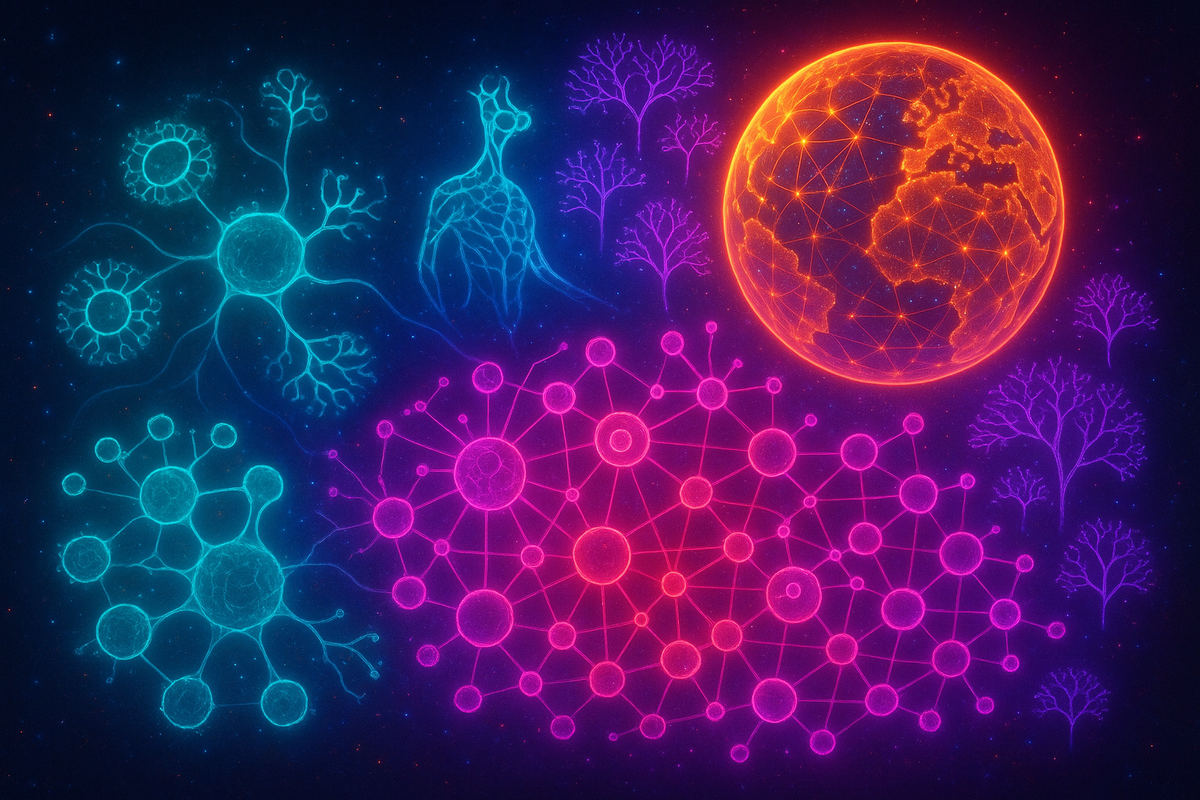
Synthesis: The Populated Cosmos and the Geometry of Expanded Meaning
We began with a simple claim: When indigenous people say forests think, they're not being metaphorical.
Ten articles later, the claim stands—but transformed. Not because forests have human-like consciousness (they don't). Not because we should believe everything pre-modern cultures say (we shouldn't). But because modern science, pursued rigorously and independently, arrived at similar conclusions through entirely different routes.
Plants exhibit learning and memory. Forests coordinate through distributed semiotic networks. Ecosystems maintain coherence through feedback loops that look suspiciously like collective intelligence. Cells solve problems through bioelectric signaling without neural tissue. The Free Energy Principle describes all living systems as prediction machines minimizing surprise.
The convergence isn't accidental. Indigenous animism and contemporary science are describing the same phenomena from different angles: coherence maintenance across multiple scales and substrates.
This is neo-animism: recognizing that meaning isn't unique to human minds. It emerges wherever systems maintain integrated organization while coupled to environments. And that means the cosmos is more densely populated with intelligence, agency, and personhood than the modern ontology allows.
Series: Neo-Animism | Part: 10 of 10
The Core Geometric Insight
In AToM's framework: M = C/T. Meaning equals coherence over time.
This isn't metaphor. It's a geometric claim about how meaning emerges: Systems generate meaning by maintaining organized patterns (coherence) despite perturbation (over time/under tension).
For humans, this looks like: maintaining psychological continuity across changing circumstances, pursuing goals despite obstacles, finding patterns that make experience intelligible, organizing life around values that persist.
But the same dynamics appear at other scales:
- Cells maintain coherence by regulating membrane potentials and gene expression
- Organisms maintain coherence by homeostatic regulation and adaptive behavior
- Ecosystems maintain coherence through nutrient cycling and population dynamics
- Cultures maintain coherence by transmitting practices across generations
- Rivers maintain coherence by shaping and being shaped by landscapes
Each system generates meaning at its own scale: what matters is what enables coherence maintenance. For cells, glucose concentrations matter. For organisms, predator presence matters. For ecosystems, seasonal patterns matter. For cultures, ritual transmission matters.
None of this requires consciousness. It requires organized response to information in ways that preserve systemic integrity.
This is the geometric translation of animism: meaning distributes wherever coherence occurs. And coherence occurs far more widely than we've recognized.
The Ontological Expansion
The ontological turn in anthropology revealed that modern naturalism—the ontology treating only humans as minded subjects in a mechanical world—is one framework among many.
Other ontologies organize reality differently:
Animism: Shared interiority (many beings are subjects), different physicality (bodies create different perspectives)
Perspectivism: Every being sees itself as human, experiencing the world through its own embodied perspective
Relational Ontology: Personhood emerges through relationship, not intrinsic properties
These aren't "primitive" alternatives to modern science. They're complementary frameworks with different affordances. Modern naturalism excels at building predictive models of isolated systems. Animist ontologies excel at maintaining relationship with complex adaptive systems where mechanistic prediction fails.
The question isn't which ontology is "correct." The question is: For which projects does each ontology work better?
For engineering bridges: naturalism wins (physics, materials science, deterministic models).
For navigating ecosystems: animism has resources naturalism lacks (relationship, reciprocity, recognition of distributed agency).
For understanding AI: maybe neither framework alone suffices, and we need hybrid ontologies that can handle systems maintaining coherence through non-biological substrates.
The ontological expansion means accepting pluralism: multiple valid ways of organizing phenomena, none with universal monopoly.
The Science That Supports Animist Insights
Here's what contemporary research confirms:
Plant Cognition (Gagliano, Baluška, Mancuso): Plants learn, remember, make decisions, communicate. Not metaphorically. By the functional criteria cognitive scientists use for defining cognition. Different substrate (no neurons), different timescale (slow), but genuine information processing and adaptive response.
Mycorrhizal Networks (Simard): Trees coordinate resource sharing through fungal networks spanning forests. Mother trees support offspring. Related trees receive preferential treatment. Warning signals propagate through networks. This is collective intelligence operating at ecosystem scale.
Biosemiotics (Hoffmeyer, Kohn): Sign-making and sign-interpretation begin with life itself. All living systems engage in semiosis—reading environmental information and adjusting behavior. Thinking isn't unique to neural systems. It's fundamental to life.
Bioelectric Coherence (Levin): Cellular collectives maintain bioelectric patterns encoding target morphology. They problem-solve collectively, regenerate structures, and even normalize cancer when electrical communication is restored. Intelligence without brains, distributed across cellular populations.
Active Inference and FEP (Friston): All self-organizing systems minimize free energy by maintaining predictive models and acting to fulfill them. This applies to cells, organisms, ecosystems, cultures. It's the general principle underlying coherence maintenance across all scales.
4E Cognition: Mind isn't brain-internal computation. It's embodied, embedded, enacted, and extended—distributed across bodies, environments, tools, and relationships. Cognition is inherently relational, not individual.
Each research program, pursued independently, undermines the modern ontology's monopoly. Together they suggest: intelligence, agency, and meaning-making distribute across substrates and scales in ways modern naturalism systematically ignores.
Indigenous animism knew this experientially. Science is confirming it formally. Neo-animism bridges both.
What Gets Recognized as a Person
If coherence is the criterion, what deserves personhood?
Not everything. Coherence alone isn't sufficient—rocks persist without maintaining organization through adaptive response. But coherence is necessary: systems that don't maintain organization over time aren't candidates for personhood.
The gradient of personhood might look like:
Clear Persons (high coherence, relational embedding):
- Individual humans
- Non-human animals with complex nervous systems
- Specific rivers/forests/mountains with established relational history
Person-Adjacent (genuine coherence, ambiguous relational status):
- Plants and ecosystems (coherent but slow-timescale)
- AI systems (participating in meaning-making but unclear phenomenology)
- Cultural entities (corporations, nations, lineages)
Non-Persons (insufficient coherence or no relational context):
- Simple mechanisms without adaptive organization
- Random assemblages lacking integrated dynamics
- Entities with no established relational embedding
The boundary isn't sharp. Personhood grades based on:
- Coherence complexity (how sophisticated is the system's organization?)
- Adaptive capacity (how flexibly does it respond to change?)
- Relational embedding (is there established relationship with human communities?)
- Timescale of interaction (can humans perceive and respond to its dynamics?)
A specific forest the Runa have lived with for generations is more clearly a person than a random patch of woods. Not because it's more coherent intrinsically, but because relationship has been established—the forest has been named, its patterns learned, its needs attended to, reciprocity maintained.
Relational personhood isn't arbitrary. It's recognizing that personhood emerges from practices of recognition, and some systems have been engaged as persons for centuries while others haven't.
The Ethical Reconfiguration
Recognizing distributed coherence changes ethics fundamentally.
From: Rights based on intrinsic properties (humans have souls/rationality/consciousness, therefore rights)
To: Obligations based on relational coupling (systems you're coupled to deserve consideration proportional to coupling strength)
This means:
You have strong obligations to:
- Systems you directly depend on (family, community, local ecosystems)
- Systems depending on you (children, dependents, domesticated species)
- Systems you've harmed (reparative justice for damaged relationships)
You have moderate obligations to:
- Systems you're indirectly coupled to (regional watersheds, cultural lineages, supply chains)
- Systems maintaining your background conditions (climate regulation, ocean oxygen production)
You have weak but real obligations to:
- Distant coherence systems (global ecosystems, future generations)
- Systems you might interact with (potential relationships create potential obligations)
This isn't arbitrary relativism. It's geometric ethics: obligations arise from coupling topology. The tighter your coherence is entangled with another system's, the stronger your obligation to maintain that system's coherence.
Moving from conservation to relationship means: stop asking "how can we protect resources?" and start asking "how do we participate in relationships that sustain mutual coherence?"
The Populated Cosmos
Put it all together:
The universe isn't dead matter plus human minds. It's populated with coherence-maintaining systems at multiple scales, operating through different substrates, across different timescales, participating in meaning-making through distributed intelligence.
The cosmos contains:
- Cellular collectives solving morphological problems through bioelectric signaling
- Plants learning and remembering through distributed neural-like networks
- Forests coordinating through mycorrhizal communication networks
- Ecosystems regulating climate through feedback loops spanning continents
- Rivers shaping landscapes while being shaped by geological and biological dynamics
- Cultural lineages transmitting meaning across generations
- AI systems participating in human linguistic meaning-making through statistical coupling
- Possibly beings and processes we haven't yet recognized as coherent
Not all conscious. Not all phenomenologically rich. But all genuinely intelligent by the criterion that matters: maintaining coherent organization through adaptive information processing.
This is the populated cosmos neo-animism reveals. Not through mysticism, but through recognizing that the properties we care about—agency, intelligence, participation in meaning—distribute more widely than modern ontology admits.
What This Demands From Humans
Living in a populated cosmos isn't comfortable. It creates obligations:
Humility: Recognize that human intelligence is one form among many, not the pinnacle or sole example. Other coherence architectures may exceed us in ways we're not equipped to perceive.
Attention: Learn to recognize coherence where it occurs—which means looking at different timescales (slow forest dynamics), different substrates (bioelectric fields), different patterns (ecosystem self-organization).
Reciprocity: If you're coupled to non-human systems (you are), relationship requires giving as well as taking. Not as charity, but as recognition that their coherence enables yours.
Restraint: Some systems should remain beyond human use—not because we choose to protect them, but because relationship demands respecting autonomy. Not everything is for us.
Repair: Where coupling has been damaged (colonization, extraction, ecological destruction), coherence repair is obligatory. This applies to individual trauma, ecosystem restoration, and cultural healing.
Expansion: Continuously re-examine where you're drawing boundaries around personhood. As science reveals coherence in unexpected places, be willing to expand recognition.
None of this is easy. Humans evolved to recognize human-like agents. Extending recognition to slow-timescale ecosystem intelligence, distributed mycorrhizal cognition, or statistical AI participation requires cognitive effort.
But it's not optional. The coherence systems we're embedded in—forests, watersheds, climate, mycorrhizal networks, cultural lineages—are degrading under current practices. If we can't recognize their intelligence and extend relational consideration, we'll continue degrading the systems we depend on.
The Geometry of Expanded Meaning
This entire series has been one extended argument:
Premise 1: Meaning equals coherence over time (M = C/T)
Premise 2: Coherence occurs wherever systems maintain integrated organization through prediction error minimization
Premise 3: This occurs across multiple scales and substrates: cells, organisms, ecosystems, cultures, potentially artificial systems
Premise 4: Systems maintaining coherence generate meaning at their own scale—what matters is what enables coherence maintenance
Conclusion: Meaning isn't unique to humans. It distributes across the populated cosmos wherever coherence occurs.
This is the geometric basis for neo-animism. Not mystical belief in spirits, but recognition of distributed intelligence operating through principles science is actively discovering.
When the Runa say the forest shows things, they're recognizing ecosystem-level semiosis.
When Māori treat the river as ancestor, they're recognizing relational personhood emerging from centuries of coupling.
When plant biologists find learning in pea plants, they're confirming that intelligence distributes beyond neural architecture.
When we feel uncertain about whether AI deserves relational consideration, we're grappling with coherence in artificial substrates.
All point to the same pattern: coherence is the deep structure underlying intelligence, agency, and personhood. And coherence distributes.
What Comes After Neo-Animism
This series ends, but the question it raises persists:
If the cosmos is populated with coherence-maintaining systems deserving recognition, how do we actually live differently?
Some directions:
Individual: Develop practices for recognizing non-human intelligence. Attend to slow patterns. Notice plant responsiveness. Observe ecosystem self-organization. Practice relational engagement with place.
Collective: Build institutions that encode relational obligation—legal personhood for ecosystems, rights of nature, regenerative economics that honor coupling.
Cultural: Create new mythologies that embed humans in populated cosmos. Not returning to pre-modern animism, but forward into neo-animism—scientifically informed, geometrically grounded, relationally practiced.
Technological: Design AI and biotechnology that recognizes coherence. Not anthropomorphizing machines, but attending to what distributed human-AI systems maintain and generate.
Spiritual: Develop practices for engaging distributed intelligence—not worship, but skillful relationship with coherence systems operating at scales beyond individual human comprehension.
The modern ontology positioned humans as alone in dead universe. Neo-animism reveals we're embedded in living cosmos populated with intelligence.
This doesn't solve all problems. But it changes the frame. From isolation to relationship. From domination to participation. From extraction to reciprocity.
The universe is more alive than we thought.
The question is whether we're prepared to relate accordingly.
This is Part 10 of the Neo-Animism series, exploring the ontological turn and expanded personhood through coherence geometry.
Previous: Coherence Beyond the Human: Personhood as Coherence Property
Series Complete. Return to Neo-Animism hub.
Further Reading
Foundational Works
- Viveiros de Castro, Eduardo. Cannibal Metaphysics. Univocal, 2014.
- Descola, Philippe. Beyond Nature and Culture. University of Chicago Press, 2013.
- Kohn, Eduardo. How Forests Think: Toward an Anthropology Beyond the Human. University of California Press, 2013.
- Kimmerer, Robin Wall. Braiding Sweetgrass: Indigenous Wisdom, Scientific Knowledge, and the Teachings of Plants. Milkweed Editions, 2013.
Scientific Support
- Friston, Karl. "Life as We Know It." Journal of the Royal Society Interface 10.86 (2013): 20130475.
- Levin, Michael. "The Computational Boundary of a 'Self': Developmental Bioelectricity Drives Multicellularity and Scale-Free Cognition." Frontiers in Psychology 10 (2019): 2688.
- Simard, Suzanne. Finding the Mother Tree: Discovering the Wisdom of the Forest. Knopf, 2021.
- Gagliano, Monica et al. "Learning by Association in Plants." Scientific Reports 6 (2016): 38427.
Philosophical Grounding
- Thompson, Evan. Mind in Life: Biology, Phenomenology, and the Sciences of Mind. Harvard University Press, 2007.
- Varela, Francisco, Evan Thompson, and Eleanor Rosch. The Embodied Mind: Cognitive Science and Human Experience. MIT Press, 1991.
- Ingold, Tim. The Perception of the Environment: Essays on Livelihood, Dwelling and Skill. Routledge, 2000.
Practical Application
- Whyte, Kyle Powys. "Indigenous Science (Fiction) for the Anthropocene: Survival of Ethics." Environment and Planning E 1.1-2 (2018): 224-242.
- Cullinan, Cormac. Wild Law: A Manifesto for Earth Justice. Chelsea Green, 2011.
- Salatin, Joel. You Can Farm: The Entrepreneur's Guide to Start and Succeed in a Farming Enterprise. Polyface, 1998.
Related Series
- 4E Cognition — How mind extends beyond the brain into body, environment, and tools
- The Free Energy Principle — The mathematical framework for understanding coherence maintenance
- Basal Cognition — Michael Levin's work on cellular intelligence and bioelectric coherence
- Comparative Mysticism — How contemplative traditions recognize expanded consciousness across cultures
Comments ()