Synthesis: What Hyperdimensional Computing Teaches About Efficient Coherence
Hyperdimensional computing encodes concepts, binds them, and retrieves them using simple operations on very large vectors. The approach is robust, fast, and brain-like. The deeper lesson: coherence in biological systems might emerge from the same high-dimensional geometry.
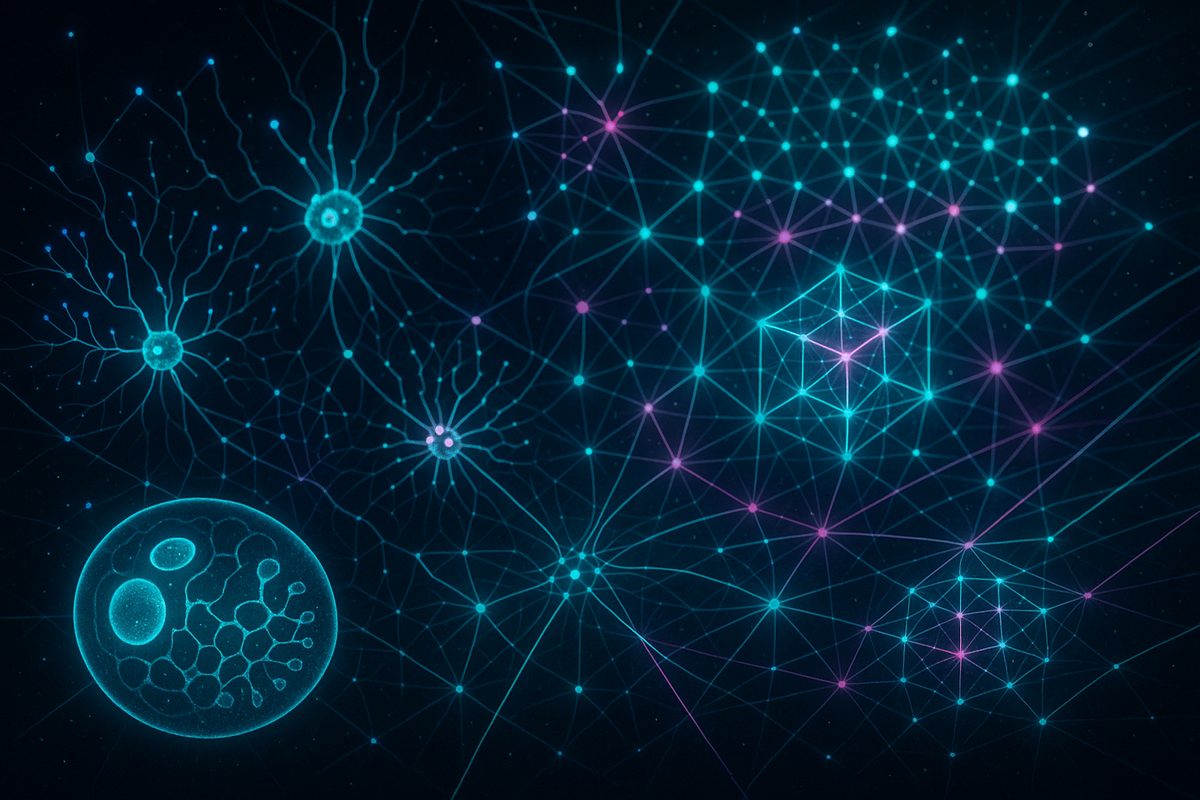
Synthesis: What Hyperdimensional Computing Teaches About Efficient Coherence
Series: Hyperdimensional Computing | Part: 9 of 9
The question isn't whether biological systems compute. It's how they manage to do it so efficiently—with minimal energy, no training cycles, and graceful degradation under noise—while our best silicon implementations burn through kilowatts and collapse under edge cases.
Hyperdimensional computing doesn't just offer a new paradigm for building machines. It reveals something fundamental about how coherent systems—biological, cognitive, social—maintain their integrity across scales and contexts. The mathematics that makes HDC work in neuromorphic chips is the same mathematics that explains how cells coordinate morphogenesis, how memories survive neural damage, and how meaning emerges from noisy sensory streams.
This isn't analogy. It's recognition of a shared computational architecture that evolution discovered billions of years ago and we're only now beginning to understand.
The Efficiency Problem
Deep learning works, but it's profoundly inefficient. Training GPT-4 consumed an estimated 50 gigawatt-hours of electricity. Inference requires massive compute clusters. The system can't learn incrementally—you retrain from scratch or use complex fine-tuning. And it's brittle: adversarial examples, out-of-distribution failures, catastrophic forgetting.
Biological cognition doesn't work this way. Your brain runs on 20 watts. You learn continuously without overwriting old knowledge. You generalize from single examples. You function under noise, partial information, and hardware failures (stroke victims can relearn speech; neurons die daily without catastrophic forgetting).
The standard explanation invokes "different architectures" or "evolutionary optimization," but this misses the deeper pattern. What biological systems have that current AI largely lacks is coherent computation in high-dimensional state spaces.
HDC points toward what this means mechanically.
What HDC Reveals About Coherence
Distributed Representation as Noise Tolerance
In HDC, information isn't stored in precise weight matrices. It's distributed across 10,000-dimensional vectors where each dimension contributes weakly. Flip a few bits randomly? The vector's semantic position barely moves. This is holographic storage—damage to any local component leaves the global pattern largely intact.
Compare this to deep learning, where perturbing a single critical neuron can collapse entire categories. The difference is geometric: high-dimensional spaces permit representational geometries where similarity structure is robust to noise because every concept occupies a vast basin in state space, not a fragile point.
This is why biological memory survives neural death. Memories aren't stored in individual synapses—they're patterns across millions of connections. Remove neurons and the attractor persists. The representation is coherent precisely because it's not localized.
Compositionality Without Training
HDC achieves compositionality algebraically: binding distinct hypervectors creates representations for compound concepts without gradient descent. FRANCE ⊗ PARIS produces a vector orthogonal to both inputs but recoverable through unbinding. You can build hierarchical structures, relational graphs, temporal sequences—all through vector operations requiring no backpropagation.
This maps directly to how biological systems solve the binding problem. How does a brain represent "red square" without confusing it with "blue circle"? In HDC terms: bind feature hypervectors (RED ⊗ SQUARE) and the confusion is geometrically impossible because bound representations are near-orthogonal to their components.
This is efficient coherence: the system maintains structured relationships without expensive search through parameter space. The structure is the geometry.
One-Shot Learning as Geometric Addition
Bundle a new example into the existing prototype by vector addition: PROTOTYPE' = PROTOTYPE + NEW_EXAMPLE. Done. No epochs, no loss functions, no learning rates. The new information integrates immediately because high-dimensional spaces make vector addition a semantic averaging operation. Noise cancels; signal accumulates.
Why doesn't biological learning work like gradient descent? Because it doesn't need to. If representations are high-dimensional and approximately orthogonal, then simple aggregation is sufficient for generalization. This is what HDC demonstrates: the right geometry makes learning trivial.
Mapping HDC Operations to Biological Coherence
Let's get precise. HDC's three core operations—binding, bundling, and permutation—aren't arbitrary mathematical tricks. They're the minimal algebra needed for coherent symbolic manipulation in high-dimensional spaces. And they map cleanly onto known biological mechanisms.
Binding = Relational Encoding
Binding creates structured representations by combining distinct vectors into a third vector orthogonal to both. Biologically, this is synchrony-based coding: neurons representing "red" and "square" fire together in phase, creating a transient coalition distinct from either component alone.
Experimental evidence (Singer, Fries, von der Malsburg): gamma-band synchronization (30-80 Hz) binds distributed features into unified percepts. Different object representations maintain distinct oscillatory patterns—orthogonal, in HDC terms.
HDC formalizes what neural synchrony accomplishes mechanically.
Bundling = Memory Consolidation
Bundling superimposes multiple vectors into a prototype. Biologically, this is synaptic integration: repeated exposures strengthen common patterns while idiosyncratic noise averages out. The hippocampus creates episodic traces; neocortical consolidation bundles them into semantic knowledge.
HDC shows why this works: in high dimensions, averaging vectors preserves shared structure while erasing uncorrelated noise. The prototype is the coherent signal extracted from experience.
Systems biology at every scale uses this principle. Michael Levin's bioelectric fields aggregate cellular voltage states to compute morphological targets. Ant colonies bundle pheromone trails to discover optimal foraging paths. Markets bundle individual trades into price signals.
Permutation = Temporal Sequencing
Circular shift (permutation) encodes order: BEFORE ≠ ρ(BEFORE). Apply permutation N times and you've got position N in a sequence. Biologically, this maps to phase precession in place cells and grid cells: as an animal traverses space, neural firing phase shifts systematically relative to the theta oscillation (Hafting, Moser & Moser).
The hippocampus represents spatial sequences as phase relationships. HDC shows this isn't a quirky biological hack—it's the correct geometry for encoding order in high-dimensional spaces.
Why Coherence Requires High Dimensions
Here's the key insight: low-dimensional systems can't sustain compositional coherence under noise.
In 3D space, add a few random vectors and the result points nowhere meaningful. But in 10,000 dimensions, the geometry changes fundamentally:
- Random vectors are near-orthogonal by default. Dot product ≈ 0 with overwhelming probability.
- This means distinct concepts occupy separate regions automatically, without learning to separate them.
- Noise stays orthogonal to signal, so corruption doesn't propagate.
- Binding creates genuinely new regions without crowding the space (exponential capacity scaling).
- Bundling preserves structure because shared components constructively interfere while noise cancels.
These properties are what HDC exploits mechanically. But they're also what evolution exploited to build robust cognition. Brains don't implement HDC; they discovered the same geometric principles because those principles are what make coherence possible in the face of noise, damage, and continuous adaptation.
The Free Energy Principle describes biological systems as minimizing surprise (prediction error). But how do they compute predictions efficiently? High-dimensional state spaces where approximate inference (bundling similar states) and relational encoding (binding variables) are geometrically natural operations.
HDC provides the computational architecture for efficient active inference.
From Cells to Societies: Coherence Across Scales
If HDC captures principles of efficient coherence, it should generalize beyond neural circuits. It does.
Cellular Coherence: Bioelectric Computing
Michael Levin's work on bioelectricity shows that cells aggregate voltage states into tissue-level fields that guide morphogenesis. This is bundling at the cellular scale: individual membrane potentials integrate into a collective field that represents the target morphology.
Perturbations to this field (via optogenetic or pharmacological intervention) redirect development—flatworms grow heads where tails should be; frogs regenerate lost structures. The field is a high-dimensional representation distributed across millions of cells, robust to local damage because the pattern exists geometrically, not in any individual component.
Levin's bioelectric networks implement HDC-like operations using voltage as the representational medium.
Social Coherence: Distributed Coordination
Collective intelligence—ant colonies, bee swarms, human institutions—operates through distributed information aggregation. No central controller; coherent behavior emerges from local interactions.
How? Bundling individual signals into collective patterns. Pheromone trails bundle ant decisions into efficient paths. Market prices bundle trade signals into valuation consensus. Democratic voting bundles preferences into collective choice.
High-dimensional state spaces make this work: each individual contributes a weak signal (high-dimensional vector), and the aggregate cancels noise while amplifying coherent structure. This is why voting systems, prediction markets, and swarm algorithms display robustness that central planning can't match.
Social coherence is geometric averaging in behavioral state space.
Cultural Coherence: Meaning as Bundled Representation
Language works because words evoke high-dimensional semantic vectors in listeners' brains. Your vector for "dog" bundles thousands of experiences—visual, auditory, tactile, emotional—into a distributed representation. When I say "dog," my utterance activates a vector in your semantic space approximately similar to mine.
Meaning is shared geometry in high-dimensional semantic space. Miscommunication happens when vectors don't align—your "democracy" and my "democracy" occupy distant regions. Successful communication is bundling: repeated interaction nudges our representations toward a shared prototype.
This is why iterative dialogue works better than monologue for complex topics. Each exchange is a bundling operation, gradually refining the shared semantic structure.
Implications for Coherence Theory (M = C/T)
The AToM framework defines meaning as M = C/T: coherence over time (or tension). HDC illuminates what coherence means computationally:
Coherence = sustained geometric structure in high-dimensional state space.
A system is coherent to the extent that its trajectory through state space maintains stable relational geometry—similar states cluster, dissimilar states remain separated, composed structures preserve their components. Incoherence is geometric collapse: states that should be distinct converge, structures that should bind dissociate, noise overwhelms signal.
HDC operations—binding, bundling, permutation—are the minimal algebra for preventing geometric collapse. They maintain structural integrity under perturbation. This is why they appear universally: from molecular assembly (binding components into structures) to neural computation (binding features into percepts) to social organization (bundling individual actions into collective outcomes).
Systems that persist are systems that implement HDC-like operations, whether they know it or not.
Time and Tension
Time matters because coherence requires sustained geometry. A system is only meaningful (coherent) if its structure persists across time scales relevant to its function. Neurons must maintain spike patterns across hundreds of milliseconds; memories across decades; species across millions of years.
Tension (T) represents forces degrading structure: noise, entropy, conflicting constraints. High-dimensional geometry trades increased dimensionality for noise tolerance. Brains can't eliminate noise, but they can represent information in geometries where noise stays orthogonal to signal.
This is the efficiency insight: don't fight entropy directly; encode in state spaces where entropy can't reach coherent structure.
Where This Leaves Us
We built AI by imitating neural networks at the wrong level of abstraction. We copied neurons firing and synapses adjusting weights, but we missed the geometric principles that make biological computation efficient.
HDC points toward those principles:
- Represent information in high-dimensional spaces where noise tolerance is geometrically intrinsic.
- Use compositional operations (binding, bundling, permutation) that preserve structure algebraically, not through gradient descent.
- Enable one-shot learning by making new information integrate through simple aggregation.
- Accept approximate computation—exact values don't matter in high dimensions, only geometric relationships.
- Distribute representations holographically so local damage doesn't cause global failure.
This isn't a recipe for better neural networks. It's recognition that coherent computation is a geometric problem, and evolution solved it by going high-dimensional.
Biological systems—from cells to brains to societies—compute in essentially hyperdimensional state spaces. They achieve efficient coherence not through precision engineering, but through geometric principles that make robustness and compositionality automatic consequences of representational architecture.
We've spent decades trying to make machines think like us. HDC suggests we first need to understand what "thinking" is geometrically. Once we see it clearly—as maintenance of structured relationships in high-dimensional state space—the path to artificial coherence becomes obvious.
The question isn't how to make machines more like brains. It's how to build systems that maintain geometric coherence efficiently. And on that question, hyperdimensional computing isn't just a new algorithm. It's a theoretical microscope revealing what coherence looks like when you zoom in far enough.
Further Reading
Key Papers:
- Kanerva, P. (2009). "Hyperdimensional Computing: An Introduction to Computing in Distributed Representation with High-Dimensional Random Vectors." Cognitive Computation, 1(2), 139-159.
- Frady, E. P., Kleyko, D., & Sommer, F. T. (2021). "A Theory of Sequence Indexing and Working Memory in Recurrent Neural Networks." Neural Computation, 33(6), 1449-1513.
- Kleyko, D., et al. (2022). "Vector Symbolic Architectures as a Computing Framework for Nanoscale Hardware." arXiv:2106.05268.
- Plate, T. A. (2003). Holographic Reduced Representation: Distributed Representation for Cognitive Structures. CSLI Publications.
- Räsänen, O., & Saarinen, J. (2016). "Sequence Prediction with Sparse Distributed Hyperdimensional Coding Applied to the Analysis of Mobile Phone Use Patterns." IEEE Transactions on Neural Networks and Learning Systems, 27(9), 1878-1889.
Connecting to Biology:
- Levin, M. (2022). "Technological Approach to Mind Everywhere: An Experimentally-Grounded Framework for Understanding Diverse Bodies and Minds." Frontiers in Systems Neuroscience, 16.
- Friston, K. (2010). "The Free-Energy Principle: A Unified Brain Theory?" Nature Reviews Neuroscience, 11(2), 127-138.
- Singer, W. (1999). "Neuronal Synchrony: A Versatile Code for the Definition of Relations?" Neuron, 24(1), 49-65.
Related Series:
- The Free Energy Principle—How biological systems minimize surprise
- Basal Cognition—Cellular intelligence and morphogenetic computation
- 4E Cognition—Mind as distributed across body and environment
This is Part 9 of the Hyperdimensional Computing series, exploring how high-dimensional mathematics illuminates efficient coherence in biological and artificial systems.
Previous: Where Hyperdimensional Meets Active Inference: Efficient Coherence Computation
Comments ()