Engineering Life from Scratch
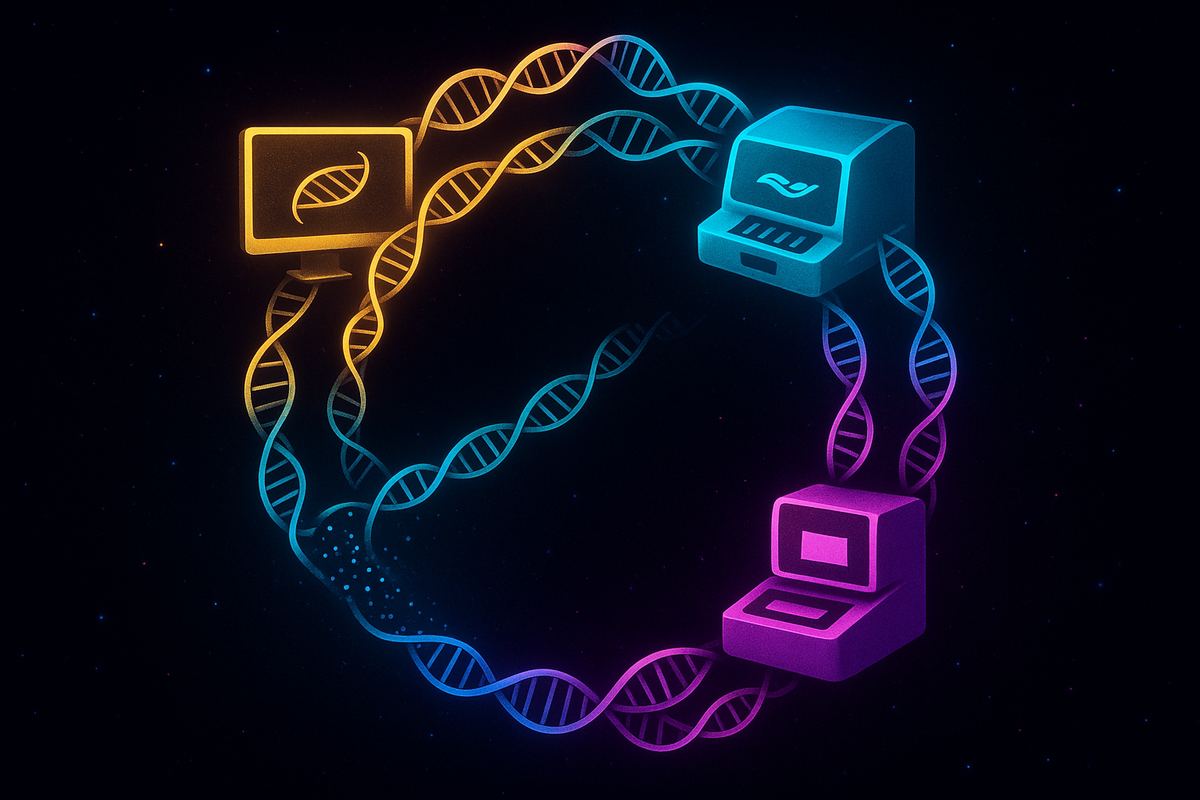
What happens when you treat DNA like code and cells like hardware? Synthetic biology lets scientists — and now undergrads — build living systems from scratch, reprogramming organisms to do things evolution never imagined.
Engineering Life from Scratch
In 2004, a group of undergraduates at MIT entered a competition to build biological machines. The challenge: design standardized genetic parts, assemble them into functional systems, and demonstrate that biology could be engineered like any other technology. The competition was called iGEM—the International Genetically Engineered Machine competition. That first year, five teams participated. Twenty years later, iGEM involves hundreds of teams from dozens of countries. The Registry of Standard Biological Parts contains thousands of genetic components. High school students are building organisms that sense arsenic in water, produce biodegradable plastics, or glow in the presence of specific chemicals. Biology became hackable. Not by accident—by design. Synthetic biology is the application of engineering principles to living systems. It's the discipline that treats life as technology.
Modularity and Standardization
Engineering disciplines rest on standardization. Electrical engineers don't design transistors from scratch for every project. They use standardized components—resistors, capacitors, transistors—with predictable properties, documented specifications, and interchangeable interfaces. Can biology work the same way? The early vision of synthetic biology said yes. Tom Knight, Drew Endy, and others at MIT proposed creating a "Registry of Standard Biological Parts"—a library of genetic components with standardized interfaces that could be mixed and matched like electronic components. The basic unit is the BioBrick: a genetic part flanked by standardized restriction enzyme sites so it can be easily combined with other BioBricks. Promoters, ribosome binding sites, coding sequences, terminators—all formatted the same way, all designed to snap together. In principle, you could order BioBricks from the Registry, assemble them into a genetic circuit, transform them into bacteria, and have a working biological system. The dream: genetic engineering as easy as plugging together Lego bricks.
The Reality Check
The dream was partially naive. Biology is messier than electronics. Genetic parts don't behave identically in different contexts. A promoter that works beautifully in E. coli might fail in yeast. A ribosome binding site optimized for one gene might not work for another. The "parts" interact with the cellular environment in complex ways. This is the context-dependence problem. Biological components aren't truly modular—their behavior depends on what surrounds them, what else the cell is doing, and countless other variables. The field has adapted. More sophisticated design tools account for context. Machine learning predicts part behavior in different backgrounds. Insulator sequences reduce crosstalk between components. The vision hasn't been abandoned, just tempered. And despite the challenges, synthetic biology works. Not perfectly, not predictably every time, but well enough to build systems that function. The gap between design and implementation remains, but it's shrinking. Biology isn't as clean as electronics. But it's clean enough to engineer.
The Design-Build-Test-Learn Cycle
Engineering disciplines iterate. You design something, build it, test it, learn from the results, and redesign. The cycle repeats until the system works. Failures are expected—they're information. Synthetic biology adopted this framework. The Design-Build-Test-Learn (DBTL) cycle structures how projects advance. Design: Use computational tools to design genetic constructs. Predict how they'll behave. Optimize codon usage, regulatory strength, metabolic flux. Build: Synthesize the DNA. DNA synthesis costs have plummeted—from dollars per base pair in 2000 to fractions of a cent today. You can order a complete gene, or an entire genome, online. Test: Transform the DNA into cells. Measure the output. Does the system produce the desired protein? Does the circuit switch as expected? Does the pathway generate the target chemical? Learn: Analyze the results. What worked? What didn't? Why? Feed the insights back into the next design. This cycle powers progress. No design works perfectly the first time. But each iteration gets closer. The failures are as valuable as the successes.
What You Can Build
Let's get concrete. What have synthetic biologists actually made? Artemisinin production. Artemisinin is a malaria drug, originally extracted from sweet wormwood plants. Jay Keasling's lab at UC Berkeley engineered yeast to produce artemisinic acid, a precursor to artemisinin. The project took years and enormous effort, but it worked. Sanofi now produces artemisinin this way, stabilizing supply for a life-saving drug. Biosensors. Cells engineered to detect specific molecules and respond visibly. Bacteria that glow when arsenic is present. Cells that change color when they sense TNT. Organisms that report on their environment. Biofuels. Engineered microbes that convert plant sugars into ethanol, butanol, or other fuels. Not yet cost-competitive with fossil fuels in most cases, but improving. Enzymes for industry. Proteins engineered to catalyze industrial reactions—making detergents more effective, enabling new chemical processes, replacing harsh chemical catalysts with biological ones. Living therapeutics. Bacteria designed to live in the gut and treat disease. Some release drugs locally. Others modulate the immune system. Several are in clinical trials. Meat and materials. Cells cultured to produce meat without animals. Mycelium grown into leather alternatives. Biological fabrication of materials traditionally made from animals or petrochemicals. These aren't science fiction. They're products, companies, therapies entering the market. Synthetic biology is past the proof-of-concept stage. It's becoming an industry.
The Toolkit
What tools do synthetic biologists use? DNA synthesis. The ability to write arbitrary DNA sequences. You specify the sequence; a company synthesizes it. Companies like Twist Bioscience, IDT, and Ginkgo's partners produce synthetic DNA at massive scale. DNA assembly. Methods to combine DNA fragments into larger constructs. Golden Gate assembly, Gibson assembly, and other techniques allow rapid construction of multigene systems. CRISPR. Gene editing in living cells. Modify existing genomes precisely. Knock out genes, insert new ones, rewrite sequences. Computational design. Software that predicts how genetic parts will behave. Tools like Benchling for design management, Geneious for sequence analysis, and increasingly, machine learning models for predicting function. High-throughput screening. Robots that test thousands of variants in parallel. Combinatorial approaches that explore large design spaces. Sequencing. Reading DNA to verify what you built and understand what happened. Sequencing is cheap and fast—verification is routine. The toolkit continues to expand. Each new tool makes more ambitious designs possible.
Foundries
The highest expression of the engineering approach is the biofoundry. A biofoundry is an automated facility for biological design-build-test-learn cycles. Robots handle liquid transfers, run assays, and process thousands of samples. Computational pipelines design experiments, analyze results, and suggest next iterations. Ginkgo Bioworks, founded by MIT synthetic biologists, built one of the largest biofoundries. They partner with companies across industries, engineering organisms for fragrance, food, agriculture, and pharmaceuticals. The Broad Institute, Berkeley, and other academic centers operate biofoundries for research. The UK and Singapore have national biofoundry initiatives. The vision: biology at industrial scale, with engineering reliability. Design an organism, build it, test it, improve it—faster than any human team could manage alone. Biofoundries are the factories of the synthetic biology era.
The Design Challenge
Let's be honest about what remains hard. Predicting behavior. We can build genetic circuits, but predicting exactly how they'll behave is still difficult. The models aren't perfect. Biological systems have emergent properties that design tools don't fully capture. Scaling up. Making something work in a flask is different from making it work in a 10,000-liter fermenter. Industrial scale introduces challenges that don't appear in the lab. Stability. Engineered organisms evolve. The mutations that synthetic biology introduces often reduce fitness—the organism "wants" to revert. Maintaining engineered functions over many generations is a real challenge. Complexity. Simple circuits work. Complex circuits—with many interacting parts, sophisticated logic, robust behavior—remain hard. The gap between what we can design and what biology can do naturally is still vast. These challenges aren't reasons for pessimism. They're engineering problems. Engineering problems get solved. But they're not solved yet.
The Deeper Shift
Synthetic biology represents something more than a new set of techniques. For four billion years, life on Earth evolved through random variation and selection. No foresight. No design. No goals except survival and reproduction. Synthetic biology introduces purpose. We design organisms to achieve specific outcomes—produce a drug, sense a chemical, compute a function. The organism doesn't "want" these outcomes; we do. We impose intention on biology. This is a new kind of relationship with life. Not just observation, not just exploitation, but design. We're becoming authors of living systems. The implications are profound. We can create organisms that never existed. We can design biological functions that evolution never discovered. We can, in principle, reshape the living world according to human intentions. We're crossing from being products of evolution to being participants in it.
Further Reading
- Endy, D. (2005). "Foundations for engineering biology." Nature.
- Keasling, J. D. (2010). "Manufacturing molecules through metabolic engineering." Science.
- Cameron, D. E., Bashor, C. J., & Collins, J. J. (2014). "A brief history of synthetic biology." Nature Reviews Microbiology.
- Church, G., & Regis, E. (2012). Regenesis: How Synthetic Biology Will Reinvent Nature and Ourselves. Basic Books.
This is Part 1 of the Synthetic Biology series, exploring the engineering of living systems. Next: "The Minimal Genome: How Simple Can Life Be?"


Comments ()