Synthesis: The Designed Biosphere
Synthetic biology started with making bacteria glow. It's trending toward programmable organisms, gene drives that can spread through wild populations, and organisms engineered to produce any molecule on demand. At some point, the designed biosphere stops being a metaphor.
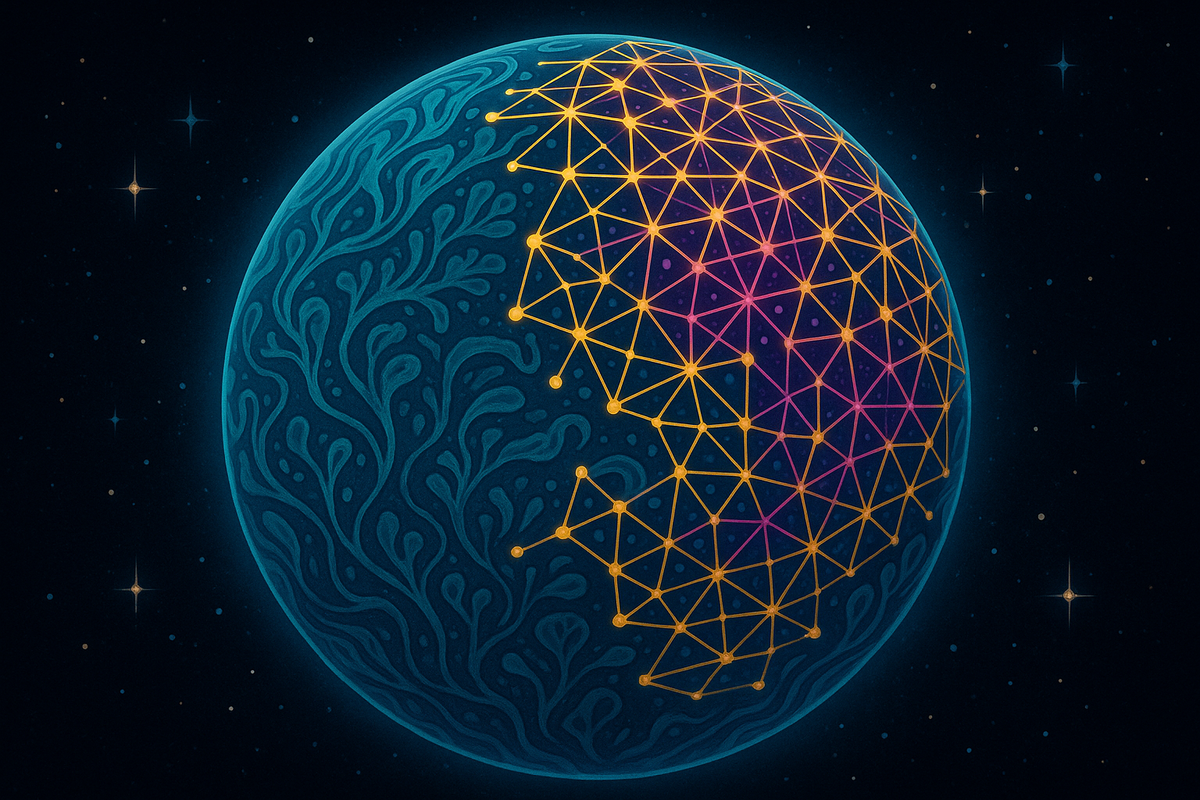
Synthesis: The Designed Biosphere
Let's pull it together. We've traced synthetic biology from its foundations—the engineering mindset, standardized parts, design-build-test-learn—through its applications: minimal genomes, directed evolution, xenobots, DNA storage, genetic circuits, living materials. What emerges is a discipline, still young but maturing, that treats life as technology. Not metaphorically. Actually. Organisms as machines. Genomes as programs. Cells as factories. Evolution as design tool. This is not a small shift. For four billion years, life on Earth was shaped by random mutation and natural selection. Now it's being shaped by human intention. We're not just observing the biosphere. We're redesigning it. The question is no longer whether we can engineer life. The question is what we will engineer—and what that means for the world we share.
The Designed Biosphere
Humanity has been shaping life for millennia. Agriculture domesticated plants and animals. Wheat, corn, dogs, cattle—all are products of human selection. We didn't understand genetics, but we bred for desired traits. Medicine intervened in biology. Vaccines, antibiotics, surgery. We didn't understand molecular mechanisms, but we changed biological outcomes. Genetic engineering (from the 1970s) added precision. Insert a gene, knock one out. Modify organisms at the DNA level. But still, mostly one gene at a time. Synthetic biology is the next step. Not just modifying—designing. Not just genes—circuits, pathways, genomes, organisms. Not just improving natural forms—creating forms that never existed. The trajectory is clear. We're moving from accidental manipulation of life to intentional design of life. From working with what evolution gave us to creating what we imagine. The biosphere is becoming, in part, a designed system.
The Applications Ahead
Where is this going? Programmable medicine. Cells engineered to sense disease and respond. Not just drugs that target pathways—living therapeutics that adapt, persist, and adjust. CAR-T cells are the first wave. More sophisticated versions will follow: cells that hunt cancer, clear atherosclerosis, repair neurons. Sustainable manufacturing. Biology as industrial platform. Fuels, chemicals, materials—produced by engineered organisms from renewable feedstocks. Fermentation replacing petrochemistry. Carbon-negative production becoming possible. Environmental remediation. Organisms that eat plastic, sequester carbon, detoxify pollution. Not just cleaning up—actively restoring. Engineered ecosystems that provide services. Agriculture transformation. Crops engineered for yield, resilience, and nutrition. Nitrogen fixation in cereals (reducing fertilizer). Perennial grains (reducing soil disruption). De-extinction or near-extinction rescue through genetic recovery. New materials. Self-healing infrastructure. Grown structures. Living buildings. Materials that maintain themselves and eventually return to the biosphere. Information technology. DNA as data storage. Cells as computers. Biological information processing for specific applications where silicon can't go. These applications are at various stages—some commercial, some in trials, some speculative. But the trajectory is consistent. Biology is becoming a design medium across domains.
The Risks
With power comes risk. Biosecurity. The same tools that create beneficial organisms could create harmful ones. Engineered pathogens. Designed bioweapons. The dual-use problem is real, and the technology is proliferating. A capable undergraduate could engineer organisms today that would have required state-level resources a generation ago. Ecological release. Engineered organisms, if released, could interact with ecosystems in unpredictable ways. Gene drives (which spread traits through wild populations) could alter or eliminate species. Unintended consequences could cascade. Evolutionary escape. Engineered functions impose fitness costs. Over time, organisms evolve to disable costly engineered circuits. Containment strategies fail. The engineered organism becomes something else—or the engineered genes spread to wild relatives. Inequality. Who benefits from synthetic biology? If the technology remains concentrated in wealthy nations and corporations, it could widen disparities. Who gets access to living medicines? Who owns engineered organisms? Existential risk. In extreme scenarios, engineered organisms could pose existential threats. A self-replicating system, designed or evolved to be unstoppable, could be catastrophic. The probability is debated; the stakes are not. These risks are being addressed through regulation, biosecurity frameworks, and technical safeguards. But regulation lags technology. The field is moving faster than governance. The capacity to design life is expanding faster than the wisdom to use it well.
The Governance Challenge
How do you govern a technology that can modify life itself? The answers are incomplete. Regulation exists—the FDA for therapeutics, the EPA and USDA for environmental releases, international biosafety protocols. But synthetic biology strains these frameworks. Categories blur. Jurisdiction fragments. Novel organisms don't fit existing boxes. Self-governance by the scientific community has some history—the Asilomar conference on recombinant DNA in 1975 established norms that shaped the field. But the community is larger and more dispersed now. Consensus is harder. Technical safeguards can help—kill switches that cause engineered organisms to die outside controlled conditions, genetic firewalls that prevent gene transfer, dependence on artificial nutrients unavailable in nature. But safeguards can fail, especially against evolution. International coordination is essential—organisms don't respect borders. But biosecurity is entangled with national interests. Transparency conflicts with defense concerns. The governance gap is serious. We're conducting experiments on the biosphere without adequate mechanisms to assess risks, enforce limits, or course-correct if things go wrong.
The Moral Dimension
Is it right to design life? Different traditions give different answers. Instrumental views see life as raw material. If we can use it, and if the benefits exceed the costs, we should. Organisms don't have inherent moral status beyond their utility. Designing life is just another form of engineering. Intrinsic value views see life as having value beyond use. Living things deserve respect for what they are, not just what they can do for us. Redesigning life violates something—maybe dignity, maybe natural integrity, maybe divine prerogative. Precautionary views emphasize uncertainty. We don't know the consequences of our interventions. We should err on the side of caution. The burden of proof is on those who would alter life. Promethean views celebrate human creativity. We are life that has learned to design life—the universe becoming self-aware and self-modifying. This is not violation but fulfillment. These views coexist, uncomfortably. Synthetic biology forces the conversation. We cannot engineer life without confronting what we believe about life.
Coherence: The AToM Perspective
The AToM framework offers a lens. Coherence is central—the maintenance of ordered patterns against entropy, the integration of parts into wholes that persist and function. Life is coherence made flesh. Organisms maintain themselves through continuous self-regulation. Synthetic biology is, in this framing, coherence engineering. Designing systems that maintain themselves, that integrate new functions into existing biology, that persist and adapt. But coherence is fragile. Engineered systems perturb existing coherence—cellular homeostasis, ecological balance, evolutionary stability. Good design works with coherence; bad design disrupts it. The risks of synthetic biology are largely risks of incoherence—systems that escape control, that propagate where they shouldn't, that destabilize what they touch. The benefits are expanded coherence—new functions that serve human needs while maintaining biological stability. The ethical frame becomes: does this design enhance or disrupt coherence? For the organism, for the ecosystem, for the biosphere?
The Long View
Let's take the longest view. Life on Earth has been evolving for four billion years. For almost all of that time, evolution was the only author. Random variation, natural selection, drift. No foresight. No intention. Now there's a new author. We're writing genomes. We're designing organisms. We're editing the tree of life. The biosphere is acquiring a designer—for better or worse, humans are now part of the authorship of life. This is not temporary. Barring civilizational collapse, synthetic biology will continue advancing. The capabilities we have now are primitive compared to what's coming. Full genome design. De novo organisms. Integration of artificial and biological systems. Centuries from now (if we make it that far), the biosphere will include designed organisms. Earth's life will be partly evolved and partly engineered. The question isn't whether—it's what, how, and why. We're in the first chapter of a very long story.
What Should We Build?
I don't have a universal answer. But I'll offer a principle. Design for coherence. Build systems that enhance stability, not disrupt it. Build organisms that can integrate with ecosystems, not overwhelm them. Build technologies that serve broad benefit, not narrow advantage. Build with humility about what we don't know. This isn't restrictive. Coherence allows enormous creativity within boundaries. It's a design constraint, not a stop sign. Evolution stumbled upon life's basic designs through unimaginable trial and error. We can do better—if we're wise. We can avoid the dead ends. We can skip the suffering. We can build things evolution never would have found. But we can also build things that should never exist. The capability is there. The restraint must be chosen. Synthetic biology is power. Power requires responsibility. The biosphere we design will be the one we live in.
Conclusion
Biology was given. Now it's designed. Not fully—evolution continues, nature persists, most of life remains wild. But at the edges, in the laboratories and biofoundries, in the startups and research programs, the designed biosphere is emerging. The tools are real: DNA synthesis, CRISPR, directed evolution, genetic circuits, cell-free systems. The applications are expanding: medicine, materials, manufacturing, information, environment. The risks are real too: biosecurity, ecological disruption, evolutionary escape, misuse. The governance is inadequate. The ethics are contested. We stand at the beginning of something consequential. The species that learned to read DNA has learned to write it. The tree of life now has an engineer. What we build next depends on who we choose to be—as scientists, as societies, as a civilization. The designed biosphere is coming. Let's make it one worth living in.
Further Reading
- Church, G., & Regis, E. (2012). Regenesis: How Synthetic Biology Will Reinvent Nature and Ourselves. Basic Books.
- Endy, D. (2005). "Foundations for engineering biology." Nature.
- National Academies of Sciences. (2017). Preparing for Future Products of Biotechnology. National Academies Press.
- Benner, S. A., & Sismour, A. M. (2005). "Synthetic biology." Nature Reviews Genetics.
This concludes the Synthetic Biology series. The engineering of life has begun. What we make of it—the organisms we create, the safeguards we build, the purposes we pursue—will shape the world that follows.


Comments ()