Telepathy: What the Research Actually Shows
Parapsychology has been running controlled telepathy experiments since the 1970s. The meta-analyses are statistically significant. The effect refuses to replicate cleanly. This is a case study in what happens when evidence is real but interpretation is contested.
Telepathy: What the Research Actually Shows
Series: Anomalous Cognition | Part: 1 of 9 Primary Tag: FRONTIER SCIENCE Keywords: telepathy, ganzfeld experiments, remote viewing, psi research, parapsychology
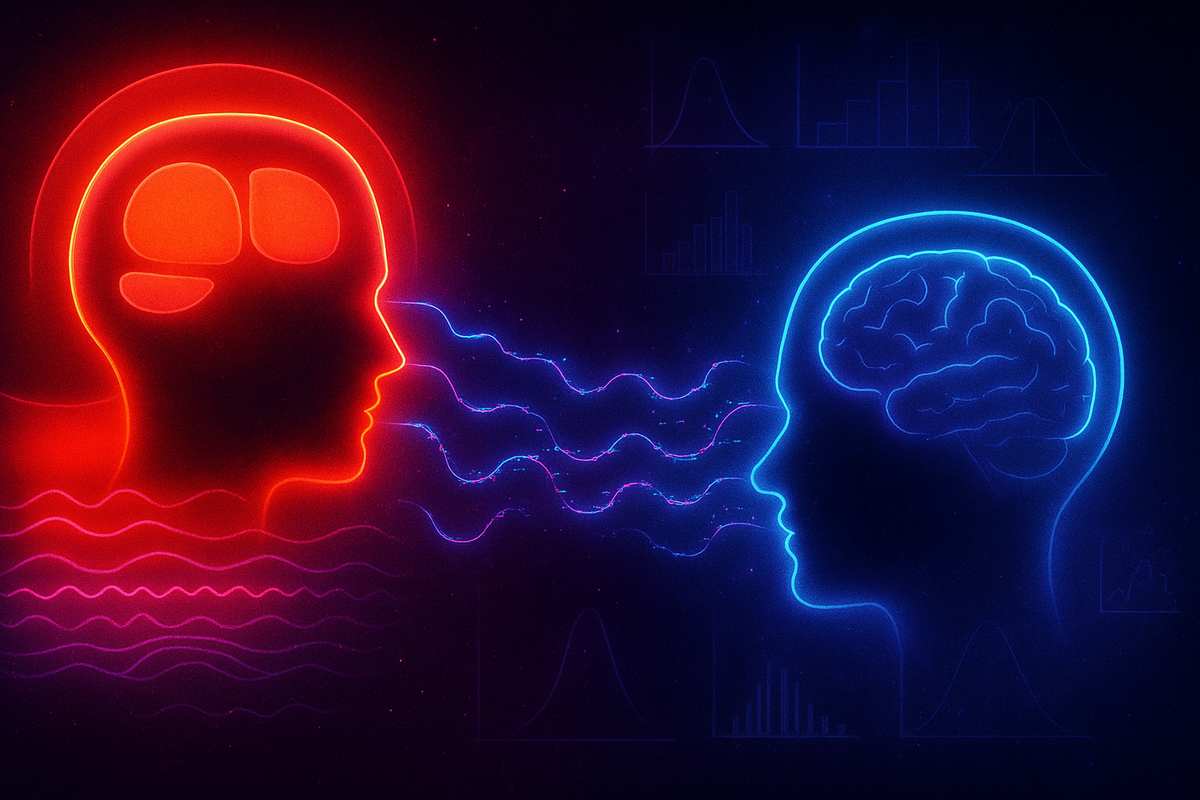
Can one mind communicate with another without using normal sensory channels?
This is the telepathy question. It's been asked for over a century, and it's been studied with scientific methods—imperfectly, controversially, but genuinely studied.
What does the research actually show? Not what believers claim. Not what skeptics dismiss. What does the evidence, honestly assessed, tell us?
The answer is uncomfortable for both sides: there's something there—small, unreliable, possibly artifactual—but something that refuses to go away completely. Whether that something is genuine telepathy or persistent methodological flaws remains genuinely uncertain.
The Ganzfeld Experiments
The most significant body of telepathy research uses the ganzfeld protocol.
The setup: a "receiver" is placed in a state of mild sensory deprivation—eyes covered with halved ping-pong balls illuminated with red light, headphones playing white noise. In this relaxed, stimulus-free state, they report whatever mental imagery arises.
Meanwhile, a "sender" in another room concentrates on a randomly selected target—typically a video clip or image.
After the session, the receiver is shown four options and asked to identify which one was the target. By chance, they should be right 25% of the time.
Across decades of studies, the hit rate has averaged around 32-33%—not large, but consistently above chance.
The statistical significance is real. Meta-analyses by both proponents (Charles Honorton) and skeptics (Ray Hyman) agreed on the basic numbers, though they disagreed on interpretation. The effect size is small—about 0.2 standard deviations—but it's been replicated across many laboratories.
Or has it?
The Methodological Wars
Critics have identified potential problems with ganzfeld research:
Sensory leakage: Could subtle cues (sounds, smells, warmth) allow receivers to detect the target? Better studies use soundproofed rooms and automated procedures, but earlier studies were less rigorous.
Randomization failures: If the target selection isn't truly random, statistical artifacts can create false positives. Some early studies had flawed randomization.
File drawer problem: Negative results might not get published, inflating apparent effect sizes. Proponents argue this can't fully account for the effect.
Judging bias: If the receiver's session is not properly blinded, the experimenter's expectations might influence scoring. Improved protocols added automated judging.
Experimenter fraud: In any field, some researchers are dishonest. A few psi researchers have been caught manipulating data.
Each criticism prompted methodological improvements. The autoganzfeld protocol automated target selection and judging to eliminate human bias. Studies became more rigorous.
And the effect persisted—smaller than in early studies, but still there. A 2010 meta-analysis found a hit rate of about 31% across autoganzfeld studies.
Skeptics argue that persistent effects mean persistent methodological problems. Proponents argue that improved methods that eliminate known problems while the effect persists suggests the effect is real.
The Stargate Program
The CIA funded psychic research for over twenty years under various code names, most famously Project Stargate.
The program studied remote viewing—attempting to perceive distant locations or events. Subjects would be given coordinates or a sealed target, then asked to describe what they "saw."
The research was conducted at Stanford Research Institute (later SRI International) by Russell Targ and Harold Puthoff, and later at Science Applications International Corporation.
Results were mixed. Some sessions produced strikingly accurate descriptions of distant targets. Many produced nothing useful. The overall statistical evidence, according to a 1995 American Institutes for Research review, suggested a small but real effect—though not reliable enough for intelligence gathering.
The program was terminated in 1995. The official conclusion: evidence for an anomalous effect exists, but it's too unreliable for practical use.
Critics point to methodological issues in the research, potential sensory cues, and the selection bias of reporting hits while ignoring misses. Proponents note that even the skeptical review found statistical evidence for something.
What Would Convince Skeptics?
True skeptics aren't looking for evidence that fits their expectations. They're looking for evidence that meets rigorous standards. For telepathy, that would mean:
Large effect sizes: Not 32% vs. 25%, but something unambiguous. 50% hit rates, or higher. Effects that can't be explained by any known statistical or methodological artifact.
Independent replication: Not just by believers in psi, but by skeptical researchers who actively try to find flaws. The best science comes from hostile replication.
Theoretical grounding: Some explanation for how telepathy could work that's consistent with known physics. Currently, there's none—no mechanism, no physical basis, just claimed effects.
Practical applications: If telepathy is real, it should have practical consequences. Information could be transmitted across shielded barriers. Stock markets could be predicted (where even small edges are profitable). These applications haven't materialized.
The evidence so far doesn't meet these standards. The effects are small, the replications are by believers, there's no theory, and there are no practical applications.
What Would Convince Believers?
For proponents, the evidence already exists. What would convince them that telepathy isn't real?
Consistent null results: If well-designed studies consistently failed to find effects, that would be telling. But some studies do find effects, and proponents focus on those.
Explanation of the positive results: If skeptics could identify the specific methodological flaw producing the effect—and demonstrate that eliminating it eliminates the effect—that would be compelling. But proposed explanations haven't fully accounted for the data.
The effect getting smaller with better methods: If the effect completely disappeared with rigorous controls, that would suggest it was artifactual. Instead, it has gotten smaller but hasn't disappeared.
This is the impasse: the effect is small enough that skeptics can attribute it to unknown flaws, large enough that proponents claim it's real. Neither side can prove their case to the other's satisfaction.
My Honest Assessment
Where does this leave us?
The evidence for telepathy is not nothing. There's a statistical anomaly that persists across studies, laboratories, and methodological improvements. It's not explained by known flaws.
But it's not convincing either. The effects are tiny, practically useless, and have no theoretical basis. The pattern is consistent with either a real but weak phenomenon or a subtle artifact that nobody has identified.
I hold the question open. I'm not convinced telepathy is real. I'm also not convinced it's been definitively disproved. The most honest position is uncertainty.
If forced to bet, I'd bet against telepathy. The prior probability of minds communicating through unknown channels is low. The evidence isn't strong enough to overcome that prior.
But I'm not certain. And certainty, here, would be intellectually dishonest.
Why It Matters
Even if telepathy isn't real, the research matters:
It reveals methodological challenges. The ganzfeld research is a case study in how hard it is to design unflawed experiments and interpret ambiguous data. Every scientist can learn from these debates.
It shows science at its edges. How do you investigate claims that might be real but might be noise? How do you maintain rigor without dismissiveness? This is science operating at its limits.
It illuminates cognitive biases. Why do people believe in telepathy? How do we assess ambiguous evidence? The psychology of belief is fascinating regardless of telepathy's reality.
The phenomenology is real. People do have experiences they interpret as telepathic. Understanding those experiences—why they happen, what they feel like, what triggers them—is legitimate psychology even if the paranormal interpretation is wrong.
Further Reading
- Bem, D.J. & Honorton, C. (1994). "Does psi exist? Replicable evidence for an anomalous process of information transfer." Psychological Bulletin. - Hyman, R. (1994). "Anomaly or artifact? Comments on Bem and Honorton." Psychological Bulletin. - Milton, J. & Wiseman, R. (1999). "Does psi exist? Lack of replication of an anomalous process of information transfer." Psychological Bulletin. - Storm, L. et al. (2010). "Meta-analysis of free-response studies, 1992-2008." Psychological Bulletin.
This is Part 1 of the Anomalous Cognition series. Next: "Precognition: Can We Know the Future?"


Comments ()