Telomeres and the Hayflick Limit: Your Cells Can Only Divide So Many Times
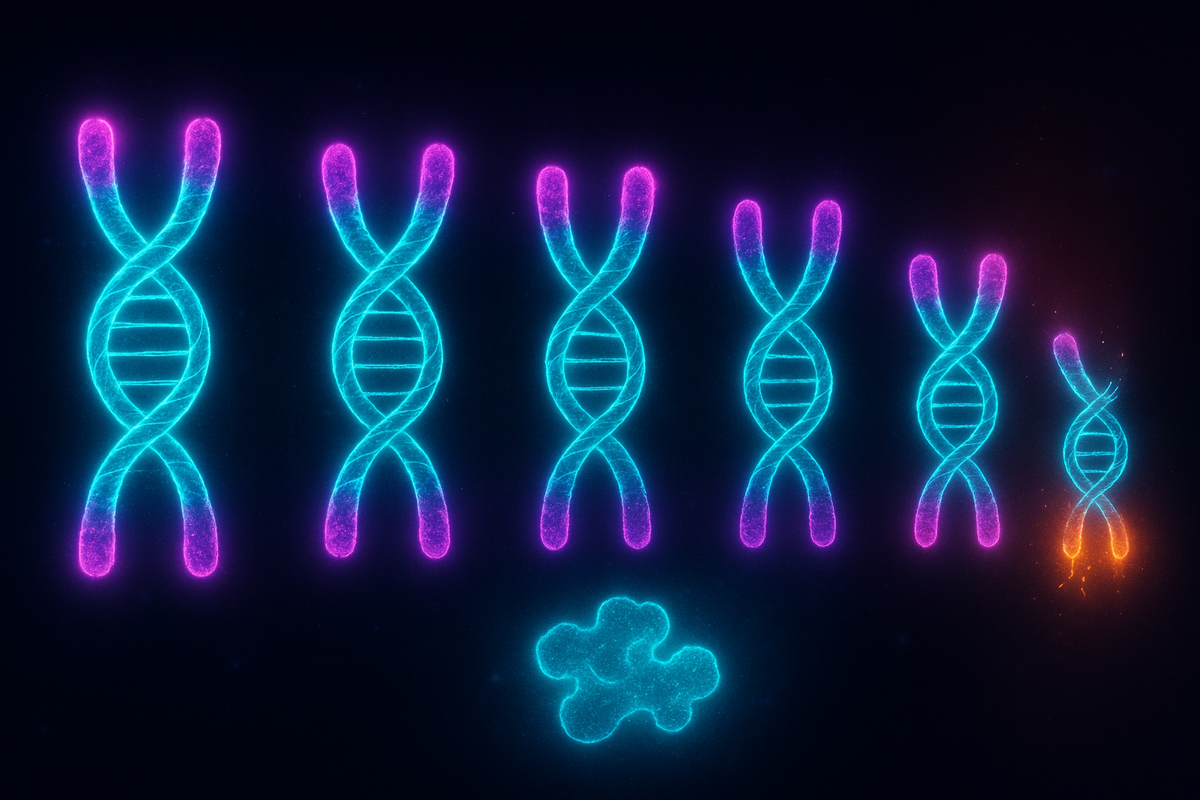
In 1961, Leonard Hayflick discovered that human cells have a division limit. The counter turns out to be your telomeres — chromosome end-caps that fray a little each time your DNA replicates. When they run out, the cell stops.
Telomeres and the Hayflick Limit: Your Cells Can Only Divide So Many Times
Series: Longevity Science | Part: 4 of 7 Primary Tag: FRONTIER SCIENCE Keywords: telomeres, Hayflick limit, telomerase, Elizabeth Blackburn, cellular aging, replicative senescence
The End Replication Problem
To understand telomeres, you need to understand a fundamental problem with DNA replication. When DNA replicates, the replication machinery (DNA polymerase) copies the double helix by reading one strand and synthesizing a complementary strand. But there's a catch: polymerase can only add nucleotides in one direction (5' to 3'), and it needs a short RNA primer to get started. On one strand (the leading strand), this works fine—replication can proceed continuously toward the end of the chromosome. On the other strand (the lagging strand), replication happens in fragments, each requiring its own primer. Here's the problem: when the primer at the very end of the lagging strand is removed, there's no way to fill in that gap. The machinery has nothing to grab onto. Every time a chromosome replicates, it loses a small chunk at the end. If chromosomes were just genes from end to end, this would be catastrophic—you'd lose essential genetic information with every cell division. But chromosomes aren't just genes. Their ends are capped with telomeres: long stretches of repetitive, non-coding DNA (in humans, the sequence TTAGGG repeated thousands of times). Telomeres are sacrificial. They're the buffer that gets eaten away so the genes don't have to be. But they're not infinite. With each division, telomeres shorten. Eventually, they get too short.
When Telomeres Get Critical
Short telomeres are a crisis. When telomeric DNA erodes enough, the chromosome ends start looking like broken DNA—and cells have powerful responses to DNA breaks. The p53 tumor suppressor pathway activates. The cell cycle arrests. The cell either dies (apoptosis) or stops dividing permanently (senescence). This is the molecular basis of the Hayflick limit. Cells count their divisions through telomere length. When the count runs out, division stops. The cutoffs are roughly:
- Newborn cells: ~10,000-15,000 base pairs of telomeric DNA per chromosome end
- Adult cells: ~5,000-7,000 base pairs
- Elderly cells: ~3,000-5,000 base pairs
- Crisis threshold: Below ~2,000-3,000 base pairs, cells hit replicative senescence or die
Different tissues age at different rates partly because of different proliferation demands. Your gut epithelium turns over completely every few days—those cells burn through telomeres fast. Your neurons divide rarely—their telomeres last longer.
Telomerase: The Immortality Enzyme
If telomere shortening limits cell division, then preventing telomere shortening would remove the limit. Right? This is exactly what happens in cells that need to divide indefinitely: stem cells, germ cells (eggs and sperm), and cancer cells. The enzyme that rebuilds telomeres is telomerase—a reverse transcriptase that carries its own RNA template. It can add the TTAGGG repeats back onto chromosome ends, counteracting the end-replication problem. Elizabeth Blackburn, Carol Greider, and Jack Szostak won the 2009 Nobel Prize for discovering telomeres and telomerase. The discovery opened an obvious question: could we use telomerase to extend cellular lifespan? The answer is yes—and no. Yes, activating telomerase in normal cells extends their replicative capacity. You can take cells that would have hit the Hayflick limit and give them more divisions. In some mouse models, telomerase activation extends lifespan and improves healthspan. But there's a catch. A big one.
The Cancer Connection
Cancer cells are immortal. That's part of what makes them cancer—they divide without limit, ignoring the signals that stop normal cells. How do they do it? About 85-90% of human cancers activate telomerase. They turn on the immortality enzyme to escape the Hayflick limit. The remaining 10-15% use an alternative mechanism called ALT (Alternative Lengthening of Telomeres), but the principle is the same: cancer defeats aging's replicative brake. This creates a profound therapeutic tension:
- Telomerase activation might be anti-aging (extending normal cell division capacity)
- Telomerase activation might be pro-cancer (enabling unlimited division of damaged cells)
The Hayflick limit is a tumor suppression mechanism. It's not there to make you old—it's there to keep damaged cells from becoming tumors. Short telomeres trigger senescence, and while senescence causes aging problems (as we saw with senolytics), it also prevents cancer. If you broadly activate telomerase, you might delay replicative senescence but increase cancer risk. The tradeoff isn't theoretical—some early studies of telomerase activation in mice showed increased cancer incidence. This doesn't mean telomerase is undruggable. It means the intervention has to be more sophisticated than "turn on telomerase everywhere."
Telomere Length and Human Aging
Telomere length is one of the most studied biomarkers of aging. The findings are robust but nuanced: Telomeres shorten with age: Cross-sectional and longitudinal studies confirm that telomere length declines with age in most tissues. The correlation is consistent. Longer telomeres associate with longevity: People with longer telomeres (for their age) tend to live longer and have lower rates of age-related disease. Again, consistent finding. Telomere length is heritable: About 40-80% of telomere length variation is genetic. Some people are born with longer telomeres than others. Stress and lifestyle affect telomeres: Chronic stress, poor sleep, smoking, obesity, and sedentary lifestyle all associate with shorter telomeres. Exercise, meditation, and healthy diet associate with longer telomeres (or slower attrition). Telomere length predicts disease: Shorter telomeres correlate with higher risk of cardiovascular disease, diabetes, certain cancers, dementia, and mortality. The correlations are modest but significant. The causal question is harder. Does short telomere length cause disease, or is it a marker of other processes that cause disease? Probably both. Short telomeres cause replicative senescence and limit tissue regeneration (causal). But they also reflect cumulative oxidative stress, inflammation, and cellular damage (marker).
The Telomere Lifestyle Industry
Telomere length's accessibility as a biomarker has spawned an industry. You can order telomere length testing direct-to-consumer. Companies sell supplements claiming to "support telomere health." Wellness influencers tout telomere-lengthening lifestyle interventions. How much of this is legitimate? Testing: Telomere testing is scientifically valid—we can measure telomere length—but the clinical utility is questionable. What do you do with the information? If your telomeres are "short," the interventions are the same healthy behaviors you should be doing anyway. If they're "long," that doesn't mean you can ignore your health. The test might motivate behavior change, but it doesn't change the optimal behaviors. Supplements: Most "telomere supplements" have minimal evidence. TA-65 (a telomerase activator derived from astragalus) has some data showing modest telomerase activation, but the clinical significance is unclear. Other supplements have even less support. Lifestyle interventions: Here the evidence is better. Exercise, stress reduction (including meditation), and healthy diet genuinely do associate with longer telomeres or slower attrition. But these interventions have myriad benefits beyond telomeres—it's unclear how much of their effect operates through telomere biology versus other pathways. The skeptical view: telomere length is a downstream marker of overall health. Improving overall health improves telomere length. But targeting telomeres specifically, as if they were the root cause, may be misguided.
Telomere-Based Therapies in Development
Despite the complexities, telomere biology is a serious therapeutic target: Telomerase gene therapy: Researchers have delivered telomerase genes using viral vectors, extending telomeres and lifespan in mice without apparent cancer increase (in some studies). Maria Blasco's group in Spain has been prominent in this work. The approach is still preclinical, with long-term safety unknown. Small molecule telomerase activators: Beyond TA-65, various compounds are being explored to activate endogenous telomerase expression. The challenge is tissue specificity and cancer risk management. Telomerase inhibition for cancer: Going the other direction—if cancer cells depend on telomerase, inhibiting it might kill them. Imetelstat and other telomerase inhibitors are in clinical trials for certain cancers. Telomere maintenance in stem cells: Supporting telomerase activity specifically in stem cell populations, while keeping it suppressed in differentiated cells, might allow targeted regenerative benefits without systemic cancer risk. The therapeutic window is narrow but potentially exists. The key is precision—not global telomerase activation, but targeted support of specific cell populations.
The Progerias: Nature's Experiments
Some of the most compelling evidence for telomere biology comes from progerias—diseases of accelerated aging. Dyskeratosis congenita (DC): Caused by mutations in telomerase or telomere maintenance genes. Patients have extremely short telomeres and premature aging of multiple organ systems. They develop bone marrow failure, pulmonary fibrosis, and cancer at young ages. DC is essentially a human model of telomere exhaustion. Werner syndrome and Bloom syndrome: Caused by mutations in DNA helicase genes involved in telomere maintenance. Patients show accelerated aging features and high cancer incidence. These diseases demonstrate that telomere dysfunction alone can drive aging phenotypes. They're also cautionary tales: the same systems that protect against cancer (telomere shortening, senescence) are what fail in these syndromes, often leading to both accelerated aging and increased cancer.
The Bigger Picture
Telomeres matter for aging. That's established. But they're one piece of a larger puzzle. The reductionist dream was that telomeres might be the aging clock—find a way to reset them, reset aging. That hasn't panned out. Telomere extension alone doesn't produce young mice, and telomere attrition isn't the only thing driving the hallmarks of aging. The more accurate picture: telomere biology is one of several interconnected systems that degrade with age. Short telomeres cause replicative senescence, which contributes to inflammaging through SASP. Telomere attrition reflects (and may cause) genomic instability. Telomere dysfunction impairs stem cell function. The hallmarks interact. Telomeres are one node in a network. Targeting them might be valuable—especially in combination with other interventions—but they're not the master switch. What telomere research does teach us: cells have limits. Those limits exist for reasons (tumor suppression). Working with those limits, rather than naively trying to abolish them, is probably the right approach. The goal isn't to make cells immortal—immortal cells are called cancer. The goal is to support regeneration while maintaining the safeguards that prevent malignancy. That's a harder problem than "activate telomerase." It's also probably the right problem.
Further Reading
- Blackburn, E.H., Epel, E.S., & Lin, J. (2015). "Human telomere biology: A contributory and interactive factor in aging, disease risks, and protection." Science.
- Blackburn, E. & Epel, E. (2017). The Telomere Effect. Grand Central Publishing.
- Shay, J.W. & Wright, W.E. (2019). "Telomeres and telomerase: three decades of progress." Nature Reviews Genetics.
- Bernardes de Jesus, B. et al. (2012). "Telomerase gene therapy in adult and old mice delays aging and increases longevity without increasing cancer." EMBO Molecular Medicine.
- Armanios, M. & Blackburn, E.H. (2012). "The telomere syndromes." Nature Reviews Genetics.
This is Part 4 of the Longevity Science series, exploring the biology of aging and interventions to extend healthspan. Next: "Why Eating Less Extends Life."


Comments ()