Tesla vs Edison: The Battle That Lit the World
The War of Currents wasn't just a technical dispute — it was a business war, a PR campaign, and a fight about whose vision of electrified civilization would win. Edison lost. Here's why AC beat DC, and what it cost both men to find out.
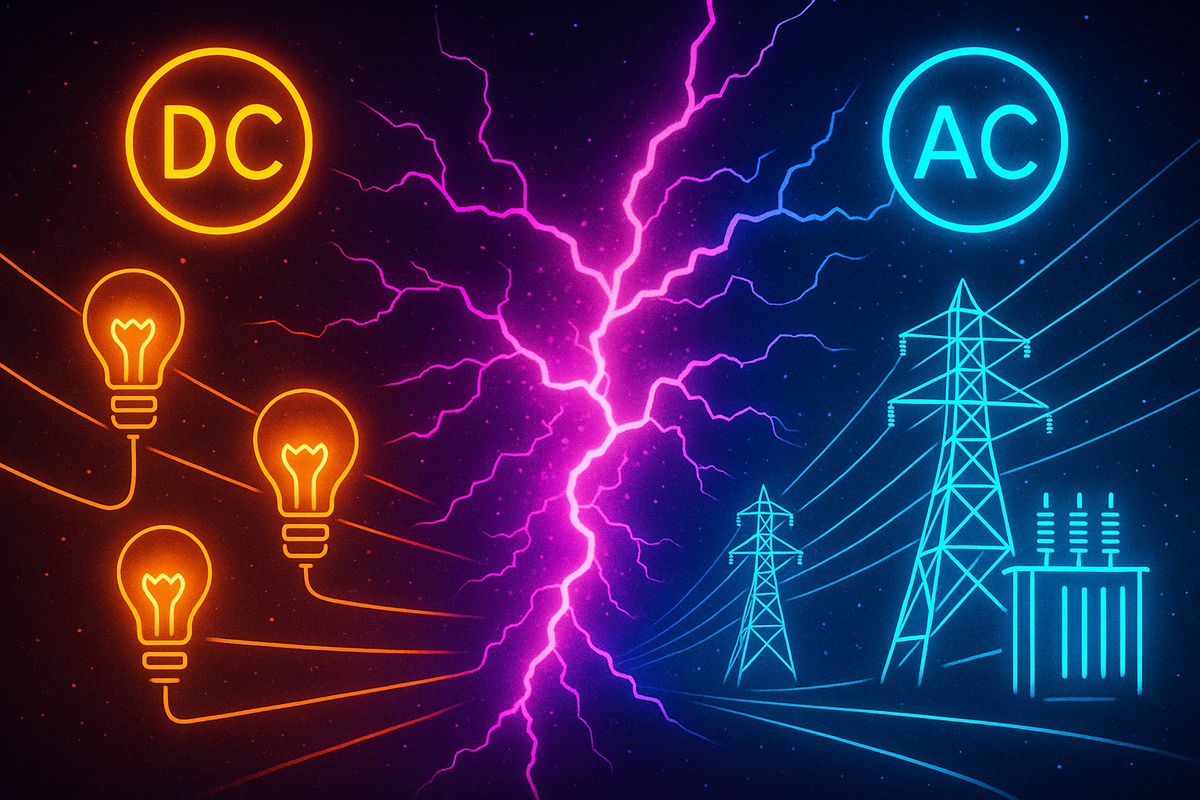
Tesla vs Edison: The Battle That Lit the World
In the 1880s, two visions of electrical power went to war. On one side: Thomas Edison, the Wizard of Menlo Park, champion of direct current. On the other: Nikola Tesla and George Westinghouse, prophets of alternating current.
The stakes were nothing less than how the modern world would be powered. The outcome would determine whether electricity remained a local curiosity or became the universal energy carrier that runs civilization.
Edison lost. Tesla and Westinghouse won. And that victory is why you can plug anything into any outlet anywhere.
But the story isn't really about Edison versus Tesla. It's about the physics of electrical transmission and the economic logic of scale. The right technology won—not because of personalities, but because of math.
The Problem of Distance
Steam engines generate mechanical power at the point where fuel is burned. This is fine if you need power where the fuel is—at a mine head, for instance. But if you want power somewhere else, you have to move either the fuel or the power.
Moving fuel (coal, wood, oil) works but is expensive. The heavier the fuel, the more costly the transport. This is why steam-powered factories clustered around coal fields and transportation hubs.
Electricity promised something different: power transmitted instantaneously over wires. Generate it where fuel is cheap—at a mine, a waterfall, a dam—and deliver it wherever it's needed. The dream was decoupled power: production here, consumption there.
But there's a problem. Electrical power equals voltage times current. Transmitting power at low voltage requires high current. High current flowing through resistance generates heat. Heat is wasted energy. Over long distances, low-voltage transmission loses most of the power to resistive heating.
The solution is high voltage. Transmit at high voltage with low current, and losses drop dramatically. Then step the voltage back down at the destination for safe use.
But Edison's direct current (DC) couldn't do this. The technology to transform DC voltage efficiently didn't exist in the 1880s. Edison's system was locked at a fixed voltage, which meant transmission losses limited his power stations to serving customers within about a mile.
The Edison Model
Edison opened the first commercial power station—Pearl Street Station in Manhattan—in 1882. It provided DC electricity to 85 customers within a square mile. The system worked. Electric lights replaced gas lamps. Customers were satisfied.
But the economics were brutal. Each square mile of customers needed its own generating station. Power plants had to be embedded in the neighborhoods they served. Land in Manhattan was expensive. Coal had to be delivered to each urban station. The inefficiency of distributed generation meant high costs per kilowatt-hour.
Edison was betting that customers would pay for the convenience of electric light and that costs would fall with scale. He built a business empire around DC: generators, cables, meters, light bulbs—an integrated system where he controlled every component.
The strategy was vertical integration. If you need electricity, you buy Edison equipment. The system is proprietary. This creates lock-in: once customers invest in Edison's DC infrastructure, they're captive to Edison's prices.
This isn't a criticism of Edison's business acumen. It's how technological standards often get established. But it meant Edison had strong incentives to resist any competing standard—especially one that threatened to make his installed base obsolete.
The AC Alternative
Alternating current reverses direction many times per second—60 times per second in the US, 50 in Europe. This oscillation makes AC fundamentally different from DC's steady flow.
The crucial advantage: AC voltage can be easily transformed. A transformer is just two coils of wire wrapped around an iron core. Feed AC into one coil, and AC at a different voltage appears in the other. Step up for transmission; step down for use. Simple, efficient, cheap.
This means AC can be transmitted at high voltage over long distances with minimal losses, then stepped down to safe levels at the point of use. A single large generating station can serve an entire region. The economics of scale favor centralized generation.
Nikola Tesla didn't invent AC, but he invented the practical AC motor—a motor that ran directly on alternating current without needing conversion to DC. This was crucial because motors, not lights, would become the dominant use of electricity. Tesla's induction motor completed the AC system: generate AC at a power plant, transmit it at high voltage, step it down, and run motors directly.
George Westinghouse, a wealthy industrialist, bought Tesla's patents and became the commercial champion of AC. Westinghouse had the business infrastructure and capital to challenge Edison's empire.
The War of Currents
What followed was one of the first modern technology standards wars.
Edison attacked AC as dangerous. High voltages could kill. He sponsored public demonstrations where animals were electrocuted with AC to dramatize the hazard. He lobbied for regulations against high-voltage transmission. He even arranged for the first electric chair to use AC power, cementing the association between alternating current and death.
The propaganda was effective but couldn't overcome the fundamental economics. AC systems could serve more customers from fewer, larger power plants. The cost advantage was decisive.
The turning point came in 1893 at the Chicago World's Fair. Westinghouse won the contract to light the fair, underbidding Edison's General Electric by offering AC power at a dramatically lower price. The fair's dazzling display of electric lights—powered by AC—demonstrated the technology's capability to millions of visitors.
That same year, Westinghouse won the contract to build a hydroelectric generating station at Niagara Falls, transmitting power 26 miles to Buffalo. The Niagara project proved that centralized generation with long-distance AC transmission was practical and economical.
By the late 1890s, the war was over. AC had won. Even General Electric, the company Edison founded, switched to AC systems.
What Victory Meant
The triumph of AC created the modern electrical grid—and with it, the infrastructure for everything that followed.
Centralized generation: Large power plants could locate wherever energy was cheapest—near coal mines, at dams, eventually at nuclear reactors. Economies of scale drove costs down. A single plant serving a million customers is vastly more efficient than a thousand plants serving a thousand each.
Universal access: Because AC could travel, electricity could reach anywhere wires could go. Urban and rural, industrial and residential—all could connect to the same grid. Electricity became a utility, not a luxury.
This universality was revolutionary. For the first time, a form of energy could be delivered to any location as easily as water through pipes. You didn't need to store fuel, operate machinery, or manage combustion. You just plugged in. This changed the relationship between people and power.
Standardized plugs and appliances: With a consistent AC standard (voltage, frequency), manufacturers could build appliances that worked anywhere. The plug on your phone charger is a descendant of the standardization that AC victory enabled.
The electrical nervous system: The grid became a network connecting power generation to power consumption, allowing demand to be met from diverse sources. This grid is now the foundation of modern civilization—as essential as roads, water, or telecommunications.
The Grid as Nervous System
Think about what the electrical grid actually does: it instantaneously transmits power from where it's generated to where it's needed. A light switch in New York might draw power from a dam in Quebec or a nuclear plant in Pennsylvania. The grid figures out how to route that power in real time.
This is why we used the phrase "civilization's nervous system" in the series overview. The grid coordinates energy flow the way a nervous system coordinates information flow. It's a network that enables everything else to function.
The grid's architecture—centralized generation, high-voltage transmission, distributed consumption—emerged from the AC victory. A DC grid would have looked completely different: distributed generation, local consumption, limited interconnection. We might have had local energy islands instead of a national network.
Would a DC world have been worse? Possibly not—distributed generation has advantages in resilience and local control. But the path we took, the AC path, enabled the scale and reach that define modern power systems.
The Continuing Legacy
The war of currents has echoes today.
HVDC transmission: For very long distances, high-voltage DC is actually more efficient than AC. Modern power electronics can convert AC to DC and back efficiently. New long-distance transmission lines, especially from renewable sources, often use HVDC. Edison's direct current is making a comeback—but at voltage levels and with technology he never imagined.
Home power: Solar panels generate DC. Batteries store DC. Many electronic devices run internally on DC. There's ongoing debate about whether home electrical systems should include DC circuits alongside AC, reducing conversion losses.
Data centers: The massive data centers powering AI run largely on DC internally. Converting grid AC to DC for servers, then managing the DC distribution, is a significant engineering challenge. Some data center designs are experimenting with native DC to reduce losses.
Electric vehicles: EVs charge their batteries with DC (converted from grid AC). The charging infrastructure is essentially a DC power network overlaid on the AC grid.
The AC standard won, but the technology keeps evolving. Edison's vision of local DC power may yet find new relevance in a world of solar panels, batteries, and distributed energy resources.
The Bigger Picture
The war of currents was ultimately about how to organize energy distribution. Two incompatible standards competed; one won; that victory shaped everything that followed.
This pattern recurs throughout energy history. Competing technologies fight for dominance. Standards emerge. Infrastructure gets built. Lock-in follows. The choices made in transition moments—often for contingent reasons—determine trajectories for decades or centuries.
We may be in another such moment now, as the grid faces the challenge of integrating renewables, batteries, and distributed generation. The outcome will shape energy systems for the next century.
But the AC grid that Tesla and Westinghouse built remains the foundation. Every time you flip a switch, you're benefiting from a battle fought over a century ago—and from the physics that made one side's victory inevitable.
The war of currents teaches a broader lesson: in energy systems, physics matters more than politics. Edison had more money, more fame, more political connections. Tesla and Westinghouse had better physics. Physics won. It usually does, eventually.
Understanding this helps make sense of current energy debates. Technologies that have physics on their side—that convert energy more efficiently, that transmit it with fewer losses, that scale more economically—tend to prevail over time, regardless of incumbent resistance. The question is always: how long does "eventually" take, and how much gets locked in during the transition?
For electricity, the transition took about 15 years. For our current energy transitions, we're still finding out.
Further Reading
- Jonnes, J. (2003). Empires of Light: Edison, Tesla, Westinghouse, and the Race to Electrify the World. Random House. - Hughes, T. P. (1983). Networks of Power: Electrification in Western Society, 1880-1930. Johns Hopkins University Press. - Nye, D. E. (1990). Electrifying America: Social Meanings of a New Technology. MIT Press.
This is Part 5 of the Energy of Civilization series. Next: "[Oil and the 20th Century: Liquid Civilization](/oil-liquid-civilization/)."

Comments ()