The Autonomic Hierarchy: Your Nervous System Has Three Gears
Polyvagal theory reveals three evolutionary circuits—ventral vagal, sympathetic, dorsal vagal—operating hierarchically from individual to cultural systems.
The Autonomic Hierarchy: Your Nervous System Has Three Gears
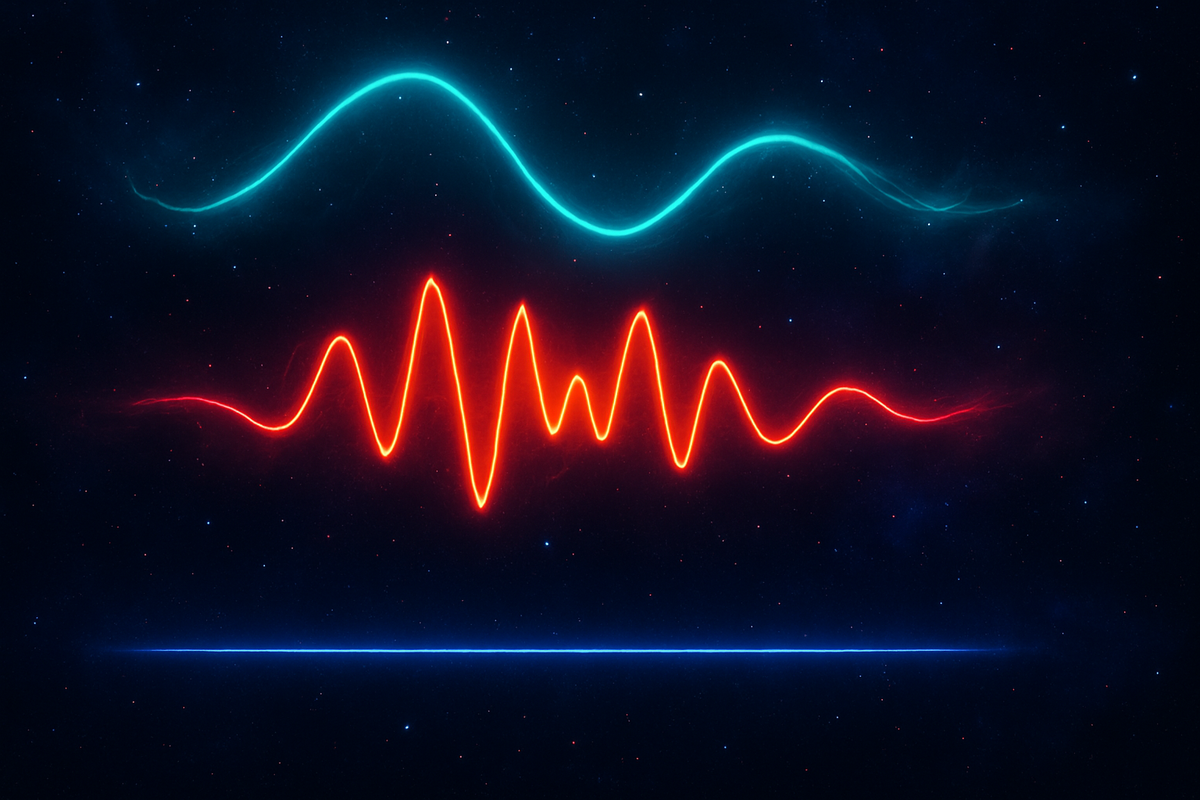
Part 1 of Polyvagal Through the Coherence LensYour nervous system isn't a switch. It's a stack.The standard model tells you there are two modes: fight-or-flight versus rest-and-digest. Sympathetic versus parasympathetic. On versus off. This binary is useful the way training wheels are useful—it gets you moving, but it obscures the actual mechanics.Stephen Porges's polyvagal theory reveals a more precise architecture. Three circuits, layered by evolutionary age, each with distinct physiological signatures and behavioral consequences. Not a toggle. A hierarchy.The Three CircuitsVentral Vagal: The Social Engagement SystemThe newest circuit, evolutionarily speaking. Myelinated vagal fibers that innervate face, voice, and middle ear. When this system is dominant, you can engage socially. Facial expression is fluid. Vocal prosody modulates naturally. You can listen to human speech against background noise. You can make eye contact without it feeling like combat.This is not merely "calm." It is a specific configuration that supports connection. The ventral vagal state is what allows mammals to coordinate—to nurse, to huddle, to communicate through sound. Without it, social behavior becomes effortful or impossible.In coherence terms: the manifold is smooth. Curvature is low. The system navigates complexity without spiking into defense. Predictions align with reality well enough that constant correction isn't required.Sympathetic: MobilizationWhen the ventral vagal system cannot maintain safety—when threat is detected or resources become insufficient—the sympathetic system takes over. Heart rate rises. Respiration accelerates. Blood flows to limbs. Digestion halts. The system prepares to act.This is fight-or-flight, but not as metaphor. The organism is literally preparing to move fast and hit hard, or move fast and escape. Every physiological shift serves the mechanics of violent or evasive motion.In coherence terms: curvature spikes. The manifold enters high-alert configuration. Dimensionality narrows to survival-relevant options. The system can no longer afford to track social nuance, long-term consequences, or creative possibilities. It's running threat calculus.Dorsal Vagal: ImmobilizationThe evolutionarily oldest circuit. Unmyelinated vagal fibers that slow the heart, suppress metabolism, produce freeze, collapse, or shutdown. When fight and flight are both impossible—when the system calculates that action cannot succeed—it conserves resources through immobilization.This looks like depression. Dissociation. Fainting. The numbness that comes when options have been exhausted. It is not laziness or weakness. It is a calculated metabolic retreat from an unwinnable situation.In coherence terms: amplitude collapse. The manifold flattens. Dimensionality drops to near-zero. The system is no longer navigating—it has withdrawn from navigation entirely.The Hierarchy in ActionThese circuits operate hierarchically. Under ordinary conditions, the ventral vagal system actively inhibits sympathetic activation. You don't have to consciously suppress fight-or-flight—the vagal brake does it automatically.When threat exceeds what the ventral system can handle, inhibition releases. Sympathetic mobilization activates. If mobilization fails—if the threat continues and action proves futile—the system descends to dorsal shutdown.This is the polyvagal ladder: ventral → sympathetic → dorsal.Ascending the ladder requires safety signals sufficient to re-engage the ventral system. The climb back is harder than the fall. Trauma disrupts this hierarchy—the system may become locked in sympathetic hyperarousal, unable to return to ventral flexibility. Or it may collapse into chronic dorsal shutdown, unable to mobilize. Or it may oscillate unpredictably between states, never stabilizing.The Same Geometry at Every ScaleThis hierarchy isn't unique to individual nervous systems. The same pattern appears wherever systems must balance engagement with defense.In relationships: secure connection (ventral) gives way to conflict mobilization (sympathetic) gives way to withdrawal and stonewalling (dorsal). The couple that cannot repair is stuck in the lower circuits.In organizations: collaborative function (ventral) gives way to competitive crisis mode (sympathetic) gives way to bureaucratic paralysis (dorsal). The institution that cannot return to flexible operation is stuck in survival mode indefinitely.In cultures: pluralistic engagement gives way to polarized mobilization gives way to fragmentation and collapse. The society that cannot de-escalate is descending the ladder.Same geometry. Different substrates. The stack is everywhere.Why This MattersUnderstanding the hierarchy changes the intervention target.If you're locked in sympathetic mode—chronic anxiety, hypervigilance, the feeling that you cannot stand down—the solution is not to think your way out. The cortex doesn't control the vagus nerve. The solution is to send signals that allow the ventral system to re-engage.If you're locked in dorsal shutdown—the flatness, the inability to mobilize, the sense that nothing matters—the solution is not to push harder. Willpower doesn't reach the unmyelinated vagus. The solution is titrated activation that proves mobilization is possible without catastrophe.The body has its own logic. Learning that logic is the first step toward working with it rather than against it.---Next: Why You Can't Think Your Way Out of Threat—the dissolution hierarchy and what happens when cognition loses its leverage.---Series: Polyvagal Through the Coherence LensArticle: 1 of 15Tags: polyvagal, autonomic nervous system, coherence, vagus nerve, trauma
Comments ()