The Biologists Who Redefined Life: Maturana, Varela, and the Autopoietic Revolution
Humberto Maturana and Francisco Varela didn't find a new molecule. They found a new question: not "what is life made of?" but "what does life do?" Their answer — autopoiesis — quietly transformed biology, philosophy of mind, and cognitive science.
The Biologists Who Redefined Life: Maturana, Varela, and the Autopoietic Revolution
Series: Autopoiesis and Second-Order Cybernetics | Part: 1 of 11
In 1972, two Chilean biologists published a paper that would fundamentally challenge how we understand what it means to be alive. Humberto Maturana and Francisco Varela weren't trying to start a revolution. They were trying to answer a deceptively simple question: what makes a living system different from a machine?
Their answer—autopoiesis, from the Greek auto (self) and poiesis (making)—transformed biology, cognitive science, systems theory, and philosophy. It's the reason we now understand cells as self-maintaining processes rather than molecular machines. It's why artificial intelligence researchers wrestle with the difference between computation and cognition. It's why social systems theorists like Niklas Luhmann describe societies as self-producing networks of communication.
But autopoiesis remains one of the most misunderstood concepts in contemporary science. It's been stretched to explain everything from consciousness to corporate culture, often losing its precision in the process. This series returns to the original insight—what Maturana and Varela actually discovered about living organization—and traces its implications across biology, mind, and meaning.
The Question That Started Everything
In the late 1960s, Humberto Maturana was studying color vision in pigeons at MIT. He was observing something strange: the nervous system didn't seem to be representing the external world so much as maintaining its own internal coherence. What the pigeon "saw" wasn't a faithful copy of wavelengths hitting its retina—it was the nervous system's response to perturbations, constrained by its own structural organization.
This led Maturana to a radical hypothesis: perception isn't representation. The brain doesn't build models of an external reality. It generates activity patterns that maintain its own operational closure while coupled to an environment.
Francisco Varela, Maturana's brilliant student, took this further. If the nervous system maintains itself through its own activity, what about the cell? What about the organism? What, precisely, distinguishes living organization from any other kind of system?
The standard answer at the time was function. Life performs certain functions—metabolism, reproduction, response to stimuli. But Maturana and Varela realized this was circular. Functions are only functions relative to an observer. A heart "pumps blood" only if you assume the organism needs blood pumped. Remove the observer, and you're left with molecules moving according to physical law.
They needed a definition that didn't depend on external purposes. A characterization of life that emerged from the system's own organization, not from our description of what it does for us.
Self-Making: The Core Insight
The breakthrough was recognizing that living systems are defined not by their components but by the process that produces those components.
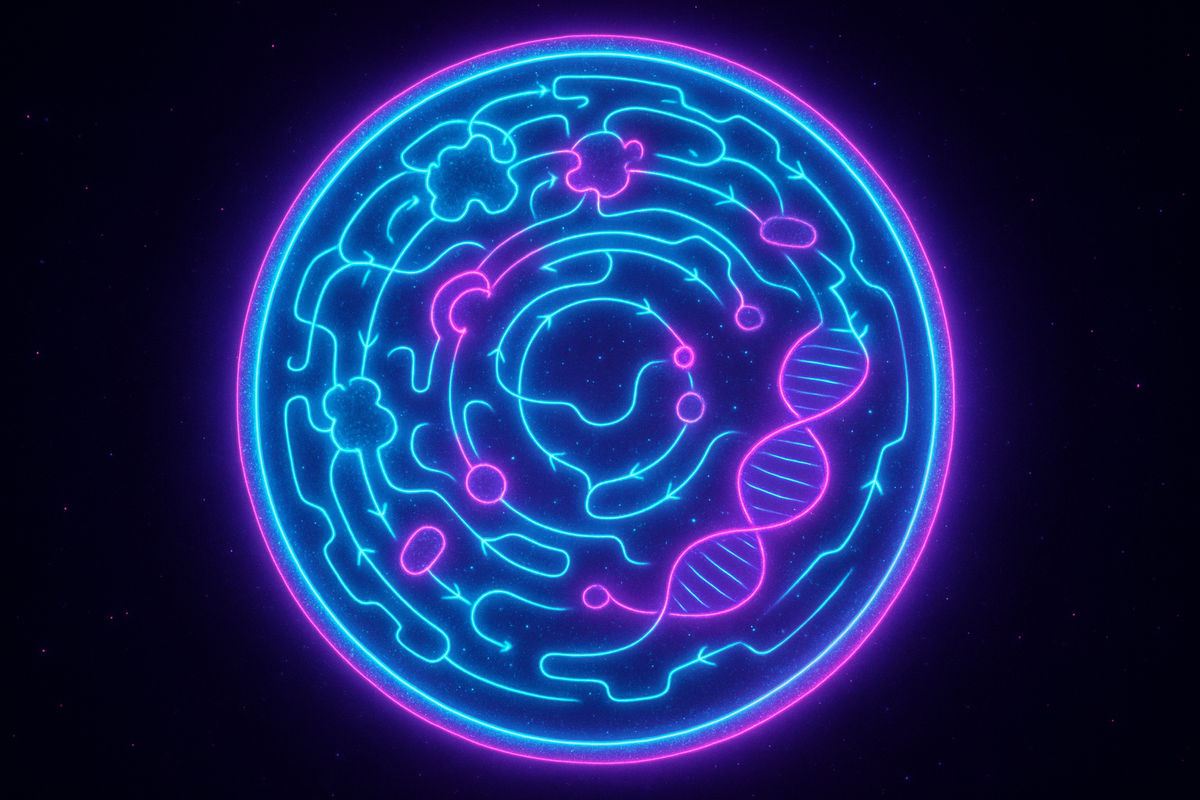
A cell doesn't just contain a membrane, proteins, and metabolic pathways. The membrane is produced by the metabolic processes it contains. Those metabolic processes are catalyzed by proteins produced by the genetic machinery enclosed by the membrane. The genetic machinery itself is maintained by metabolic products. Everything in the system is both producer and product.
This is autopoiesis: a network of processes that recursively produce the components that constitute the network.
The system doesn't have a blueprint separate from its operation. The organization is the operation. Life is characterized by operational closure—the system's processes refer only to themselves and the components they produce, forming a self-contained unity.
Maturana and Varela gave this precise technical definition in their 1973 book Autopoiesis and Cognition:
"An autopoietic machine is a machine organized (defined as a unity) as a network of processes of production (transformation and destruction) of components which: (i) through their interactions and transformations continuously regenerate and realize the network of processes (relations) that produced them; and (ii) constitute it (the machine) as a concrete unity in space in which they (the components) exist by specifying the topological domain of its realization as such a network."
Translation: A living system continuously produces itself. Its boundary isn't imposed from outside—it's generated by the very processes it contains. The membrane doesn't enclose life; the life process produces the membrane as its own boundary.
What Autopoiesis Is Not
Before we go further, let's clear up the most common confusions.
Autopoiesis is not the same as self-organization. Many systems self-organize—hurricanes, crystallization patterns, flocking birds. But they don't produce the components that produce them. A hurricane doesn't make air molecules; it moves existing molecules into temporary patterns. When the energy gradient dissipates, the pattern vanishes. The components remain, indifferent to the structure they briefly formed.
A cell, by contrast, synthesizes its own membrane lipids, manufactures its enzymes, replicates its genetic material. Remove the cell, and these components stop being produced. The organization and the components co-define each other.
Autopoiesis is not homeostasis. Homeostatic systems maintain certain variables within bounds—thermostats keep temperature constant, regulatory mechanisms maintain blood glucose. But the thermostat doesn't produce itself. It's built by an external process and maintains variables relevant to an external designer's purposes.
Autopoietic systems maintain their own organization not because it serves external goals but because that's what their organization does. Self-maintenance isn't a function—it's the definitional property.
Autopoiesis is not reproduction. This surprises people. Reproduction is neither necessary nor sufficient for autopoiesis. A mule is alive (autopoietic) but sterile. A virus reproduces but isn't autopoietic—it lacks metabolic autonomy and depends on host cell machinery to produce its components.
Reproduction is an interaction between living systems and their medium, not the defining characteristic of living organization itself.
And critically: autopoiesis is not a metaphor. It's a precise organizational criterion. Maturana and Varela were explicit that autopoiesis applies to living cells, full stop. Extensions to social systems, consciousness, or economies require careful justification—and often collapse into loose analogy rather than rigorous application.
Why This Changes Everything
If autopoiesis is the defining feature of life, several orthodox assumptions crumble.
First: life is not defined by information processing. DNA isn't a program that builds an organism. It's a component in an autopoietic network that enables the network to maintain itself across perturbations. Genetic information only has meaning within the context of the living system that reads, transcribes, and uses it. Remove the cell, and DNA becomes an inert polymer.
This has profound implications for genetics, development, and evolutionary theory—topics we'll explore in depth throughout this series.
Second: the environment doesn't instruct the organism. Living systems are structurally determined—their responses to perturbations are determined by their own organization, not by the perturbation itself. The environment triggers changes, but the organism's structure determines which changes occur.
This isn't solipsism. Organisms are coupled to their environments and die if that coupling breaks. But the coupling is structural, not instructional. The environment selects which organisms persist, but doesn't specify their responses.
Third: cognition is a biological phenomenon, not a computational one. If living systems maintain operational closure while structurally coupled to an environment, then cognition is simply the process by which that coupling is navigated. Every interaction that maintains viability is cognitive.
This isn't metaphor—it's definitional. Maturana and Varela argued that "living systems are cognitive systems, and living as a process is a process of cognition." Nervous systems don't create cognition; they expand the domain of interactions available to the organism.
This claim—that cognition is coextensive with life—scandalized artificial intelligence researchers who assumed cognition required computation, and biologists who assumed only organisms with brains could be cognitive. But if autopoiesis is correct, a bacterium navigating a glucose gradient is performing cognition just as fundamentally as a human solving equations.
We'll unpack this extraordinary claim across multiple articles, connecting it to contemporary work in basal cognition, active inference, and embodied cognitive science.
The Epistemological Revolution
Maturana and Varela didn't just redefine life—they redefined knowing.
If organisms are operationally closed, observers can never step outside their own organization to access an "objective" reality. Every description we make is constrained by our own structure as observers. We don't discover a pre-existing world; we bring forth a world through our activity as living, cognitive systems.
This is enactivism: the idea that cognition is enacted through sensorimotor coupling, not representation. The world we experience isn't independent of our biology. Color doesn't exist "out there" in wavelengths—it's brought forth by the structural coupling between photons and visual systems. The same wavelength appears as different colors to organisms with different visual structures.
This doesn't collapse into relativism. We're constrained by our biology and by the medium we're coupled with. But it does mean that objectivity—in the sense of a view from nowhere—is impossible. All observation is observer-dependent, not because we're biased, but because observation requires an observer, and observers are structurally determined.
This epistemology influenced later movements in cognitive science: embodied cognition, which argues that minds are shaped by bodies; situated cognition, which emphasizes environmental context; extended cognition, which questions where minds end and worlds begin.
But enactivism goes further. It's not just that cognition is shaped by embodiment—it's that cognition is embodied action. Thinking is doing. Understanding is sensorimotor coordination. Knowledge isn't acquired by building internal representations; it's enacted through skillful coping with the environment.
From Cells to Society: The Reach of Autopoietic Thinking
Once you see autopoiesis, you start seeing it everywhere—sometimes productively, sometimes not.
Niklas Luhmann applied autopoiesis to social systems, arguing that societies are autopoietic networks of communications. Not humans, but communications—recursive references that produce further communications. This was controversial (Maturana rejected it), but it influenced systems theory, sociology, and organizational studies.
Evan Thompson and colleagues extended autopoiesis into phenomenology, linking Maturana and Varela's biology to Husserl's and Merleau-Ponty's accounts of lived experience. The result was neurophenomenology: rigorous first-person methods combined with neuroscience.
Terry Winograd and Fernando Flores brought autopoiesis to computer science, arguing in Understanding Computers and Cognition (1986) that computation is fundamentally different from biological cognition. This challenged the AI orthodoxy and influenced human-computer interaction design.
Business theorists adopted autopoiesis to describe organizations, sometimes productively (Peter Senge's The Fifth Discipline), sometimes not (every management fad that invokes "self-organization" without rigor).
The danger is dilution. Autopoiesis becomes a buzzword for anything circular or self-sustaining, losing the precision that made it revolutionary. A forest ecosystem isn't autopoietic—it's a collection of autopoietic organisms in coupling relations. An economy isn't autopoietic—money doesn't produce banks that produce money. The metaphor breaks down under scrutiny.
Throughout this series, we'll be rigorous. We'll distinguish genuine extensions of autopoiesis from loose analogies. We'll trace the concept's reach without losing its conceptual integrity.
Why Autopoiesis Matters Now
We live in an age obsessed with artificial intelligence, synthetic biology, and computational models of mind. Autopoiesis matters because it draws a line—not between smart and stupid, but between living organization and everything else.
Current AI systems, no matter how sophisticated, are not autopoietic. They don't produce the components that produce them. They process information, but they don't maintain themselves as unities through metabolic self-production. GPT-4 doesn't synthesize its own parameters; AlphaGo doesn't regenerate its neural architecture through recursive self-assembly.
This doesn't make AI uninteresting. It makes it different. Understanding that difference is crucial as we build increasingly complex synthetic systems. Will we create autopoietic machines? Can we? Should we? These aren't abstract questions—they're urgent design challenges.
In synthetic biology, researchers are learning to engineer minimal cells, xenobots, and organoids. Are these systems autopoietic? If not, what's missing? If so, have we created life, or merely mimicked some of its properties? Autopoiesis gives us conceptual tools to navigate these questions rigorously.
In neuroscience and psychiatry, recognizing the nervous system as autopoietically organized—maintaining its own coherence rather than representing external reality—reframes pathology. Depression isn't a broken representation of the world; it's a mode of structural coupling that the system has fallen into and can't escape without perturbation. Therapy isn't correcting errors; it's enabling new coupling patterns.
In ecology and climate science, understanding organisms as operationally closed while environmentally coupled clarifies the stakes. We can't engineer ecosystems like machines because ecosystems are composed of autopoietic unities that respond according to their own organization, not our intentions. Interventions have unpredictable consequences because living systems are structurally determined, not input-output devices.
And in philosophy and ethics, autopoiesis challenges anthropocentrism. If cognition is coextensive with life, then every bacterium, every fungus, every plant is bringing forth a world. The ethical question isn't whether non-human life has consciousness (whatever that means), but whether we respect the autonomy of self-making systems whose worlds differ from ours.
The Coherence Connection
If you're familiar with the AToM framework (M = C/T—Meaning equals Coherence over Time), you'll recognize autopoiesis as coherence at the biological scale.
An autopoietic system maintains integrable trajectories under constraint. The cell's metabolic processes aren't random—they're coordinated such that the system remains viable over time. The pathways are constrained by the membrane, the genetic machinery, the available substrates. But within those constraints, the system sustains a consistent organizational identity.
This is precisely what coherence means in information geometry: a system whose state-space dynamics have low curvature, meaning perturbations don't send it careening into unrecoverable states. The autopoietic organization is a coherence-maintaining process.
When autopoiesis breaks down—in cancer, senescence, apoptosis—coherence collapses. Metabolic pathways decouple. The boundary degrades. The system fragments. Death is the loss of autopoietic organization, which in coherence terms is the transition from low-curvature stability to high-curvature dissolution.
Throughout this series, we'll see how autopoiesis and coherence are two descriptions of the same phenomenon: systems that maintain themselves by maintaining specific organizational patterns over time.
What's Coming in This Series
This is the first of eleven essays exploring autopoiesis, second-order cybernetics, and their implications.
Here's the roadmap:
Part 2: Operational Closure and Structural Coupling
How living systems maintain autonomy while environmentally coupled—the paradox at the heart of autopoiesis.
Part 3: The Nervous System as Autopoietic Expander
Why brains don't represent the world, and what they do instead.
Part 4: Cognition Without Computation
The enactive alternative to artificial intelligence, and what it means for understanding minds.
Part 5: Second-Order Cybernetics
When observers realize they're part of what they observe—Heinz von Foerster, Gordon Pask, and the cybernetics of cybernetics.
Part 6: Autopoiesis and Social Systems
Luhmann's controversial extension, and whether societies can be self-making.
Part 7: Development as Ontogenic Drift
How organisms develop without genetic blueprints, and what this means for evolution.
Part 8: The Immune System as Cognitive Domain
Recognizing self from non-self as autopoietic boundary maintenance.
Part 9: Pathology as Coupling Breakdown
Mental illness, cancer, and aging through the lens of autopoiesis.
Part 10: Can We Build Autopoietic Machines?
Synthetic biology, artificial life, and the prospects for genuinely living technology.
Part 11: Synthesis—Living Systems as Meaning-Makers
Autopoiesis, coherence, and the deep connection between biology and meaning.
Why You Should Care
Autopoiesis is not just another systems theory. It's a foundational reconceptualization of what life is, and therefore what cognition, meaning, and autonomy are.
If you're in biology, it challenges you to think beyond molecular mechanisms to organizational principles.
If you're in AI, it forces you to confront what separates genuine cognition from sophisticated computation.
If you're in philosophy, it dissolves the Cartesian split between mind and body, observer and observed.
If you're in psychology or psychiatry, it reframes pathology as structural coupling patterns rather than representational errors.
If you care about consciousness, selfhood, agency, or meaning, autopoiesis offers a rigorous biological foundation that doesn't reduce experience to mechanisms or retreat into mysticism.
And if you're simply trying to understand what it means to be a living, knowing, meaning-making being in a universe of processes—autopoiesis is where the revolution begins.
Further Reading
Primary Sources:
- Maturana, H. R., & Varela, F. J. (1980). Autopoiesis and Cognition: The Realization of the Living. D. Reidel Publishing.
- Varela, F. J., Maturana, H. R., & Uribe, R. (1974). "Autopoiesis: The Organization of Living Systems, Its Characterization and a Model." Biosystems, 5(4), 187-196.
- Varela, F. J., Thompson, E., & Rosch, E. (1991). The Embodied Mind: Cognitive Science and Human Experience. MIT Press.
Contemporary Applications:
- Thompson, E. (2007). Mind in Life: Biology, Phenomenology, and the Sciences of Mind. Harvard University Press.
- Di Paolo, E. A., Buhrmann, T., & Barandiaran, X. E. (2017). Sensorimotor Life: An Enactive Proposal. Oxford University Press.
- Bourgine, P., & Stewart, J. (2004). "Autopoiesis and Cognition." Artificial Life, 10(3), 327-345.
Critiques and Clarifications:
- Swenson, R. (1992). "Autocatakinetics, Yes—Autopoiesis, No: Steps Toward a Unified Theory of Evolutionary Ordering." International Journal of General Systems, 21(2), 207-228.
- Ruiz-Mirazo, K., & Moreno, A. (2004). "Basic Autonomy as a Fundamental Step in the Synthesis of Life." Artificial Life, 10(3), 235-259.
This is Part 1 of the Autopoiesis and Second-Order Cybernetics series, exploring how life makes itself and what that means for minds, meaning, and autonomy.
Next: "Operational Closure and Structural Coupling: The Paradox of Autonomous Systems"
Comments ()