The Desktop Metaphor: Why Your Perception Is Like a Computer Interface
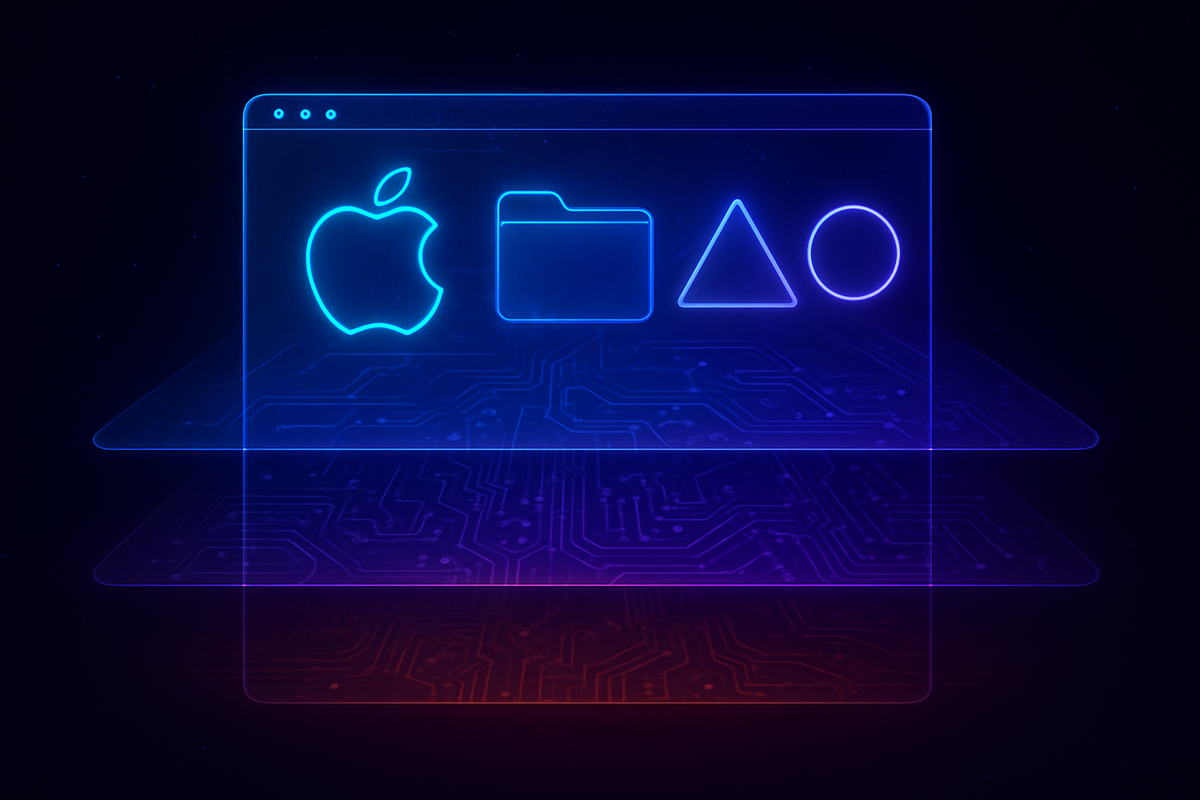
You don't see the transistors when you drag a file to the trash. You see an icon — a control surface hiding complexity. Hoffman's desktop metaphor argues every perception works this way, including rocks, tables, and other people. Useful, not accurate.
The Desktop Metaphor: Why Your Perception Is Like a Computer Interface
Series: Interface Theory | Part: 3 of 10
When you click on a file icon, you don't see spinning magnetic platters or voltage fluctuations in silicon. You see a blue folder. That folder isn't lying to you—it successfully guides action. But it's not revealing truth either. You couldn't build a hard drive by studying desktop icons, no matter how carefully you measured their pixels.
Donald Hoffman's central claim is that your perception works the same way. Evolution built your sensory systems like Apple built macOS: to hide complexity behind functional symbols. The redness of an apple, the solidity of a table, the three-dimensionality of space itself—these are perceptual icons that guide fitness-relevant action while concealing whatever underlying reality actually exists.
This isn't a vague analogy. It's a precise claim about the functional architecture of perception, with testable implications. And it undermines something most of us take for granted: that accurate perception of objective reality provides evolutionary advantage.
The fitness-beats-truth theorem showed why evolution wouldn't build veridical (truth-tracking) perception. The desktop metaphor shows how evolution built the alternative: a user interface optimized for survival, not accuracy.
The Icon Hides the Circuit
Open your laptop. The file system presents as a nested hierarchy of folders. That structure is real in a functional sense—it successfully organizes information. But it bears no structural correspondence to the physical hardware. Files aren't "inside" folders. Folders aren't "on" the desktop. The desktop itself doesn't exist as a surface containing objects.
These are interface conventions. They work because they provide functional access without requiring you to understand:
- Sector allocation in flash memory
- File system journaling protocols
- Voltage regulation in storage controllers
- Error correction algorithms
- Wear leveling strategies
The interface accomplishes something crucial: it maintains operational coherence while hiding irrelevant complexity.
Now consider a snake detecting infrared radiation from warm prey. Does the snake perceive photons? No—it perceives "food-direction." The perceptual system discards everything except fitness-relevant information, packaging it as an actionable icon: "strike here."
The snake's infrared perception is like a targeting reticle in a video game. It works. But it reveals nothing about the fundamental nature of electromagnetic radiation. Evolution didn't build snake perception to understand Maxwell's equations. It built perception to catch rats.
Fitness-Relevant Compression
Your visual system processes roughly 10 million bits of information per second. Your conscious awareness accesses maybe 50 bits per second. Where did the other 9,999,950 bits go?
They were compressed into icons.
You don't perceive:
- Individual photon wavelengths (you perceive "red")
- Reflectance spectra (you perceive "surface")
- Binocular disparity calculations (you perceive "depth")
- Edge-detection computations (you perceive "object")
Each perceptual icon—color, shape, distance, solidity—represents massive computational work hidden behind a clean symbolic interface. Like a desktop icon that conceals gigabytes of underlying data, your percept of "chair" conceals staggering neurological complexity.
This compression isn't optional. Organisms with finite nervous systems facing complex environments must compress. The question is: does that compression preserve truth, or does it sacrifice truth for utility?
Hoffman's answer: evolution optimizes compression for fitness payoff, not structural correspondence.
An apple appears red because that spectral signature historically correlated with caloric value. Ripeness became redness. The underlying molecular structure—whatever it is—gets replaced by a fitness-tuned symbol. You can navigate a grocery store using redness without understanding anthocyanin biochemistry. That's the point.
The interface conceals the machinery.
Icons Don't Resemble Circuits (And Percepts Don't Resemble Reality)
Here's where the metaphor becomes radical.
A file icon on your desktop doesn't resemble the magnetic domains on a hard drive. Not even slightly. There's no structural homomorphism between the visual representation (rectangle, label, color) and the physical substrate (electromagnetic patterns in silicon). The relationship is purely symbolic—the icon is a pointer, not a portrait.
Hoffman claims the same holds for perception and reality.
The redness you see doesn't resemble the underlying structure of the apple. Solidity doesn't resemble whatever keeps atoms from interpenetrating. Space itself—the three-dimensional stage on which objects seem to exist—doesn't resemble the actual structure of physical reality.
This sounds insane. How could space be an interface feature? Isn't space just... there?
But consider: your desktop presents files as existing "in" folders, which exist "on" a desktop surface. None of that spatial language corresponds to anything in the hardware. The file system creates a spatial metaphor to make information navigable. The metaphor works without being true.
Hoffman argues evolution did the same thing with space. Three-dimensional Euclidean geometry is an interface convention, optimized for navigating medium-sized objects at medium speeds. It works brilliantly for throwing spears and building shelters. But modern physics suggests spacetime isn't fundamental—it emerges from deeper structures (quantum entanglement, holographic principles, whatever underlies general relativity).
Your perception presents space as fundamental because that's the interface evolution built. Just as macOS presents folders as fundamental because that's the interface Apple built.
Neither interface reveals the circuit.
The Trash Can Doesn't Kill Files
Click "Delete." Drag a file to the trash can. The file vanishes from your desktop.
What actually happened? Did you destroy magnetic patterns? Did you erase voltage states in flash memory? Not yet—the file still exists. The operating system just updated some pointers. The file won't actually be overwritten until that sector gets reallocated for new data.
The trash can icon gave you functional control without requiring you to understand:
- File system metadata
- Inode tables
- Block allocation
- Garbage collection
The interface let you act on files without understanding files.
Now consider: you see a predator, you run, you survive. What actually happened in the underlying reality? You moved through "space," a predator moved through "space," you maintained sufficient "distance."
But if space is an interface feature, then something else—something you can't perceive—underlies the fitness-relevant dynamics. Your running corresponds to some change in whatever reality actually is. The change was fitness-relevant (you survived), but you have no perceptual access to its true structure.
You acted effectively within the interface. That's all evolution required.
The Coherence Underneath the Icon
Here's where AToM's coherence geometry connects to Hoffman's interface theory.
An operating system maintains computational coherence by managing:
- Memory allocation
- Process scheduling
- Resource conflicts
- State transitions
The desktop interface hides all of this. You see smooth icon movements; underneath, the kernel manages thousands of state updates per second. The interface presents coherent behavior by concealing incoherent complexity.
Perception does the same thing.
Your visual field feels unified—a single coherent scene. But neurologically, vision is massively parallel: separate processing streams for color, motion, edges, depth, object recognition. These streams don't even operate at the same speeds or resolutions. Your brain reconciles them into a coherent percept.
That reconciliation is active construction, not passive reception. It's more like rendering a video game frame than opening a camera shutter. The percept maintains coherence by discarding conflicts, filling gaps, enforcing priors.
The result: you experience a stable world of solid objects in three-dimensional space.
The mechanism: prediction error minimization across hierarchical generative models (see active inference), integrating priors refined by millions of years of evolutionary selection.
The function: maintain action-guiding coherence in the face of incomplete, noisy, ambiguous sensory data.
This is interface construction. And like any interface, it trades truth for usability.
When the Interface Glitches
A corrupted file icon might flicker, freeze, or display incorrect colors. The glitch doesn't tell you what went wrong in the underlying hardware—it tells you the interface failed to maintain coherent representation.
Perceptual illusions work the same way.
The Müller-Lyer illusion (two lines of equal length appearing different) isn't a failure of measurement—it's the interface applying depth cues inappropriately. The perceptual system interprets 2D line segments as projections of 3D corners, then "corrects" for perspective. The correction is wrong for the actual stimulus (flat lines on paper), but it would be right for the fitness-relevant environment (corners in 3D space).
The interface applies a rule that usually works. The illusion reveals the rule.
Or consider motion aftereffects: stare at a waterfall, then look at stationary rocks—the rocks appear to flow upward. Your visual system adapted to downward motion, recalibrating its baseline. When motion stops, the recalibrated system interprets zero motion as opposite motion.
This isn't a bug. It's the interface doing what interfaces do: maintaining operational coherence by adjusting internal states to match expected statistics. The aftereffect is what it feels like when the adjustment overshoots.
Hoffman's point: these aren't glitches revealing truth about underlying reality. They're glitches revealing truth about the interface. They show you the operating principles of perception, not the structure of the perceived.
Perceptual Icons as Markov Blankets
Karl Friston's concept of a Markov blanket—the boundary that defines what a system treats as "external"—maps cleanly onto Hoffman's interface metaphor.
Your laptop's operating system defines a boundary between user space and kernel space. The desktop interface lives in user space. You interact with icons, menus, windows. You can't directly access kernel memory or hardware registers—the OS maintains that boundary to prevent you from corrupting system state.
That boundary is a Markov blanket. It statistically separates what you can affect (interface elements) from what the system protects (low-level processes).
Perception establishes a similar blanket. You can't perceive your own neural states. You can't access raw sensory data before it's processed. You perceive objects in space—finished perceptual products, not intermediate computations.
The interface is the blanket's content. What's "outside" the blanket isn't unfiltered reality—it's the system's statistical model of fitness-relevant dynamics, rendered as actionable symbols.
This connects to active inference: organisms maintain themselves by minimizing surprise (prediction error) across their Markov blankets. Perception is part of that minimization. You see what you expect to see, updated by prediction error when expectations fail.
The desktop metaphor makes this concrete: your perceptual interface is the prediction, prediction error drives interface updates, and the whole system works to keep your actions effective—not to keep your beliefs true.
What This Means for Meaning
If perception is an interface, not a window, what happens to meaning?
In AToM's framework, meaning equals coherence over time: M = C/T. Systems generate meaning by maintaining integrated structure across temporal and informational gradients.
Interface Theory doesn't contradict this—it deepens it.
Meaning isn't "out there" in objective reality, waiting to be discovered. Meaning is what your perceptual interface constructs to maintain coherence between your actions and fitness-relevant outcomes. The redness of the apple means something because it guides adaptive behavior. That meaning is real, functional, powerful.
But it's real the way a file icon is real: as an interface feature, not a revelation of underlying circuitry.
The mistake—what Hoffman calls "naive realism"—is thinking the interface reveals the structure of what it represents. The corrective is recognizing that interfaces are purpose-built, evolution-tuned functional tools. They do the job they were built to do. That job isn't truth-tracking.
This shifts how we understand meaning-making. You don't discover meaning in a pre-existing world. You construct meaning by maintaining coherent interfaces between your actions and your environment. The environment shapes what interfaces work (natural selection), and the interface shapes what the environment affords (niche construction).
Meaning is the coherence achieved at that boundary.
The Strange Implications
If perceptual space is an interface feature, what's it an interface to?
Hoffman's answer gets wild: conscious agents. He proposes that reality consists of networks of perceiving, deciding, acting agents. Spacetime is the data structure conscious agents use to organize fitness-relevant information. Physical objects are icons representing interactions between agents.
This sounds like mysticism. It's not—it's rigorous mathematical formalism (Markovian kernels defining agent dynamics). But it's also speculative, contested, philosophically radical.
You don't need to buy the conscious agents framework to take the desktop metaphor seriously. The metaphor stands on its own: perception is an evolved interface; interfaces hide complexity; evolution optimizes for fitness, not truth.
But the metaphor invites the question: if perception is an interface, what's underneath?
Hoffman's answer: more perception, all the way down. The universe is made of observers, not objects.
AToM's answer: coherence dynamics—systems maintaining integrated structure through prediction error minimization across scales.
Maybe those answers converge. Perception as coherence maintenance, consciousness as what coherence feels like, meaning as the geometry of integrated states.
Or maybe the interface isn't meant to answer that question. Maybe that's like asking what's "underneath" the desktop—a category error, applying spatial language from the interface to whatever the interface represents.
Living in the Interface
You're reading this on a screen. You perceive black text on white background, letters arranged in words, sentences conveying ideas.
What's actually happening? Pixels switching states, photons entering your retina, voltage cascades in occipital cortex, semantic networks activating in temporal lobes, predictions updating in prefrontal regions.
None of that is in your experience. You experience meaning—ideas, claims, connections. That's the interface working. The machinery is hidden.
Hoffman's provocation: it's interfaces all the way down. When you "look deeper" with microscopes or particle accelerators, you're still seeing interfaces. More precise interfaces, perhaps. Interfaces revealing different fitness-relevant information at different scales. But interfaces nonetheless.
You never escape the desktop. You just load different applications.
This doesn't make science futile—it makes science a practice of building better interfaces. More predictive models, tighter coherence between theory and observation, higher resolution on fitness-relevant dynamics.
But it does mean: the map is not the territory. The interface is not the circuit. The percept is not the thing.
And the meaning you extract isn't discovered in reality—it's constructed by the coherent interaction between your perceptual systems and the environment those systems evolved to navigate.
The desktop metaphor doesn't eliminate meaning. It relocates it: from objective fact to functional achievement.
Meaning is what your interface does when it works.
This is Part 3 of the Interface Theory series, exploring Donald Hoffman's radical rethinking of perception through AToM coherence geometry.
Previous: Fitness Beats Truth: The Mathematical Theorem That Undermines Naive Realism
Next: Conscious Agents All the Way Down: Hoffman's Mathematical Framework
Further Reading
- Hoffman, D. D., Singh, M., & Prakash, C. (2015). "The Interface Theory of Perception." Psychonomic Bulletin & Review, 22(6), 1480-1506.
- Hoffman, D. D. (2019). The Case Against Reality: Why Evolution Hid the Truth from Our Eyes. W.W. Norton & Company.
- Mark, J. T., Marion, B. B., & Hoffman, D. D. (2010). "Natural selection and veridical perceptions." Journal of Theoretical Biology, 266(4), 504-515.
- Fields, C., Hoffman, D. D., Prakash, C., & Singh, M. (2018). "Conscious agent networks: Formal analysis and application to cognition." Cognitive Systems Research, 47, 186-213.
- Friston, K. (2010). "The free-energy principle: a unified brain theory?" Nature Reviews Neuroscience, 11(2), 127-138.
Comments ()