The Energy Crisis of AI: Why Neuromorphic Is Inevitable
The compute scaling driving AI progress is on a collision course with energy reality. Data centers already consume electricity equivalent to entire countries. Neuromorphic chips that spike like neurons could cut AI energy use by orders of magnitude — not incremental: a necessary reinvention.
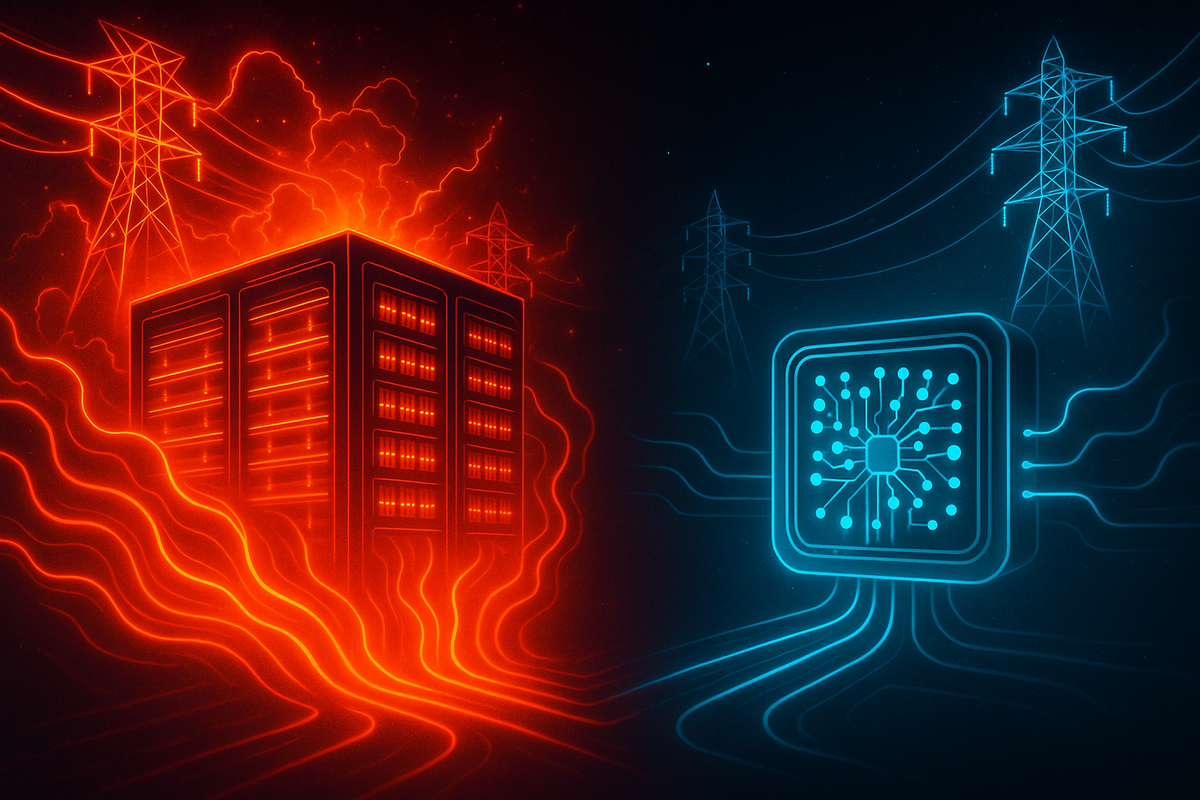
The Energy Crisis of AI: Why Neuromorphic Is Inevitable
Series: Neuromorphic Computing | Part: 6 of 9
Your pocket might hold more computing power than the Apollo program, but it can't run GPT-4. Your brain runs on 20 watts—about the same as a dim lightbulb—while performing tasks that require data centers consuming megawatts. This isn't just an interesting discrepancy. It's the fundamental constraint that will shape the next decade of AI development.
The path we're on is thermodynamically unsustainable. And the alternative isn't a minor optimization. It's a complete architectural revolution—one that silicon has been resisting for decades, but can no longer avoid.
The Exponential Wall We're Hitting
Training GPT-3 consumed roughly 1,287 MWh of electricity. That's equivalent to the annual energy consumption of 120 American homes. GPT-4's training run likely used several times that—OpenAI won't say exactly how much, which tells you something about the scale.
The problem isn't just training. Inference—actually running these models to answer questions—consumes staggering resources at scale. A single ChatGPT query uses approximately 2.9 watt-hours, compared to 0.3 watt-hours for a Google search. When millions of people ask questions daily, those fractions compound into infrastructure that requires its own dedicated power plants.
This is happening while AI capabilities continue to scale. More parameters means better performance, which means larger models, which means exponentially more energy. The Chinchilla scaling laws suggest that optimal training compute should increase roughly linearly with model size—meaning every doubling of capability requires roughly doubling the energy budget.
You can see where this goes. Extrapolate current trajectories and you arrive at models that require nuclear reactor-scale power supplies. AGI built on transformer architectures might literally melt the grid.
The industry response has been to build bigger data centers and negotiate with utilities for dedicated power. Microsoft is reactivating Three Mile Island to power its AI ambitions. This is not a joke—it's the actual plan. When your technology roadmap requires recommissioning nuclear reactors, you've encountered a thermodynamic ceiling, not just an engineering challenge.
Why Traditional Computing Is Fundamentally Inefficient for Intelligence
The core problem is architectural mismatch. Von Neumann architectures—the foundation of conventional computing—separate memory from processing. Every computation requires shuttling data back and forth across what's called the "von Neumann bottleneck." This works fine for many tasks, but it's catastrophically inefficient for the kind of massively parallel, pattern-matching work that brains and AI systems do.
Neural networks exacerbate this problem. Matrix multiplications—the fundamental operation in deep learning—require moving enormous amounts of data between memory and processors. Even with GPUs optimized for parallelism, you're still burning watts to move electrons across silicon representing numbers that will be immediately discarded after a single operation.
Biological neurons don't work this way. They compute where they store. The synaptic weights aren't separate from the processing units—they are the processing units. There's no shuttling of data, no separation between memory and computation. This architecture is called "in-memory computing" or "compute-in-memory," and it's the fundamental reason biological intelligence achieves such absurd efficiency.
The numbers are stark. The human brain performs roughly 10^16 operations per second (one estimate among many contested ones, but directionally correct) using about 20 watts. A GPU performing a trillion operations per second might consume 300 watts. On a per-operation basis, brains are achieving efficiency that's orders of magnitude better than silicon.
This isn't about biology being "better"—it's about different physical constraints producing different architectures. Evolution optimized for efficiency because energy was scarce and brains are expensive. Engineering optimized for speed and precision because electricity was cheap and transistors were abundant. Both succeeded in their contexts.
But the contexts are converging. Energy is no longer cheap at AI scale, and precision often matters less than pattern recognition. We're being forced back toward the architectural principles biology discovered billions of years ago.
Neuromorphic: Computing That Works Like It Thinks
Neuromorphic computing abandons the von Neumann architecture entirely. Instead of clocking synchronized operations across separated memory and processing units, neuromorphic chips implement networks of artificial neurons that communicate through sparse, asynchronous events—spikes.
Spiking neural networks (covered in detail elsewhere in this series) represent information not as continuous numbers but as temporal patterns of discrete events. A neuron fires or it doesn't. Information lives in the timing and pattern of spikes, not in floating-point weights updated in lockstep.
This isn't just a different programming model—it requires different hardware. Intel's Loihi 2 chip contains 1 million artificial neurons and 120 million synapses. Unlike a GPU, these neurons don't all compute simultaneously on every clock cycle. They activate only when they receive input spikes, consuming power only when actually doing work. The chip idles at milliwatts and scales power consumption with computational load.
The efficiency gains are dramatic. On certain tasks—particularly those involving temporal patterns, sensory processing, and control—neuromorphic systems achieve 100x to 1000x better energy efficiency than GPUs running equivalent neural network models. And this is early hardware, far from theoretical limits.
The catch is programmability. GPUs are general-purpose parallel processors that happen to be excellent for neural networks. Neuromorphic chips are specialized for spiking dynamics and event-based computation. You can't just compile existing PyTorch models to neuromorphic hardware—you need different algorithms, different training methods, different ways of thinking about computation.
This is why adoption has been slow. The entire AI software stack is built for continuous, synchronized, differentiable operations. Converting existing models to sparse, asynchronous, spike-based representations is hard, and the tooling is immature. It's easier to buy another GPU.
But "easier" stops mattering when you hit physical limits. And we're hitting them.
Event-Based Everything: Sensors That Don't Waste Energy Watching Nothing Happen
Neuromorphic computing pairs naturally with event-based sensing. Conventional cameras capture full frames at fixed intervals—typically 30 to 60 times per second. Every pixel is read, digitized, and transmitted, regardless of whether anything in the scene changed.
Event cameras work differently. Each pixel operates independently, triggering only when it detects a change in brightness. The output isn't a sequence of frames—it's a stream of asynchronous events marking exactly when and where something moved or changed.
This is dramatically more efficient. A conventional camera processing a static scene burns power capturing and transmitting 30 identical frames per second. An event camera in the same scene produces zero events. Power consumption scales with information, not with time.
More importantly, event cameras match the temporal granularity of neuromorphic processors. Conventional vision systems downsample 60 fps video to feed into neural networks running at 10-30 Hz inference rates. Event cameras provide microsecond-resolution events, which spiking networks can process as they arrive without frame-based buffering.
The combination—event cameras feeding neuromorphic processors—enables vision systems that use milliwatts instead of watts, with lower latency and better temporal resolution. This isn't hypothetical. DVS (Dynamic Vision Sensor) cameras already outperform conventional cameras for high-speed tracking, navigation in low light, and other temporal tasks.
The same principle extends to other modalities. Event-based audio sensors, tactile sensors, even olfactory sensors are being developed. The pattern is consistent: sense only when something changes, compute only when events arrive, consume power proportional to information rather than time.
The Path to Ubiquitous Intelligence
Here's what conventional AI scaling can't give you: intelligence everywhere.
Your wearable can't run a frontier language model because it doesn't have a nuclear reactor in the band. Your drone can't do sophisticated vision because it would run out of battery in minutes. Your IoT sensor network can't coordinate complex responses because transmitting everything to the cloud wastes energy and introduces latency.
The vision of ambient intelligence—AI embedded in every device, environment, and tool—is thermodynamically impossible with current architectures. You can't put a GPU in every room.
But you could put a neuromorphic chip in every device. At milliwatt power consumption, intelligence becomes embeddable. Hearing aids that do real-time speech enhancement and translation. Glasses that provide continuous contextual annotation of the visual field. Wearables that perform sophisticated sensor fusion and health monitoring without burning through batteries in hours.
This is what Intel calls "edge AGI"—general intelligence deployed at the edge rather than centralized in data centers. Not because distributed systems are trendy, but because centralized intelligence can't scale to ubiquity without melting the infrastructure.
The economics flip. Conventional AI scales cost linearly with users—more queries mean more GPUs in data centers. Neuromorphic intelligence scales cost with chip production, which benefits from semiconductor manufacturing economies. The marginal cost of one more intelligent device approaches the cost of the chip itself, not the ongoing energy to run it.
This matters for the developing world, for accessibility, for privacy (processing locally instead of shipping data to cloud), and for resilience (intelligence that works without connectivity). It matters for robotics, wearables, medical devices, and a thousand applications that current AI can't touch because the energy budget doesn't work.
Why the Transition Is Inevitable, Not Optional
The chip industry has known about neuromorphic architectures for decades. Intel, IBM, and academic labs have built research chips. Why hasn't neuromorphic computing already replaced conventional architectures?
Inertia. The entire computing industry—hardware, software, training, deployment—is optimized for von Neumann machines and synchronous, dense operations. Switching architectures means rewriting the stack. That only happens when forced.
We're being forced.
Data center energy consumption already represents 1-2% of global electricity use, and AI is the fastest-growing component. National grids are not expanding fast enough to absorb AI's exponential growth. Energy costs are becoming the dominant factor in AI economics—already exceeding compute amortization costs for large models.
When energy becomes the bottleneck, architectural efficiency becomes the only lever. You can't Moore's Law your way out of thermodynamic constraints. You can't optimize software around a 100x efficiency gap. The only solution is to change the fundamental substrate.
This is what Intel's investment in Loihi, IBM's TrueNorth, BrainChip's Akida, and dozens of neuromorphic startups represent. Not a curiosity. A preparation for the inevitable transition that will happen when conventional scaling breaks.
The transition will be messy. Hybrid systems running conventional transformers for some tasks and neuromorphic networks for others. Gradual migration as tooling matures. Specialized deployment for edge cases before general adoption. This is how architectural transitions happen—slowly, then suddenly.
But the direction is locked in by physics. You can't build ubiquitous intelligence on architectures that consume megawatts per query. You can't scale to AGI on systems that require dedicated power plants. You can only build the future on hardware that works more like brains: sparse, asynchronous, event-driven, and efficient.
Neuromorphic isn't the future because it's clever. It's the future because the alternative is impossible.
What This Means for Coherence at Scale
The neuromorphic transition isn't just a hardware story—it's a story about what kinds of intelligence become possible.
Active inference—the framework connecting biological cognition to the Free Energy Principle—maps naturally onto neuromorphic architectures. Spiking networks implementing predictive processing and error minimization through temporal dynamics are doing, in silicon, what brains do in wetware.
This convergence suggests that neuromorphic systems won't just be more efficient—they'll be better suited for the kinds of embodied, situated, temporally extended cognition that conventional AI struggles with. Robotics. Real-time sensor fusion. Adaptive control. The tasks where biological intelligence still dominates might be exactly the ones where neuromorphic hardware finds its first decisive advantages.
Coherence—in the geometric sense this series explores—requires integrated information processing across scales and modalities. Conventional AI achieves this through massive matrix multiplications in centralized data centers. Neuromorphic AI achieves it through distributed event-driven coupling of specialized modules.
These aren't just different implementations of the same thing. They're different computational ontologies that will produce different kinds of intelligence. Just as biological coherence emerges from electrochemical dynamics we're only beginning to understand, silicon coherence on neuromorphic substrates might surprise us with emergent properties we didn't engineer.
The energy crisis of AI isn't a problem to solve—it's a forcing function pushing us toward architectures that think the way they compute, rather than simulating thought on machines designed for calculation. We're not just building more efficient AI. We're building AI on principles that more closely match the geometry of intelligence itself.
And we don't have a choice. Physics is making the decision for us.
This is Part 6 of the Neuromorphic Computing series, exploring the hardware revolution for brain-like AI.
Previous: Liquid Neural Networks: Computation That Flows Like Water
Next: Neuromorphic Active Inference: Hardware for the Free Energy Principle
Further Reading
- Strubell, E., Ganesh, A., & McCallum, A. (2019). "Energy and Policy Considerations for Deep Learning in NLP." arXiv:1906.02243.
- Davies, M., et al. (2021). "Advancing Neuromorphic Computing with Loihi: A Survey of Results and Outlook." Proceedings of the IEEE.
- Galluppi, F., et al. (2015). "A Hierarchical Configuration System for a Massively Parallel Neural Hardware Platform." Proceedings of CF'15.
- Patterson, D., et al. (2022). "Carbon Emissions and Large Neural Network Training." arXiv:2104.10350.
- Schuman, C.D., et al. (2022). "Opportunities for Neuromorphic Computing Algorithms and Applications." Nature Computational Science.
Comments ()