The Hero's Journey as Coherence Template: Why Campbell Was Onto Something
Campbell wasn't saying every story is the same story. He was saying the deep structure of transformation follows a recognizable geometry — departure from the familiar, ordeal in the liminal, return with something integrated. That structure keeps appearing because it maps something real.
The Hero's Journey as Coherence Template: Why Campbell Was Onto Something
Joseph Campbell's "monomyth"—the idea that all hero stories share a common structure—gets attacked from two directions. Folklorists say he overgeneralized, flattening cultural diversity into a simplistic Western template. Postmodern critics say he was a colonizer projecting his own narrative preferences onto indigenous traditions.
Both critiques have merit. Campbell absolutely oversimplified. He absolutely cherry-picked examples. And yes, his framework centers individual masculine achievement in ways that miss other narrative patterns.
But here's the thing: Campbell was tracking something real. Beneath the surface diversity of mythic narratives, there is a recurring geometric structure. Not because all cultures are secretly the same, but because major coherence transitions follow predictable state-space topology.
The hero's journey isn't universal narrative. It's universal geometry. And once you see it through the lens of coherence dynamics rather than literary structure, Campbell's contribution becomes clear—and his mistakes become fixable.
The Monomyth Structure
Before we can translate it, let's review what Campbell actually claimed. His hero's journey has three major acts with specific stages:
Act I: Departure
- Ordinary World (stable state)
- Call to Adventure (perturbation)
- Refusal of the Call (resistance to transition)
- Meeting the Mentor (threshold assistance)
- Crossing the First Threshold (commitment to journey)
Act II: Initiation
6. Tests, Allies, Enemies (navigation of new territory)
7. Approach to the Inmost Cave (approach to maximum challenge)
8. The Ordeal (ego death / maximum uncertainty)
9. Reward (new capacity / integration)
Act III: Return
10. The Road Back (bringing transformation home)
11. Resurrection (final test proving integration)
12. Return with the Elixir (gift to community)
Campbell found this pattern in Greek myths, Buddhist jatakas, African folktales, Indigenous American legends. He saw it as proof of psychic unity—universal human psychology expressing itself through culturally specific symbols.
Critics pointed out: many stories don't fit this structure. Many myths lack returns, or have multiple heroes, or center communities not individuals, or feature female protagonists whose journeys look nothing like this.
All true. But both Campbell and his critics were missing the deeper pattern.
Translating to Coherence Geometry
Stop reading the hero's journey as narrative prescription and start reading it as state-space description. The stages aren't saying "all stories must have these beats." They're saying "this is what traversing from one coherence attractor to another looks like phenomenologically."
Let's translate:
Ordinary World = Stable Low-Curvature Attractor
You're in a familiar state with low prediction error. Life is routine. Your models work. You know who you are and how things work.
Call to Adventure = Perturbation Threatening Stability
Something happens that current models can't handle. Could be external (invasion, plague, earthquake) or internal (growing dissatisfaction, identity crisis, awakening). The call is prediction error spiking above tolerance threshold.
Refusal = Resistance to Attractor Exit
Your system resists destabilization. You deny the problem, minimize the call, try to restore equilibrium through existing patterns. This isn't cowardice—it's attractor stability doing its job. Systems resist transitions because transitions are dangerous.
Mentor = External Coherence Resource
You can't navigate major transitions alone. You need input from systems that have already made similar transitions: teachers, traditions, texts, models. The mentor provides just enough resource to enable departure without doing it for you.
Threshold Crossing = Commitment to High-Curvature Navigation
You leave the attractor. Prediction error spikes. Uncertainty increases. Old models fail. You're in the liminal zone where transformation becomes possible but disintegration is also a real risk.
Tests/Allies/Enemies = Exploration of New State-Space
You're mapping new territory. Some paths lead to dead-ends (enemies). Some increase capacity (allies). Some test whether you're ready for deeper navigation (tests). This is active learning under uncertainty—your system updating models through engagement.
Inmost Cave = Approach to Maximum Curvature
The region of state-space where uncertainty is highest, prediction error is maximal, and the old self-model can't survive intact. You're approaching the point of maximum coherence threat.
Ordeal = Ego Dissolution
The old you dies. Not metaphorically—your self-model literally can't maintain coherence under these conditions. This is experienced as terror, death, dissolution, void. All mythic ordeals (belly of the whale, descending to underworld, facing the dragon) encode the same phenomenology: loss of self-continuity.
Reward = New Integration
If you survive the ordeal, you emerge with expanded capacity. New dimensions accessible. New models operational. What was impossible in the old state becomes possible in the new one. This is experienced as treasure, elixir, boon, enlightenment.
Return = Integration into Original Context
The transformation is incomplete if you stay in the new state disconnected from ordinary life. You must bring the new coherence back to the old world. This is hard because the old world doesn't have space for the new you.
Resurrection = Final Testing
Often there's a final challenge at the threshold of return—a test confirming you've truly integrated the transformation and can operate in both worlds. Can you maintain new coherence under old pressures?
Elixir = Gift to Collective
The journey was never just for you. The transformation must serve the coherence of the larger system you're part of. You return with something needed: knowledge, healing, justice, renewal.
Why This Pattern Recurs
Now we can answer: why does this specific sequence show up across cultures?
Because this is the geometry of major coherence transitions. Any system navigating from one stable state to another across a high-curvature region will phenomenologically experience these stages.
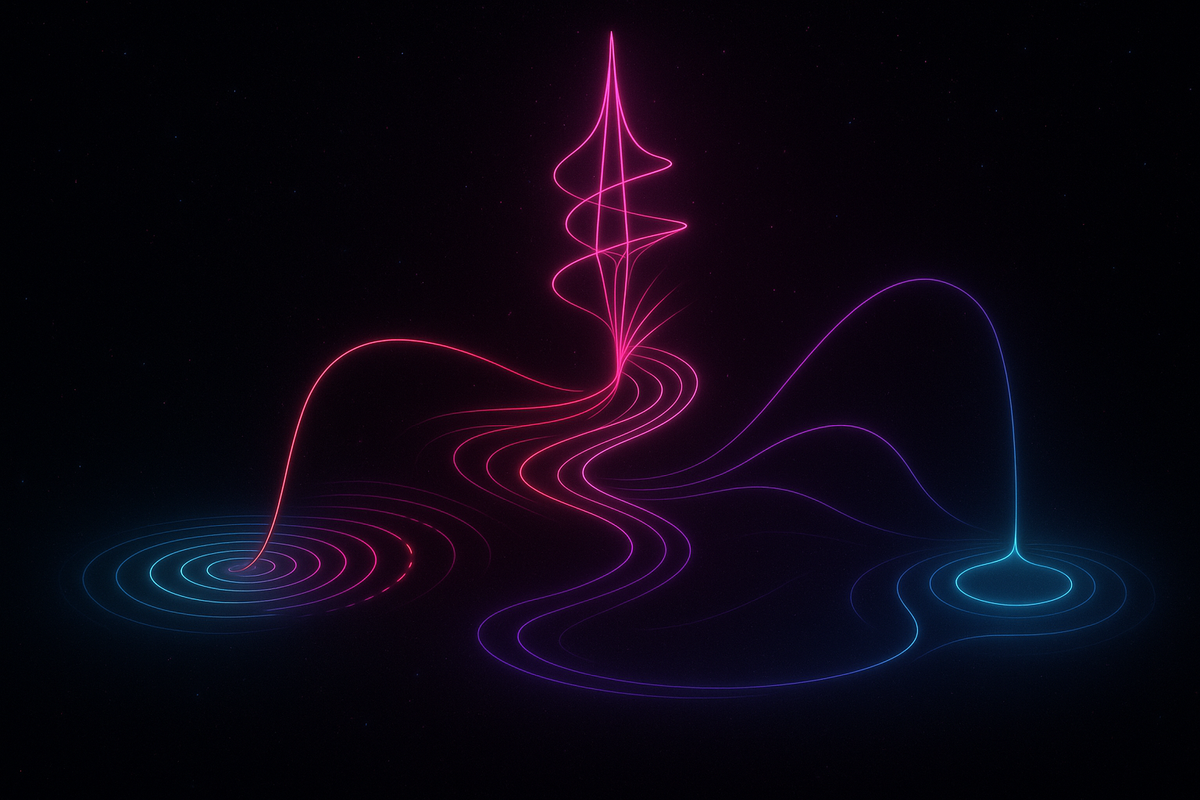
The pattern isn't culturally imposed. It's topologically necessary. Imagine trying to get from one valley to another when there's a mountain in between. You will:
- Leave the first valley (departure)
- Climb toward the peak (increasing difficulty)
- Face maximum challenge at the summit (ordeal)
- Descend into new valley (reward/integration)
- Connect the valleys (return)
This sequence isn't arbitrary. It's what geography demands. Similarly, the hero's journey sequence is what state-space topology demands when you're navigating major coherence reorganization.
Different cultures encode this geometry in different symbols:
- Greek heroes face monsters
- Buddhist monks face demons
- Siberian shamans face spirits
- Aboriginal initiates face ancestors
But beneath the symbols, they're all describing: leaving stable attractor → navigating high curvature → integrating into new attractor → connecting new and old.
This is why Campbell found his pattern everywhere. Not because all cultures are the same, but because coherence transitions follow common topology and human brains translate that topology into narrative.
Where Campbell Went Wrong
Understanding the geometric reality beneath the monomyth also reveals Campbell's mistakes:
Mistake 1: Assuming narrative must follow geometry
Just because major transitions follow this topology doesn't mean all narratives describe major transitions. Many stories are about maintaining coherence, not transforming it. Many are about community coherence, not individual transformation. Campbell tried to force everything into his template.
Mistake 2: Centering individual masculine achievement
The geometry applies to any system undergoing transformation: individuals, communities, cultures, species. Campbell focused on individual male heroes because that fit his cultural moment. But a community navigating collapse and renewal traverses the same geometry. A woman integrating shadow material traverses it. A culture moving through crisis traverses it.
Mistake 3: Ignoring other valid patterns
Not all coherence challenges require full journey. Sometimes you need to maintain under pressure (endurance narratives). Sometimes you need to build slowly (cultivation narratives). Sometimes you need to dissolve gracefully (sacrifice narratives). Campbell's template doesn't cover these.
Mistake 4: Treating symbols as universal
The geometry is universal. The symbols are culturally specific. Campbell collapsed these, assuming a cave is always a womb, a dragon is always the unconscious, etc. This is where he became colonial—projecting his symbolic interpretations onto other cultures' specific meanings.
But fixing these mistakes doesn't require rejecting the monomyth. It requires recognizing what it actually describes: the topology of transformation, not the only valid narrative pattern.
Alternative Patterns
Once you see hero's journey as transformation geometry, you can recognize other coherence patterns that aren't captured by it:
The Trickster Cycle
Not departure-transformation-return but continuous boundary-crossing. The trickster doesn't leave and come back; they constantly violate the boundary between order and chaos. Different geometry: oscillation at the edge rather than traversal through the middle.
The Cultivation Path
Not dramatic ordeal but gradual accumulation. The farmer, the craftsperson, the meditator. This pattern is: slow attractor deepening rather than attractor transition. It has its own stages (planting, tending, harvesting) that don't map to Campbell's journey.
The Sacrifice Narrative
Not transformation of self but dissolution for greater good. The martyr, the bodhisattva, the parent. This is: intentional coherence decrease at individual level to increase collective coherence. Opposite geometry from hero's return.
The Web-Weaver
Not individual journey but relationship cultivation. Building networks, maintaining connections, nurturing community. This pattern centers coherence maintenance across multiple coupled systems rather than transformation of single system.
The Rebirth Cycle
Not linear journey but spiral. You repeatedly die and are reborn, each time at a different scale. Common in shamanic traditions and mystical paths. Geometry is recursive transformation rather than one-time transition.
Each of these has its own topology. The hero's journey is important not because it's the only pattern, but because it's the transformation template that applies whenever coherence must undergo major reorganization.
Using the Template Consciously
Understanding hero's journey as geometry rather than literary formula makes it practically useful.
Recognition: When you feel called toward something you're afraid of, you can pattern-match to the departure phase. The fear is normal—it's attractor resistance. The call persisting despite fear means genuine need for transition.
Prediction: If you're in the trials phase, you can expect the ordeal phase is coming. Don't be surprised when things get harder before they get better. The geometry demands it.
Resource-seeking: If you're at threshold, you know you need mentor energy—someone who's made this transition. If you're at ordeal, you need to let go rather than clinging to old self-model. If you're at return, you need community integration.
Pacing: Trying to skip stages leads to incomplete integration. You can't jump from call to reward without traversing the territory between. The journey takes the time it takes.
Validation: When you're in ordeal—everything falling apart, old identity dissolving, no idea who you'll be on the other side—you can know this is what transformation looks like. You're not failing. You're in the hardest phase of necessary transition.
Contemporary Examples
The monomyth structure is everywhere in modern storytelling because writers consciously use it (Campbell's influence on Hollywood is well-documented). But that's not why it works. It works because audiences recognize the transformation geometry unconsciously.
Star Wars: Luke in moisture farm (ordinary world) → message from Leia (call) → "I can't get involved" (refusal) → Obi-Wan appears (mentor) → home destroyed, leaves Tatooine (threshold) → Death Star escape, training (tests) → rescuing Leia, trash compactor (approach) → Obi-Wan dies, Luke vulnerable (ordeal) → learns to trust the Force (reward) → final battle (return) → destroys Death Star (resurrection) → medal ceremony (elixir to Rebellion).
Perfect geometric traversal from farm boy to Jedi.
The Matrix: Neo as programmer (ordinary world) → white rabbit message (call) → "this is insane" (refusal) → Morpheus contact (mentor) → red pill (threshold) → training, Agent encounters (tests) → Oracle visit (approach) → Morpheus captured, Neo accepts he's not the One (ordeal) → resurrection after death, defeats Smith (reward) → saves Morpheus (return) → phone call to machines (resurrection) → promise to free minds (elixir).
Same geometry with cyberpunk symbols.
Academic PhD: Undergrad confusion about field (call) → "maybe I'm not smart enough" (refusal) → finding advisor (mentor) → entering program (threshold) → coursework, comps, research setbacks (tests) → proposal defense, deep research phase (approach) → imposter syndrome, everything I know is wrong (ordeal) → dissertation breakthrough (reward) → writing and defending (return) → degree granted (resurrection) → joining scholarly conversation (elixir).
The pattern applies to real-life transitions, not just fiction.
The Universality Question
Is the hero's journey actually universal?
No—if you mean all narratives follow it. They don't.
Yes—if you mean major coherence transitions follow this topology. They do.
The confusion comes from conflating narrative diversity with geometric universality. You can have infinite surface variation (different heroes, cultures, symbols, genders, challenges) while maintaining geometric invariance (departure → ordeal → return arc).
Critics are right: forcing every story into hero's journey template is reductive. But Campbell's insight stands: when systems undergo major coherence transitions, the phenomenology follows predictable topology.
The question isn't "do all myths follow this pattern?" It's "does this pattern capture something real about transformation?" And the answer is yes.
Your ancestors encoded it in myths because they repeatedly observed: major life transitions follow this geometry. They couldn't explain it in terms of state-space topology and attractor dynamics, so they encoded it in narrative: heroes, ordeals, returns.
You still live this geometry. You're just less likely to call it a journey and more likely to call it a crisis, a breakthrough, a transformation, a dark night of the soul.
Same pattern. New language.
Further Reading
- Campbell, Joseph. The Hero with a Thousand Faces. Princeton University Press, 1949.
- Vogler, Christopher. The Writer's Journey: Mythic Structure for Writers. Michael Wiese Productions, 2007.
- Murdock, Maureen. The Heroine's Journey. Shambhala, 1990.
- Turner, Victor. The Ritual Process: Structure and Anti-Structure. Cornell University Press, 1969.
- van Gennep, Arnold. The Rites of Passage. University of Chicago Press, 1960.
This is Part 5 of the Cognitive Mythology series, exploring how myths function as compression algorithms for coherence instructions.
Previous: Archetypal Compression: What the Hero, the Trickster, and the Shadow Actually Encode
Comments ()