The Hip-Hop Cypher: A Case Study in Spontaneous Ritual
No one wrote the rules of the cypher. They assembled spontaneously and then stabilized — because they work. Circle, beat, MC, response, escalation, peak. It's the same structural sequence found in ritual traditions worldwide, arrived at independently through practice.
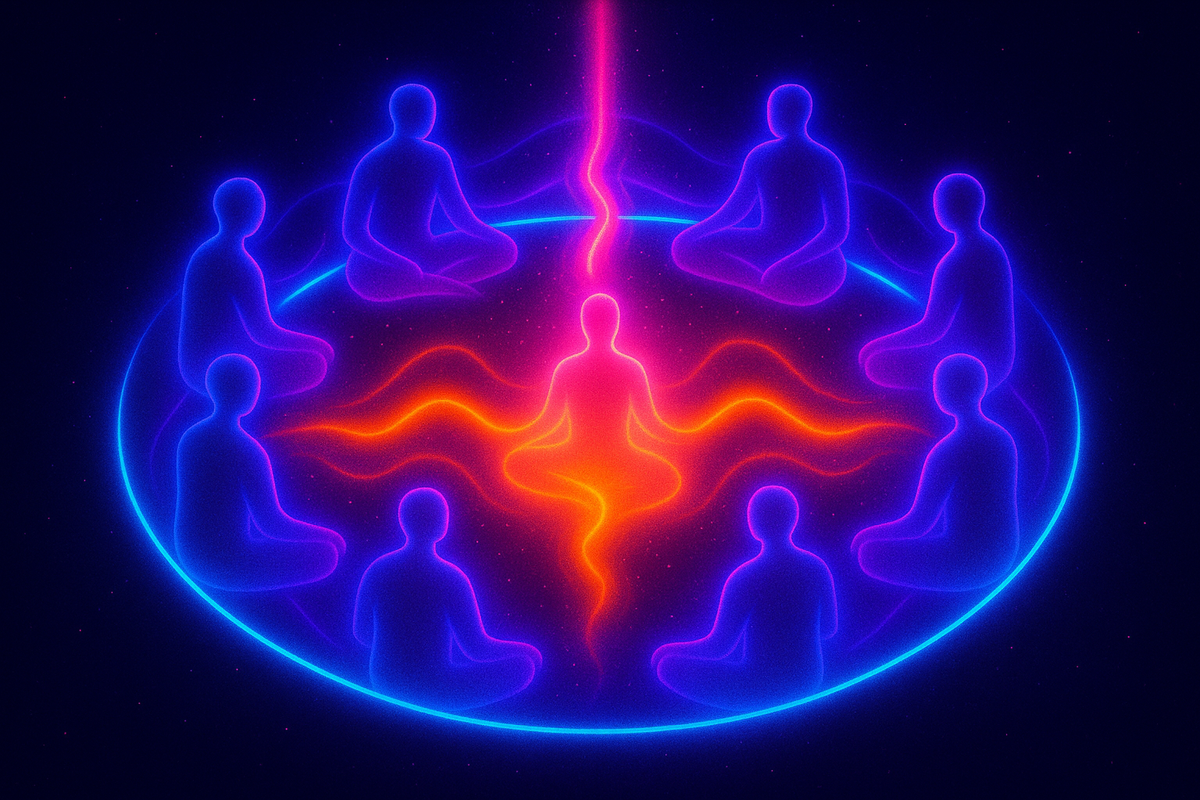
The Hip-Hop Cypher: A Case Study in Spontaneous Ritual
Series: Ritual Entrainment | Part: 9 of 11
A basement in the Bronx, 1978. A circle of teenagers forms around a beatboxer providing steady rhythm. One steps into the center, freestyling verses for sixteen bars while others nod, gesture, and vocalize support. When the first finishes, another immediately picks up the flow. No plan, no script, perfect coordination. The beat never stops. The circle holds for hours.
This is the cypher—hip-hop's spontaneous ritual technology. It looks like casual jam session, but structurally it's as sophisticated as any traditional ceremony. Circle formation, turn-taking protocol, rhythmic foundation, call-and-response, competitive-but-cooperative participation, witness role, entry and exit markers.
The cypher isn't just where freestyling happens. It's a complete ritual system that spontaneously implements all the core principles of entrainment. And because it emerged organically from urban youth culture rather than ancient tradition, it reveals something fundamental: ritual structure isn't arbitrary cultural overlay. It's emergent from the physics of collective synchronization.
When humans gather to create something together, the same patterns reassert themselves every time.
The Geometry of the Circle
Why does the cypher form a circle rather than audience rows, a stage, or scattered clusters?
Because circles maximize mutual coupling.
In a circle, everyone sees everyone. Your peripheral vision captures the whole group. Mirror neurons fire not just to the center performer but to the swaying, nodding, gesturing witnesses around the circle. Visual feedback loops create all-to-all coupling.
The circle has no hierarchy—no front row, no VIP section, no backstage. Everyone occupies equivalent space. Participants are simultaneously performer (when in center) and audience (when witnessing). The role rotation maintains egalitarian structure.
The circle creates acoustic resonance. Sound reflects back from bodies, concentrating in the center. The beatboxer in the middle gets natural amplification. Everyone hears everyone else's contributions clearly.
The circle defines inside from outside. You're either in the cypher or you're not. Clear boundary, no ambiguity. This creates the container that makes ritual work—protected space where different rules apply.
Traditional rituals discovered this independently across cultures: prayer circles, drum circles, healing circles, ceremonial dance circles, King Arthur's round table. The geometry solves the same functional problem: maximum mutual awareness and egalitarian structure for collective synchronization.
Rhythm as Foundation: The Beat Never Stops
Every cypher has rhythmic foundation—beatboxing, looped beat, instrumental track, or just hand-clapping and foot-stomping. The specific source doesn't matter. What matters is consistency.
The beat provides temporal structure that everyone entrains to. It's the carrier wave for all other activity. Without steady rhythm, the cypher dissolves—people talk over each other, timing drifts, coordination collapses.
Watch an experienced beatboxer holding down a cypher. They're not doing solos or showing off. They're maintaining unwavering pulse, often for hours. The service role is sacred—without the beat, nothing else works.
The rhythm also manages turn-taking. Sixteen bars is standard—four sets of four-beat measures. This creates predictable windows: you know when the current MC will finish, when space opens for the next, how long you have if you enter.
The rhythm prevents gaps and overlaps. One MC finishes on the measure; the next enters on the downbeat. No awkward silence, no talking over each other. The beat coordinates temporal slots as precisely as a traffic signal.
This is computational—the rhythm implements a distributed algorithm for managing shared resources (attention, airtime) without central coordination. The beat is the clock; the protocol is implicit but universally understood.
Turn-Taking Protocol: Emergence of Order
No one assigns turns. No one decides who goes next. Yet cyphers run smoothly with dozens of participants rotating through without confusion. How?
Implicit readiness signaling. Body language indicates who's preparing to enter—moving toward the circle's center, making eye contact with current performer, shifting weight forward. Others read these cues and defer if they're not as committed.
Respect for completion. You let the current person finish their sixteen bars (or however long the norm is for that cypher). Interrupting is violation. The rhythm enforces this—trying to enter mid-verse creates obvious discord.
Energy matching. If someone comes in hot with aggressive energy, the next person often matches or escalates. If someone brings playful energy, the next often plays off it. The emotional tone passes through the rotation, creating narrative continuity without planning.
Challenge and response. Sometimes a person's verse includes a challenge—calling out the next person, setting up a theme, creating tension that demands resolution. This creates obligatory next turn, maintaining momentum.
Silence as space. If no one enters immediately after someone finishes, the beat continues. This is invitation—the gap is opportunity, not failure. Someone will enter. Patience maintains rather than breaks the flow.
The result is spontaneous order. No rules are stated, yet the system self-organizes. This is what happens when humans interact within clear rhythmic structure and shared spatial configuration. Coordination emerges.
Call-and-Response: The Congregation Participates
The cypher isn't solo performance with passive audience. It's collective creation where witnessing is active participation.
Vocal affirmation. "Ooh!" "Yeah!" "Uh!" "Word!" Vocalizations punctuate strong lines, signaling appreciation and keeping energy high. These aren't interruptions—they're part of the fabric, woven between the bars.
Physical response. Head nodding, hand gestures, facial expressions, body movement. The circle isn't still—it's animated, pulsing, breathing together. Visual feedback tells the performer they're landing.
Building on previous content. MCs reference what earlier participants said, creating through-lines. Inside jokes emerge. Themes develop. The cypher becomes collaborative composition rather than sequential solos.
Energy regulation. If energy drops, the circle intensifies response—louder affirmations, more movement, creating social pressure and support for the performer to elevate. If someone's struggling, the circle often softens, giving space and encouragement.
The beatboxer is also in dialogue—sometimes increasing intensity under a hot verse, pulling back to let voice dominate, adding flourishes that accent clever lines.
Everyone is implicated. You can't spectate in a cypher—your presence matters, your energy contributes, your attention shapes what happens. Passivity is felt as absence.
This is liturgy—the congregation's responses aren't optional decoration. They're structural elements that make the ritual work.
Competition and Communion: Paradox Resolved
Cyphers are simultaneously competitive and cooperative. MCs try to outdo each other—better wordplay, more complex rhymes, harder delivery. Yet they also support each other—giving props, building on themes, maintaining collective energy.
This seems paradoxical until you understand the structure.
Competition serves the collective. Trying to be better than the last person raises the overall level. Everyone benefits from the escalation. The challenge pushes participants to access capabilities they wouldn't reach alone.
There's no winner. Unlike a battle (which is different format), the cypher doesn't declare outcomes. You shine, then return to the circle as witness. No trophy, no ranking, just the momentary glory of a hot verse appreciated by peers.
Support doesn't mean absence of judgment. Weak verses get muted response. Falling off beat gets called out. Recycled lines get dismissed. But the feedback is immediate and social, not punitive. You can try again next rotation.
The beat belongs to everyone. You're competing for excellence within shared structure. It's not zero-sum—your brilliance doesn't diminish others. It elevates the whole cypher, which elevates everyone.
This resolves the competition-cooperation paradox: high standards plus collective ownership. You push yourself for the group's sake. The group's energy enables your peaks.
Sports can work this way—pickup basketball, jam band sessions, improv theater. Competitive excellence within cooperative structure. The cypher just makes it explicit.
The Freestyle State: Where Thought Becomes Sound
Experienced MCs describe freestyle as altered state. The words flow without conscious composition. The rhyme comes before you know what you're saying. The rhythm carries you.
This is real—neuroimaging studies of freestyle rap show decreased activity in dorsolateral prefrontal cortex (executive control, self-monitoring) and increased activity in medial prefrontal cortex (self-referential processing) and motor regions.
In other words: the parts of the brain that normally monitor and edit language quiet down. The parts that generate spontaneous self-expression and coordinate motor output light up.
This is the flow state athletes and musicians describe—action without conscious deliberation, performance beyond normal capacity, timelessness, loss of self-consciousness.
But crucially, it's facilitated by the ritual structure. The beat provides external rhythm so you don't have to consciously maintain timing. The circle provides social support so you're not alone on stage. The turn-taking gives clear boundaries so you don't have to decide when to start or stop. The call-and-response gives continuous feedback so you know what's landing.
The structure holds space for the spontaneous. This is what ritual does—creates containers within which humans can access states they can't reliably reach through individual effort.
The freestyle state is partial ego dissolution—the verbal self-monitoring system releases, allowing pre-conscious linguistic processes to surface. But unlike solitary meditation or psychedelic ego dissolution, this happens in social context, synchronized to the collective.
Your consciousness couples to the cypher's rhythm and energy. You're still you, but you're also the circle—drawing from their energy, creating for them, held by the structure they maintain.
Entry and Exit: Threshold Management
Cyphers don't start abruptly or end suddenly. They have phase transitions—gradual formation and dissolution.
Formation: A few people gather. Someone starts a beat. Others nod along, feel it out. One person might test the waters with a few bars. If it lands, others move closer, the circle tightens, and the cypher coheres. If energy isn't there, people drift off without commitment.
Maintenance: Once established, the cypher becomes stable attractor. New people can join—moving into the circle, waiting for appropriate moment to enter a turn. Existing participants can leave—stepping back during someone else's verse, no ceremony needed.
Dissolution: Energy naturally wanes. Verses get shorter or less inspired. Gaps lengthen. People start talking between turns. Someone says "Yo, I gotta bounce," and others agree. The beat stops. The circle opens. No formal ending, just gradual return to ordinary interaction.
This is good threshold management—allowing natural entry and exit without demanding binary commitment. You can dip in, test the water, see if it's your moment. You can leave when you need to without breaking the ritual for others.
Compare to traditional church service: fixed start time, fixed duration, walking out mid-service is conspicuous violation. The rigidity serves different function (communal coordination) but reduces individual autonomy.
The cypher's flexibility makes it more accessible and sustainable. It can happen anywhere, anytime, with whoever's present. It scales from three people to thirty. It lasts as long as energy sustains it.
This is ritual optimized for spontaneity and urban context—no need for scheduled gathering, dedicated space, or formal organization.
What the Cypher Reveals
The hip-hop cypher is accidentally perfect case study in emergent ritual because:
-
No ancient tradition to copy. It developed in late 20th century urban America, not 5000 years of institutional refinement. The form emerged from functional requirements, not cultural inheritance.
-
Created by teenagers. The founders weren't scholars of comparative religion or trained ceremonialists. They were kids making do with what they had.
-
Secular and street. No gods, no sacred texts, no explicit spiritual framework. Just rhythm, words, competition, and community.
-
Fully functional. Despite lacking traditional elements, it works—creates powerful bonding, enables flow states, generates meaning, builds community, transmits culture.
-
Widespread adoption. The cypher format spread globally, adapting to different languages and cultures while maintaining core structure. This suggests the form solves universal problems, not just local needs.
If ritual structure were arbitrary cultural artifact, we wouldn't expect teenagers in the Bronx to independently discover the same patterns as Sufi mystics or Buddhist monks. But they did, because the patterns aren't arbitrary—they're emergent from the physics of collective human synchronization.
The cypher gives us ritual in its purest form: humans + rhythm + circular space = spontaneous order, collective coherence, and transcendent moments.
Everything else is elaboration.
This is Part 9 of the Ritual Entrainment series, exploring how rhythmic practices synchronize nervous systems and generate collective meaning.
Previous: Digital Rituals: Can Entrainment Work Without Bodies in the Same Room
Next: Building Effective Ritual: Design Principles for Collective Coherence
Further Reading
- Alim, H. S., Ibrahim, A., & Pennycook, A. (2008). Global Linguistic Flows: Hip Hop Cultures, Youth Identities, and the Politics of Language. Routledge.
- Braxton, R. C., & Peoples, W. A. (2006). "The cipherology: Knowledge, identity, and authority in hip-hop." Ethnography, 7(1), 51-73.
- Liu, S., Chow, H. M., Xu, Y., Erkkinen, M. G., Swett, K. E., Eagle, M. W., ... & Braun, A. R. (2012). "Neural correlates of lyrical improvisation: an fMRI study of freestyle rap." Scientific Reports, 2(1), 1-7.
- Schloss, J. G. (2009). Foundation: B-boys, B-girls, and Hip-Hop Culture in New York. Oxford University Press.
- Morgan, M., & Bennett, D. (2011). "Hip-hop & the global imprint of a black cultural form." Daedalus, 140(2), 176-196.
Comments ()