The Hydrogen Anchor Revisited: From Atoms to Coherence in One Geometric Principle
Structural coherence as a universal principle: from the hydrogen atom's barbell geometry to neural oscillations, psychological integration, and cultural persistence.
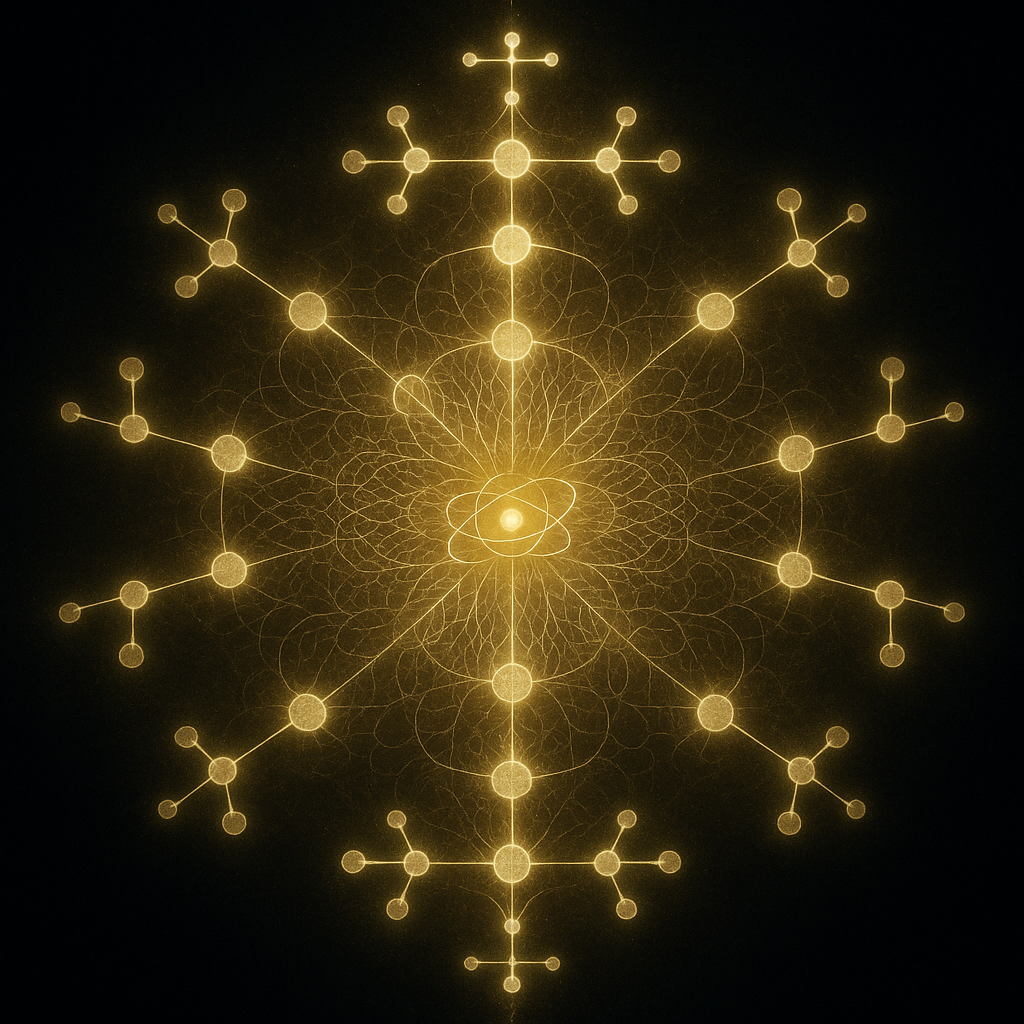
The Hydrogen Anchor Revisited: From Atoms to Coherence in One Geometric Principle
Formative Note
This essay represents early thinking by Ryan Collison that contributed to the development of A Theory of Meaning (AToM). The canonical statement of AToM is defined here.
We began with hydrogen.
One proton. One electron. The simplest atom. The first structure that ever held together in the universe. Everything else—every heavier element, every molecule, every cell, every organism, every mind—is built from this foundation.
Hydrogen is where coherence begins.
Not metaphorically. Literally. The hydrogen atom maintains its structure against the forces that would tear it apart. The electron is bound to the proton by electromagnetic attraction, held in quantum orbitals, stable across time. The first persistence. The first maintenance of form.
Everything since has been variations on this theme. More complex structures, more elaborate constraints, more sophisticated persistence. But the same geometric principle: coherence under constraint.
We've spent twenty articles unpacking this principle at the level of minds. Manifolds that belief states inhabit. Curvature that measures sensitivity. Topology that constrains trajectories. Functors that carry structure across scales. Constructors that perform coherence tasks. The full apparatus of the mathematics of meaning.
Now let's tie it back. Let's see how the hydrogen anchor holds the whole edifice—how the same geometric logic runs from atoms to coherence in one continuous thread.
The Structure of Hydrogen
Hydrogen is so simple it's almost trivial. And yet.
The proton sits at the center, massive and stable. 99.95% of the atom's mass. The nucleus. The anchor.
The electron orbits—or rather, exists in probability clouds around the proton. 0.05% of the mass. Light. Reactive. The part that connects to other atoms, that forms bonds, that does chemistry.
Between them: nothing. A forbidden middle. Quantum mechanics doesn't allow the electron to exist at arbitrary distances from the proton. It must occupy discrete energy levels—quantum orbitals. The electron is either in the ground state or it jumps to an excited state. There's no stable in-between.
This creates a peculiar structure. Heavy anchor. Light explorer. And a discontinuous middle where stable existence is impossible.
The hydrogen atom persists because the binding energy exceeds the perturbations. The electromagnetic attraction between proton and electron is strong enough to maintain the structure against thermal noise, against collisions, against the constant pressure to fall apart. The atom is a stable configuration—a coherent structure under constraint.
The Barbell Geometry
Hydrogen's structure is a barbell. Weight at one end (the proton). Weight at the other end (electron in ground state or in excited state). A thin bar in between (the discontinuous middle).
This barbell geometry is not incidental. It's the simplest stable geometry under the relevant constraints. Given electromagnetic attraction and quantum mechanics, hydrogen must have this shape.
And here's the startling claim: this shape recurs.
Not because higher systems copy hydrogen. But because the same geometric logic—coherence under constraint, stable configurations as attractors—produces the same shapes at every scale.
Neural dynamics. Neurons fire in barbell patterns—resting potential, then action potential, then back to rest. The "middle" states are unstable. The dynamics jump discontinuously from one stable state to another. The barbell shape appears because the same logic applies: coherence requires discrete stable states, not continuous intermediate ones.
Attention patterns. Attention oscillates—focused engagement, then diffuse processing, then focused again. Sustained moderate attention is metabolically expensive and cognitively unstable. The stable configurations are at the ends of the barbell, not in the middle.
Relationship dynamics. Secure relationships operate in barbell mode—safety/stability as the baseline anchor, then excursions into novelty/meaning, then return to base. Relationships that try to live in the middle—chronic moderate uncertainty—are unstable. The geometry recurs.
Organizational patterns. Stable organizations have barbell structure—bureaucratic stability as the anchor, then innovation projects as the explorer, then consolidation back to stability. Organizations attempting continuous moderate change—always somewhat stable, always somewhat changing—tend to collapse.
The barbell isn't a metaphor applied across domains. It's a geometric truth emerging from the logic of coherence itself. When systems must maintain structure under constraint, barbell configurations are where they end up.
The Incoherent Middle
Psychology is haunted by middle-worship.
"Balance." "Moderation." "The golden mean." The assumption that the healthy place is between extremes, that stability lives in the middle, that we should aim for the center of every distribution.
The geometry says otherwise.
The middle is often the incoherent region. The place where no stable configuration exists. The space between hydrogen's electron orbitals where no electron can persist.
Burnout is the incoherent middle. Neither rested nor productively engaged. Chronic moderate depletion that never reaches the extreme of collapse (which might force recovery) or returns to the baseline of rest. Stuck in the middle, where there's no stable configuration.
Ambivalence is the incoherent middle. Neither committed nor clearly rejected. Chronic moderate investment that never reaches the extreme of full engagement (which might produce meaning) or the baseline of withdrawal (which might allow reorientation). Stuck between states that would at least be stable.
Bureaucratic drift is the incoherent middle. Neither preserved tradition nor completed transformation. Chronic moderate change that never achieves the stability of what was or the new stability of what might be. Organizations in permanent transition, which is to say, in permanent instability.
The incoherent middle isn't always wrong. Sometimes systems must pass through it to get from one stable configuration to another. Sometimes the middle is transition, and transition is necessary.
But the middle isn't where to live. It's where to pass through. The geometry says: find your anchors. Find your stable configurations. The health is at the ends of the barbell, not in the bar between them.
Constraint and Stability
Why does the barbell shape keep appearing?
Because coherence requires constraint, and constraint creates stability at discrete configurations rather than continuous ranges.
Consider: if any configuration were equally stable, there would be no structure. Everything would be as good as everything else. The system would wander randomly through state space with no tendency to persist at any location.
Constraint creates preference. Some configurations satisfy the constraints better than others. Those configurations become attractors—places the system tends toward, places it stays when it reaches them.
When constraints are strong, the attractors are few. The vast middle of state space is unstable. Only special configurations can persist.
Hydrogen's constraints are electromagnetic attraction and quantum mechanics. The stable configurations are the electron orbitals. Everything else is unstable.
Psychological constraints are metabolic costs, prediction error pressure, social demands. The stable configurations are the barbell ends—baseline states and peak states. The middle is unstable because it doesn't satisfy the constraints as well as the ends do.
This is the geometric logic. Constraint creates stability. Stability creates attractors. Attractors tend toward barbell distribution. The shape is a consequence of the principle.
The Scale Jump
Hydrogen to neurons to minds to relationships to cultures.
How does the structure propagate across such different scales?
The answer we've been developing: functors. Structure-preserving maps between categorical levels. The shape that appears at the level of physics maps to the shape that appears at the level of biology maps to the shape that appears at the level of psychology. The mapping isn't exact copying; it's structure preservation.
What's preserved? The barbell geometry. The incoherent middle. The attractor structure under constraint. These features are what functors carry.
What's lost? The specific implementation. The particular mechanism. The detailed dynamics. These features are scale-specific; they don't propagate.
This is why the same pattern appears at every scale without the scales being identical. The pattern is the abstract geometry. The instantiation is scale-specific. The functor connects them—carrying the geometry, losing the particulars.
From hydrogen to mind is not reduction. We're not saying minds are "really" hydrogen atoms. We're saying minds and hydrogen atoms share geometric structure because they share the logic of coherence under constraint. Different mechanisms implementing the same pattern. Different constructors performing analogous tasks.
Coherence All the Way Down
And up.
The claim isn't just that coherence appears at multiple scales. It's that coherence is the same thing at all scales—the maintenance of structure under constraint, instantiated differently at different levels, but unified by the geometry that all instantiations share.
At the hydrogen scale: electromagnetic binding maintaining atomic structure.
At the cellular scale: metabolic processes maintaining cellular integrity.
At the neural scale: oscillatory synchronization maintaining cognitive integration.
At the psychological scale: belief-updating and regulation maintaining identity coherence.
At the relational scale: attunement and repair maintaining dyadic coherence.
At the organizational scale: communication and process maintaining institutional coherence.
At the cultural scale: narrative and ritual maintaining collective coherence.
Same geometry. Different substrates. Connected by functors.
The coherence operator we discussed—Ĉ[q], the integral that combines curvature, divergence, and topology—applies at every level. Its value at the neural level constrains its value at the psychological level. Its value at the individual level shapes its value at the relational level. The operator tracks the same thing across scales because coherence is the same thing across scales.
This is the unity that the mathematics reveals. Not metaphorical resonance but structural identity. Coherence is the thread that runs through everything, from hydrogen to meaning.
What We've Built
Let me summarize the architecture we've constructed across these twenty articles.
The manifold foundation. Belief states form a space—a statistical manifold. This space has geometry: a metric (Fisher information) that measures distances, curvature that measures sensitivity, topology that captures global structure. The manifold is real, not metaphorical.
The coherence tuple. Coherence is a multidimensional property: curvature smoothness (κ), dimensional stability (d), topological persistence (H_k), cross-frequency coupling (ρ). These components can be individually assessed; together they describe how well a system holds together.
The dynamics. Systems move through their manifolds. Geodesics are the natural paths. Attractors are stable configurations. Trajectories can be smooth or turbulent, constrained or free. The dynamics have geometry.
The failures. Trauma is geometric deformation—curvature spikes, dimensional collapse, topological fragmentation, hysteretic warping. Incoherence is high Ĉ. The failures have structure, which means they have characteristic signatures and characteristic repairs.
The cross-scale structure. Functors connect levels. Categories describe what structure is. Natural transformations describe how different approaches relate. The categorical framework makes cross-scale analysis precise.
The constructor view. Systems are constructors performing coherence tasks. The task can succeed or fail. The constructor can be damaged or repaired. Life is ongoing construction.
The possibility dimension. Meaning lives partly in actuality, partly in possibility. The geometry of counterfactuals shapes meaning as much as the geometry of actuals. Agency is structure in possibility space.
The reality claim. This is architecture, not metaphor. The structure is really there. It's measurable, predictable, falsifiable. The mathematics of meaning is mathematics.
This is the edifice. Twenty articles building one structure: the geometry of coherence, from hydrogen to meaning.
What the Mathematics Gives Us
What do we gain by describing meaning geometrically?
Precision. Vague concepts become precise. "Coherence" is no longer a metaphor; it's a measurable quantity with components. "Trauma" is no longer just suffering; it's specific geometric deformation. "Healing" is no longer just feeling better; it's specific geometric repair.
Prediction. Geometry constrains dynamics. If we know the geometry, we know something about what's possible and what's not. Predictions become possible—not exact predictions (the systems are too complex) but constrained predictions. Better than nothing.
Unification. The same patterns everywhere. Not mysterious resonance but structural identity. Understanding coherence at one level gives leverage on coherence at other levels. The silos between disciplines become permeable.
Intervention. Knowing the geometry tells you where to push. If the problem is curvature spike, the intervention is curvature smoothing. If the problem is topological fragmentation, the intervention is bridge-building. Geometry guides action.
Meaning itself. The mathematics doesn't just describe meaning; it is meaning. Coherence under constraint is what meaning is. The geometry is the architecture of mattering. To understand the geometry is to understand what it is for things to mean.
What Remains Unknown
The architecture is incomplete.
We don't know the exact metric on psychological state spaces. We don't know the precise topology of attractor basins. We don't know the detailed functor structure connecting scales. We don't know how to measure the coherence operator directly.
The geometry is real, but our knowledge of it is partial. The map is incomplete. Large territories remain unmapped.
This is where the work is. Empirical work: measuring coherence signatures in physiology, language, behavior. Theoretical work: refining the mathematical framework, improving the precision. Practical work: developing interventions that target geometric features.
The mathematics of meaning is early-stage. We're at the beginning, not the end. What these twenty articles provide is a sketch of the architecture, a framework for further investigation, a vocabulary for the work ahead.
The shape is visible. The details remain to be filled in.
The Return to Hydrogen
We end where we began.
Hydrogen. The first atom. The simplest coherence. One proton and one electron, bound by forces, maintaining structure, persisting through time.
Everything since is elaboration. More complex constraints, more elaborate binding, more sophisticated persistence. But the principle is unchanged: coherence under constraint. The structure that holds together against the pressure to dissolve.
When you maintain your identity through difficulty—when you integrate experience rather than fragment—you're doing what hydrogen does. Different mechanism, same geometry. Different scale, same logic.
When two people attune and synchronize—when a relationship coheres rather than dissolves—they're doing what hydrogen does. Binding. Persisting. Maintaining structure.
When a culture preserves its meaning across generations—when narratives hold and institutions persist—it's doing what hydrogen does. Coherence at scale. Pattern across time.
The geometry is ancient. It was here before minds existed. It will be here after minds are gone. The mathematics of meaning is older than meaning, older than mathematics, older than anything that could understand it.
We are not imposing structure on chaos. We are discovering the structure that was always there. The geometry exists independent of our description. What we've done is name it.
Meaning is coherence under constraint. Coherence has geometry. The geometry runs from hydrogen to human and beyond. This is the mathematics of meaning.
Comments ()