The Missing Half of Evolution: Why Culture Changes Everything
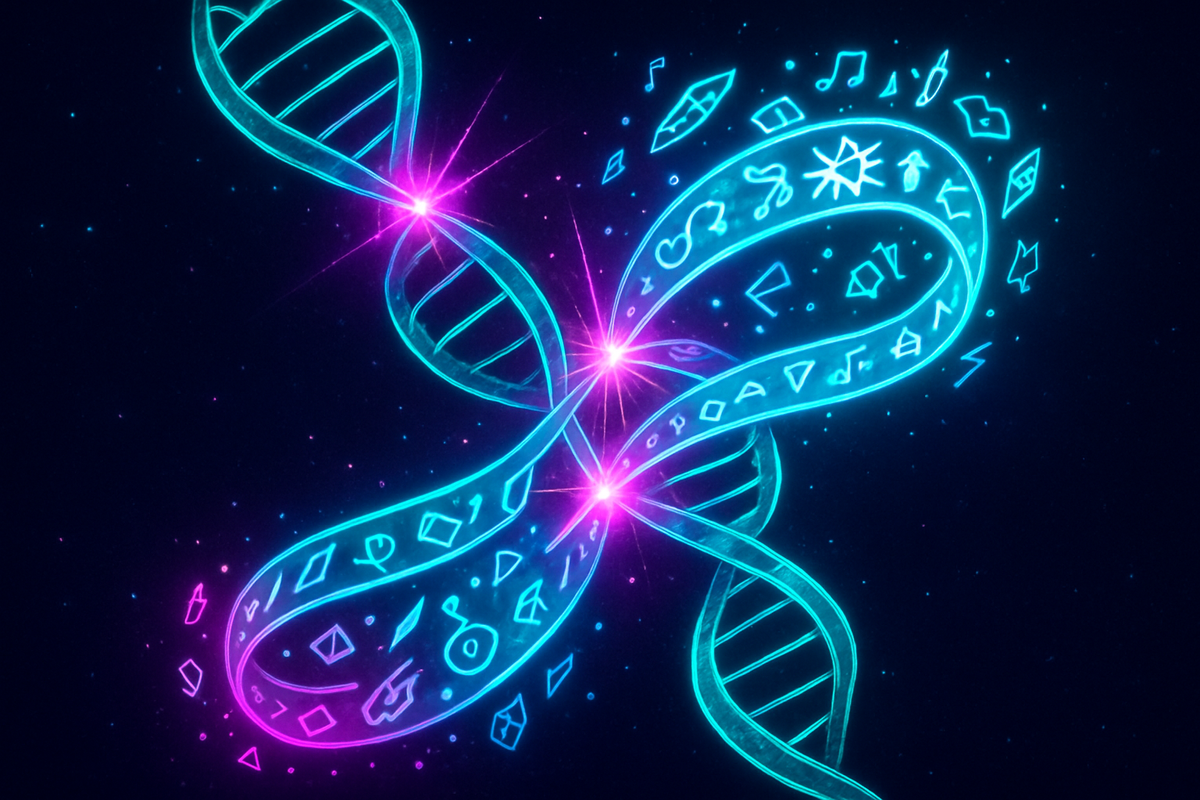
Standard evolutionary theory explains the body. But human uniqueness — language, cumulative technology, moral systems — requires a second inheritance system: culture. Gene-culture coevolution shows how biological and cultural evolution loop back on each other in ways neither can explain alone.
The Missing Half of Evolution: Why Culture Changes Everything
Series: Gene-Culture Coevolution | Part: 1 of 9
There's a profound asymmetry in how we think about human evolution. Ask someone what makes humans unique, and they'll tell you about opposable thumbs, big brains, bipedalism. These are the biological answers—the genetic inheritance we carry in our DNA. But this is only half the story.
The other half is harder to see because it doesn't live in bodies. It lives in practices, stories, technologies, and social structures. It lives in the fact that you're reading these words in a language you learned, using concepts no one was born knowing, on a device that required thousands of accumulated innovations to create.
This is cultural inheritance—and it doesn't just add to genetic evolution. It fundamentally changes how the evolutionary game works.
Why Standard Evolution Can't Explain Us
Standard Darwinian evolution is elegant in its simplicity. Genes that help organisms survive and reproduce become more common. Genes that don't, disappear. Variation happens through random mutation. Selection happens through differential reproductive success. Over geological time, you get adaptation.
This works beautifully for explaining finch beaks, bacterial resistance, and peacock tails. But it fails spectacularly at explaining humans.
Consider: How did humans come to dominate every terrestrial ecosystem on Earth—from Arctic tundra to tropical rainforest to desert—without evolving distinct subspecies adapted to each environment? How do we explain the explosion of behavioral diversity across human cultures when our genomes are nearly identical? Why does a child born in one culture and raised in another adopt the second culture's practices entirely, despite their genetic ancestry?
The answer: because humans have a second inheritance system running in parallel to our genes. We inherit not just DNA but culture—and culture evolves on a completely different timescale with completely different rules.
Two Streams, One Species
This is the insight at the heart of gene-culture coevolution theory, developed most systematically by Robert Boyd, Peter Richerson, and Joseph Henrich. Humans don't just evolve biologically. We evolve culturally. And critically, these two systems don't just run side by side—they feed back on each other.
Cultural practices can create selection pressures that favor certain genes. And genetic changes can enable new forms of cultural transmission. The result is a dual inheritance system where biology and culture become deeply entangled.
The technical term is gene-culture coevolution. But what it really means is that humans are evolution's experiment in creating a species that can rewrite its own selection pressures through learning and social transmission.
The Proof Is Everywhere
Once you see the dual inheritance framework, the evidence becomes overwhelming.
Language is a perfect example. No infant is born speaking. But every neurotypical child raised in a linguistic community acquires language with stunning reliability. The capacity for language—the neural architecture, the vocal apparatus, the cognitive machinery—is genetic. But which language you speak, what concepts your language makes easy to express, how your language structures thought—this is cultural inheritance, transmitted through learning.
And here's where it gets interesting: human language capacity almost certainly coevolved with early proto-languages. As our ancestors developed more sophisticated cultural transmission, there was increasing selection pressure for brains that could handle more complex communication. Better brains enabled richer culture. Richer culture created pressure for even better brains. A feedback loop spanning hundreds of thousands of years.
Cooking is another case study. The practice of cooking food—a cultural innovation—externalized part of the digestive process. This created selection pressure favoring smaller teeth, shorter guts, and the reallocation of metabolic resources to other systems (like, say, expensive brains). Our biology literally changed in response to a cultural practice.
Dairy farming provides the most elegant demonstration of the whole phenomenon. Most mammals lose the ability to digest lactose after weaning. But in populations with a long history of dairy herding—Northern Europeans, some East African groups, parts of the Middle East—there's a genetic mutation that maintains lactase production into adulthood.
The practice of dairy farming created the selection pressure. The gene spread because it was advantageous in that cultural context. No dairy farming, no selection pressure. No genetic change, no ability to capitalize on dairy farming. Culture changed genes. Genes enabled culture. Dual inheritance in action.
Why This Changes Everything
Understanding gene-culture coevolution isn't just academic. It reframes fundamental questions about human nature, human diversity, and human potential.
It explains human universals and human variation simultaneously. The biological capacity for culture is universal. The content of culture varies because cultural evolution is faster and more flexible than genetic evolution. We're all running the same wetware, but with radically different software.
It dissolves nature-nurture debates. These aren't separate systems. They're coupled evolutionary processes. Asking whether behavior is "genetic or cultural" is like asking whether a rectangle's area is determined by its width or its height. The question misunderstands the phenomenon.
It reveals why humans are the only species with cumulative culture. Many animals have social learning. Some even have traditions. But humans are unique in our ability to build on previous generations' innovations, creating a ratchet effect where knowledge compounds across time. This isn't just quantitatively different. It's a different kind of evolutionary process entirely.
It shows why we're so strange. Humans cooperate with strangers at massive scales. We have norm-enforcing institutions. We develop symbolic systems of staggering complexity. We create shared fictions that billions believe in. These aren't accidents. They're features of a species whose evolutionary strategy is building and maintaining coherence communities—groups held together by shared cultural knowledge.
The Geometry of Dual Inheritance
In AToM terms, what dual inheritance theory describes is a species that evolved the capacity to maintain coherence not just biologically but culturally.
Genetic evolution moves slowly, constrained by generation time and the mechanics of reproduction. It can't respond quickly to environmental changes. It can't share adaptations horizontally across a population within a single generation.
Cultural evolution has no such constraints. A good idea can spread in days. An innovation can be adopted and built upon immediately. Cultural inheritance allows for the rapid propagation of coherence-preserving strategies across both space and time.
But here's the key: culture isn't just faster evolution. It's externalized evolution. Genes store information in DNA. Culture stores information in brains, artifacts, practices, and institutions. This means the evolutionary archive becomes accessible, modifiable, and transmissible in ways genetic information never can be.
Humans became the first species to store its survival instructions outside its genome. We became cultural constructors—systems that build and maintain coherence through inherited knowledge that exists in the space between individuals rather than just within them.
What's at Stake
We are living through a period where cultural evolution is accelerating at an unprecedented rate. Digital technology has transformed the speed and structure of cultural transmission. Global connectivity has created cultural mixing on a scale never before possible. AI is beginning to participate in the cultural evolutionary process as both transmitter and generator of knowledge.
Understanding gene-culture coevolution isn't just about understanding the past. It's about understanding the present—and preparing for a future where the relationship between biological and cultural inheritance is being radically reconfigured.
We are not blank slates. But we are also not genetically determined. We are dual inheritance systems—products of two evolutionary streams that have become inextricably entangled in creating what it means to be human.
And that changes everything about how we should think about ourselves, our societies, and our potential futures.
This is Part 1 of the Gene-Culture Coevolution series, exploring how genes and culture evolve together to make humans uniquely human.
Next: Dual Inheritance: How Genes and Culture Evolve Together
Further Reading
- Boyd, R., & Richerson, P. J. (2005). The Origin and Evolution of Cultures. Oxford University Press.
- Henrich, J. (2016). The Secret of Our Success: How Culture Is Driving Human Evolution, Domesticating Our Species, and Making Us Smarter. Princeton University Press.
- Laland, K. N., Odling-Smee, J., & Myles, S. (2010). "How culture shaped the human genome: bringing genetics and the human sciences together." Nature Reviews Genetics, 11(2), 137-148.
- Richerson, P. J., & Boyd, R. (2005). Not by Genes Alone: How Culture Transformed Human Evolution. University of Chicago Press.
Comments ()