The Stadium as Temple: Sports Fandom as Secular Religion
Synchronized chanting, ecstatic peaks, collective identity — sports fandom doesn't just imitate religion, it produces the exact same neurological and social effects. The stadium is a temple.
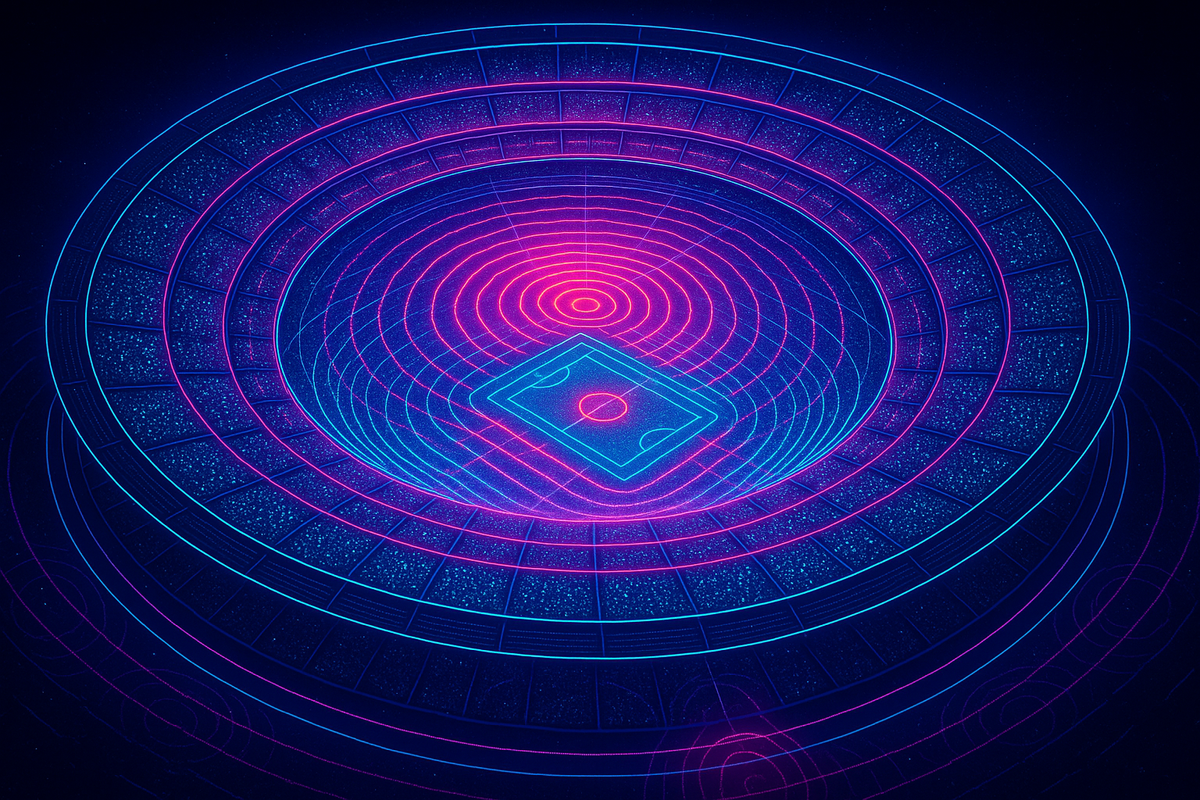
The Stadium as Temple: Sports Fandom as Secular Religion
Series: Ritual Entrainment | Part: 5 of 11
When 80,000 people rise as one at a stadium, their voices merging into a thunderous roar, something ancient happens. The architecture channels their breath into synchrony. The chants lock individual nervous systems into collective rhythm. For two hours, separate selves dissolve into something larger—not metaphorically, but neurologically.
This isn't poetry. It's entrainment—the same mechanism that makes pendulum clocks synchronize, fireflies flash in unison, and religious congregations achieve what Durkheim called collective effervescence. Sports fandom is one of the most powerful ritual technologies in modern secular society. It achieves what religion traditionally provided: the neurological experience of transcending the isolated self through synchronized collective action.
The stadium is a temple. And what happens there is sacred—not because we call it that, but because of what it does to the geometry of human coherence.
The Architecture of Collective Synchronization
Roman amphitheaters weren't just entertainment venues. They were entrainment containers—architectural technologies designed to couple tens of thousands of nervous systems into a single dynamical state.
Modern stadiums inherit this function with surgical precision:
Bowl-shaped acoustic geometry folds sound back onto itself, creating natural amplification and delay patterns that force voices into rhythmic alignment. When 50,000 people chant "DE-FENSE," the stadium itself becomes an oscillator, feeding the chant back with reinforcement that makes deviation from the rhythm physically uncomfortable.
Synchronized sightlines ensure every spectator sees the same critical events within milliseconds. The visual cortex of 80,000 brains processes the same touchdown catch simultaneously, triggering synchronized autonomic responses—heart rate spikes, breath holds, then explosive release. Neurologically, this creates what motor neuroscience calls mirror system activation at scale.
Ritualized entry sequences prime the nervous system for entrainment before the game even starts. National anthems, team chants, coordinated clapping—these aren't decorative. They're the universal toolkit of ritual technology: rhythm, repetition, and synchronized action that lower individual autonomic resistance to collective coupling.
The architecture doesn't just host the ritual. It enforces it. Try sitting silently during a fourth-quarter rally when everyone around you is standing, clapping, chanting. Your nervous system will experience this as prediction error—the environment demands synchrony, and your isolation registers as tension. The only coherent response is to join.
This is entrainment by design.
Why Fandom Feels Like Belonging: The Neuroscience
Sports fandom triggers the same neural circuits that evolved for tribal cohesion—but it does so in a controlled, repeatable, non-violent context.
The Insula and Embodied Team Identity
Neuroscientist Marco Iacoboni's work on mirror neurons reveals something striking: when passionate fans watch their team play, their motor cortex activates as if they themselves were performing the actions. When a striker shoots, the fan's brain simulates the shot. When a linebacker tackles, the fan's proprioceptive system mirrors the collision.
This isn't imagination. It's embodied simulation—the brain treating the team's actions as extensions of the self. Over time, repeated exposure builds what cognitive scientist Andy Clark calls an extended cognitive system: the boundary between "self" and "team" becomes neurologically porous.
Functional MRI studies show that when a fan's team wins, their brain's reward centers (ventral striatum, nucleus accumbens) light up as strongly as if they had personally achieved the victory. Cortisol drops. Testosterone spikes. The nervous system treats the team's success as literal self-success.
When the team loses? The anterior cingulate cortex—the region that processes social pain—activates with the same intensity as experiencing personal rejection. Fandom isn't metaphorical identification. It's Markov blanket reconfiguration: the statistical boundary that defines "self" expands to include the team.
Synchrony as Social Proof
Anthropologist Harvey Whitehouse's research on "modes of religiosity" identifies two pathways to group cohesion: doctrinal (shared beliefs) and imagistic (shared intense experiences). Sports fandom is overwhelmingly imagistic.
Fans don't bond primarily through abstract ideology about their team. They bond through synchronized physiological arousal:
- The collective breath-hold before a penalty kick
- The simultaneous eruption after a game-winning shot
- The rhythmic stomping that makes the stadium structure vibrate
Psychologist Scott Wiltermuth's experiments demonstrate that even arbitrary synchronized movement—marching in step, clapping in unison—increases trust, cooperation, and self-sacrifice toward the synchronized group. Sports stadiums amplify this effect by orders of magnitude: synchronized action paired with high-stakes outcomes and shared emotional intensity.
When thousands of nervous systems entrain to the same oscillatory pattern—rising and falling with the momentum of the game—the brain interprets this as valid social proof of coalition membership. You're not imagining the connection. Your interoceptive system is directly experiencing it.
Tribal Cognition in a Post-Tribal World
Humans evolved in groups of 30-150 individuals where in-group/out-group distinctions were survival-relevant. The cognitive mechanisms that made tribal belonging adaptive—coalition formation, synchronized ritual, symbolic markers of membership—don't disappear when we move to cities of millions.
Sports fandom is a pressure valve for tribal cognition that would otherwise discharge into more dangerous forms: ethnic nationalism, political sectarianism, violent gang affiliation.
The Harmless Discharge of Coalitional Energy
Evolutionary psychologist Robin Dunbar argues that human brain size constrains our capacity for stable social relationships to around 150 people. Beyond that, we rely on symbolic proxies for coalition identity: flags, uniforms, creeds, team logos.
Sports provide a nearly perfect symbolic proxy:
- Clear boundaries: You're either a Patriots fan or you're not. The Markov blanket is explicit.
- Costly signaling: Season tickets, jerseys, travel to away games—these aren't cheap. They function like religious tithes: costly signals of genuine commitment that filter out free-riders.
- Ritualized conflict: Games channel coalitional aggression into rule-bounded competition. The rival team is the out-group, but the violence is symbolic, not literal.
- Cyclical renewal: Every season begins with hope. Every game offers redemption. The ritual never permanently resolves—it's an infinite game that sustains engagement without requiring actual war.
Political scientist Jonathan Haidt notes that humans crave self-transcendence: experiences where the boundary between self and group dissolves. Traditional religions provided this through synchronized prayer, chanting, dancing. In increasingly secular societies, sports fandom fills the gap.
The stadium becomes the cathedral. The jersey becomes the vestment. The team anthem becomes the hymn. The season becomes the liturgical calendar.
This isn't degradation of the sacred. It's the same sacred function, relocated.
The Coherence Geometry of Fandom
In AToM terms, fandom is a coherence attractor: a dynamical structure that pulls individual nervous systems into synchronized states, increasing collective coherence while decreasing individual autonomic uncertainty.
Low Curvature Through Predictable Ritual
A fan knows the rhythm of the season. The schedule is published months in advance. Game day has a fixed structure: pre-game rituals, national anthem, kickoff, halftime, fourth quarter rally. This temporal predictability creates low-curvature regions in the fan's state-space: the system knows where it will be, socially and emotionally, at specific times.
Contrast this with the high-curvature chaos of modern atomized life: uncertain employment, fragmented communities, algorithmically mediated relationships with no stable rhythm. Fandom provides what religion traditionally offered: a coherent temporal structure that the nervous system can entrain to.
Meaning Through Shared Trajectories
Meaning, in AToM notation, is M = C/T: coherence over time (or tension). Fandom generates meaning because it creates integrable trajectories through shared state-space:
- Narrative coherence: The season is a story. Each game is a chapter. The fan's identity evolves with the team's fortunes, but the through-line is continuous.
- Social coherence: The fan shares this trajectory with millions of others. The collective memory of "the '85 Bears" or "the Miracle on Ice" creates synchronic coupling across decades.
- Embodied coherence: The rituals—tailgating, chanting, wearing the colors—entrain the body to a rhythm that transcends individual fluctuation.
When the team wins the championship, the fan's nervous system experiences curvature collapse: the tension (T) that built across the season resolves into maximal coherence. The victory doesn't just feel meaningful. It is meaningful, geometrically: the trajectory completes with low prediction error.
When the team loses in heartbreaking fashion? Curvature spikes. The trajectory was integrable (low prediction error up to the final play), then suddenly diverged (high surprise). The pain isn't weakness. It's the cost of having entrained to a trajectory that failed to cohere.
Fandom is costly because meaning is costly. You can't generate C without risking T.
The Dark Side: When Entrainment Becomes Entrapment
Not all coherence is beneficial. Cults achieve high internal coherence through entrainment—but at the cost of adaptability, autonomy, and external calibration. Sports fandom can cross this line.
Hooliganism as Hyper-Entrainment
Soccer hooliganism in Europe, fan riots after championship victories, violent clashes between rival supporters—these aren't anomalies. They're what happens when entrainment exceeds regulatory capacity.
Neuroscientist Tania Singer's research on empathy shows that mirror system activation for in-group members increases schadenfreude (pleasure at out-group suffering) and decreases pain empathy for out-group members. Strong fandom doesn't just build in-group love. It builds out-group dehumanization.
When entrainment becomes the dominant regulatory mechanism—when the fan's nervous system depends on the rhythm of collective arousal—individual prefrontal regulation weakens. The crowd becomes the superego. Violence becomes coherent.
This is entrainment without constraint—the same mechanism that makes cults dangerous.
Parasocial Coherence Collapse
Fans who over-identify with their team are vulnerable to coherence collapse when the team fails. Psychologist Daniel Wann documents "team identification" as a predictor of both well-being (when teams win) and depression, anxiety, even domestic violence (when teams lose).
This isn't metaphor. When the fan's Markov blanket includes the team, the team's failures are prediction errors in the fan's self-model. The system expected coherence. It received chaos. Without alternative coherence sources, the nervous system destabilizes.
The stadium as temple works—but like all sacred technologies, it requires calibration. The system must entrain to the rhythm without collapsing into it.
Why Secular Society Needs Stadiums
The decline of traditional religion in the West correlates with the rise of sports fandom. This isn't coincidence. Both serve the same neurobiological function: providing predictable, repeatable contexts for collective synchronization.
The Missing Ritual Infrastructure
Sociologist Robert Bellah warned in the 1980s that American individualism was eroding the "habits of the heart"—the ritual structures that bind communities. Churches provided weekly entrainment. Civic organizations provided seasonal rhythms. Extended families provided generational continuity.
As these structures weaken, the nervous system still craves coherent oscillatory coupling. Sports stadiums provide this at scale:
- Weekly rhythm: Sunday games, Thursday night football, Saturday tailgates
- Seasonal arc: Spring training, playoffs, championship, off-season reflection
- Generational transmission: Fathers take sons to their first game; the team allegiance passes down like a surname
This isn't entertainment. It's coherence infrastructure.
Political theorist Benedict Anderson described nations as "imagined communities"—collectives bound by shared symbols despite never meeting. Sports teams are imagined communities with embodied verification: you show up, you synchronize, you feel the connection in your nervous system.
In a world of algorithmic feeds, remote work, and parasocial relationships, stadiums are among the last remaining contexts where synchronous co-presence still happens at scale. That's not nostalgia. That's recognition of a neurobiological need.
What Makes a Good Ritual Container?
Not all stadiums succeed equally. Some create coherence. Others create chaos. The difference lies in design principles:
1. Constraint Without Coercion
Effective rituals guide behavior without forcing it. The stadium architecture, the gameday schedule, the chant rhythms—all provide low-dimensional attractors that make entrainment easy but not mandatory. You can sit during the fourth quarter rally. You'll just feel the tension of being out of sync.
Contrast this with authoritarian rallies where participation is enforced. That generates compliance, not coherence.
2. Predictability With Surprise
The structure of the game is fixed (four quarters, scoring rules, field dimensions). But the outcome is uncertain. This balance—predictable ritual surrounding unpredictable events—is what makes sports compelling.
If the outcome were scripted, there'd be no tension, thus no meaning (M = C/T requires T). If the ritual were chaotic, there'd be no coherence, thus no meaning. The stadium balances both.
3. Scalable Synchrony
Small groups can entrain through eye contact and conversation. Large groups require architectural amplification: acoustic geometry, visual choreography, rhythmic prompts (the Jumbotron leading chants).
The best stadiums create nested synchrony: small groups (family, friends) within medium groups (sections) within large groups (the full stadium). Each scale reinforces the others.
4. Symbolic Density
The team colors, the fight song, the mascot, the retired jerseys—these aren't decorations. They're coherence anchors: stable symbols that persist across seasons, allowing long-term narrative integration.
When a fan sees the logo, the nervous system retrieves decades of associated memories, emotions, and social bonds. The symbol compresses state-space, making past coherence accessible in the present.
Practical Implications: Building Post-Religious Coherence
If sports stadiums function as secular temples, what does that teach us about building coherence in other domains?
1. Ritualize What Matters
Communities that lack ritual infrastructure will suffer coherence deficits. The solution isn't to force religion onto secular populations. It's to recognize ritual as a neurobiological technology and apply it intentionally:
- Weekly community meals with predictable rhythm
- Seasonal festivals tied to local rhythms (harvest, solstice, civic anniversaries)
- Synchronized movement practices (group dance, martial arts, parkour meetups)
The content matters less than the oscillatory structure. Humans need predictable opportunities for collective synchronization.
2. Architect for Entrainment
Physical spaces shape coherence potential. Designers should ask:
- Does this space amplify or dampen synchronized action?
- Can people see and hear each other, creating feedback loops?
- Does the geometry guide behavior without coercing it?
Concert halls, churches, and stadiums succeed because their architecture does something to occupants. Flat, modular, anonymous spaces generate atomization because they impose no coherence structure.
3. Balance In-Group Love With Out-Group Respect
Fandom's tribal function is valuable—but only if bounded. The best fan cultures celebrate their team without dehumanizing opponents. Rivalry is ritualized, not radicalized.
This requires explicit norms: chanting for your team is sacred; violence toward the other is profane. The distinction must be culturally enforced, or entrainment devolves into tribalism.
4. Provide Coherence Diversity
Relying on a single source of coherence—whether religion, nationalism, or fandom—creates fragility. When that source fails, the system collapses.
Resilient individuals and communities cultivate multiple coherence attractors: family, profession, hobbies, political engagement, spiritual practice. Fandom can be one—but not the only.
The stadium is a temple. But no one should live in a temple full-time.
From the Field to the World
The stadium doesn't create anything artificial. It reveals what humans already are: oscillatory systems that achieve coherence through synchronized coupling.
When you stand in the stands, chanting with 80,000 others, you're not escaping reality. You're experiencing a fundamental truth: the self is porous, the boundary between "me" and "we" is negotiable, and meaning emerges from shared rhythms, not isolated cognition.
Sports fandom is secular religion because religion was always applied entrainment technology. The content changes—Yahweh, the Patriots, the revolution—but the mechanism remains: synchronized ritual that transforms isolated individuals into coherent collectives.
The question isn't whether we need this. We do. The question is whether we'll build intentional, ethical, life-affirming containers for it—or let it discharge into tribalism, nationalism, and violence.
The stadium shows the way. Not as metaphor. As blueprint.
This is Part 5 of the Ritual Entrainment series, exploring how collective synchronization creates meaning and coherence across scales.
Previous: The Universal Toolkit: Chanting, Drumming, Movement, and Shared Consumption
Next: The Rave and the Revival: Electronic Music as Entrainment Technology
Further Reading
- Wiltermuth, S. S., & Heath, C. (2009). "Synchrony and Cooperation." Psychological Science, 20(1), 1-5.
- Whitehouse, H. (2004). Modes of Religiosity: A Cognitive Theory of Religious Transmission. AltaMira Press.
- Dunbar, R. I. M. (2010). "How Many Friends Does One Person Need?" Faber & Faber.
- Iacoboni, M. (2008). Mirroring People: The New Science of How We Connect with Others. Farrar, Straus and Giroux.
- Wann, D. L., et al. (2001). "The Relationship Between Team Identification and Willingness to Consider Anonymous Acts of Hostile Aggression." Aggressive Behavior, 27(4), 243-254.
- Bellah, R. N., et al. (1985). Habits of the Heart: Individualism and Commitment in American Life. University of California Press.
- Haidt, J. (2012). The Righteous Mind: Why Good People Are Divided by Politics and Religion. Pantheon.
Comments ()