The Subtle Body as Coherence Architecture: Chakras, Nadis, and Phenomenological Mapping
The subtle body isn't a failed attempt at anatomy. It's a map of functional nodes and coupling pathways — structures felt from the inside. Chakras and nadis describe the architecture of coherent experience. Whether or not they map onto physiology is a separate, fascinating question.
The Subtle Body as Coherence Architecture: Chakras, Nadis, and Phenomenological Mapping
Series: Tantra Epistemology | Part: 3 of 10
The subtle body is not anatomy.
This needs to be stated clearly because centuries of misunderstanding have treated chakras and nadis as if they were physical structures that science simply hasn't detected yet—mystical organs awaiting discovery through better instrumentation. This confusion produces two unhelpful camps: believers insisting the subtle body is literally real (just invisible), and skeptics dismissing it as prescientific nonsense.
Both miss the point. The subtle body is a phenomenological map—a systematic way of organizing and tracking felt experience. It doesn't compete with anatomical models; it operates in a different domain entirely, answering different questions.
Anatomy tells you where your liver is. The subtle body tells you where you feel power, where you feel constriction, where integration happens or fails. Anatomy is third-person description of physical structure. The subtle body is first-person description of functional organization as experienced from within.
This distinction transforms how we understand tantric energy maps. They're not failed biology—they're sophisticated phenomenology, refined through centuries of introspective practice.
The Architecture of Chakras
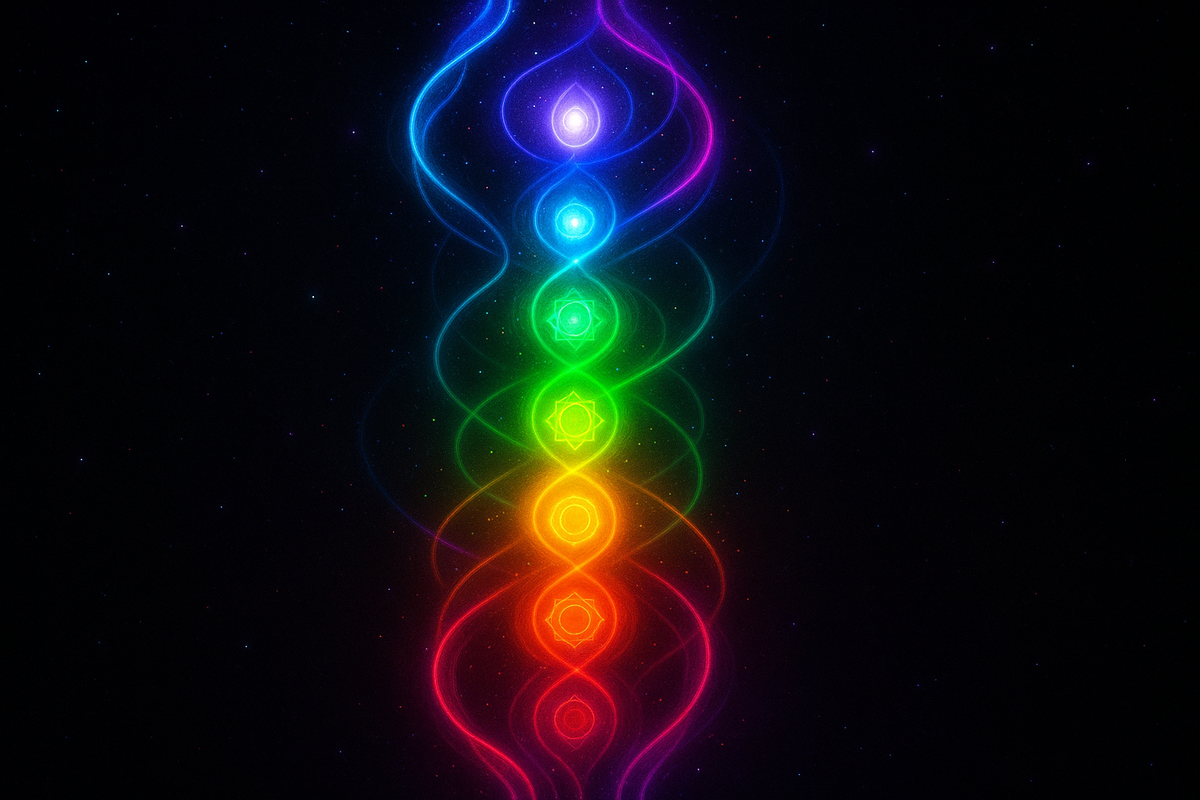
The chakra system most familiar in the West involves seven major centers running from the base of the spine to the crown of the head. Each corresponds to different qualities of experience, different kinds of concern, different aspects of how coherence manifests:
Muladhara (root chakra, base of spine): survival, grounding, fundamental safety. The felt sense of having a stable base, of being embodied and connected to material reality. When blocked: chronic anxiety, dissociation, feeling unmoored. When open: a sense of solidity, capacity to be present, trust in basic stability.
Svadhisthana (sacral chakra, lower abdomen): pleasure, creativity, emotional fluidity. The felt sense of aliveness, capacity for enjoyment, emotional responsiveness. When blocked: numbness, rigidity, inability to feel or create. When open: emotional vitality, creative flow, capacity for pleasure without grasping.
Manipura (solar plexus, upper abdomen): power, will, agency. The felt sense of self-directed action, capacity to pursue goals, healthy aggression. When blocked: passivity, collapse, inability to assert boundaries. When open: confidence, directed energy, capacity for effective action.
Anahata (heart center, chest): love, connection, integration. The felt sense of relationship, compassion, capacity to include rather than exclude. When blocked: isolation, defended boundaries, inability to connect. When open: loving presence, relational ease, integration of self and other.
Vishuddha (throat chakra, throat): expression, truth, communication. The felt sense of voice, capacity to articulate, bringing inner experience into external form. When blocked: suppression, inability to speak, swallowed truth. When open: authentic expression, clarity of communication, alignment between inner and outer.
Ajna (third eye, forehead): insight, intuition, perspective. The felt sense of seeing clearly, pattern recognition, meta-awareness. When blocked: confusion, inability to see beyond immediate circumstance. When open: clarity, perspective, recognition of larger patterns.
Sahasrara (crown, top of head): transcendence, unity, dissolution of boundaries. The felt sense of connection to something larger, ego transparency, non-dual awareness. When blocked: existential isolation, meaninglessness, imprisonment in separate self. When open: sense of participation in larger whole, dissolution into unity.
These aren't arbitrary categories. They map to fundamental domains of human functioning: safety, pleasure, agency, connection, expression, understanding, transcendence. The chakra system provides a structured way to track coherence across these domains.
Nadis: The Pathways of Integration
If chakras are nodes in the coherence network, nadis are the pathways connecting them. Traditional tantric physiology describes 72,000 nadis—channels through which prana flows. Three are considered primary:
Ida—the lunar channel, running up the left side. Associated with cooling, calming, receptive qualities. Parasympathetic activation, right-brain processing, yin energy. The capacity to rest, receive, integrate.
Pingala—the solar channel, running up the right side. Associated with warming, energizing, active qualities. Sympathetic activation, left-brain processing, yang energy. The capacity to act, produce, differentiate.
Sushumna—the central channel, running up the spine. Associated with integration, balance, unified functioning. When ida and pingala balance, energy flows through sushumna—the path of integration.
Again, this isn't anatomy competing with neuroscience. It's a phenomenological model for tracking activation patterns. Ida and pingala roughly map to parasympathetic and sympathetic nervous system activity. Sushumna describes the felt experience when those systems achieve dynamic balance rather than oscillating between states or getting stuck in one.
The nadi system offers a vocabulary for noticing: Am I too much in ida (collapsed, passive, withdrawn)? Too much in pingala (wired, driven, overactive)? Or flowing through sushumna (integrated, balanced, responsive)?
This becomes practical. When you notice yourself stuck in sympathetic activation—anxious, driven, unable to rest—you can work with cultivating ida qualities through specific practices. When stuck in parasympathetic collapse—depressed, lethargic, unable to act—you can work with pingala activation. The goal isn't to live in one state, but to develop fluidity and access to both as needed.
The Functional Reality of Phenomenological Maps
Here's why the subtle body matters: it directs attention to domains of experience that modern Western frameworks often ignore.
Contemporary psychology tends to focus on cognition (thoughts, beliefs) and emotion (feelings, moods). We've developed elaborate models for cognitive distortions and emotional regulation. This is valuable, but it misses layers.
The subtle body framework adds:
Energetic tracking. Not just "how do I feel?" but "where is energy available, where is it stuck, where does it want to move?" This reveals dynamics that emotional labeling misses. You might say "I feel anxious," but energetic tracking might reveal that there's constriction in the throat (expression blockage), collapse in the solar plexus (agency failure), and upward-rushing energy looking for discharge (ungrounded activation). These distinctions suggest different interventions.
Vertical integration. The chakra system naturally points to questions of integration across levels: Are survival concerns (root) competing with relational concerns (heart)? Is intellectual understanding (third eye) disconnected from embodied knowing (root, sacral)? Does capacity for transcendence (crown) bypass the work of grounding (root) and relationship (heart)?
Coupling patterns. The nadi system points to the balance or imbalance between activation and rest, doing and being, analysis and synthesis. Modern life tends to overactivate pingala (productivity, striving, analysis) while underactivating ida (rest, receptivity, synthesis), with sushumna—the integrated state—rarely accessed.
These maps create resolution. Instead of undifferentiated "I don't feel good," you can distinguish between "my root chakra feels unstable," "my heart center feels closed," "my throat feels constricted," or "I'm stuck in pingala activation." Each of these points to different practices and different kinds of attention.
How the Mapping Actually Works
The subtle body doesn't exist independent of experience—it's a structure imposed on experience to make it more workable. Here's the process:
Attention training. You learn to direct attention systematically to different regions of the body and different qualities of sensation. This creates higher-resolution interoceptive awareness—the ability to distinguish subtle gradations in felt experience.
Pattern recognition. As you track sensations repeatedly, patterns emerge. Certain feeling-tones cluster in certain locations. Particular challenges correlate with particular sensations. The heart region really does feel different when you're in loving presence versus defended isolation. The solar plexus really does feel different when you're in your power versus collapsed.
Framework application. The chakra map provides labels and structure for organizing what you're noticing. This is where the map becomes useful: it helps you remember, compare, communicate, and work with patterns you might otherwise lose in the chaos of raw sensation.
Intervention. Once you can reliably identify patterns (my throat chakra is constricted, my root is unstable, I'm stuck in ida), you can apply targeted practices. Breathwork, movement, sound, visualization—different techniques for working with different patterns.
The map isn't the territory, but good maps make the territory navigable. The subtle body provides a stable structure for exploring the constantly shifting landscape of felt experience.
Variations Across Traditions
Not all tantric traditions use identical maps. Some systems describe five chakras, others seven, some nine or more. The locations sometimes vary. Different traditions emphasize different nadis.
This diversity doesn't undermine the framework—it confirms its nature. If the subtle body were literal anatomy, we'd expect cross-cultural agreement (everyone has the same organs in the same places). But since it's phenomenological mapping, variation makes sense. Different traditions, pursuing different goals, developed different maps for different purposes.
The seven-chakra system became dominant in part because it was the model popularized in the West, not necessarily because it's universally superior. A five-chakra system might provide adequate resolution for some practices while being simpler to work with. A more elaborate system might distinguish patterns that a simpler model lumps together.
What matters isn't finding the "correct" subtle body map. What matters is whether the map you're working with helps you track, understand, and work with your experience more effectively than you could without it.
Translating to Coherence Geometry
In AToM terms, the subtle body describes the dimensional structure of phenomenological coherence:
Chakras function as local coherence attractors—domains where particular qualities of organization stabilize. Root = coherence around survival and embodiment. Heart = coherence around connection and relationship. Crown = coherence around transcendence and unity. Each represents a stable configuration around specific concerns.
Vertical integration (energy flowing smoothly up the chakra system) corresponds to multi-scale coherence—when functioning at one level doesn't conflict with functioning at others. A person "operating from all chakras" has integrated survival, pleasure, agency, love, expression, insight, and transcendence into a functioning whole rather than having these domains fragment or compete.
Nadis map to coupling patterns between subsystems. Ida/pingala balance represents the dynamic equilibrium between complementary processes (rest/action, receptive/productive, integration/differentiation). Sushumna activation represents higher-order integration where those polarities resolve into unified functioning.
Blockages correspond to regions of high curvature—places where the manifold has constraints that resist smooth flow. These often coincide with trauma, chronic tension, or unintegrated material. Working with blockages energetically means working with the felt experience of navigating these high-curvature regions.
The subtle body, properly understood, is applied coherence geometry using phenomenological vocabulary instead of mathematical formalism. It's a way to track and work with the shape of your state space using the only instrument available for that purpose: felt experience itself.
Working With the Map
The utility of the subtle body framework depends on practice. Reading about chakras does nothing. Learning to actually feel the distinctions—to reliably recognize root-centered experience versus heart-centered versus crown-centered—requires attention training.
Start simple: Can you feel your breath? Can you distinguish between tight breathing and easy breathing? Can you notice when your chest feels open versus closed? These basic distinctions are the foundation.
From there, you can add chakra vocabulary: When I feel confident and capable, where do I feel that? (Usually solar plexus.) When I feel loving and connected, where? (Usually heart center.) When I feel creatively alive, where? (Usually sacral.) The framework helps you organize what's already present.
With practice, you can use the map diagnostically. Feeling powerless and unable to act? Check the solar plexus—is there collapse or constriction there? Feeling isolated despite being around people? Check the heart center—is there defended closing? Feeling existentially lost? Check the crown—is there disconnection from larger meaning?
The map becomes a tool for self-awareness and intervention. Not because it's literal anatomy, but because it provides structured access to the phenomenology of coherence across domains you care about.
This is Part 3 of the Tantra Epistemology series, exploring tantric philosophy and practice through the lens of coherence geometry.
Previous: Energy as Coherence Flow: What Practitioners Actually Feel
Next: Kundalini as Phase Transition: What Rising Energy Actually Means
Further Reading
- Bharati, Agehananda. The Tantric Tradition. Anchor Books, 1965.
- Samuel, Geoffrey. "The Subtle Body in India and Beyond." In Religion and the Subtle Body in Asia and the West. Routledge, 2013.
- Flood, Gavin. The Tantric Body: The Secret Tradition of Hindu Religion. I.B. Tauris, 2006.
- Dupuche, John R. "The Subtle Body in Kashmir Śaivism." In Religion and the Subtle Body in Asia and the West. Routledge, 2013.
Comments ()