The Sufi Path: Annihilation in the Beloved
Fana — annihilation — is Sufism's most radical concept. Not union with the divine but the dissolution of the self that was seeking union. Rumi, dhikr practice, and the ecstatic traditions map a path that ends where the traveler disappears.
The Sufi Path: Annihilation in the Beloved
Series: Comparative Mysticism | Part: 6 of 10
"I am He whom I love, and He whom I love is I. We are two spirits dwelling in one body. If you see me, you see Him; if you see Him, you see us both."
This is Al-Hallaj, the 10th-century Sufi mystic, speaking from a state beyond ordinary consciousness. Not poetry. Not metaphor. Phenomenological report of complete ego dissolution through ecstatic love.
The statement got him executed. The orthodox scholars of Baghdad heard blasphemy—a human claiming identity with God. But Al-Hallaj wasn't claiming anything. He was reporting what remains when the separate self dissolves: only the Beloved. The distinction between lover and Beloved had collapsed. What spoke through him was no longer "him."
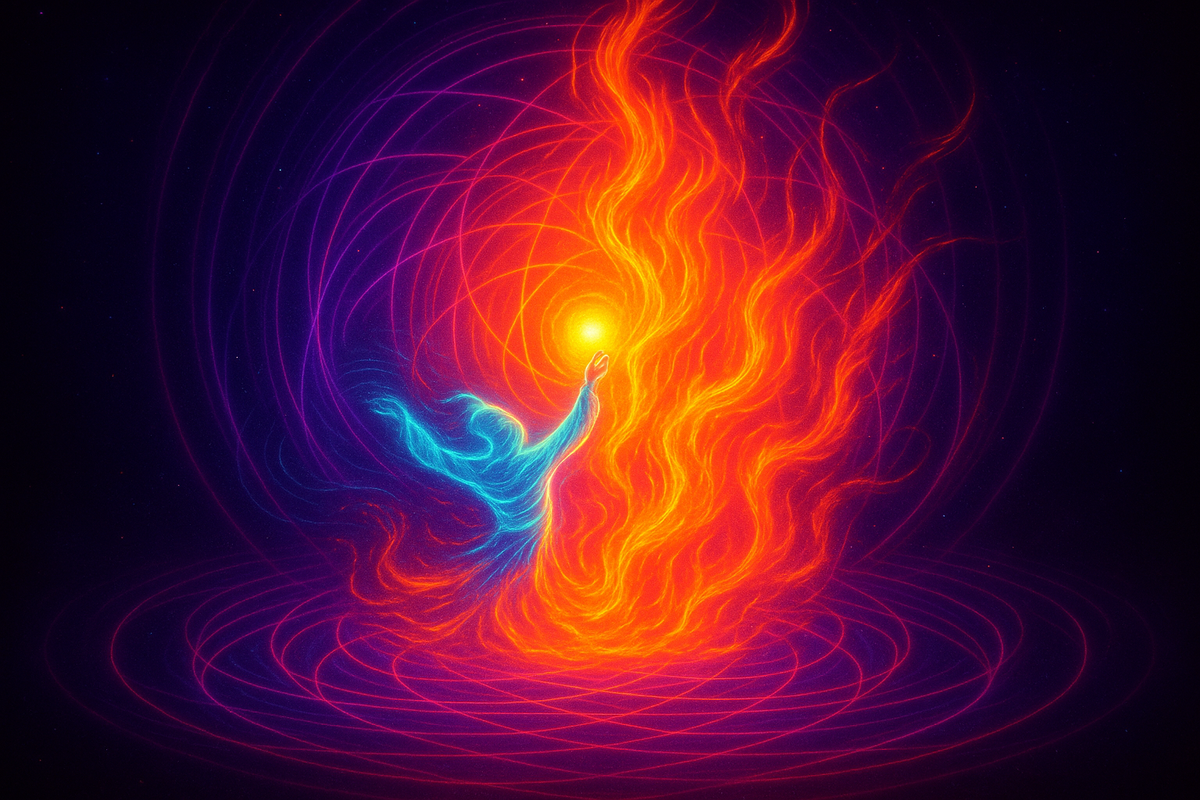
This is the Sufi path: fana (annihilation) in God. Not the gradual dismantling of Buddhism. Not the purifying ascent of Christian mysticism. But ecstatic dissolution through remembrance, longing, and love so intense that the self burns away like a moth in flame.
Where Buddhism uses analysis and Christianity uses surrender, Sufism uses ecstasy. The self doesn't analyze itself out of existence or give itself away—it disappears into what it loves with such intensity that nothing else remains.
Fana and Baqa: Annihilation and Subsistence
Sufi metaphysics describes two key states:
Fana (annihilation, passing away) — the dissolution of the ego-self into God. The drop merges with the ocean. The separate "I" that seemed so real is revealed as temporary wave on the surface of divine reality. You die before you die. The nafs (ego-self) is extinguished.
But fana isn't the endpoint. After annihilation comes:
Baqa (subsistence, remaining in God) — what remains after the separate self has dissolved. This isn't nothing. It's functioning from the recognition of unity rather than separation. The wave continues waving, but it knows it's the ocean. Actions happen, but there's no separate agent acting. Life continues, but "you" are no longer living it—God is living through you.
This is the same post-ego-dissolution integration we see in every tradition:
- Buddhism: seeing through the self (anatta) but continuing to function
- Christianity: spiritual marriage where the soul is one with God yet retains personhood
- Advaita: recognizing you were always brahman, then living from that recognition
The Sufi formulation emphasizes the ecstatic dimension. This isn't calm recognition—it's burning, yearning, overwhelming love that consumes the separate self completely.
The Method: Dhikr as Erasure
The primary Sufi practice is dhikr—remembrance of God. Typically, repetitive invocation of divine names synchronized with breath and often accompanied by movement or music.
La ilaha illa Allah (There is no god but God)
Allah, Allah, Allah
Hu (He)
You repeat the phrase or name—hundreds, thousands of times. With each repetition, you're wearing away the self. The separate "I" that seemed so substantial gets thinner with each invocation. What fills the space: God-consciousness.
This is functionally identical to mantra practice in Hinduism or the Jesus Prayer in Christianity: rhythmic attunement that gradually shifts the system from ordinary consciousness (high-curvature, bounded self) to mystical consciousness (low-curvature, dissolved boundaries).
The genius of dhikr: it works somatically, not just cognitively. The Mevlevi whirling dervishes spin for hours, chanting, until the ordinary sense of self can't maintain itself. The body becomes part of the practice—movement, breath, sound, all synchronized to create an entrainment field that pulls practitioners toward the same attractor.
In group practice (hadra), the collective dhikr creates resonance. Individual nervous systems couple through shared rhythm, shared sound, shared intent. The separate self dissolves not just through individual practice but through collective entrainment—you're pulled into the larger coherence of the group, which is itself oriented toward God.
This is why Sufism often feels more accessible than Buddhism's solo meditation: you're not doing it alone. The community, the teacher (murshid), the lineage, the practice itself—all function as supports that make the dissolution less terrifying and more sustainable.
The Stages: From Seeking to Union
Sufi literature describes progressive stages (maqamat) and states (ahwal):
Stage 1: Awakening (yaqza) — You realize ordinary life isn't enough. Something's missing. This is the beginning of seeking. Most humans never get here—they're content with worldly success and comfort. But once awakening happens, you can't go back to unconscious life.
Stage 2: Repentance (tawba) — Turning away from distractions and toward God. Not moral guilt (though that's part of it)—geometric reorientation. You stop seeking satisfaction in temporary things and start seeking the only source of permanent satisfaction.
Stage 3: Sincerity (ikhlas) — Purifying motivation. Are you seeking God for what you'll get, or for God's own sake? This is reducing curvature—eliminating the transactional attitude that creates tension. Pure devotion emerges when you want nothing except proximity to the Beloved.
Stage 4: Love (mahabbah) — The heart opens. No longer seeking as strategy—you're in love. The relationship stops being about you and becomes about the Beloved. This is the transition point where self-concern begins dissolving into God-concern.
Stage 5: Fear and hope — Oscillation between terror of separation and longing for union. High-curvature state. The self is still present enough to fear its dissolution, but drawn powerfully toward it. This tension drives the practice forward.
Stage 6: Longing (shawq) — Pure desire for union. The fear transforms into urgency. You're the moth seeing the flame, unable to resist despite knowing you'll be consumed. Rumi: "The minute I heard my first love story, I started looking for you, not knowing how blind that was. Lovers don't finally meet somewhere. They're in each other all along."
Stage 7: Fana — Annihilation. The separate self dissolves. Only God remains. You can't make this happen—it happens to you when the conditions are right. Grace, not achievement.
Stage 8: Baqa — Subsistence in God. Functioning continues, but from unity rather than separation. The "you" that returns isn't the "you" that dissolved. Something has fundamentally shifted.
Different teachers emphasize different details, but the overall pattern is consistent: from seeking, through love and longing, to annihilation, and finally integration.
Key Figures: Rumi, Rabia, Ibn Arabi
Rumi is the most famous Sufi poet in the West. His Masnavi and Divan-e Shams are phenomenological maps disguised as love poetry.
"Out beyond ideas of wrongdoing and rightdoing, there is a field. I'll meet you there." — This is low-curvature space beyond the dualities that create tension.
"You are not a drop in the ocean. You are the entire ocean in a drop." — Non-dual recognition: what you think you are (drop/ego) is actually the whole (ocean/God) appearing as local pattern.
"The wound is the place where the Light enters you." — Suffering as the mechanism that breaks open the ego. Not gratuitous—necessary. The self has to crack before what's beyond self can be recognized.
Rumi's relationship with Shams-e Tabrizi (his teacher) catalyzed his awakening. The friendship was so intense it burned through his ordinary identity. When Shams disappeared, Rumi's grief drove him into depths of practice that produced his most profound work. Personal loss as geometric transforming force.
Rabia al-Adawiyya (8th century) is one of the earliest Sufi saints and represents pure love mysticism. Her famous prayer: "O God, if I worship You for fear of Hell, burn me in Hell. If I worship You in hope of Paradise, exclude me from Paradise. But if I worship You for Your own sake, then withhold not Your everlasting Beauty."
This is the purification of motivation Christianity's St. John calls "spiritual poverty." Release of all self-interest, even spiritual self-interest. When that happens, what remains is pure orientation toward the Beloved—and that orientation, sustained, pulls you inevitably toward union.
Ibn Arabi (12th-13th century) is the intellectual architect of Sufi metaphysics. His Fusus al-Hikam and Futuhat al-Makkiyah provide sophisticated philosophy underlying the ecstatic poetry.
Key concept: wahdat al-wujud (unity of being). There is only one Being—God—and everything else is manifestation, appearance, theophany. The multiplicity you experience is like waves on the ocean: real as patterns, but not separate from the single substance they arise from.
This is phenomenologically identical to Advaita's brahman, but arrived at through Islamic theology rather than Hindu philosophy. Ibn Arabi even uses similar language: the world is God's mirror, reflecting divine attributes. What you think you see as "other" is God seeing Godself through infinite perspectives.
The mystic realizes: I am one of those perspectives. I am how God knows what it's like to be me. The separate self is real—but it's not what I thought it was. It's a mode of divine self-knowing, not an independent entity.
Wine, Taverns, and Intoxication: Metaphor as Precision
Sufi poetry is saturated with wine imagery. Hafez, Omar Khayyam, Rumi—all speak of being drunk, of taverns, of the wine-seller who intoxicates without literal wine.
This isn't about alcohol. It's phenomenological reporting.
The mystical state feels like intoxication—ordinary consciousness alters, inhibitions dissolve, the sober rational self loosens its grip, something larger takes over. The wine is divine love. The tavern is the sacred space where transformation happens. The intoxication is sukr (mystical drunkenness)—the temporary loss of ordinary self-consciousness that precedes sahw (sobriety in God).
Western readers often miss this because they read it as literal transgression. But Persian and Arabic audiences understood: these are technical terms describing specific states. When Hafez says "Last night in the tavern I saw angels knocking at the door; they kneaded the clay of Adam and cast it in the mold," he's describing visionary states accessed through ecstatic practice, not alcohol.
The metaphor works because it captures something essential: you can't stay in ordinary consciousness and reach union. You must become drunk on something that dissolves normal boundaries. Better divine love than literal wine—but the phenomenology overlaps enough that the metaphor carries precision.
The Beloved: Personal or Impersonal?
Here's where Sufism gets interesting geometrically. Is the Beloved a personal God (Allah) or impersonal divine reality (Haqq)?
The answer: both, depending on stage and tradition.
Early practice tends toward personal relationship. You love Someone. You long for Him. You pray to God. This builds relationship—and relationship creates the entrainment dynamic that drives the practice. You can't fall in love with an abstract principle. You need a felt sense of the Other to generate the longing that dissolves boundaries.
But as practice deepens, the relationship becomes paradoxical. The closer you get to the Beloved, the less clear the distinction becomes. At a certain point, the lover discovers she's not separate from the Beloved—has never been separate. The relationship was a necessary stage, but it was always happening within unity, not between two separate things.
This is Ibn Arabi's wahdat al-wujud: what seemed like "me loving God" was actually "God loving God through the appearance of separation." The personal dissolves into the impersonal—or rather, the personal is revealed as a mode of the impersonal.
Rumi captures this: "I was raw, I was cooked, I was burned. The beloved is all in all; the lover merely veils Him. The beloved is living; the lover a dead thing."
The path requires both: personal devotion to build intensity, then recognition that the personal was always nested within the impersonal. You can't skip the personal—the heart needs something to love before it can recognize that what it loved was never separate from itself.
Why Ecstasy Works
The Sufi path reveals something important about ego dissolution: intense positive affect destabilizes the self-model more reliably than neutral observation.
Buddhist vipassana works through equanimous attention—neither seeking nor avoiding, just observing. This is effective but requires significant capacity for sustained attention without emotional charge. Most people can't maintain that.
Sufi practice works through maximal arousal—intense longing, overwhelming love, ecstatic movement, music, poetry, group entrainment. The self-model evolved to maintain homeostasis. Extreme states (whether terror or ecstasy) destabilize it.
Ecstasy is particularly effective because it's approach-based rather than avoidance-based. Terror also destabilizes the self, but the organism contracts in defense. Ecstasy destabilizes while the organism expands in approach. The boundaries dissolve not through threat but through positive overflow—so much love, beauty, longing that the container can't hold it and cracks open.
This is why music and dance are central to Sufism. They're not decoration—they're technologies for generating the arousal states that make ego dissolution more accessible. The sama (spiritual listening/concert) creates conditions where the rational self can't maintain its grip. Movement, rhythm, repetition, beauty, collective energy—all working together to dissolve boundaries.
When it works, the separate self doesn't resist dissolution because dissolution feels like finally arriving home. The moth doesn't fear the flame—it's drawn irresistibly toward it. And when it burns, what burns away is only the illusion of separation. What remains is what was always there: union.
This is Part 6 of the Comparative Mysticism series, exploring the convergent geometry of mystical states across contemplative traditions.
Previous: The Christian Path: Surrender and Union Through Love
Next: The Hindu-Yogic Path: Integration and Recognition
Further Reading
- Schimmel, A. (1975). Mystical Dimensions of Islam. University of North Carolina Press.
- Chittick, W. C. (1989). The Sufi Path of Knowledge: Ibn al-Arabi's Metaphysics of Imagination. SUNY Press.
- Ernst, C. W. (1997). The Shambhala Guide to Sufism. Shambhala Publications.
- Sells, M. A. (1996). Early Islamic Mysticism: Sufi, Qur'an, Mi'raj, Poetic and Theological Writings. Paulist Press.
- Barks, C. (Trans.). (1995). The Essential Rumi. HarperCollins.
Comments ()