Synthesis: Why the Laws of Thermodynamics Are Really One Law
Zeroth, first, second, third — the laws of thermodynamics sound like a textbook committee's invention. But underneath the numbering is a single, ruthless constraint on how the universe is allowed to behave. Everything flows from there.
Synthesis: Why the Laws of Thermodynamics Are Really One Law
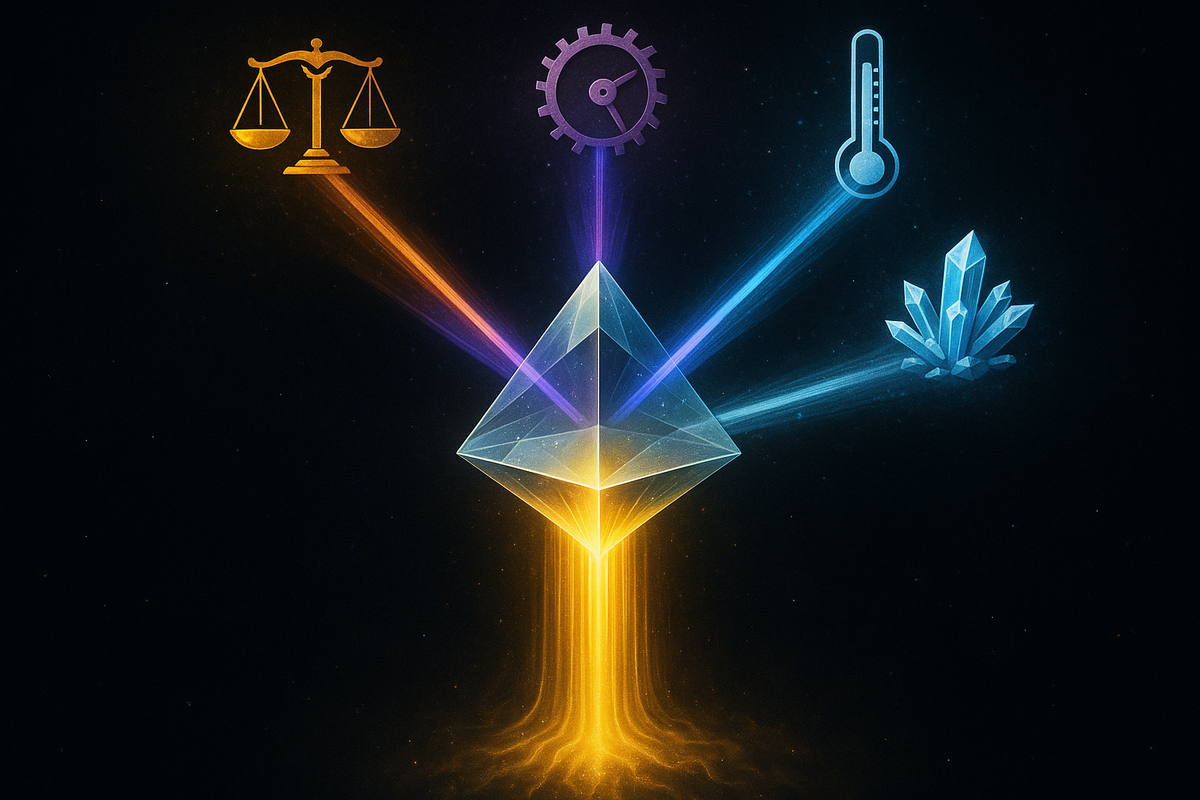
We've traveled through four laws: the Zeroth, First, Second, and Third. Each seems to say something different. Temperature transitivity. Energy conservation. Entropy increase. The unreachability of absolute zero.
But here's the secret: they're all facets of one thing.
The four laws aren't independent axioms bolted together. They emerge from a single foundation: statistical mechanics—the behavior of enormous numbers of particles following simple rules. From that foundation, all four laws arise as different perspectives on the same underlying constraint.
This synthesis reveals thermodynamics as physics' most universal framework—more fundamental than the specific forces of nature, more inevitable than any particular law.
The Statistical Foundation
Ludwig Boltzmann saw it in the 1870s. Thermodynamics isn't fundamental physics—it's emergent physics. It arises when you have many particles and care only about averages.
Consider a box of gas. Each molecule follows Newton's laws—deterministic, time-reversible. Nothing in molecular physics points forward in time. Yet macroscopic behavior has direction: gases expand, heat flows from hot to cold, eggs don't unscramble.
The resolution: probability at scale becomes certainty. With 10²³ particles, the probability of observing a macroscopic decrease in entropy is so small that "improbable" becomes "never." The laws of thermodynamics are probability theorems wearing physics clothes.
The pebble: Thermodynamics is what happens when you have too many particles to track. It's the physics of giving up on details and embracing statistics.
The Laws Unified
Energy and Entropy: Two Sides of One Coin
The First Law says energy is conserved: ΔE = 0 for isolated systems. The Second Law says entropy increases: ΔS ≥ 0 for isolated systems.
Together, they constrain what can happen. The First Law constrains quantity—how much energy you have. The Second Law constrains quality—what you can do with it.
Consider a steam engine. The First Law says energy in equals energy out. The Second Law says some of that energy must become waste heat—low-temperature, high-entropy, unavailable for work. The laws cooperate to set efficiency limits.
The two laws aren't separate constraints; they're complementary aspects of how probability applies to energy. Conservation says the chips stay on the table. Entropy says they spread toward the most likely distributions.
Temperature: The Common Currency
The Zeroth Law guarantees that temperature is well-defined. Without it, the other laws couldn't reference temperature consistently.
The First Law uses temperature implicitly (heat capacities, internal energy at temperature T).
The Second Law is written in terms of temperature: dS = dQ/T for reversible processes. The temperature appears because entropy depends on how thermal energy distributes.
The Third Law anchors the temperature scale at absolute zero, giving entropy a reference point.
Temperature isn't just a number—it's the thread connecting all four laws. It measures average kinetic energy (First Law connection), appears in entropy calculations (Second Law), has a transitive definition (Zeroth Law), and has an absolute floor (Third Law).
The Third Law as a Boundary Condition
The Third Law says entropy approaches zero as temperature approaches zero. This seems like a separate claim, but it follows from statistical mechanics.
At absolute zero, a perfect crystal has one microstate—all atoms in their lowest energy positions, no alternatives. S = k ln W = k ln 1 = 0.
The unattainability of absolute zero follows from the Second Law. If you could reach 0 K, you'd have a perfectly ordered system from which you could extract entropy-free work. But the Second Law says you can't decrease total entropy. Reaching absolute zero would require expelling entropy, which gets exponentially harder as you approach the limit.
The Third Law is the Second Law applied at the boundary.
Free Energy: The Master Function
The laws combine into one master function: free energy.
Gibbs free energy: G = H - TS
At constant temperature and pressure, systems evolve to minimize G. This single principle captures: - Energy minimization (the H term, related to First Law) - Entropy maximization (the -TS term, related to Second Law) - Temperature as the balance point (connecting everything)
When ΔG < 0, a process is spontaneous. When ΔG > 0, it won't happen spontaneously. When ΔG = 0, equilibrium.
Every chemical reaction, every phase transition, every biological process is asking the same question: does this decrease free energy? The answer predicts what happens.
The pebble: Free energy unifies the laws into one decision rule. Everything that happens, happens because it reduces free energy. That's thermodynamics in one sentence.
Information: The Fifth Element
Maxwell's demon revealed that information belongs in thermodynamics. Landauer's principle made it quantitative: erasing one bit costs kT ln 2 joules.
This connects thermodynamics to computation. Every logical operation has thermodynamic consequences. The entropy of the universe includes the entropy of our information storage.
Shannon's information entropy has the same mathematical form as Gibbs' thermodynamic entropy. This isn't coincidence—they're the same thing measured in different units.
The modern view: thermodynamics is the physics of information. Energy, entropy, and information form an inseparable triad. You can't understand one without the others.
The One Law
If we had to state thermodynamics as one law, it might be:
Systems evolve toward configurations that maximize probability, subject to constraints.
Energy conservation is a constraint—only energy-conserving paths are allowed. Entropy increase is probability maximization—systems find the most likely arrangements. The temperature scale emerges from the statistics of energy distribution. Absolute zero is the edge of the probability space.
Or more poetically:
The universe flows downhill in free energy, and there's no uphill without paying.
This captures the directionality (things happen that reduce free energy), the inevitability (probability always wins), and the cost structure (fighting probability requires energy input).
Thermodynamics as Geometry
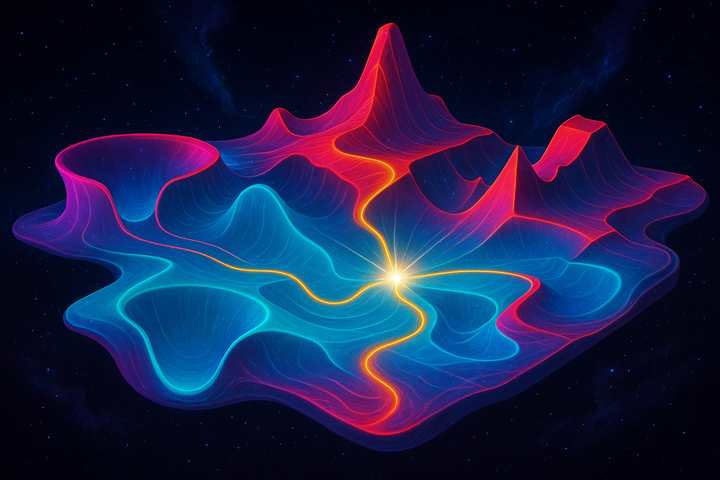
There's a beautiful geometric view. The space of possible states forms a manifold. Energy conservation defines a surface within that space. Entropy increase defines a direction on that surface—the gradient toward higher probability.
Systems roll downhill on this entropy landscape. Equilibrium is at the bottom. The laws describe the shape of the landscape and the rules of motion.
This geometric view connects thermodynamics to differential geometry and information geometry—advanced fields that treat probability distributions as geometric objects.
Why Thermodynamics Is Universal
Other physical laws are specific: electromagnetism governs charges, gravity governs masses, the strong force governs quarks. Thermodynamics governs everything.
Why? Because thermodynamics doesn't care about the specific interactions. It only requires: 1. Many particles (so statistics apply) 2. Conservation laws (so something is preserved) 3. Randomness (so probability has meaning)
Given these minimal ingredients, the laws of thermodynamics follow. They apply to gases, plasmas, solids, liquids, black holes, the early universe, and computer chips. They're format-agnostic.
The pebble: Thermodynamics is physics' most inevitable framework. It follows from math plus conservation plus randomness. No special assumptions required.
Connecting to AToM
The AToM framework sees meaning as coherence—systems maintaining structure against entropy's pull. Free energy minimization is the physical basis for this.
Living systems, minds, cultures—all are patterns that persist by managing free energy. They're not exceptions to thermodynamics; they're thermodynamics done artfully.
A human life is a temporary free energy minimum. A thought is a transient pattern in neural free energy. A society is a collective structure maintained by coordinated energy flows.
The synthesis reveals: meaning is what happens when systems minimize free energy in interesting ways. The thermodynamic perspective doesn't reduce meaning—it grounds it in physics while allowing genuine complexity.
The View from Above
Zoom out far enough, and thermodynamics is the story of the universe:
1. Big Bang: Low entropy, high free energy, far from equilibrium 2. Now: Entropy increasing, free energy dissipating, complex structures arising temporarily 3. Heat death: Maximum entropy, zero free energy, equilibrium everywhere
Everything that happens—stars, planets, life, intelligence—is the universe exploring paths from low to high entropy. We're patterns in that flow, not exceptions to it.
The four laws are signposts describing the terrain. But the terrain itself is one landscape, one gradient, one direction.
The Final Pebble
Thermodynamics began with steam engines and became the physics of possibility itself.
Four laws, one message: energy is conserved, entropy increases, and you can't beat probability at scale. Everything else is commentary.
But what commentary! From this simple foundation arise: - The arrow of time - The limits of engines - The physics of computation - The conditions for life - The fate of the universe
No other branch of physics says so much with so little.
Series Pebbles: The Best Lines
The Big Sentences: - "Thermodynamics is the operating system. Everything else runs on top of it." - "The universe doesn't do free lunches. Every output requires an input." - "Entropy is the universe's ratchet. It only clicks one way." - "Life is a temporary eddy in entropy's river. We persist by making the universe more disordered faster than we order ourselves." - "Time has a direction because entropy has a direction." - "The universe has a basement, and the door is locked." - "Every time you delete a file, the universe gets imperceptibly warmer." - "Free energy unifies the laws into one decision rule. Everything that happens, happens because it reduces free energy."
Wait, WHAT? Moments: - The Patent Office refuses to examine perpetual motion applications - Hiroshima converted 0.6 grams of mass into energy—half a paperclip - A mole of gas has 10^(10²³) microstates - The demon paradox took 115 years to resolve - Information erasure has an energy cost measurable in labs
Thread Hooks: - "The four laws of thermodynamics have held for 170 years. Every perpetual motion machine ever built has failed. Here's why they always will:" - "Why can't you unscramble an egg? The answer explains why time moves forward, why you age, and why the universe will go dark." - "Maxwell's demon: the 150-year-old thought experiment that connects your computer's heat to the fate of the universe."
Further Reading
- Atkins, P. (2010). The Laws of Thermodynamics: A Very Short Introduction. Oxford University Press. - Carroll, S. (2010). From Eternity to Here. Dutton. - Penrose, R. (2004). The Road to Reality. Knopf. - Schrödinger, E. (1944). What Is Life? Cambridge University Press.
This concludes the Laws of Thermodynamics series. The universe has an operating system, and now you know its source code.

Comments ()