The Third Law: Absolute Zero and the Unreachable Floor
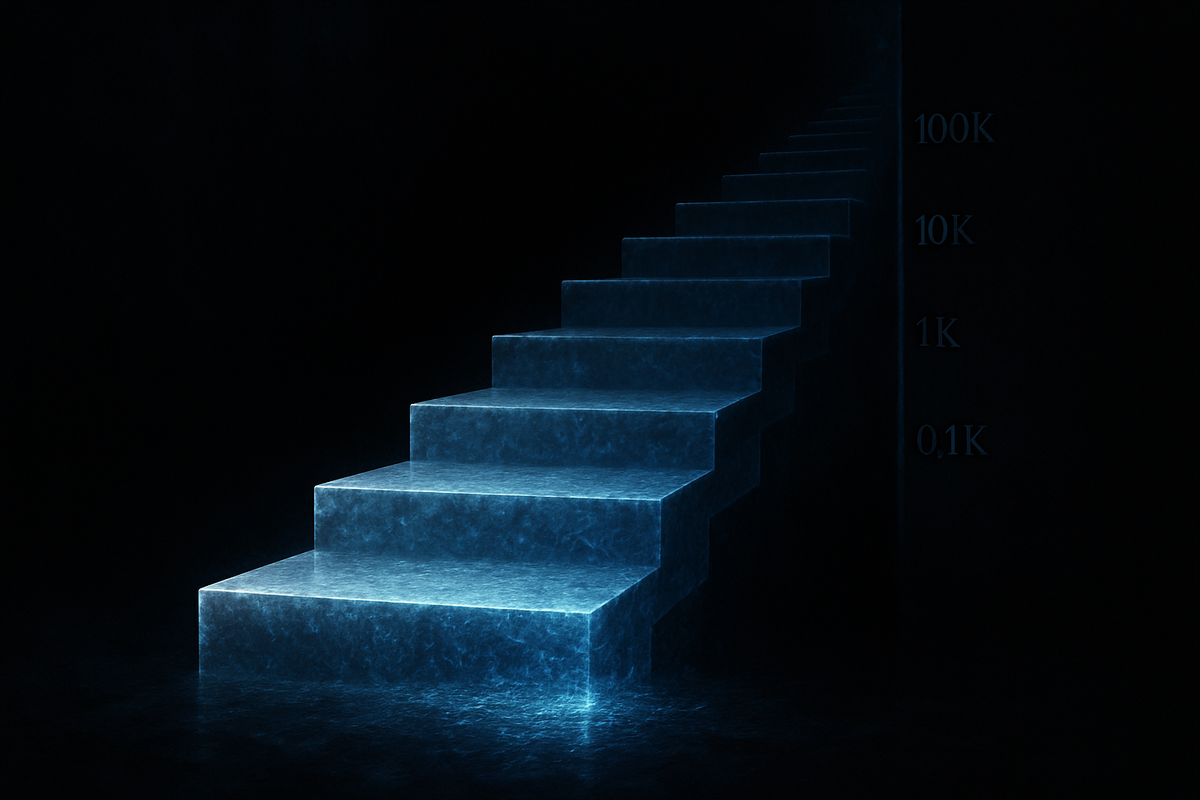
Absolute zero isn't just very cold — it's a mathematical asymptote. The Third Law says entropy approaches a minimum as temperature drops, and actually reaching 0 K would take an infinite number of steps. Nature draws a hard line.
The Third Law: Absolute Zero and the Unreachable Floor
In the early 1900s, Walther Nernst was studying chemical reactions at low temperatures. He noticed something strange: as temperature dropped, the entropy change in reactions approached zero. No matter what chemicals he used, the same pattern emerged.
Nernst proposed a new principle in 1906: as temperature approaches absolute zero, the entropy of a system approaches a constant value. For perfect crystals, that constant is zero.
This became the Third Law of Thermodynamics. And it came with a stunning corollary: you cannot reach absolute zero.
The Law
The Third Law states: As the temperature of a system approaches absolute zero, its entropy approaches a minimum value (zero for a perfect crystal).
Mathematically: lim(T→0) S = 0 for perfect crystals.
An alternative statement, sometimes called the unattainability principle: It is impossible to reach absolute zero in a finite number of steps.
Both formulations are equivalent. If entropy must smoothly approach zero as temperature approaches zero, then the final steps of cooling become infinitely difficult.
The pebble: The universe has a basement, and the door is locked. You can get infinitely close, but you'll never touch the floor.
What Is Absolute Zero?
Absolute zero is 0 Kelvin, -273.15°C, -459.67°F. It's the temperature at which particles have minimum possible energy.
At absolute zero: - All thermal motion ceases (as much as quantum mechanics allows) - A perfect crystal has exactly one microstate (every atom in its place) - Entropy reaches its minimum value - Time, in some sense, stops (no thermal fluctuations to drive processes)
But here's the quantum mechanical catch: even at absolute zero, particles retain zero-point energy—the minimum energy allowed by the uncertainty principle. They can't be completely still. Heisenberg won't allow it.
Why You Can't Reach Zero
Imagine trying to cool something to absolute zero. Each cooling step removes heat. But as you approach zero, strange things happen:
1. Diminishing returns: Removing each successive bit of heat requires exponentially more effort 2. Heat capacity approaches zero: Near 0 K, materials have almost no heat capacity, making them hard to cool further 3. Refrigeration becomes harder: All refrigeration methods become less efficient as the cold reservoir approaches the cooling target
The mathematics shows that reaching exactly 0 K would require infinite steps or infinite resources. You can approach asymptotically—scientists have reached billionths of a Kelvin—but never arrive.
The pebble: Absolute zero is physics' asymptote. You can get arbitrarily close, but the last step is always ahead of you.
Nernst's Discovery
Walther Nernst arrived at the Third Law through careful chemical measurements. He was studying how equilibrium constants change with temperature.
At high temperatures, reactions proceed quickly and equilibria are well-behaved. But near absolute zero, something special happens: the entropy changes in reactions approach zero, regardless of the specific reaction.
Nernst realized this implied a fundamental limit. If all entropy changes vanish at 0 K, then entropy itself must be approaching a fixed value—the same for all systems. For perfect crystals with only one possible arrangement, that value is zero.
This was chemistry pointing toward deep physics. Nernst received the 1920 Nobel Prize in Chemistry for his work.
Perfect Crystals and Residual Entropy
The Third Law says perfect crystals have zero entropy at 0 K. But what about imperfect materials?
Residual entropy occurs when a substance retains multiple possible configurations even at absolute zero. Ice is a famous example: the hydrogen bonds can arrange in many ways, even in a frozen crystal. This gives ice a small positive entropy even as T→0.
Glasses (amorphous solids) have higher residual entropy because their atoms are frozen in disordered positions. They're not in equilibrium—they're stuck.
The pebble: Only perfect order achieves zero entropy. Real materials carry disorder into the deepest cold.
Quantum Effects at Low Temperature
As temperature drops, quantum mechanics takes over. Thermal fluctuations quiet down, and quantum fluctuations dominate.
Bose-Einstein Condensation: Below certain temperatures, bosons (particles with integer spin) pile into the lowest energy state. They become a single quantum entity—a new phase of matter discovered in 1995.
Superconductivity: Many materials lose all electrical resistance below critical temperatures, often just a few Kelvin. Cooper pairs of electrons condense into a coherent quantum state.
Superfluidity: Liquid helium below 2.17 K flows without viscosity, climbs walls, and exhibits quantum behavior at macroscopic scales.
These phenomena are only visible because thermal noise is suppressed. The Third Law's domain is where quantum strangeness becomes manifest.
The Coldest Places
Deep space: The cosmic microwave background gives empty space a temperature of 2.7 K—cold, but not close to absolute zero.
Laboratory records: As of 2024, scientists have cooled atoms to below 1 nanokelvin (10⁻⁹ K) using laser cooling and evaporative techniques. The Boomerang Nebula, at 1 K, is colder than space but warmer than labs.
Practical limits: Dilution refrigerators routinely reach millikelvin temperatures for quantum computing. Getting colder requires increasingly exotic techniques.
Each order of magnitude closer to zero gets harder. That's the Third Law in action.
Consequences of the Third Law
Heat Capacity Vanishes
Near absolute zero, the heat capacity of all materials approaches zero. It takes almost no energy to change the temperature—but you also can't extract much energy by cooling.
This follows from the Third Law: if entropy approaches a constant, then dS/dT → 0, which means C = T(dS/dT) → 0.
Thermal Expansion Vanishes
Materials stop expanding or contracting near 0 K. The coefficient of thermal expansion goes to zero. This matters for precision instruments that must operate at cryogenic temperatures.
Refrigeration Becomes Impossible
As T→0, no refrigeration cycle can achieve further cooling in finite time. You'd need infinite stages or infinite time. Practical cooling stops somewhere above zero, no matter how clever the technique.
The Third Law and Entropy Scales
The Third Law provides an absolute reference point for entropy. Unlike energy (which has no natural zero), entropy has a defined zero at T = 0 K for perfect crystals.
This lets us calculate absolute entropies, not just entropy changes. Chemists use this to compute thermodynamic quantities from first principles: start at 0 K (S = 0), integrate heat capacities up to the temperature of interest, and you have absolute entropy.
The pebble: The Third Law anchors the entropy scale. Without it, we'd only know entropy differences, never entropy values.
Philosophical Implications
The Third Law completes the thermodynamic picture:
- Zeroth Law: Temperature is well-defined - First Law: Energy is conserved - Second Law: Entropy increases (or stays constant) - Third Law: Entropy has a floor
Together, they bound what's possible. The Third Law says there's a limit to how ordered a system can be, how cold you can go, how quiet thermal noise can become.
In a sense, the Third Law protects quantum mechanics from classical physics. If you could reach 0 K, you could eliminate thermal fluctuations entirely, potentially observing systems with impossible precision. The Third Law prevents this by making absolute zero unreachable.
Statistical Mechanics View
From statistical mechanics, the Third Law is almost obvious. Entropy S = k ln W. At absolute zero, a perfect crystal has exactly one microstate: every atom in its one possible position. W = 1, so S = k ln 1 = 0.
The unattainability follows from how the density of states changes near zero energy. The closer you get to the ground state, the fewer available states to remove energy to. Cooling becomes like trying to drain the last water from a flat pan—the last drops cling impossibly.
Applications
Cryogenics Engineering
Designing systems for extreme cold requires understanding the Third Law. Heat capacities, thermal expansions, and material properties all behave differently near zero. Quantum computers, particle accelerators, and MRI machines all depend on cryogenic engineering.
Chemical Calculations
The Third Law enables absolute entropy calculations, which are essential for predicting chemical equilibria and reaction spontaneity. Without a reference point, thermochemistry would be relative and incomplete.
Understanding Phase Transitions
The approach to zero temperature reveals phase transitions that don't exist at higher temperatures. Superconductivity, superfluidity, and Bose-Einstein condensation are visible only because the Third Law's domain suppresses thermal chaos.
The Complete Picture
The three laws (plus the Zeroth) form a closed system:
1. Temperature is well-defined (Zeroth) 2. Energy is conserved (First) 3. Entropy increases (Second) 4. Entropy has a minimum (Third)
They're not independent axioms—they emerge together from statistical mechanics. But historically, they were discovered separately, each filling a gap the others left.
The Third Law is the quietest of the four—rarely invoked, easily forgotten. But it anchors the entropy scale, explains why we can't reach perfect cold, and protects the quantum realm from classical intrusion.
Further Reading
- Zemansky, M. W. & Dittman, R. H. (1997). Heat and Thermodynamics. McGraw-Hill. (Chapter 13) - Wilks, J. (1961). The Third Law of Thermodynamics. Oxford University Press. - Pippard, A. B. (1957). Elements of Classical Thermodynamics. Cambridge University Press.
This is Part 5 of the Laws of Thermodynamics series. Next: "[Entropy: The Second Law's Enforcer](/entropy-second-law/)"
Comments ()