TikTok as Temple: Sacred Space in the Algorithm Age
You enter TikTok and lose track of time. The algorithm seems to know what you need before you do. You emerge changed, slightly. Ritual scholars have a name for that sequence — and TikTok performs it better than most institutions.
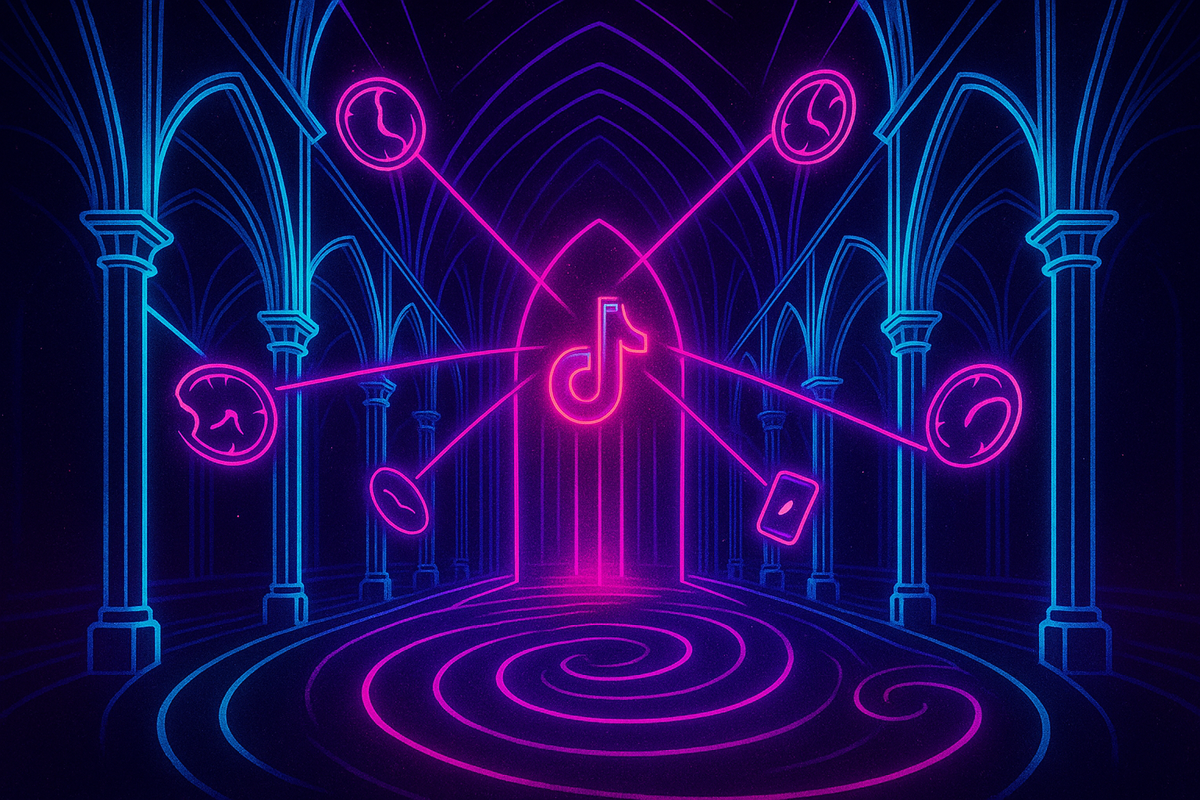
TikTok as Temple: Sacred Space in the Algorithm Age
Series: Digital Folklore | Part: 6 of 10
You open the app. The threshold is immediate—the For You page loads, infinite scroll begins, the world outside recedes. Time behaves differently here. Minutes become hours without noticing. You're not passively watching—you're being shown things, as if by an intelligence that knows you better than you know yourself.
This isn't just an app. It's sacred architecture. And understanding TikTok through the lens of sacred space clarifies what's actually happening when you can't stop scrolling.
What Makes Space Sacred
Sacred space isn't about religious content. It's about structural properties that create specific psychological and social effects. Temples, churches, mosques, shrines—across cultures, they share features:
Threshold. You cross a boundary. Outside → inside. Profane → sacred. The crossing is marked, often ritualized. Remove shoes. Bow. Cross yourself. The boundary isn't just physical—it's psychological.
Separation from ordinary time. Time inside the sacred space feels different. Slower, more compressed, or nonlinear. Hours in meditation feel like minutes. The liturgy creates its own temporal rhythm.
Heightened attention. You're more alert, more receptive, more emotionally available. The environment is designed to intensify your experience.
Directedness. Sacred space points you somewhere. The altar at the front. The mihrab indicating Qibla. The mandala at the center. Your attention is structured, not random.
Revelatory quality. The space discloses things. Insights, emotions, truths that feel like they come from outside yourself. The architecture facilitates encounter with something transcendent.
Exit difficulty. Leaving feels disruptive. You linger. The transition back to ordinary reality requires effort.
Now map these to TikTok.
TikTok's Temple Architecture
Threshold: The For You Page
Opening TikTok is crossing into a different realm. The For You page isn't a menu—it's an immediate immersive experience. No browsing required. The content is already playing. You're inside before you decide to enter.
The threshold is algorithmically optimized. The first video shown is chosen to grab you based on your history. If it hooks, you stay. The app has designed the threshold to minimize friction—one tap from notification to full immersion.
Separation from Ordinary Time
TikTok destroys clock time. You open it for "a few minutes" and emerge 90 minutes later, disoriented. The app provides no temporal markers. Videos are short (15 seconds to 3 minutes), but the stream is infinite. There's no end, no chapters, no sense of completion.
This is deliberate. The algorithm varies video length, topic, and intensity to prevent habituation. Just when you might exit, something intensely engaging appears. The temporal structure is designed to trap attention.
Heightened Attention
TikTok demands full sensory engagement. Video and audio together. Constant motion. Bright colors, loud sounds, emotional intensity. The videos are optimized for retention—hooks in the first second, rapid editing, visceral content.
Your nervous system is more activated on TikTok than in ordinary scrolling. Heart rate increases. Dopamine spikes with each transition. The app keeps you in a state of heightened arousal.
Directedness: The Algorithm as Oracle
Here's where it gets strange. The For You page feels personalized in an uncanny way. It shows you things you didn't search for but deeply resonate with. How did it know you were thinking about that? Why does this hit so precisely?
The algorithm isn't magic—it's sophisticated collaborative filtering, watch-time tracking, and engagement prediction. But experientially, it feels like the app knows you. Like it's revealing truths about yourself through the content it serves.
This is oracle dynamics. You're not choosing what to see—you're being shown what you need to see. The algorithm occupies the position of divine intelligence, curating revelation.
Revelatory Quality
TikTok users often describe the experience as discovering things about themselves. "I didn't know I needed to hear this." "This video called me out." "The algorithm put this on my FYP at the exact right moment."
The app facilitates self-discovery, emotional catharsis, identity clarification. Not through deliberate searching, but through algorithmically mediated encounter. You passively receive, and what you receive feels significant.
This is the structure of religious experience: revelation comes to you, not from you.
Exit Difficulty
You've experienced this. You know you should close the app. You've been scrolling for too long. You need to do other things. But one more video. Just one more. The next one might be even better.
TikTok's infinite scroll removes natural stopping points. There's no bottom to reach, no end of content. The algorithm ensures that high-engagement videos appear intermittently, variable-ratio reinforcement—the most addictive behavioral conditioning schedule.
Leaving requires active effort against the app's architecture. It feels disruptive, like pulling yourself out of a trance.
The Algorithmic Divine
Let's name what's happening: TikTok's algorithm occupies the structural position of God.
Not because anyone worships it literally, but because it exhibits features humans have historically attributed to divine intelligence:
Omniscience. The algorithm knows your viewing history, engagement patterns, demographic data, time spent on each video, what you watch repeatedly, what makes you scroll past, what you share. It knows you through your behavior in ways you don't know yourself.
Personalized providence. It curates your experience individually. What appears on your For You page is unique to you. The algorithm provides for each user what that user needs (in terms of engagement).
Inscrutability. You can't fully understand how the algorithm works. It's proprietary, complex, constantly updating. Its decisions feel mysterious, sometimes arbitrary. Like divine will, it operates beyond full comprehension.
Formative power. The algorithm shapes what you see, which shapes what you think about, which shapes your identity and worldview. It has the power to form consciousness.
And users treat it accordingly. They develop folk theologies:
- "The algorithm is testing me" (trial theology)
- "I got blessed by the algorithm" (grace theology)
- "The algorithm put this on my FYP for a reason" (divine purpose)
- "I need to post at the right time to please the algorithm" (ritual appeasement)
- "The algorithm shadowbanned me" (divine punishment)
This isn't metaphor. People genuinely relate to the algorithm as an intelligent force that can be pleased or angered, that has intentions, that distributes favor.
Why This Works
Humans are pattern-seeking, meaning-making animals. When we encounter systems that respond to our behavior in complex ways we don't fully understand, we anthropomorphize them, attribute intention, and develop quasi-religious relationships.
This happened with nature (gods of thunder, river spirits). It happened with political authority (divine right of kings). It happened with market forces (the invisible hand). Now it's happening with algorithms.
TikTok's algorithm is sophisticated enough to feel intelligent, personalized enough to feel attentive, and opaque enough to feel mysterious. That combination triggers the same cognitive machinery that generates religious experience.
Add the architectural features—threshold, temporal separation, heightened attention, revelatory content, exit difficulty—and you get a functional temple. Not in the sense of religious dogma, but in the sense of creating sacred space where ordinary consciousness is suspended and revelatory experience becomes possible.
The Danger
Sacred space isn't inherently bad. It serves real psychological needs: transcendence, meaning, encounter with something larger than self.
The problem with TikTok-as-temple: the oracle is optimized for engagement, not truth or flourishing.
Traditional sacred spaces, ideally, point you toward what matters. The temple directs your attention to the divine, to community, to ethical living, to transcendent values.
TikTok points you toward what keeps you watching. The algorithm doesn't care about your coherence, your growth, or your wellbeing. It cares about retention, engagement, time-on-platform. If existential dread keeps you scrolling, you'll see more existential dread. If rage keeps you engaged, you'll see more rage-inducing content.
The revelations you receive are real—but they're curated by an intelligence optimized for a goal that has nothing to do with your actual needs.
This creates:
Emotional manipulation. The algorithm learns which emotions keep you engaged and triggers them repeatedly.
Reality distortion. Your For You page isn't reality—it's reality filtered through engagement optimization. But it feels like truth because it's personalized.
Addiction by design. The temple architecture is engineered to make exit difficult. Not because the experience is meaningful, but because the behavioral conditioning is effective.
Outsourced meaning-making. Instead of actively constructing meaning, you passively receive what the algorithm serves. This feels easier, but it atrophies agency.
Conscious Participation
Recognizing TikTok as sacred space doesn't mean deleting the app (though that's valid). It means engaging with awareness of the architecture.
Notice the threshold. You're entering a space designed to alter your consciousness. Can you cross it intentionally rather than unconsciously?
Set temporal boundaries. Sacred spaces traditionally have temporal limits—the service ends, the meditation bell rings. Can you impose those?
Remember the oracle's motive. The algorithm isn't showing you what's true or what you need. It's showing you what keeps you watching.
Distinguish revelation from manipulation. Some content genuinely resonates and serves your growth. Some just triggers engagement. Can you tell the difference?
Maintain ontological clarity. TikTok isn't reality. It's not even a representative sample. It's a highly curated stream optimized for engagement.
Build exit capacity. If you can't close the app when you intend to, that's not a minor inconvenience. That's loss of agency in a domain that's infiltrating hours of your life.
And perhaps most importantly: ask what needs TikTok is meeting that your actual life isn't. If the app provides transcendence, discovery, emotional intensity, community—why aren't you getting those from embodied reality?
The Future of Sacred Architecture
TikTok won't be the last algorithmically mediated sacred space. We're moving toward a world where AI systems curate experience, anticipate needs, and shape consciousness at scale.
This could be profound or dystopian, depending on what the systems optimize for.
If they optimize for engagement (current trajectory), we get addiction, manipulation, and meaning outsourced to corporate platforms.
If they optimize for human flourishing (radical rethinking required), we could get tools that genuinely support coherence, growth, and wellbeing.
The architectural principles remain the same—threshold, attention, revelation, directedness. The question is: toward what?
Traditional temples pointed toward God, enlightenment, communal coherence, ethical living. TikTok points toward the next video. What will the next generation of algorithmic sacred spaces point toward?
That depends on whether we recognize what's being built and demand it serve human needs—or whether we passively scroll into whatever architecture keeps us watching longest.
In the next article, we'll explore parasocial entrainment—how one-directional relationships with content creators generate real emotional bonds and collective synchronization, despite never being reciprocal.
This is Part 6 of the Digital Folklore series, exploring memes, fandoms, and world-building as contemporary mythology.
Previous: World-Building as Coherence Engineering: Why Fictional Universes Matter
Next: Parasocial Entrainment: One-Directional Relationships That Feel Real
Further Reading
- Eliade, M. (1959). The Sacred and the Profane: The Nature of Religion.
- Bucher, T. (2018). If...Then: Algorithmic Power and Politics. Oxford University Press.
- Zuboff, S. (2019). The Age of Surveillance Capitalism. PublicAffairs.
- Harris, T. on attention engineering (Center for Humane Technology resources)
Comments ()