Time Travel: What Physics Actually Allows
The physics of time travel isn't forbidden — it's constrained. General relativity allows closed timelike curves, and the Novikov self-consistency principle resolves the grandfather paradox. The real barrier isn't logic; it's engineering something that bends spacetime.
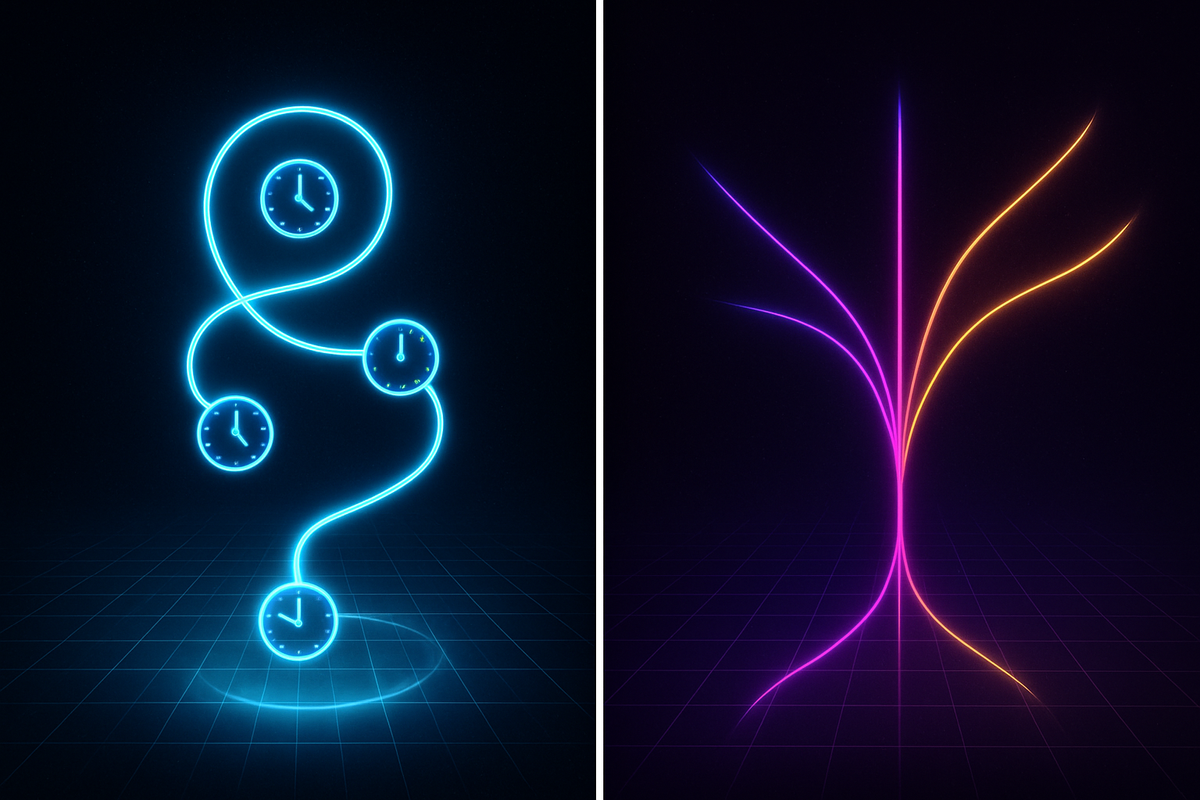
Time Travel: What Physics Actually Allows
Series: Spacetime Physics | Part: 5 of 9 Primary Tag: FRONTIER SCIENCE Keywords: time travel, closed timelike curves, Gödel universe, grandfather paradox, chronology protection
Time travel is a staple of science fiction. It's also a legitimate topic in theoretical physics.
General relativity doesn't distinguish past from future the way our experience does. The equations are time-symmetric. And they allow solutions with closed timelike curves—paths through spacetime that loop back to their own past.
Does this mean time travel is possible? Physics gives an uncomfortable answer: it's not clearly forbidden, but it might be. And if it's possible, it's nothing like the movies.
Forward Time Travel: Already Happening
Let's start with the easy case: traveling forward in time is not only possible, it's inevitable. We're all doing it right now, at the rate of one second per second.
But you can travel forward faster than others, and this is special relativity working as intended.
The twin paradox: One twin stays on Earth. The other rockets away at high speed, turns around, and returns. Due to time dilation, less time passes for the traveling twin. They return younger than their stay-at-home sibling.
This is time travel to the future. The traveling twin has jumped ahead in time relative to Earth. They've skipped over years that everyone else had to live through.
The gravity version: Time runs slower in stronger gravitational fields. Spend time near a massive object (or a black hole), then return to weaker gravity, and you've jumped forward. The movie Interstellar uses this—characters near a black hole age hours while decades pass on Earth.
This is real, tested physics. Astronauts on the International Space Station age slightly less than people on Earth (the speed effect dominates the gravity effect at ISS altitude). GPS satellites must correct for both effects.
Forward time travel exists. It's just expensive: you need either very high speeds or very strong gravity, and the further you want to jump, the more extreme the requirements.
Backward Time Travel: The Problem
Traveling to the past is different. Much harder. Possibly impossible.
The physics issue isn't energy or speed. It's causality. If you can visit the past, you can potentially change it. Change it, and you create paradoxes.
The grandfather paradox: Go back in time, kill your grandfather before your parent is born, and you're never born. But if you're never born, you never go back to kill him. But then he lives, you're born, you go back... Logical contradiction.
The information paradox: Where does the information come from? You go back in time and tell Shakespeare his plays. He writes them down. You learned the plays from his writings, which exist because you told him. The plays have no origin—they're a causal loop with no beginning.
These paradoxes suggest backward time travel might be logically impossible, or at least logically constrained.
What General Relativity Allows
Despite the paradoxes, general relativity permits solutions with closed timelike curves (CTCs). A CTC is a worldline—a path through spacetime—that returns to its own starting point in time and space.
The Gödel universe: In 1949, Kurt Gödel found a solution to Einstein's equations describing a rotating universe. In Gödel's universe, CTCs exist everywhere. You could travel in a large circle and return before you left.
Our universe isn't a Gödel universe (it's not rotating as a whole, and it's expanding). But Gödel showed that general relativity's equations permit time travel solutions.
The Kerr solution: Rotating black holes (Kerr black holes) have a ring singularity rather than a point. The math suggests that passing through the ring might lead to a region with CTCs. Whether this is physical or a mathematical artifact of the idealized solution is debated.
Wormholes: As discussed in the previous article, a traversable wormhole with one mouth time-shifted relative to the other could create CTCs. This requires exotic matter and faces stability challenges.
Cosmic strings: Hypothetical defects in spacetime, if they exist and move past each other at high speed, might permit CTCs in certain configurations.
None of these are easy to create. All face serious obstacles. But they show that general relativity doesn't simply forbid time travel.
Chronology Protection
Stephen Hawking proposed the chronology protection conjecture: the laws of physics conspire to prevent time machines.
The idea is that when you try to create a CTC, quantum effects become important at the "Cauchy horizon"—the boundary where the time machine would form. Vacuum fluctuations blow up, creating a wall of infinite energy that destroys the machine before it works.
This isn't proven. The calculation is difficult because it requires quantum field theory in curved spacetime, and we don't have complete confidence in those results near where CTCs would form.
But the conjecture has appeal. It would explain why we don't see time travelers from the future—time machines are self-destructive. And it would protect causality without requiring us to find a logical error in the time-travel solutions.
Hawking quipped: "The best evidence that time travel is not possible, and never will be, is that we have not been invaded by hordes of tourists from the future."
Self-Consistency and Many Worlds
If time travel is possible and chronology protection fails, physics still has to be consistent. There are proposals for how:
The Novikov self-consistency principle: Named after Igor Novikov, this principle states that any events involving time travel must be self-consistent. You can't change the past because the past has already incorporated your time-traveling intervention.
If you go back to kill your grandfather, something will always prevent you. Your gun jams, you have a change of heart, you kill the wrong person. The universe enforces consistency—not through magic, but through the constraint that only self-consistent histories are possible.
This solves the grandfather paradox but creates others: it seems to restrict free will, and it's unclear what physical mechanism enforces consistency.
Many-worlds interpretation: Another approach says that when you travel back and "change" something, you create a branching timeline. You don't change your own past; you create an alternate history.
In this view, there's no paradox because you're not really visiting your own past—you're visiting a different branch of reality that looks like your past. Kill "your" grandfather, and you just prevent your counterpart from being born in that branch. Your own history is unchanged.
This is consistent but changes what "time travel" means. You can't revisit your childhood home as it was. You can only visit parallel versions.
The Bootstrap Paradox
Even without grandfather-style contradictions, time travel permits strange bootstrap paradoxes (also called causal loops).
Example: A physicist receives a book from her future self explaining how to build a time machine. She builds it, travels back, and gives the book to her past self. The book was never written—it has no origin.
This doesn't involve a logical contradiction. The events are self-consistent. But information (the contents of the book) has no causal origin. It exists because it exists.
Is this forbidden? Physics doesn't clearly say so. Self-consistent loops might be permitted. They're just deeply weird.
What Time Travel Would Actually Mean
If backward time travel were possible, it would require a framework different from our naive expectations:
No changing the past: Either the past can't be changed (Novikov self-consistency), or "changing" it creates branches (many-worlds). Either way, you can't undo what's happened in your timeline.
Closed timelike curves, not arbitrary travel: You couldn't jump to any moment in history. CTCs are specific geometries. You could only travel along paths that the spacetime geometry permits.
Time machines, not time jumping: You'd need a physical time machine—probably something like a wormhole. You can't travel to times before the machine exists. A time machine built in 2050 can't take you to 1950.
Extreme requirements: Building a time machine would require exotic matter, enormous energies, or both. This isn't something a hobbyist invents in a garage.
The Honest Answer
Can we travel backward in time?
What we know: - Forward time travel is real and tested - General relativity allows solutions with CTCs - Those solutions require extreme conditions (exotic matter, rotating universes, etc.) - Paradoxes create logical constraints - Chronology protection might forbid time machines, but isn't proven
What we don't know: - Whether chronology protection is real - Whether exotic matter exists in usable form - Whether CTC solutions are physically realizable or just mathematical curiosities - What really happens at Cauchy horizons
Best guess: Backward time travel is probably impossible, but physics hasn't proven it. The obstacles are severe. The paradoxes suggest deep constraints. Chronology protection might be real. But "probably impossible" isn't "certainly impossible."
We should hold this question with appropriate uncertainty.
Further Reading
- Gödel, K. (1949). "An example of a new type of cosmological solutions of Einstein's field equations of gravitation." Reviews of Modern Physics. - Thorne, K. (1994). Black Holes and Time Warps. W.W. Norton. (Chapter on time machines) - Novikov, I. (1983). Evolution of the Universe. Cambridge University Press. - Hawking, S. (1992). "Chronology protection conjecture." Physical Review D.
This is Part 5 of the Spacetime Physics series. Next: "The Alcubierre Drive: Warp Speed Without Breaking Laws."



Comments ()