Topological Data Analysis in Neuroscience
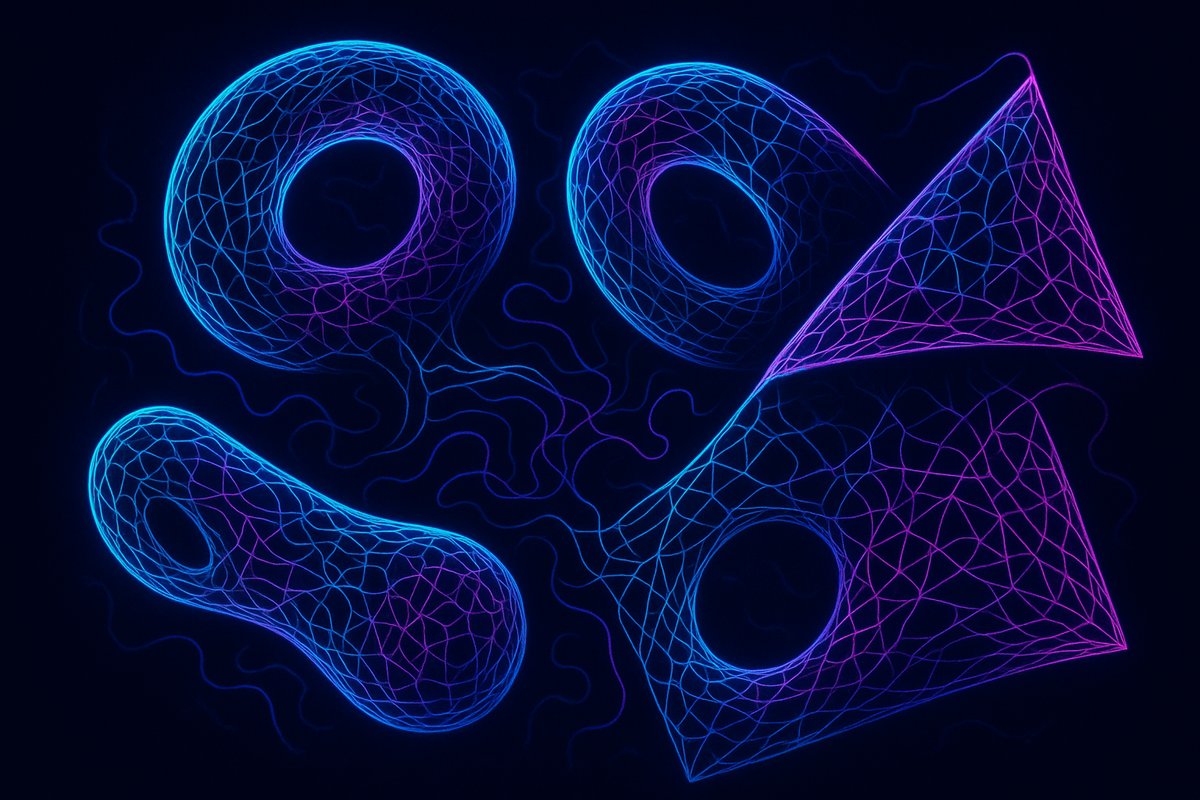
Neural data is messy. Thousands of neurons firing in high-dimensional spaces, creating patterns that shift and flow. Traditional analysis tools—correlation matrices, dimensionality reduction, clustering algorithms—capture some of this structure. But they miss something fundamental: shape.
Topological Data Analysis (TDA) sees what others can’t. It reveals holes, loops, cavities, and higher-dimensional structures in neural activity patterns. Structures that persist across noise. Structures that correlate with consciousness, learning, and pathology. Structures that might be the actual geometry of thought.
This is neuroscience through a topological lens—and it’s revealing that brains compute in shapes we’re only beginning to understand.
Why This Matters for Coherence
Coherence has geometry. The shape of neural activity patterns matters: how dimensions couple, where cavities form, what topological features persist. TDA provides tools for measuring these shapes, tracking how they transform with learning, and identifying signatures of coherent versus incoherent brain states.
Understanding topological methods in neuroscience helps us understand what coherence looks like when measured geometrically, not just statistically.
What This Series Covers
This series explores topological data analysis in neuroscience and its implications for understanding brain structure, function, and consciousness. We’ll examine:
- Persistent homology and how it finds features that matter
- The Blue Brain Project’s discoveries about neural circuit topology
- Topological signatures of consciousness
- TDA for functional connectivity and network analysis
- How neural manifolds transform during learning
- Connections between topology and information geometry
- Clinical applications and topological biomarkers
- What topology teaches us about the shape of coherence
By the end of this series, you’ll understand why the question “What shape is thought?” has mathematically precise answers—and why those answers reveal structure that traditional methods miss.
Articles in This Series
- The Shape of Thought: How Topologists Are Decoding the Brain
- Persistent Homology 101: Finding Features That Matter
- The Blue Brain Project: Topology of Neural Circuits
- Topological Signatures of Consciousness: What Shape Is Awareness?
- Brain Networks Through a Topological Lens
- Learning in Topological Space: How Neural Manifolds Transform
- TDA Meets Information Geometry: Two Approaches to Neural Structure
- Clinical TDA: Topological Biomarkers for Brain Disorders
- Synthesis: What Topology Teaches About the Shape of Coherence
Part of the FRONTIER SCIENCE collection. For related geometric approaches, see The Free Energy Principle and Applied Category Theory.
Comments ()