Trained Immunity: Memory Without Memory Cells
Immunology's central dogma held that only adaptive immunity — T and B cells — could remember past threats. Trained immunity breaks that rule. Innate immune cells can be epigenetically primed by one infection to respond faster to entirely different ones.
Trained Immunity: Memory Without Memory Cells
Series: New Immunology | Part: 3 of 8 Primary Tag: FRONTIER SCIENCE Keywords: trained immunity, BCG vaccine, innate immune memory, epigenetics, monocytes, macrophages
The Discovery
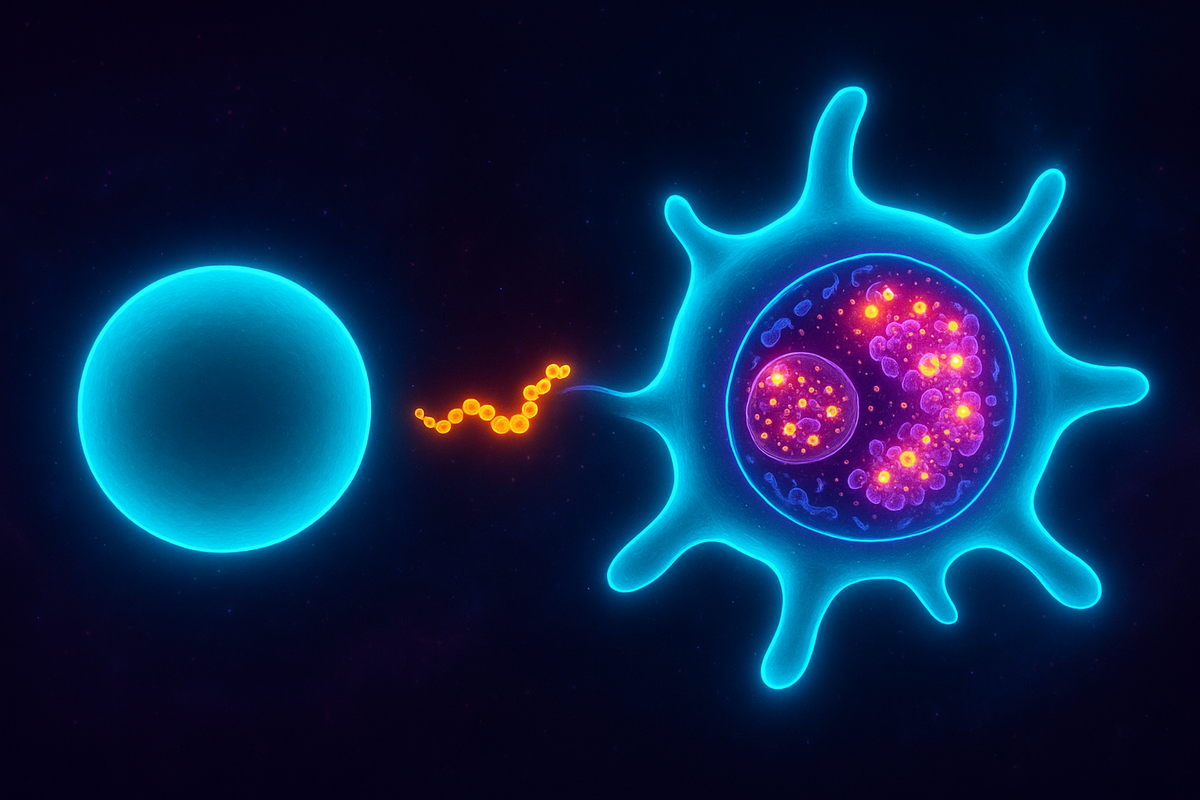
The modern story of trained immunity begins with Mihai Netea at Radboud University in the Netherlands. In 2011, his team published a study showing that monocytes (innate immune cells) could be "trained" by exposure to certain stimuli to respond more vigorously to subsequent, unrelated challenges. The experimental setup was simple: expose monocytes to β-glucan (a component of fungal cell walls), wash it away, wait a week, then challenge with bacteria. The β-glucan-exposed monocytes produced more inflammatory cytokines, killed pathogens more effectively, and behaved as if they had learned something. But monocytes don't have the receptor diversity of T and B cells. They can't generate antibodies. They don't undergo clonal selection. How could they remember? The answer was epigenetic reprogramming.
Epigenetics: The Memory of Gene Expression
Epigenetics refers to modifications that affect gene expression without changing the DNA sequence itself. The main mechanisms: DNA methylation: Adding methyl groups to cytosines in DNA, typically silencing nearby genes. Histone modification: Histones are the proteins DNA wraps around. Adding acetyl groups, methyl groups, or phosphate groups to histones can open or close the chromatin, making genes more or less accessible. Chromatin remodeling: Physically moving or restructuring the histone-DNA complexes to change accessibility. These modifications can be relatively stable—persisting through cell divisions, lasting for weeks or months. They're how cells maintain their identity: a neuron stays a neuron because its epigenetic marks keep neuron genes accessible and other genes silenced. Trained immunity works through epigenetic changes in innate immune cells. Exposure to certain stimuli leaves marks on the chromatin that persist after the stimulus is gone. These marks keep inflammatory genes more accessible, primed for rapid transcription on subsequent challenge. The cells haven't learned in the adaptive immunity sense—they haven't developed specific receptors. But they've been trained to respond more vigorously to future challenges.
The BCG Effect
BCG (Bacillus Calmette-Guérin) is a live attenuated strain of Mycobacterium bovis, used as a tuberculosis vaccine since 1921. It's one of the most widely used vaccines in history, with billions of doses administered. The nonspecific protective effects of BCG have been observed for decades:
- Reduced neonatal mortality: In West Africa, BCG vaccination within the first week of life reduces all-cause mortality by about 40%—far more than TB prevention could explain.
- Protection against respiratory infections: BCG-vaccinated children have fewer respiratory infections.
- Cancer immunotherapy: BCG is actually used to treat bladder cancer—injected directly into the bladder, it stimulates an immune response that attacks tumor cells.
- COVID-19: During the pandemic, epidemiological studies suggested countries with BCG vaccination programs might have lower COVID severity. Randomized trials are testing BCG for COVID protection in healthcare workers.
The mechanism appears to be trained immunity. BCG trains monocytes and macrophages to respond more aggressively to subsequent infections—bacterial, viral, or fungal. Netea's group showed that BCG vaccination in humans causes epigenetic changes in circulating monocytes that persist for months. The trained monocytes produce more TNF-α, IL-1β, and IL-6 when restimulated with unrelated pathogens. The effect is real, measurable, and durable.
Beyond BCG: Other Training Stimuli
BCG isn't the only training stimulus. Several microbial components induce trained immunity: β-glucan: The fungal cell wall component that first demonstrated training in the lab. It binds the receptor Dectin-1 on monocytes and triggers a signaling cascade that leads to epigenetic reprogramming. Muramyl dipeptide (MDP): A component of bacterial cell walls. Binds NOD2, another innate immune receptor. Oxidized LDL: Interestingly, non-microbial stimuli can also train. Oxidized LDL (implicated in atherosclerosis) can induce a trained immunity-like state in macrophages—which may actually be bad, contributing to chronic inflammation in arterial plaques. Certain whole organisms: Beyond BCG, other attenuated vaccines (like oral polio vaccine) may have nonspecific protective effects through similar mechanisms. The common features: pattern recognition receptor engagement, metabolic reprogramming (shift toward glycolysis), and epigenetic changes at inflammatory gene loci.
The Metabolic Connection
Trained immunity isn't just about epigenetics—it's also about metabolism. When monocytes are trained, their metabolic profile shifts:
- Increased glycolysis: Cells switch to faster, less efficient ATP production (aerobic glycolysis or Warburg effect)
- Increased fumarate and succinate: These metabolic intermediates can act as signaling molecules that promote epigenetic changes
- Enhanced cholesterol synthesis: Cholesterol pathways support the epigenetic modifications
The metabolic and epigenetic changes are linked. Fumarate, for instance, inhibits certain histone demethylases, causing histone marks to accumulate. The metabolism itself becomes part of the memory. This connection has therapeutic implications. Interfering with specific metabolic pathways can enhance or inhibit training. The target isn't just the immune response—it's the metabolic state that enables the response.
Tolerance: The Opposite of Training
Training increases responsiveness. But the same cells can also undergo the opposite: tolerance (or "paralysis"), where prior stimulation leads to reduced responsiveness to subsequent challenges. Sepsis provides a clear example. In the acute phase of sepsis, the immune system mounts a massive inflammatory response. But many sepsis survivors subsequently enter an immunosuppressed state—their monocytes produce less cytokine when stimulated, and they're more susceptible to secondary infections. This too is epigenetically mediated. The sustained inflammation causes different epigenetic marks that silence inflammatory genes rather than priming them. Training and tolerance are opposing outcomes of innate immune memory:
- Training: enhanced responsiveness
- Tolerance: reduced responsiveness
Which outcome occurs depends on the stimulus, dose, timing, and context. Low doses of certain stimuli train; high doses induce tolerance. Short exposures train; prolonged exposures tolerize. Understanding this balance is medically crucial. Sepsis patients die not just from initial infection but from secondary infections during the tolerized state. Restoring trained immunity in these patients might save lives.
Evolutionary Perspective
Why would innate immune cells evolve the capacity to "remember"? From an evolutionary standpoint, training makes sense in environments with recurrent threats. If you survive one bacterial infection, you're likely to encounter bacteria again. Being primed—responding faster and stronger—provides survival advantage. Tolerance makes sense too. After fighting off a major infection, the danger of excessive inflammation might outweigh the benefit of continued vigilance. Tolerization is a cooling-off period. The innate system isn't just reacting—it's calibrating. It adjusts its baseline responsiveness based on prior experience, optimizing for the current threat environment. Interestingly, plants have similar mechanisms. Plants can't run away from pathogens; they face repeated exposure in the same location. Plant immunity includes "priming" phenomena remarkably similar to trained immunity in animals. This suggests the principles are ancient and general.
Therapeutic Implications
Trained immunity opens therapeutic possibilities: Broadly protective vaccines: Could we design vaccines that provide nonspecific protection through trained immunity? BCG does this somewhat accidentally. A deliberate approach might be more effective. Adjuvants: Vaccine adjuvants enhance immune responses. Some may work partly through training innate cells. Understanding trained immunity could lead to better adjuvant design. Sepsis treatment: Reversing the tolerized state in sepsis patients could restore immune function. Trials are exploring BCG and other training stimuli for sepsis survivors. Cancer immunotherapy: Trained macrophages might be more effective at attacking tumors. Combining training stimuli with other immunotherapies could enhance responses. Metabolic intervention: Since metabolism and training are linked, metabolic drugs might modulate training. This is a nascent area but conceptually rich. The flip side: we need to be careful. Trained immunity contributes to chronic inflammatory diseases. Foam cells in atherosclerotic plaques show trained immunity features. Training isn't always good—context matters.
Rewriting the Textbooks
Trained immunity forces a reconceptualization of innate immunity: Old view: Innate immunity is fixed, hardwired, and doesn't learn. Memory is the exclusive province of adaptive immunity. New view: Innate cells can be functionally reprogrammed by experience. The reprogramming is epigenetic (not genetic) and relatively short-lived (months, not years) compared to adaptive memory. But it's real memory nonetheless. The boundary between innate and adaptive blurs further. Innate immunity has memory. Adaptive immunity, it turns out, has innate-like features (certain invariant T cells respond rapidly to common patterns). The two systems aren't separate—they're interleaved aspects of one integrated defense system. Immunology textbooks published after ~2015 include trained immunity. Earlier editions don't. The field changed.
The Coherence Frame
From a coherence perspective, trained immunity is the innate system calibrating its responsiveness to match environmental threat level. A single, fixed inflammatory set-point isn't optimal for all environments. In a high-pathogen environment, you want to be primed—ready to respond aggressively. In a low-pathogen environment, excessive inflammation wastes resources and causes damage. Trained immunity allows the innate system to maintain contextual coherence—aligning its behavior with recent experience. The epigenetic marks are a form of stored information about the environment. This is a simpler, faster form of learning than adaptive immunity's clonal selection. It doesn't generate specificity—the monocyte still recognizes the same patterns. But it modulates intensity based on experience. The system tunes itself. The coherence is temporal: what happened recently affects how the system responds now. The body maintains a running estimate of its threat environment and adjusts its baseline accordingly.
Further Reading
- Netea, M.G. et al. (2011). "Trained immunity: a memory for innate host defense." Cell Host & Microbe.
- Netea, M.G. et al. (2016). "Trained immunity: A program of innate immune memory in health and disease." Science.
- Arts, R.J.W. et al. (2018). "BCG Vaccination Protects against Experimental Viral Infection in Humans through the Induction of Cytokines Associated with Trained Immunity." Cell Host & Microbe.
- Divangahi, M. et al. (2021). "Trained immunity, tolerance, priming and differentiation: distinct immunological processes." Nature Immunology.
This is Part 3 of the New Immunology series, exploring the frontier of how immunity shapes health and disease. Next: "Checkpoint Inhibitors: Releasing the Brakes on Cancer."


Comments ()