Trauma: When the Geometry Collapses
Trauma as structural collapse in coherence geometry (M=C/T). Healing requires geometric reconstruction through entrainment, not insight or reassurance alone.

Trauma: When the Geometry Collapses
Formative Note
This essay represents early thinking by Ryan Collison that contributed to the development of A Theory of Meaning (AToM). The canonical statement of AToM is defined here.
You now know three things.
Hydrogen showed you the pattern: a stable baseline, reactive peaks, and a forbidden middle — the minimal geometry that allows a system to stay intact.
The Fundamental Equation showed you the ratio; meaning is emerges when coherence exceeds trauma.
Entrainment showed you the mechanism: the rhythmic coupling through which systems synchronize, regulate, and restore themselves.
Coherence showed you the measurement: smooth curvature, broad dimensionality, persistent topology, and reliable reversibility — the structural conditions under which meaning becomes possible.
Now we reach the inflection point — the place where the theory becomes personal, clinical, relational, cultural, and existential all at once:
What happens when the geometry fails?
Not when you feel bad, or stressed, or overwhelmed.
Those are transient states inside a coherent manifold.
Trauma is different.
Trauma is not just taking a hit. It's the shape the system freezes into because the hits kept coming. It’s what happens when stress stops being an event and becomes a climate, when misattunement becomes the baseline, when a rough season becomes the geometry you have to live inside. Trauma is the point where normal load stops bouncing off and starts bending inward.
When that ratio collapses, meaning collapses with it. Identity destabilizes. Prediction error spikes. The world stops feeling navigable. The system does not simply struggle — it loses the geometry required to remain itself.
Important Clarification
In this essay, “trauma” is used in the AToM sense: a structural collapse of coherence geometry caused by stress that exceeds entrainment capacity. This includes clinical, capital-T Trauma — but is not limited to it. Chronic stress, relational misattunement, cultural incoherence, developmental instability, and everyday overload can all generate the same geometric signatures. This is not a clinical diagnosis or a psychological label. This is a description of what happens when the manifold can no longer maintain integrable trajectories under constraint.
And this is why safety alone doesn’t heal trauma.
Why insight doesn’t fix it.
Why “knowing you’re okay” does not restore calm.
Why time passes, yet nothing changes.
The problem is not the memory — it’s the geometry left behind.
Trauma is what happens when the atom stops being an atom.
When coherence collapses, and the system cannot spontaneously rebuild itself.
What follows is the blueprint of that collapse — and the geometry of reconstruction.
Trauma Is Not About the Event
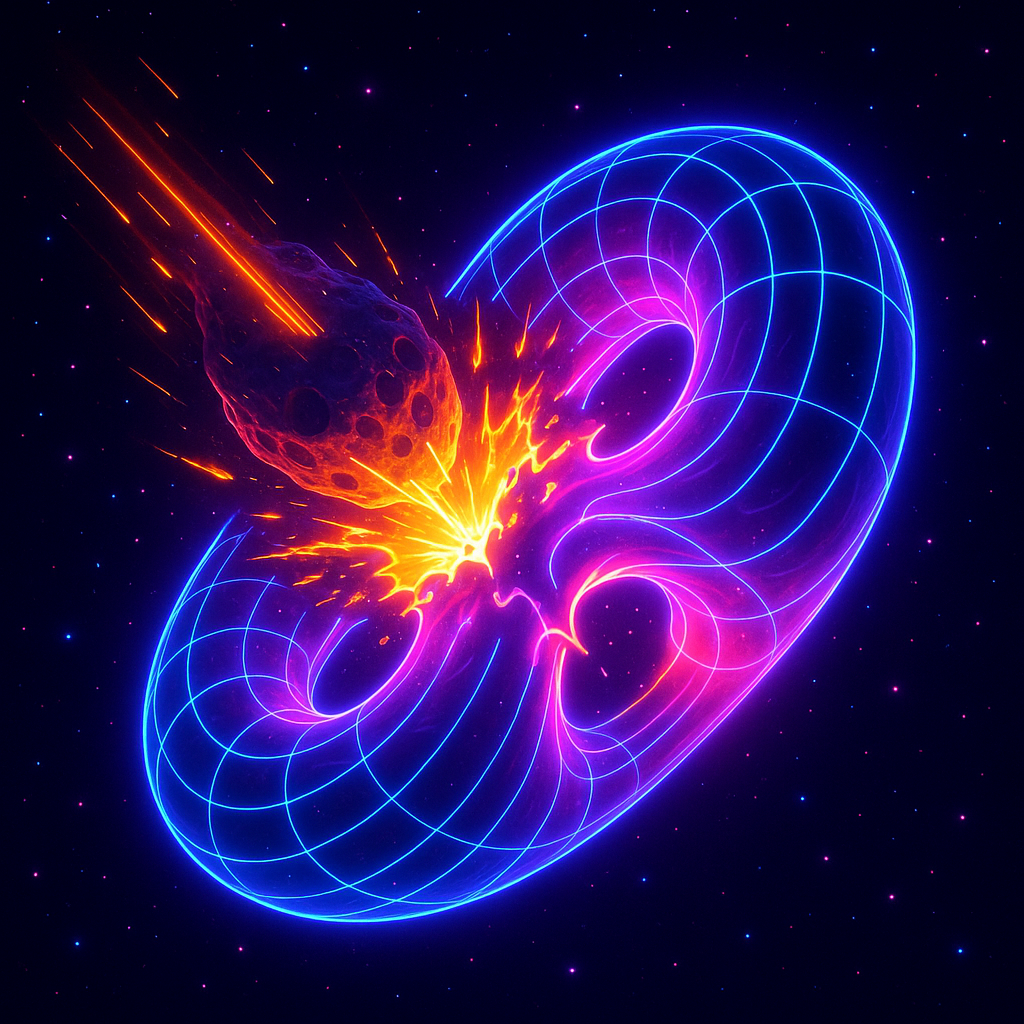
Why the same experience breaks some systems and not others
Two people live through the same car accident. One feels shaken but recovers within weeks. The other carries panic, hypervigilance, and intrusive somatic memories for years.
Standard psychology says, “everyone responds differently.”
AToM says something more precise: the difference is geometric.
Trauma is not the event.
Trauma is what happens when ongoing stress, misattunement, or overload exceeds the system’s ability to entrain and metabolize it. It is the moment where a passing strain becomes a persistent deformation — where what should have been an acute perturbation instead becomes a lasting change in the system’s curvature, dimensionality, and topology. A bad day stays a day. Trauma is when the bad day becomes a bad month, the bad month becomes a bad year, and the accumulating load gradually reshapes the manifold itself.
This is why two people experiencing the same external stimulus can diverge so sharply. The event is identical; the difference lies in the coherence bandwidth each system brings into the moment. One system absorbs the perturbation elastically, bending and returning to shape. The other’s coherence capacity is exceeded, and the deformation becomes plastic — a persistent geometric change rather than a temporary fluctuation.
Biology calls this “allostatic overload.”
AToM calls it coherence collapse.
Several things follow immediately from this:
A child may be traumatized by what an adult withstands not because the event was worse, but because the child’s coherence geometry is still forming and therefore more vulnerable to overload.
Chronic stress may be more traumatic than a single shock because collapse is cumulative: small but continuous misattunements can deform the manifold more than one catastrophic hit.
A seemingly “minor” event can produce major trauma when the system was already operating at the edge of its coherence bandwidth.
And relational betrayal often traumatizes more deeply than physical danger because relational coherence — the geometry that makes repair possible — is more fundamental to human stability than momentary threat.
Trauma is not an event problem. It is a geometry problem.
It is what happens when a system can no longer absorb the load it carries.
When the rhythms that once regulated fail to synchronize.
When the manifold that once held experience smoothly begins to kink, narrow, or fragment.
Trauma is the point where stress stops being a story about what happened to you and becomes a structure you live inside.
This geometric distinction explains why insight alone can’t undo trauma, why safety doesn’t automatically restore calm, and why time does not heal what has become structurally deformed.
Once the manifold collapses, the system cannot simply “bounce back.”
It must be rebuilt.
The Five Signatures of Collapse
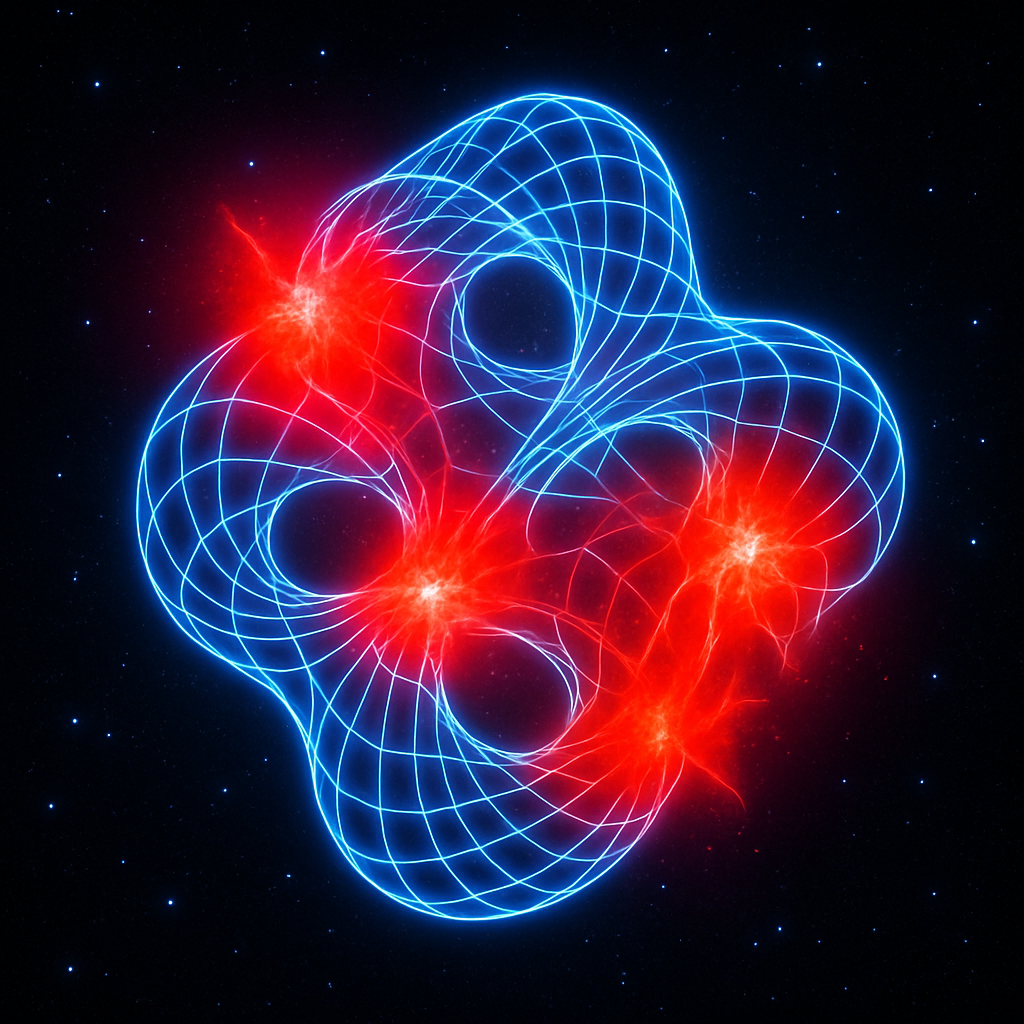
Trauma is not chaos — it is a patterned deformation.
What actually breaks when trauma happens
When coherence collapses, the manifold does not fail randomly. It breaks in five specific, measurable ways that appear across every domain of human experience. These signatures are not symptoms; they are the geometric consequences of sustained overload.
Trauma is not chaos — it is a patterned deformation.
The first signature is dimensional collapse. Before collapse, a coherent system can access multiple emotional states, behavioral options, relational modes, and cognitive perspectives. After overload, the system contracts. Emotional range narrows. Behavioral flexibility disappears. Social engagement becomes brittle or avoids entire regions of experience.
The state space that once allowed many paths forward constricts into a narrow corridor. This is not stubbornness or unwillingness to change. It is the literal loss of available degrees of freedom. In AToM terms, **trauma **compresses the system’s dimensionality until only a few trajectories remain accessible.
The second signature is curvature spikes — the shift from proportional response to hypersensitivity. In a smooth manifold, small perturbations create small prediction errors. After deformation, the same cue triggers disproportionate internal activation.
Hypervigilance, startle responses, emotional volatility, catastrophic interpretations, and somatic panic are not overreactions; they are what happen when curvature becomes jagged. A small movement inside a steep geometry produces massive internal gradients. This is why people say, “I know I’m safe, but I don’t feel safe.” Cognition lives in one region of the manifold; the curvature deformation lives in another.
The third signature is topological bottlenecking — the emergence of narrow, rigid pathways that trap the system in repetitive cycles. Before collapse, many transitions exist between states; after collapse, only a few narrow channels remain. Intrusive memories, rumination loops, repetitive relational conflicts, addictive cycles, and stuck emotional states all arise from this geometry.
The system can enter these attractors easily but cannot exit without external coupling. Persistent homology would show deep, pathological wells forming in the topology. The person is not choosing to stay stuck; there is nowhere else the geometry can take them.
The fourth signature is hysteresis, the point where the system can no longer return to baseline through its own dynamics. Before collapse, stress activates and the system recovers naturally; after collapse, returning to baseline requires disproportionate effort. Fatigue becomes chronic. Ordinary demands feel overwhelming.
Regulation that once happened automatically now requires external scaffolding. This is why reassurance, insight, or safety do not restore coherence: they lower load but do not reverse the deformation. The manifold has reshaped itself in a way that does not spontaneously unwind.
The fifth signature is boundary formation, often expressed as dissociation. When collapse threatens global failure, the system protects itself by partitioning. Emotional, sensory, cognitive, or relational subsystems lose integration to prevent destabilizing signals from propagating.
Dissociation is not absence; it is a protective topological partition that sacrifices integration for survival. It prevents catastrophic coherence failure by isolating volatile regions of the manifold. The cost is fragmentation: memory, emotion, agency, and narrative cease to cohere as one continuous field.
Together, these five signatures describe the structural truth beneath trauma:
Dimensional collapse reduces what the system can access.
Curvature spikes distort what the system perceives.
Bottlenecks restrict where the system can go.
Hysteresis traps the system in the shape it collapsed into.
Boundaries divide the system against itself for preservation.
None of this is metaphor. These are the geometric consequences of sustained overload.
Trauma is not mysterious once you see these signatures.
The system has not failed; its geometry has.
And because the deformation is structured, reconstruction can be structured as well.
Why Trauma Persists

The geometry doesn’t simply “heal with time”
Trauma endures not because the event was powerful, but because the deformation was. Once coherence collapses, the resulting geometry becomes self-stabilizing in the wrong direction. A traumatized system is not clinging to the past — it is living inside a manifold that has been reshaped by accumulated overload. This is why time alone does not fix trauma, why insight does not dissolve patterns, and why safety does not reliably restore calm.
The collapse created structure, and structure is stubborn.
The first reason trauma persists is that the new geometry becomes self-reinforcing.
When dimensionality collapses, the system avoids the regions it can no longer navigate, reinforcing the collapse.
When curvature spikes, hypersensitivity leads to avoidance, which prevents curvature from ever smoothing.
When bottlenecks form, the system reroutes through the same narrow pathways, deepening the attractors.
When boundaries appear, parts of the system cannot communicate long enough to integrate.
Trauma’s geometry maintains itself because every attempted solution — avoidance, vigilance, rigidity, compartmentalization — reinforces the deformation.
The second reason trauma persists is the separation between cognitive understanding and autonomic geometry. You can know you are safe, understand what happened, recount the narrative, and still feel trapped in the same internal cycles. That is because insight lives in regions of the manifold that still function, while collapse lives in regions shaped by autonomic deformation.
Cognitive reframing cannot directly smooth curvature spikes.
Narrative processing cannot reopen topological bottlenecks.
Somatic overload cannot be undone by intellectual clarity.
The domains are adjacent but not coupled; knowledge does not automatically propagate across a fractured manifold.
The third reason trauma persists is that safety is necessary but insufficient. Removing threat lowers load, but it does not rebuild coherence. A system can be fully safe and still carry collapsed dimensionality, jagged curvature, rigid bottlenecks, persistent hysteresis, and entrenched partitions.
This is why people leave harmful environments or enter supportive relationships yet continue to feel dysregulated. Safety stops further deformation, but it does not reverse what has already taken shape. *Geometry is not undone by absence; it is undone only by reconstruction.*4565
Together, these dynamics explain why trauma endures even when conditions improve, why people feel “stuck as who they became in the collapse,” and why healing requires more than time or insight. Trauma persists because the system is not remembering the past — it is continuing to live inside the geometry that the past created.
And until that geometry is reshaped, the system will continue to behave exactly as it was forced to behave when coherence first collapsed.
What Reconstruction Looks Like

Trauma collapses coherence; entrainment rebuilds it.
How coherence is rebuilt after the manifold deforms
If trauma is geometric collapse, then healing is geometric reconstruction. And reconstruction does not happen through insight, willpower, or time — it happens through entrainment, the only mechanism capable of restoring curvature, reopening dimensions, dissolving bottlenecks, reducing hysteresis, and softening boundaries. Trauma collapses coherence; entrainment rebuilds it.
Reconstruction begins with re-expanding dimensionality. A system that has collapsed into narrow attractors cannot simply choose new behavior; it must regain access to states it can no longer reach. Gradual exposure to novelty, titrated emotional range, safe relational variability, embodied practices that unlock new somatic states, and low-stakes behavioral experiments all serve the same purpose: they incrementally widen the manifold. Each controlled deviation introduces a new degree of freedom, restoring the system’s ability to move. Dimensionality does not return all at once; it is scaffolded through repetition, safety, and incremental challenge.
As dimensions reopen, the system must also smooth curvature spikes. A traumatized geometry reacts to small perturbations with massive internal activation; healing requires repeated experiences where anticipated catastrophe does not arrive. Co-regulation with another nervous system, titrated exposure to previously overwhelming cues, and predictable contexts that signal safety help reduce the amplitude of internal gradients. Curvature does not flatten through logic; it flattens through rhythmic encounters where prediction error remains tolerable. Each successful passage through a once-dangerous region sands down the sharp edges of the manifold.
Reconstruction continues with reopening topological bottlenecks — the narrow pathways that trap the system in loops. Here, the system must form new bridges between states that have been cut off from one another. Approaches such as bilateral stimulation, somatic completion of thwarted protective responses, parts-based negotiation, and narrative integration all function by reintroducing pathways that bypass the bottleneck. The goal is not to erase the attractor but to create alternative routes, allowing the system to move between regions that trauma rendered discontinuous. With enough new pathways, pathological attractors lose their gravitational pull.
As these changes accumulate, the system begins to restore reversibility, reducing hysteresis. A traumatized system collapses quickly but returns slowly; a healing system regains elasticity. Autonomic retraining through breathwork, rhythmic movement, synchronized relational interactions, and repeated cycles of activation followed by co-regulated settling rebuild the system’s capacity to return to baseline without disproportionate effort. This is the heart of autonomic flexibility: the system remembers how to come back.
Finally, reconstruction requires softening the partitions created during collapse. The boundaries that once protected the system from catastrophic failure eventually prevent integration. These walls cannot be torn down all at once; they must become permeable through controlled reintroduction of the material they once isolated. Trauma processing, parts work, somatic reconnection, and memory reconsolidation allow information, sensation, emotion, and narrative to re-enter shared space. Integration is the gradual re-coupling of regions that have not communicated since the collapse.
Across all these processes, the underlying mechanism is the same: entrainment. Rhythmic coupling, predictable co-regulation, and repeated alignment across scales reorganize the geometry. Trauma breaks coherence in patterned ways; entrainment restores it through equally patterned repair. A system does not heal by insight but by rhythm — the restoration of smooth trajectories through a space that had become jagged, narrow, or fragmented.
Reconstruction is not a return to the old shape. It is the creation of a new one — a manifold that can support the system’s life going forward. Trauma collapses geometry; entrainment rebuilds it. And every cycle of reconstruction increases the ratio M=C/T lifting meaning as coherence is restored.
Why Some Traumas Are Harder to Heal

Where the geometry breaks determines how difficult it is to rebuild.
Not all collapses are equal
Although all trauma is a deformation of coherence geometry, not every deformation has the same depth, distribution, or reversibility. Some collapses happen in regions of the manifold that are easier to rebuild; others strike at foundational structures that shape the rest of the system’s coherence. The system’s recovery trajectory depends on where the geometry failed, when it failed, and what functions were supported by the region that collapsed.
The hardest traumas to heal are developmental traumas, not because the events were necessarily more severe, but because they occurred while the coherence geometry itself was still forming. In early life, curvature, dimensionality, persistence, and coupling are not yet established; the manifold is still being assembled through relational entrainment.
When stress or misattunement overwhelms a developing system, the collapse becomes part of the geometry rather than a disruption to it. The system grows around the deformation. Baselines form with elevated curvature, dimensions never fully open, persistence patterns remain fragile, and boundaries emerge before integration was possible. Healing here is not reconstruction; it is construction — building smooth geometry in regions where it never existed.
Betrayal trauma is also disproportionately difficult to heal because it collapses the relational coherence manifold — the very structure responsible for repairing collapse. The nervous system relies on co-regulation, trust, and relational entrainment as the primary mechanism for smoothing curvature and restoring dimensionality.
When the source of attunement becomes the source of threat, the repair loop becomes contaminated. Entrainment itself feels dangerous. The system can no longer borrow coherence from others. The collapse is not only geometric but recursive: the part of the manifold responsible for healing is the part that has deformed. Recovery therefore requires rebuilding the very capacities — trust, attunement, repair — that trauma destabilized.
Complex trauma, or layered trauma over time, is harder to heal because each traumatic episode deforms a different region of the manifold, and the collapses accumulate. One deformation narrows dimensionality; another spikes curvature; a third deepens bottlenecks; a fourth reinforces boundaries.
The hysteresis increases with each hit. Eventually, the manifold is not dealing with a single deformation but a network of interacting collapses, each constraining the others. Reconstruction must unwind not one collapse mode but several, each nested inside the next.
Trauma without witness is uniquely challenging because coherence is not just an individual property — it is also cultural and relational. When no one acknowledges, validates, or co-regulates the experience, the system loses the external scaffolding needed to stabilize narrative coherence and relational persistence.
The event cannot be integrated because the meaning cannot be socially anchored; boundaries solidify not just to contain distress but to protect the system against relational invalidation. The deformation persists because the world around the system provides no entrainment pathways for repair.
Each of these categories illustrates the same principle: trauma is harder to heal when the collapse occurs in regions responsible for coherence itself — during development, in attachment structures, across multiple domains, or in the absence of relational and cultural scaffolding.
Where the geometry breaks determines how difficult it is to rebuild.
But none of these cases are hopeless. They simply require more scaffolding, more cycles of entrainment, and more careful reconstruction. The manifold that collapses most deeply is also the one that, once rebuilt, becomes most resilient. Traumas differ in difficulty, not in possibility.
What Doesn’t Work (And Why)

The limits of cognition, reassurance, and time
Most failed trauma interventions share the same problem: they target content instead of structure. They attempt to change thoughts, reinterpret events, suppress symptoms, or impose willpower on a geometry that no longer supports those moves.
When the manifold has collapsed, cognitive tools cannot reach the regions that need reconstruction. The system is not resisting insight — it is simply not shaped in a way that allows insight to propagate.
This is why positive thinking, reframing, and forced optimism fall flat. Cognitive interventions operate in the narrative layer of the manifold, but curvature spikes and dimensional collapse reside in the autonomic layer. Telling a traumatized system it is safe does nothing to smooth curvature; telling it to “look on the bright side” does nothing to reopen dimensions.
The problem is not perspective. The problem is geometry.
Time alone also fails for the same reason. Time removes the original stressor, but it does not reverse the deformation. Hysteresis ensures that the system remains in its collapsed shape long after danger is gone. Years may pass, the environment may change, but the geometry stays fixed until something actively reshapes it. “Getting over it” is not a function of time; it is a function of reconstruction.
Avoidance and suppression appear adaptive in the short term but ultimately deepen the collapse. Avoidance preserves collapsed dimensionality by preventing the system from encountering the regions that need reopening. Suppression preserves curvature spikes by preventing the smoothing cycles needed to reduce hypersensitivity. What feels like protection becomes reinforcement of the deformation.
Exposure-based strategies can fail — or even retraumatize — when they ignore bandwidth. Flooding a system with more perturbation than its collapsed geometry can handle pushes curvature even higher, tightens bottlenecks, and increases the cost of reversibility. When exposure exceeds entrainment capacity, the system’s remaining coherence collapses further. The failure is not in exposure itself, but in forcing it faster than the manifold can reorganize.
Even narrative processing, which is essential for integration, fails if attempted too early or in isolation. A coherent narrative requires coupling between cognitive, emotional, interoceptive, and relational regions. When boundaries are rigid or topological bottlenecks are entrenched, narrative cannot reach the regions that hold the deformation. The story may become clearer, but the geometry remains unchanged. Insight without embodied change becomes a story about why nothing changes.
And reassurance — the most common and well-intentioned response to distress — falters for a simple reason: reassurance lowers T, but it does not raise C. Meaning returns only when the numerator grows. Safety is a condition for healing, not the mechanism of it.
Across all of these approaches, the pattern is consistent: anything that assumes the system is intact will fail when the system is not. Trauma is a collapse in coherence geometry, and only interventions that rebuild geometry — entrainment, titrated novelty, relational regulation, rhythmic re-patterning, somatic integration — can undo what collapse has done. What doesn’t work is anything that treats trauma as a problem of perspective, memory, or effort. What works is anything that treats it as a problem of structure.
Here is Section 7, rewritten in the same tightened, continuous, canonical AToM-library voice—this is the “emotional peak” of the Trauma essay, where rigor and hope converge. It preserves the structural clarity and geometric framing while delivering the existential relief the reader needs before the final section.
The Geometry of Hope

Why trauma, understood correctly, is less hopeless than it feels
Understanding trauma as a geometric collapse can feel heavier at first. It makes the problem sound deeper, more structural, more embedded than any story about “a hard experience” or “a difficult past.” But this is precisely why the geometry offers hope. What feels unchangeable is not your identity or your fate — it is the shape the system was forced into when load exceeded coherence. And shapes, unlike stories, can be rebuilt.
Once you understand trauma as collapse in curvature, dimensionality, persistence, and coupling, everything confusing about trauma becomes legible. You finally see what broke, why it stayed broken, and what must be rebuilt. You see that you did not fail to recover; your geometry simply could not return to its prior state without support. You see that your reactions were not overreactions; they were proportional inside a deformed manifold. You see that the rigidity, avoidance, numbness, loops, and shutdowns were not personality flaws but structural consequences of collapse. You see that nothing about trauma is mysterious once you understand the deformation that produced it.
And in that clarity, a deeper hope appears. Because geometry is not destiny. Geometry is plastic. Curvature can smooth. Dimensions can reopen. Bottlenecks can dissolve. Hysteresis can soften. Boundaries can become permeable. A system that has collapsed can be rebuilt through entrainment, titration, co-regulation, rhythmic experience, relational repair, and gradual re-expansion of the manifold. The system you have now is the result of past overload; the system you can have is the result of future entrainment.
This hope is not naïve. It does not deny the difficulty of reconstruction or the time required for new geometry to stabilize. It does not minimize the energy needed or the support required. But it does assert something profound and empirically grounded: trauma is not permanent because geometry is not permanent. The manifold you live inside today is not the final shape of your life. It is the shape produced by a particular history of load and misattunement. And new histories can produce new shapes.
Trauma feels hopeless only when it is misunderstood. When trauma is framed as a memory problem, a disorder, a moral failure, or a flaw in character, hope collapses with coherence. But when trauma is understood as a structural deformation — a geometry problem, not a personal defect — then the path forward becomes clear. You are not trying to “overcome” a story. You are reconstructing the space you live in.
The atom can be rebuilt.
The manifold can be restored.
Meaning returns not because the past changes, but because the geometry does.
Trauma Completes the Blueprint

From pattern to mechanism to collapse to reconstruction
With trauma, the AToM architecture becomes fully visible.
Hydrogen revealed the minimal structure a coherent system must maintain: a stable baseline, reactive peaks, and a forbidden middle that preserves identity across perturbation.
The Fundamental Equation showed you the ration; meaning is emerges when coherence exceeds trauma.
Entrainment revealed the mechanism by which coherence is built and rebuilt across scales: synchronized rhythms that smooth curvature, expand dimensionality, stabilize persistence, and strengthen coupling.
Coherence revealed the measurement: the geometry that determines whether systems stay integrated under constraint.
Trauma is where the theory becomes real.
It is the moment when that geometry fails — not because of weakness or willpower, but because sustained load exceeded the system’s capacity to entrain.
Trauma shows you what happens when curvature spikes, when dimensions collapse, when bottlenecks deepen, when reversibility disappears, and when boundaries harden to prevent total failure.
Trauma is the structural pivot between coherence and reconstruction: the place where the manifold buckles and must be rebuilt.
And once you understand trauma, you implicitly understand what comes next.
Healing is not mysterious.
It is not a matter of insight, or time, or “getting over” what happened.
Healing is coherence reconstruction through entrainment.
The same dynamics that build systems are the dynamics that repair them. Smooth the curvature through safe repetition. Reopen dimensions through titrated novelty. Dissolve bottlenecks through new pathways. Reduce hysteresis through rhythmic regulation. Soften boundaries through gradual reintegration.
Trauma is collapse; healing is geometry reclaimed.
This blueprint extends beyond individuals.
Relational trauma is the collapse of dyadic coherence.
Organizational dysfunction is the collapse of role dimensionality, informational curvature, and temporal coupling.
Cultural fragmentation is the collapse of narrative persistence and the boundaries that once held collective identity.
Trauma at every scale is the same structural event: coherence failing to exceed load.
And reconstruction at every scale is the same structural solution: entrainment restoring coherence.
Seen in this light, trauma is not a deviation from the theory — it is the keystone.
It confirms the pattern revealed by hydrogen, the mechanism revealed by entrainment, and the measurement revealed by coherence.
Trauma shows why the geometry matters. It shows what breaks, how it breaks, why it stays broken, and how it is rebuilt.
Meaning itself lives inside this sequence.
A system is meaningful when coherence exceeds trauma.
A system collapses when trauma overwhelms coherence.
A system heals when entrainment restores the geometry that meaning depends on.
Trauma completes the blueprint not because it is the end of the story, but because it reveals the shape of the story.
You now understand the architecture of collapse — and, more importantly, the architecture of reconstruction.
The manifold breaks.
The manifold reforms.
And what emerges is not the same system as before, but a system capable of carrying meaning again.
Comments ()