U-Substitution: The Chain Rule in Reverse
The chain rule tells you how to differentiate a composition of functions. U-substitution runs that process in reverse — spotting the 'inner function' inside an integral and substituting it away to get something you can actually integrate. It handles roughly half of all closed-form integrals.
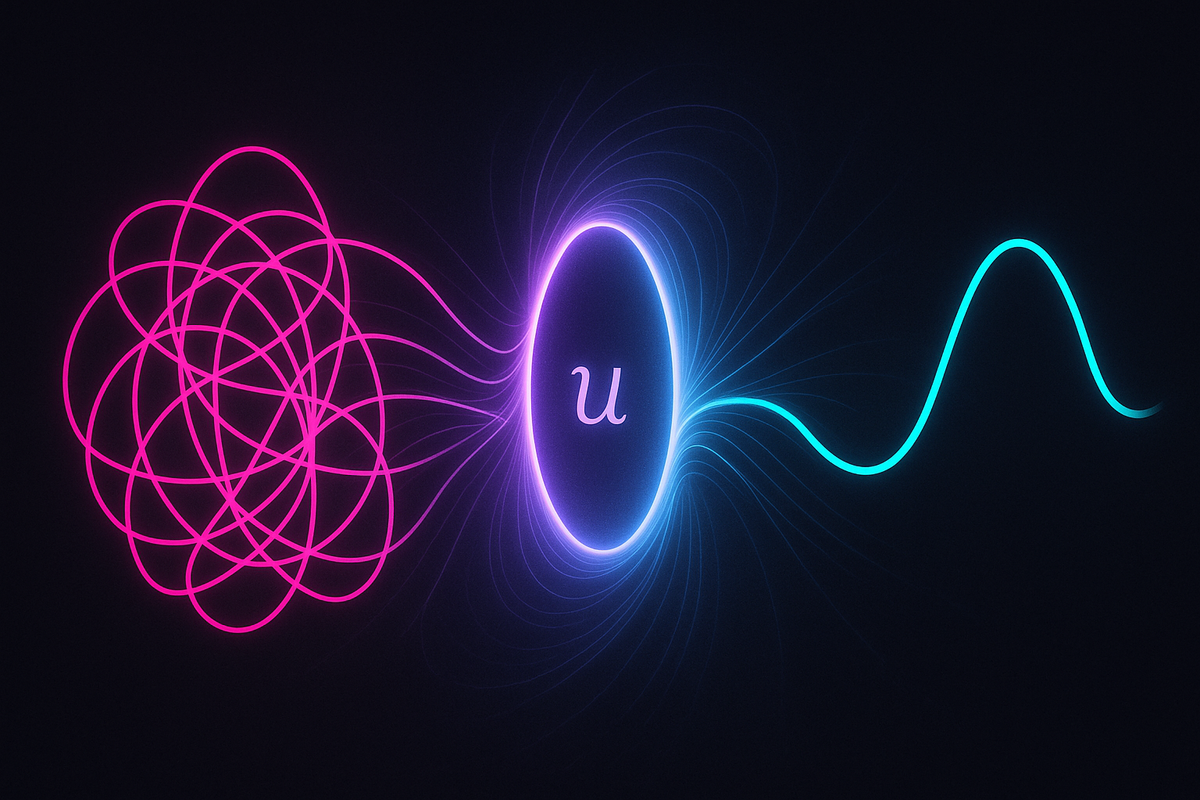
U-substitution is the chain rule, run backward.
The chain rule says: to differentiate f(g(x)), multiply f'(g(x)) by g'(x).
U-substitution says: if you see f'(g(x)) · g'(x) in an integral, you can simplify by letting u = g(x).
This is the most common integration technique. Master it, and half of all integrals become straightforward.
The Pattern
Chain rule (forward): d/dx [f(g(x))] = f'(g(x)) · g'(x)
U-substitution (reverse): ∫ f'(g(x)) · g'(x) dx = f(g(x)) + C
Look for a function and its derivative together. The derivative is often hiding in plain sight, possibly multiplied by a constant.
The Mechanics
Step 1: Choose u = (inside function).
Step 2: Compute du/dx = g'(x), then write du = g'(x) dx.
Step 3: Substitute everything: replace g(x) with u, and g'(x) dx with du.
Step 4: Integrate in u.
Step 5: Substitute back: replace u with g(x).
Example 1: Basic Substitution
∫ 2x · cos(x²) dx
Spot it: x² is inside the cosine, and its derivative 2x is right there.
Let u = x². Then du = 2x dx.
Substitute: ∫ cos(u) du = sin(u) + C
Substitute back: sin(x²) + C
Check: d/dx[sin(x²)] = cos(x²) · 2x = 2x cos(x²) ✓
Example 2: Adjusting Constants
∫ x · e^(x²) dx
Let u = x². Then du = 2x dx, so x dx = du/2.
∫ x · e^(x²) dx = ∫ e^u · (1/2) du = (1/2) eᵘ + C = (1/2) e^(x²) + C
The factor of 2 is missing in the original integral, so we compensate with 1/2.
Example 3: Powers of Inner Functions
∫ (2x + 1)⁵ dx
Let u = 2x + 1. Then du = 2 dx, so dx = du/2.
∫ u⁵ · (1/2) du = (1/2) · u⁶/6 + C = u⁶/12 + C = (2x + 1)⁶/12 + C
Check: d/dx[(2x+1)⁶/12] = 6(2x+1)⁵ · 2 / 12 = (2x+1)⁵ ✓
Example 4: Trigonometric Integrals
∫ tan(x) dx = ∫ sin(x)/cos(x) dx
Let u = cos(x). Then du = -sin(x) dx, so sin(x) dx = -du.
∫ (-1/u) du = -ln|u| + C = -ln|cos(x)| + C
Or equivalently: ln|sec(x)| + C
Example 5: Square Roots
∫ x/√(1 + x²) dx
Let u = 1 + x². Then du = 2x dx, so x dx = du/2.
∫ (1/2) u^(-1/2) du = (1/2) · 2u^(1/2) + C = √u + C = √(1 + x²) + C
Recognizing the Pattern
Ask yourself: is there a composite function f(g(x)) whose derivative might give me this integrand?
If yes, the inside function g(x) is your u.
Common triggers:
- e^(something) → let u = something
- (something)ⁿ → let u = something
- sin(something), cos(something) → let u = something
- ln(something) appears with 1/x type terms → let u = the argument of ln
- √(something) → let u = something
The "something" is whatever is inside. Its derivative should appear (up to a constant) elsewhere in the integrand.
Substitution with Definite Integrals
For definite integrals, change the bounds when you substitute.
∫₀² x(x² + 1)³ dx
Let u = x² + 1. Then du = 2x dx, so x dx = du/2.
When x = 0: u = 1. When x = 2: u = 5.
∫₁⁵ (1/2) u³ du = (1/2) · [u⁴/4]₁⁵ = (1/8)[625 - 1] = 624/8 = 78
You never substitute back to x. Compute everything in u with new bounds.
When Substitution Doesn't Work
Not every integral yields to substitution.
∫ e^(x²) dx — no simple antiderivative exists.
∫ x² eˣ dx — needs integration by parts, not substitution.
∫ 1/(x² + 1)² dx — needs partial fractions or trig substitution.
Substitution works when the derivative of the inside function appears outside. When it doesn't, you need other tools.
Variations and Tricks
Completing the square: For ∫ 1/(x² + 2x + 5) dx, complete the square to get ∫ 1/((x+1)² + 4) dx, then substitute u = x + 1.
Algebraic manipulation: Sometimes multiply and divide by a constant, or add and subtract terms, to create the needed form.
Backwards thinking: If you know d/dx[tan(x)] = sec²(x), then ∫ sec²(x) dx = tan(x) + C. Every derivative formula gives you an integral formula for free.
Practice Recognizing Patterns
Train your eye to see the chain rule hiding:
∫ sec²(3x) dx — inside is 3x, derivative is 3, divide by 3 → (1/3)tan(3x) + C
∫ e^(5x) dx — inside is 5x, derivative is 5, divide by 5 → (1/5)e^(5x) + C
∫ cos(x)/sin(x) dx — inside is sin(x), derivative is cos(x) → ln|sin(x)| + C
∫ x² · e^(x³) dx — inside is x³, derivative is 3x², close enough → (1/3)e^(x³) + C
With practice, you'll do simple substitutions mentally.
Summary
U-substitution transforms integrals by replacing a composite function with a single variable.
- Let u = inside function.
- Express dx in terms of du.
- Substitute and integrate.
- Substitute back (indefinite) or change bounds (definite).
It's the chain rule in reverse. Every application of the chain rule in differentiation gives you a pattern for substitution in integration.
Further Reading
- Stewart, J. Calculus. Extensive substitution examples.
- Larson, R. Calculus. Step-by-step worked problems.
- Paul's Online Math Notes — Free detailed integration practice.
This is Part 5 of the Integrals series. Next: "Integration by Parts" — handling products of functions.
Part 5 of the Calculus Integrals series.
Previous: Definite Integrals: Computing Actual Areas Next: Integration by Parts: The Product Rule in Reverse
Comments ()