Union and Intersection: Combining Sets
Union and intersection are the OR and AND of set theory. They look elementary until you realize they're the foundation of Venn diagrams, SQL joins, probability addition rules, and Boolean logic — the same two ideas, everywhere you look.
You've got a list of people who like pizza. You've got another list of people who like sushi. Now you want to throw a party.
Who do you invite?
If you want anyone who likes at least one of those foods: that's union. If you want only people who like both: that's intersection.
These are the two fundamental ways to combine sets. Union expands — it includes everything from either set. Intersection contracts — it keeps only what's shared. Between these two operations, you can describe almost any relationship between collections.
Union: Everything from Either
The union of A and B, written A ∪ B, contains every element that appears in A or B (or both).
A ∪ B = {x : x ∈ A or x ∈ B}
The "or" is inclusive. If something is in both sets, it still appears in the union — just once.
Examples:
- {1, 2, 3} ∪ {3, 4, 5} = {1, 2, 3, 4, 5}
- {a, b} ∪ {c, d} = {a, b, c, d}
- {1, 2} ∪ ∅ = {1, 2}
Notice: duplicates don't accumulate. The 3 appears in both sets, but the union lists it once. Sets don't count multiplicity.
Intersection: Only What's Shared
The intersection of A and B, written A ∩ B, contains only elements that appear in both A and B.
A ∩ B = {x : x ∈ A and x ∈ B}
Both conditions must hold. If an element is in A but not B, it's out. If it's in B but not A, also out.
Examples:
- {1, 2, 3} ∩ {3, 4, 5} = {3}
- {a, b} ∩ {c, d} = ∅
- {1, 2, 3} ∩ {1, 2, 3} = {1, 2, 3}
The second example shows disjoint sets — sets with no overlap. Their intersection is empty.
The Venn Diagram Picture
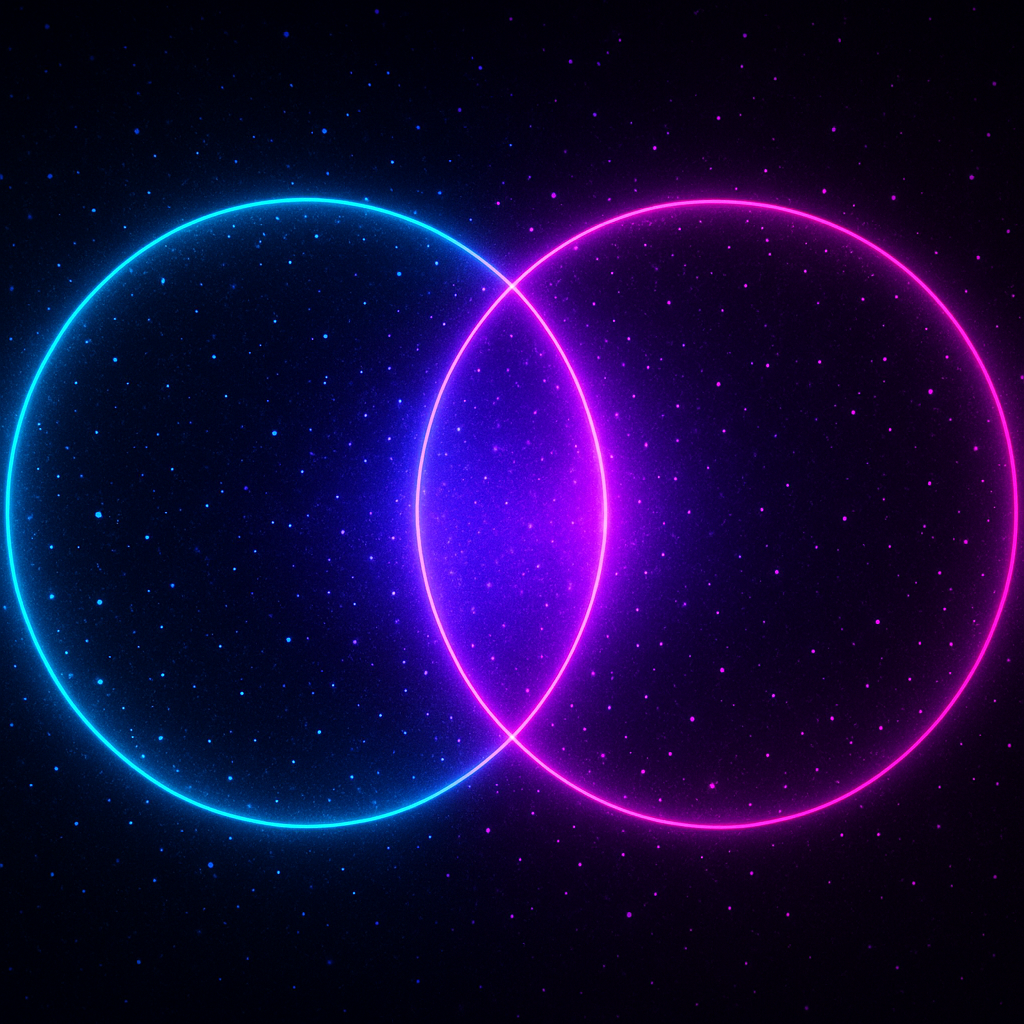
Draw two overlapping circles. Label them A and B.
- A ∪ B: shade everything inside at least one circle
- A ∩ B: shade only the lens-shaped overlap
The entire shaded region for union is larger. The shaded region for intersection is smaller. Union expands, intersection contracts.
Properties of Union
Commutative: A ∪ B = B ∪ A
Order doesn't matter. "A or B" is the same as "B or A."
Associative: (A ∪ B) ∪ C = A ∪ (B ∪ C)
You can group unions however you like. Just combine everything.
Identity: A ∪ ∅ = A
Adding nothing changes nothing.
Idempotent: A ∪ A = A
Unioning a set with itself gives the same set.
Properties of Intersection
Commutative: A ∩ B = B ∩ A
Associative: (A ∩ B) ∩ C = A ∩ (B ∩ C)
Identity: A ∩ U = A (where U is the universal set)
Intersecting with everything keeps everything.
Idempotent: A ∩ A = A
Annihilator: A ∩ ∅ = ∅
Intersecting with nothing gives nothing.
Distributive Laws
Union and intersection interact through distribution:
A ∩ (B ∪ C) = (A ∩ B) ∪ (A ∩ C)
Intersection distributes over union. Think: "A and (B or C)" equals "(A and B) or (A and C)."
A ∪ (B ∩ C) = (A ∪ B) ∩ (A ∪ C)
Union distributes over intersection. This one's less intuitive but equally valid.
Both can be verified by drawing Venn diagrams and checking that the shaded regions match.
Absorption Laws
A ∪ (A ∩ B) = A
If you already have A, adding "things in both A and B" doesn't give you anything new — those things are already in A.
A ∩ (A ∪ B) = A
If you intersect A with "A or B," you get exactly A. Everything in A is in the union; intersecting pulls back to just A.
Counting with Union
When sets overlap, you can't just add their sizes:
|A ∪ B| = |A| + |B| - |A ∩ B|
Why subtract the intersection? Because elements in both sets get counted twice when you add |A| and |B|. Subtracting |A ∩ B| corrects for this.
Example: 18 students take math, 15 take physics, 8 take both. |Math ∪ Physics| = 18 + 15 - 8 = 25 students take at least one subject.
This is the inclusion-exclusion principle for two sets.
Union and Intersection with Subsets
If A ⊆ B:
- A ∪ B = B (A adds nothing new)
- A ∩ B = A (the overlap is all of A)
If A and B are disjoint (A ∩ B = ∅):
- |A ∪ B| = |A| + |B| (no correction needed)
Multiple Sets
Union and intersection extend to any number of sets:
A₁ ∪ A₂ ∪ ... ∪ Aₙ = elements in at least one Aᵢ
A₁ ∩ A₂ ∩ ... ∩ Aₙ = elements in every Aᵢ
The more sets you union, the bigger the result tends to get. The more sets you intersect, the smaller the result tends to get.
Indexed Families
For an infinite collection of sets {Aᵢ : i ∈ I}:
⋃ᵢ∈ᵢ Aᵢ = {x : x ∈ Aᵢ for some i ∈ I}
⋂ᵢ∈ᵢ Aᵢ = {x : x ∈ Aᵢ for all i ∈ I}
Example: Let Aₙ = {1, 2, ..., n} for n ∈ ℕ.
- ⋃ₙ∈ℕ Aₙ = ℕ (every natural number appears eventually)
- ⋂ₙ∈ℕ Aₙ = {1} (only 1 is in every Aₙ)
Connection to Logic
Union corresponds to "or." Intersection corresponds to "and."
If A = {things satisfying property P} and B = {things satisfying property Q}:
- A ∪ B = {things satisfying P or Q}
- A ∩ B = {things satisfying P and Q}
This parallel runs deep. The algebra of sets mirrors propositional logic. Every set identity has a logical equivalent.
Building Complex Operations
With just ∪, ∩, and complement, you can construct any Boolean operation on sets:
Symmetric difference: A △ B = (A ∪ B) \ (A ∩ B) = things in exactly one of A or B
A only: A \ B = A ∩ Bᶜ = things in A but not B
Every combination of membership conditions can be expressed through these building blocks.
The Core Insight
Union and intersection are dual operations.
Union asks: "Is it in this one or that one?" Intersection asks: "Is it in this one and that one?"
Together, they let you build any combination of sets from simpler pieces. They're the fundamental operations of set algebra — just as addition and multiplication are the fundamental operations of arithmetic.
Once you internalize "union expands, intersection contracts," the rest follows naturally.
Part 4 of the Set Theory series.
Previous: Subsets and Supersets: When One Set Lives Inside Another Next: Venn Diagrams: Making Set Operations Visible
Comments ()