Violence and Its Decline
The per capita rate of violent death has fallen dramatically across human history — from hunter-gatherer societies to the present. That trend is real and documented. Why it happened, whether it will continue, and what threatens to reverse it remain genuinely open questions.
Violence and Its Decline
Are We Getting Better at Not Killing Each Other—Or Just Waiting for the Next Catastrophe?
Here's a claim that sounds too good to be true: we live in the most peaceful era in human history.
Not relatively peaceful. The most peaceful. Less war. Less murder. Less torture. Less slavery. Less cruelty to children, to prisoners, to animals. By almost every measurable dimension, humans are less violent now than at any point in the past 10,000 years.
This is Steven Pinker's thesis in The Better Angels of Our Nature, and the data is staggering. Medieval homicide rates were 30-100 times higher than today's. The 20th century—despite two world wars and multiple genocides—killed a smaller percentage of the population than most previous centuries. Torture was once public entertainment. Now it's a war crime.
If the data is right, it changes everything about how we understand human nature, political progress, and what the future might hold.
But is the data right?
The Core Tension
Pinker's optimism faces three devastating critiques:
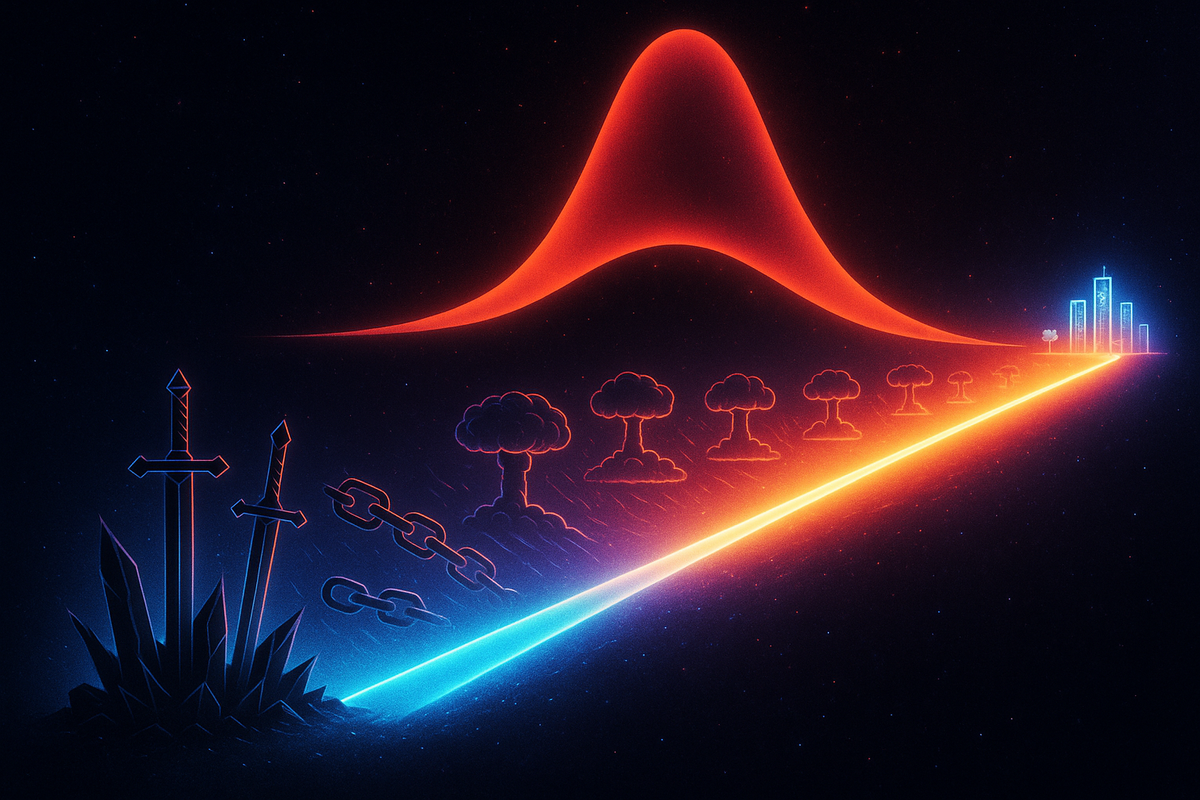
The statistical objection (Nassim Taleb): Violence follows a fat-tailed distribution. Rare catastrophic events—world wars, genocides, nuclear strikes—dominate the statistics. You can't claim violence is declining based on the interval between catastrophes. We might just be in a lucky lull before the next tail event.
The definitional objection (Johan Galtung): What counts as violence? Pinker measures direct violence—people killing people. But "structural violence" kills without anyone pulling a trigger. Poverty. Lack of healthcare. Pollution. If a child dies because they couldn't afford medicine, is that less violent than if someone stabbed them?
The temporal objection: Are we measuring genuine progress or just the gap between disasters? The Long Peace since 1945 could be nuclear deterrence. It could be American hegemony. It could be luck. If any of those fail, the trend reverses overnight.
This series takes the debate seriously.
The Series
[Is Violence Really Declining?](/violence-really-declining/) — Introduction to the violence debate. The data, the stakes, and why smart people disagree violently about violence.
[Steven Pinker: Better Angels](/steven-pinker-better-angels/) — The optimist case in full. The six historical trends, the five inner demons, the four better angels. What Pinker actually argues and what the evidence shows.
[Nassim Taleb: The Fat Tails Critique](/taleb-fat-tails-violence/) — The statistical counterattack. Why extreme events break trend analysis. Why Pinker's methods might be fundamentally flawed.
[Structural Violence: Beyond Direct Harm](/structural-violence-galtung/) — Johan Galtung's framework. Violence embedded in systems. Who's dying that we're not counting?
[Randall Collins: The Micro-Sociology of Violence](/randall-collins-violence/) — Violence as interactional phenomenon. Why most violence is hard, why humans avoid it, and what that means for understanding it.
[Democratic Peace Theory](/democratic-peace-theory/) — The claim that democracies don't fight each other. The evidence, the exceptions, and whether it holds.
[The Long Peace: Nuclear Deterrence?](/long-peace-nuclear-deterrence/) — Post-WWII stability and its causes. Nukes? Norms? Trade? What's keeping the great powers from war—and how fragile is it?
[Synthesis: Between Catastrophes or Genuine Progress?](/violence-progress-synthesis/) — The convergence. What can we actually conclude about violence trends? And what should we do about it either way?
Why This Matters Now
If Pinker is right, then something is working. Institutions, norms, trade, democracy—some combination of factors has made us dramatically less violent. We should identify what's working and do more of it.
If Taleb is right, we're in a false peace. The next tail event could be nuclear war, bioweapons, or something we haven't imagined. The decline is an illusion created by sampling error.
If Galtung is right, we've just hidden violence behind systems. The bodies pile up, we just don't call it murder.
The answer matters. How you think about violence shapes how you think about progress, politics, and what kind of future to build.
Begin with [Is Violence Really Declining?](/violence-really-declining/) to understand the debate that divides optimists and pessimists about human nature.

Comments ()