Volume and Surface Area: Three-Dimensional Measurement
Volume scales as the cube of linear dimension; surface area scales as the square. This gap shapes biology, engineering, and physics in ways that feel counterintuitive until you see the math — then you see it everywhere.
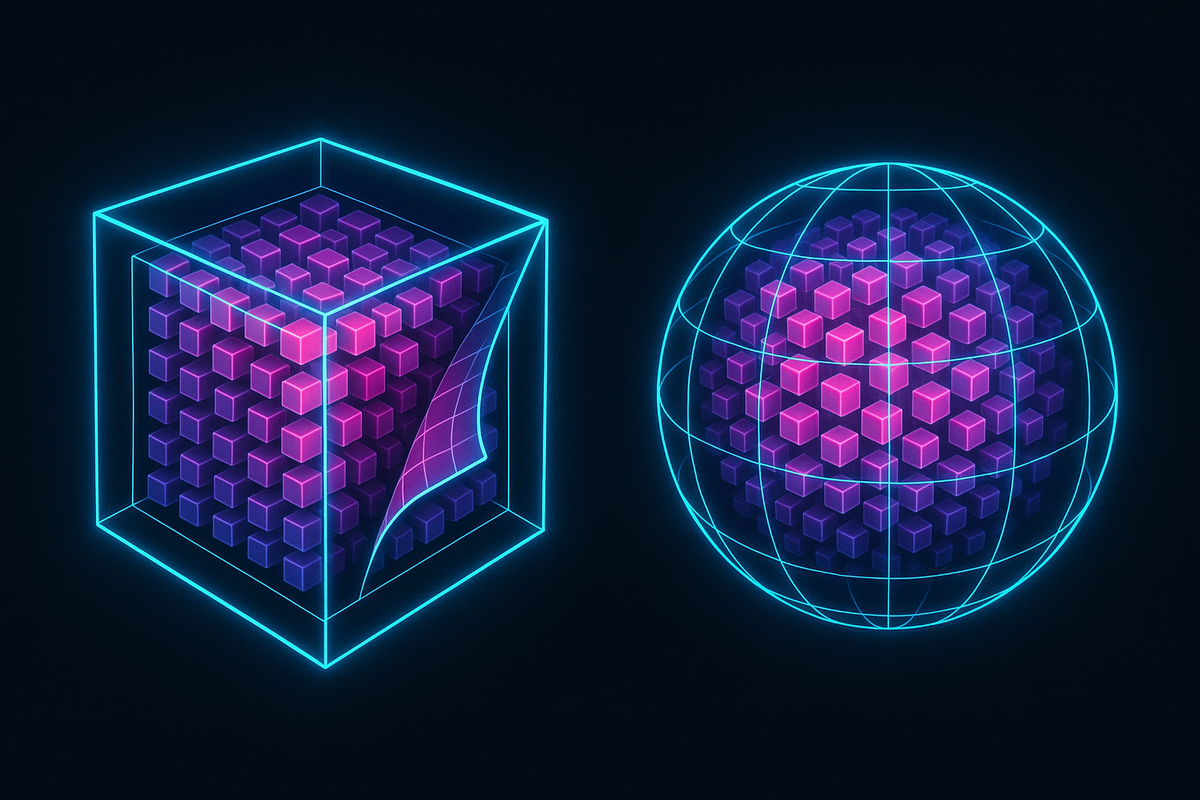
Surface area is skin. Volume is guts.
A balloon and a crumpled piece of paper might have the same surface area — the same amount of material. But the balloon has huge volume (air inside), while the crumpled paper has almost none.
Here's the unlock: surface area and volume are independent measurements that scale differently. Double an object's size, and its surface area quadruples but its volume octuples. This mismatch explains why elephants have different body plans than mice, why coffee cools faster in a wide mug, why lungs are spongy and intestines are folded.
The relationship between surface and volume determines how things exchange with their environment — heat, nutrients, oxygen. It's not just geometry. It's biology, engineering, and physics.
What Volume Measures
Volume is how much space an object occupies. How many unit cubes fit inside?
Measured in cubic units: cubic meters, cubic feet, liters (1 liter = 1000 cm³).
For basic solids:
Rectangular prism (box): V = lwh (length × width × height)
Cube: V = s³ (side cubed)
Cylinder: V = πr²h (base area × height)
Sphere: V = (4/3)πr³
Cone: V = (1/3)πr²h (one-third of a cylinder with same base and height)
Pyramid: V = (1/3)Bh (one-third of a prism with same base and height)
What Surface Area Measures
Surface area is the total area of an object's outer surface. How much wrapping paper would you need?
Measured in square units, like any area.
For basic solids:
Rectangular prism: SA = 2lw + 2lh + 2wh (six faces)
Cube: SA = 6s² (six identical square faces)
Cylinder: SA = 2πr² + 2πrh (two circular ends + curved side)
Sphere: SA = 4πr²
Cone: SA = πr² + πrl (circular base + curved surface, where l is slant height)
Why They Don't Scale Together
Here's the crucial insight:
Scale an object by factor k (every length multiplied by k):
- Surface area scales by k² (it's two-dimensional)
- Volume scales by k³ (it's three-dimensional)
Double a cube's side:
- Surface area: 6s² → 6(2s)² = 24s² (quadrupled)
- Volume: s³ → (2s)³ = 8s³ (octupled)
The ratio of surface area to volume decreases as objects get bigger.
Small objects have proportionally more surface relative to their volume. Large objects have proportionally less.
The Square-Cube Law
Galileo noticed this in 1638. It's called the square-cube law:
When you scale up, volume grows faster than surface area.
This has consequences everywhere:
Biology: Large animals have less surface area per unit volume. They can't exchange heat, oxygen, or nutrients as efficiently. That's why elephants have big ears (more surface for cooling) and why lungs have millions of tiny air sacs (more surface for gas exchange).
Cooking: A large roast takes much longer to cook per pound than a small one. Heat enters through the surface, but there's more volume to heat.
Engineering: Scale up a structure, and its weight (proportional to volume) grows faster than the cross-sectional area of its supports. That's why skyscrapers need different structural strategies than houses.
Why Small Things Are Efficient Exchangers
A small cell has lots of surface area relative to its volume. Nutrients diffuse in, waste diffuses out, easily.
Scale that cell up 10×:
- Surface area increases 100×
- Volume increases 1000×
- Surface-to-volume ratio drops to 1/10 of what it was
The big cell can't exchange fast enough to support its interior. This is why cells divide rather than just growing larger. It's why multicellular organisms need circulatory systems — they can't rely on diffusion through the outer surface.
Cavalieri's Principle
Here's how to think about volumes of weird shapes:
Cavalieri's principle: If two solids have the same cross-sectional area at every height, they have the same volume.
Imagine slicing each solid into infinitely thin horizontal wafers. If every corresponding pair of wafers has the same area, the total stacked volume is equal.
This is why a tilted cylinder has the same volume as an upright one — every horizontal slice is still a circle of the same radius.
Deriving Sphere Volume
The sphere formula, V = (4/3)πr³, isn't obvious. Here's the intuition:
Use Cavalieri's principle. Compare a hemisphere to a cylinder with a cone removed from its center.
Slice both at height h above the base:
- Hemisphere slice: a circle of radius √(r² - h²), area = π(r² - h²)
- Cylinder-minus-cone slice: a ring with outer radius r and inner radius h, area = πr² - πh² = π(r² - h²)
Same area at every height! So same volume.
Volume of cylinder = πr² × r = πr³. Volume of cone = (1/3)πr² × r = (1/3)πr³. Volume of cylinder-minus-cone = πr³ - (1/3)πr³ = (2/3)πr³.
That's the hemisphere. Full sphere = 2 × (2/3)πr³ = (4/3)πr³.
Surface Area of a Sphere
Why is the surface area of a sphere exactly 4πr²?
Here's one way to see it: the surface area equals the area of four great circles (circles with the same radius as the sphere).
Or think of it as: peel an orange and lay the peel flat. You'll cover an area of 4πr².
Or use calculus: the surface area is the derivative of volume with respect to radius. d/dr[(4/3)πr³] = 4πr².
The "4" isn't arbitrary — it falls out from the geometry of how spheres nest inside each other.
Practical Applications
Packaging: Minimize surface area (material cost) for a given volume (capacity). Spheres are optimal, but boxes pack better. Trade-offs.
Heat transfer: More surface area means faster heating or cooling. Radiators are finned to increase surface. Food is cut small to cook faster.
Drug delivery: Smaller particles have more surface area per mass, so they dissolve faster. That's why powders absorb quicker than tablets.
Architecture: Minimizing surface area reduces heat loss. Igloos and domes are efficient because spherical-ish shapes minimize surface for a given volume.
The Sphere Is Optimal
Among all shapes with a given volume, the sphere has the minimum surface area.
Among all shapes with a given surface area, the sphere encloses the maximum volume.
This is why bubbles are spherical. Surface tension wants to minimize surface area. The minimum-surface shape is a sphere.
It's also why cells, eggs, and planets tend toward spherical — physical forces push toward the shape that minimizes surface for a given volume.
Units and Dimensional Analysis
Surface area: square units (m², cm², ft²) Volume: cubic units (m³, cm³, ft³, liters)
If your volume calculation gives you square units, you made a dimensional error. The units are a sanity check.
Converting between units:
- 1 m² = 10,000 cm² (because 1 m = 100 cm, and 100² = 10,000)
- 1 m³ = 1,000,000 cm³ (because 100³ = 1,000,000)
The exponent matches the dimension: squared for area, cubed for volume.
The Core Insight
Surface area is the interface with the world. Volume is the stuff inside.
They measure different things and scale differently. As things get bigger, volume grows faster than surface, which limits exchange with the environment.
This simple geometric fact — the square-cube law — shapes biology, constrains engineering, and explains why the physical world looks the way it does.
When you see a formula for surface area or volume, don't just memorize it. Ask: what does this tell me about how this object interacts with its surroundings?
Part 8 of the Geometry series.
Previous: Area and Perimeter: Measuring Two-Dimensional Space Next: Coordinate Geometry: Where Algebra Meets Geometry
Comments ()