What Is Discrete Mathematics? The Math of Distinct Objects
Continuous math describes how things flow. Discrete math describes how things connect, combine, and count. It's the mathematical foundation of every computer ever built — and it starts with surprisingly simple ideas about graphs and logic.
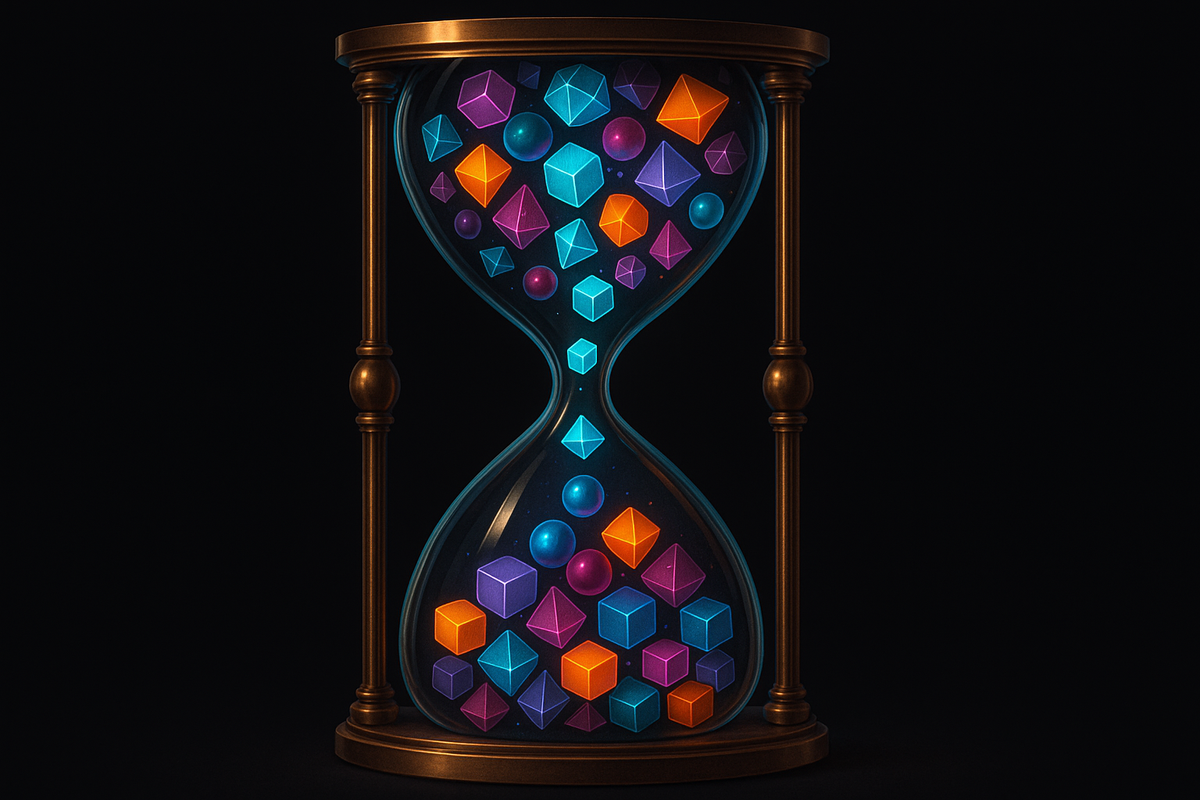
The entire history of mathematics can be divided into two camps: those who think about smoothness and those who think about separation.
Calculus—the math Newton and Leibniz fought over—is about smoothness. Continuous change. Infinitely divisible space. You can zoom in forever and there's always more. It's the mathematics of flowing water, growing populations, accelerating objects. The universe as a seamless fabric.
Discrete mathematics is the opposite. It's the math of things that are fundamentally separate. Countable. Distinct. You can't have 2.7 nodes in a network. You can't arrange π people in a line. A bit is either 0 or 1, never halfway between.
And it turns out that when you build machines that think, discrete is what you get.
The Difference That Makes Computing Possible
Here's why this matters: computers don't do calculus.
They fake it extremely well—your weather app runs fluid dynamics simulations by chopping continuous equations into millions of tiny discrete steps—but at the bottom, everything is digital. Binary. Discrete.
Every piece of information in a computer is made of bits: distinct, countable, separate states. ON or OFF. 1 or 0. You can have a trillion of them, but you can't have 2.3 of them. This fundamental discreteness propagates upward through every layer of computation.
- Memory addresses are discrete locations, not continuous space
- Instruction sets are finite, enumerable operations
- Data structures are arrangements of distinct elements
- Algorithms are sequences of discrete steps
This isn't a limitation. It's what makes computation possible. You can't compute with smoothness—there's too much information in a continuous interval. But you can compute with discrete structures, because they're countable, finite, and manipulable.
Discrete math is the native mathematics of machines that think.
What Counts as Discrete Math
The term covers a sprawling territory. Unlike calculus—which has a clear starting point (limits, derivatives, integrals)—discrete math is more of a collection of related fields that all deal with discrete structures.
The core areas:
Combinatorics — The art of counting arrangements, selections, and possibilities without exhaustively listing them all
Graph Theory — The mathematics of networks: nodes connected by edges, from social networks to neural networks to the internet itself
Logic & Boolean Algebra — The math of true and false, AND and OR, the two-state system that builds every logic gate in every processor
Number Theory — Properties of integers, primes, divisibility, modular arithmetic—the foundation of cryptography
Set Theory — The mathematics of collections and their relationships, the formal foundation of modern math
Sequences & Recurrence Relations — Patterns that define themselves, like the Fibonacci sequence where each term comes from the previous ones
Algorithmic Complexity — How the difficulty of problems scales with size, why some tasks are computationally feasible and others aren't
These aren't separate topics—they're interconnected ways of thinking about discrete structures. A tree is both a graph (nodes and edges) and a data structure (organizing information). A recurrence relation generates a sequence (math) that defines an algorithm's runtime (computer science).
The History Nobody Tells You
Discrete math feels modern because it exploded with computer science. But humans have been doing discrete mathematics for millennia.
Counting and combinatorics emerged from gambling. In the 1600s, Blaise Pascal and Pierre de Fermat exchanged letters about dice games and accidentally invented probability theory. The binomial coefficients—the numbers in Pascal's triangle—had been known for centuries, but Pascal systematized them. Those same numbers now determine how many ways you can choose k items from n options, the basis of modern combinatorics.
Graph theory started with a party trick. In 1736, the people of Königsberg wondered if you could walk through their city crossing each of its seven bridges exactly once. Leonhard Euler proved it was impossible by abstracting the problem into nodes (landmasses) and edges (bridges). He didn't need to try every possible path. The structure itself—whether each node had an odd or even number of connections—determined the answer. This was revolutionary: the problem's structure could tell you what was possible, independent of trying solutions.
Boolean algebra was pure theory when George Boole published it in 1854. He wanted to formalize logic using mathematics. The idea that true and false could be treated as 1 and 0, combined using operations like AND, OR, and NOT, seemed like philosophical abstraction. Then, eighty years later, Claude Shannon realized Boole's algebra perfectly described electrical circuits. Switches could be on or off. Gates could be open or closed. Boolean algebra became the mathematics of computation before computers existed.
The pattern repeats: discrete math often emerges from pure curiosity—games, puzzles, philosophical questions—then decades or centuries later becomes the foundation of technology.
Why Continuous Math Isn't Enough
You learned calculus. It's powerful. So why do we need a whole other kind of math?
Because calculus assumes you can keep dividing. It's built on limits, infinitesimals, continuous functions. But many real-world problems are fundamentally discrete:
- You can't partition half a person into a group. Scheduling, resource allocation, and voting all deal with indivisible units.
- You can't cross 3.7 bridges. Network problems involve whole connections, not fractional edges.
- You can't have 0.4 bits of information. Data is quantized.
- Algorithms run in discrete steps. Your code doesn't execute "continuously"—it runs one instruction at a time.
Even when the underlying phenomenon is continuous—like the fluid dynamics governing weather—computers must discretize it to compute. The continuous equations get chopped into discrete time steps and spatial grids. The simulation is discrete math approximating continuous reality.
And sometimes, discrete structures reveal truths that continuous math misses.
Take the Four Color Theorem: any map can be colored using at most four colors such that no adjacent regions share a color. This is a purely discrete problem—you can't use "three and a half" colors—and it resisted proof for over a century. When it was finally proven in 1976, it required exhaustive computer verification of thousands of discrete cases. Continuous mathematics couldn't touch it.
Discrete math isn't "simpler" than calculus. It's differently hard. The problems it tackles often have no closed-form solutions. You can't integrate your way out of "how many ways can I arrange 52 cards?" You have to think combinatorially.
The Conceptual Shift
Moving from continuous to discrete math requires a mental gear-shift.
In calculus, you think about rates of change, smooth curves, approaching limits. The central operation is differentiation: how does this quantity change as that one varies infinitesimally?
In discrete math, you think about counting, structures, relationships between distinct objects. The central operation is often existence and counting: How many such objects are there? Does a structure with these properties exist? How do discrete elements combine?
Here's a concrete example:
Continuous problem: A ball is thrown upward at 20 m/s. What's its velocity after 2 seconds? Solution: Use calculus. Differentiate position to get velocity as a function of time.
Discrete problem: You have 10 people and want to form a committee of 3. How many possible committees? Solution: Use combinatorics. Calculate C(10,3) = 120. Calculus can't help you here.
The discrete problem isn't "easier"—it's structurally different. You're not finding a rate of change. You're counting distinct configurations in a finite space.
Where Discrete Structures Hide
Once you see discrete mathematics, you notice it everywhere:
Language — Words are discrete symbols. Phonemes are distinct sounds. Grammar rules are discrete transformations. Chomsky's formal grammars—the theory of how languages generate valid sentences—are pure discrete math.
Biology — DNA is a discrete code: four bases (A, T, C, G) in specific sequences. Gene regulatory networks are graphs. Evolutionary trees are... trees.
Social networks — Facebook's friend graph, Twitter's follow network, LinkedIn's connection structure—all discrete graphs where people are nodes and relationships are edges.
The internet — Routers are nodes, connections are edges. Your data hops through a discrete network, not a continuous medium. Graph theory determines how packets route.
Games — Chess positions are discrete states. Game trees enumerate possible moves. Winning strategies are paths through discrete possibility spaces.
Cryptography — Modern encryption relies on properties of prime numbers and modular arithmetic. Bitcoin mining is discrete computation searching for specific hash values.
Machine learning — Neural networks are graphs. Layers are discrete. Weights update in discrete steps via discrete algorithms (backpropagation). Even "continuous" gradient descent is implemented as discrete numerical steps.
The world appears continuous, but we slice it into discrete chunks to understand and manipulate it. And when we build artificial systems—computers, networks, algorithms—they're discrete from the ground up.
The Computer Science DNA
If you study computer science, you're studying applied discrete mathematics.
Every fundamental data structure maps to a discrete mathematical concept:
- Arrays — Sequences, ordered collections
- Linked lists — Sequences with pointer relationships
- Stacks and queues — Restricted sequence operations
- Trees — Hierarchical graphs without cycles
- Hash tables — Mappings from discrete keys to values
- Graphs — General networks of connected nodes
Every algorithm is a discrete process:
- Sorting — Reordering a discrete sequence
- Searching — Finding specific elements in discrete structures
- Path-finding — Navigating graphs (Dijkstra, A*)
- Recursion — Functions calling themselves, often solving problems via recurrence relations
- Dynamic programming — Breaking problems into discrete subproblems and combining solutions
Even the analysis of algorithms is discrete math: Big O notation describes how the number of operations scales with input size. O(n) means linear growth. O(n²) means quadratic. O(2ⁿ) means exponential—and suddenly your algorithm can't scale past tiny inputs.
Discrete math doesn't just describe computation. It defines what's computationally possible.
Why Some Problems Are Impossible
Here's where discrete math gets existential.
There are problems we know can't be solved efficiently, no matter how clever the algorithm or powerful the computer. Not "hard to solve"—provably impossible to solve efficiently for large inputs.
The Traveling Salesman Problem: Given a list of cities and distances between them, find the shortest route visiting each city exactly once. Sounds simple. But no one has found an algorithm that scales well. The best-known solutions are exponential in time: trying every possible route.
As of 2025, no one knows if an efficient solution exists. This is the famous P vs. NP problem, one of the Millennium Prize Problems worth a million dollars. If someone proves such problems can't be solved efficiently, entire branches of cryptography remain secure. If someone finds an efficient solution, most of modern encryption breaks overnight.
Discrete math reveals these boundaries. It's not just "here's how to solve this problem." It's "here are the limits of what's solvable."
What Makes Discrete Math Different from Calculus
Let's make the contrast explicit:
| Calculus | Discrete Math |
|---|---|
| Continuous quantities | Distinct, separate objects |
| Smooth change | Step-wise transitions |
| Infinite divisibility | Indivisible units |
| Derivatives, integrals | Counting, arrangements |
| Real numbers | Integers, finite sets |
| Rates of change | Combinatorial structures |
| Physics of motion | Logic of possibility |
Neither is "better." They're tools for different kinds of problems.
If you want to model a moving object, calculus. If you want to count possible paths through a maze, discrete math.
If you want to optimize a smooth function, calculus. If you want to schedule classes without conflicts, discrete math.
If you're simulating fluid flow, calculus. If you're designing a network protocol, discrete math.
The digital revolution runs on discrete math because computers are discrete machines. Every calculation is a finite sequence of finite operations on finite data. That's the discrete universe.
The Rest of This Series
Now that you know what discrete math is—the mathematics of distinct, countable structures—the rest of the series dives into its core areas:
We'll start with combinatorics, the art of counting without exhaustively listing. Then permutations and combinations: when order matters and when it doesn't. The binomial theorem reveals the hidden structure in Pascal's triangle.
From there, graph theory: the mathematics of networks, from Euler's bridges to Facebook's social graph. Trees as a special case: hierarchical structures everywhere from file systems to evolutionary biology.
Recurrence relations show how sequences can define themselves. Big O notation explains why some algorithms scale and others collapse under load. Boolean algebra built every computer with just two numbers. And modular arithmetic secures the internet by making numbers wrap around.
Each piece connects. Discrete math isn't a laundry list of topics—it's a coherent way of thinking about structure, counting, and computational possibility.
By the end, you'll see the discrete skeleton beneath the digital world.
Further Reading
- Rosen, Kenneth H. Discrete Mathematics and Its Applications. McGraw-Hill, 8th edition, 2018.
- Graham, Ronald L., Donald E. Knuth, and Oren Patashnik. Concrete Mathematics: A Foundation for Computer Science. Addison-Wesley, 2nd edition, 1994.
- Euler, Leonhard. "Solutio problematis ad geometriam situs pertinentis." Commentarii academiae scientiarum Petropolitanae, 1741. (The original Königsberg bridge paper)
- Knuth, Donald E. The Art of Computer Programming (series). Addison-Wesley, 1968–. (The bible of algorithmic thinking)
- Boole, George. The Mathematical Analysis of Logic. 1847. (Founding text of Boolean algebra)
This is Part 1 of the Discrete Mathematics series, exploring the foundational math of computer science, algorithms, and computational thinking. Next: "Combinatorics Explained — Counting Without Counting."
Part 1 of the Discrete Mathematics series.
Previous: Discrete Mathematics Explained Next: Combinatorics: Counting Without Counting
Comments ()