What Is an Exponential Function? When the Variable Is the Power
Linear functions grow by adding. Exponential functions grow by multiplying — which means the bigger they get, the faster they grow. That self-referential feedback is behind compound interest, viral spread, radioactive decay, and the number e.
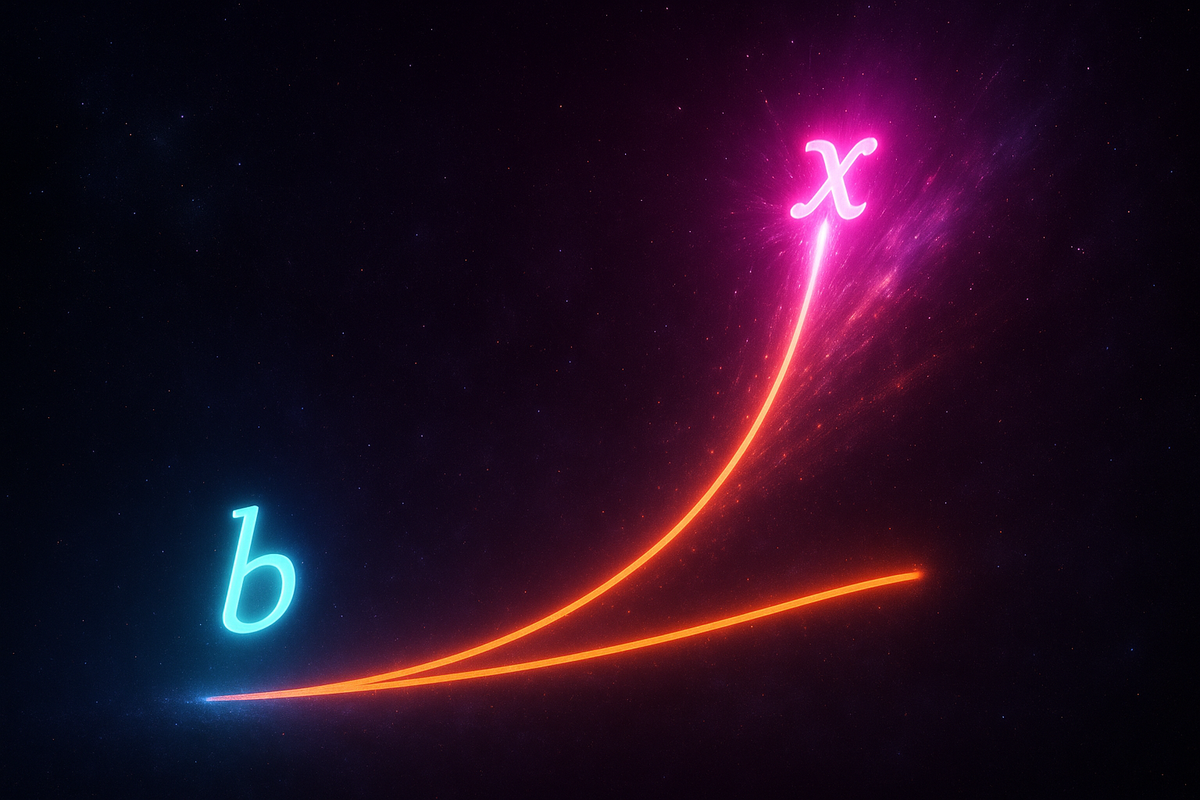
In an exponential function, the variable is in the exponent.
That's the definition, but here's the insight: this small change—moving x from the base to the exponent—transforms growth from additive to multiplicative.
f(x) = 2ˣ
When x = 1, you get 2. When x = 2, you get 4. When x = 3, you get 8.
Each step doesn't add 2—it multiplies by 2. The function doubles with every increment. And doubling is the engine of explosive growth.
The Form
An exponential function has the form:
f(x) = bˣ or more generally f(x) = a · bˣ
Where:
- b is the base (a positive number, typically b > 1 for growth, 0 < b < 1 for decay)
- a is the initial value (f(0) = a)
- x is the exponent (the variable)
Compare to a polynomial like x²:
- In x², the base varies (it's x) and the exponent is fixed (it's 2)
- In 2ˣ, the base is fixed (it's 2) and the exponent varies (it's x)
This inversion is everything. Polynomials grow predictably. Exponentials explode.
Think about what each function does when you increase x by 1:
- For x²: you go from x² to (x+1)². The increase is 2x + 1—it depends on where you are, and it's an addition.
- For 2ˣ: you go from 2ˣ to 2ˣ⁺¹ = 2 × 2ˣ. You multiply by 2, regardless of where you are.
The polynomial adds more and more each step, but it's still adding. The exponential multiplies by the same factor every step—and that factor compounds.
Why Exponentials Grow So Fast
Consider 2ˣ versus x²:
| x | x² | 2ˣ |
|---|---|---|
| 1 | 1 | 2 |
| 2 | 4 | 4 |
| 3 | 9 | 8 |
| 4 | 16 | 16 |
| 5 | 25 | 32 |
| 10 | 100 | 1,024 |
| 20 | 400 | 1,048,576 |
| 100 | 10,000 | ~10³⁰ |
At x = 4, they're equal. By x = 10, the exponential is 10 times larger. By x = 20, it's 2,600 times larger. By x = 100, the exponential is so large we need scientific notation while the polynomial is just 10,000.
Exponentials always beat polynomials eventually. No matter how high the polynomial's degree, exponential growth catches up and blows past.
This is why exponential thinking matters: what looks slow at first becomes overwhelming.
The Three Regimes
Exponential functions behave differently depending on the base:
b > 1: Exponential Growth f(x) = 2ˣ, f(x) = 10ˣ, f(x) = eˣ
As x increases, f(x) increases without bound. The larger b, the faster the growth.
0 < b < 1: Exponential Decay f(x) = (1/2)ˣ = 2⁻ˣ, f(x) = (0.9)ˣ
As x increases, f(x) decreases toward zero. The closer b is to 0, the faster the decay.
b = 1: Constant f(x) = 1ˣ = 1
Nothing happens. This is the boring case.
Growth and decay are symmetric. If b > 1 gives growth, then 1/b gives decay. The function 2ˣ grows; the function (1/2)ˣ = 2⁻ˣ decays.
Key Properties
Property 1: The y-intercept is always a
f(0) = a · b⁰ = a · 1 = a
Every exponential function passes through (0, a). For f(x) = bˣ, it passes through (0, 1).
Property 2: Never zero, never negative
For b > 0, bˣ > 0 for all x. The graph approaches but never touches the x-axis.
Property 3: Multiplicative behavior
f(x + 1) / f(x) = bˣ⁺¹ / bˣ = b
Moving one unit right multiplies the function by b. This is the signature of exponential functions.
Property 4: The derivative is proportional to the function
d/dx(bˣ) = (ln b) · bˣ
The rate of change of an exponential is proportional to its current value. This is why exponentials appear in growth models.
The Graph
Exponential growth curves have a distinctive shape:
- Nearly flat for negative x (approaching the asymptote y = 0)
- Pass through (0, 1) or (0, a)
- Curve sharply upward for positive x
- No maximum—grow forever
Exponential decay is the mirror image:
- Start high for negative x
- Pass through (0, 1) or (0, a)
- Curve toward the asymptote y = 0 for positive x
- Approach but never reach zero
The horizontal asymptote (y = 0) is a defining visual feature.
Transformations
Vertical shift: f(x) = bˣ + k
Shifts the asymptote from y = 0 to y = k.
Horizontal shift: f(x) = bˣ⁻ʰ
Shifts the graph right by h units.
Vertical stretch: f(x) = a · bˣ
Stretches by factor a. The y-intercept becomes a.
Reflection: f(x) = b⁻ˣ or f(x) = -bˣ
The first reflects across y-axis (turns growth into decay). The second reflects across x-axis.
Why the Base Matters
Different bases give different rates:
| Base | Meaning |
|---|---|
| 2 | Doubling per unit |
| 10 | 10× per unit |
| e ≈ 2.718 | Natural/continuous growth |
| 1.1 | 10% increase per unit |
| 0.5 | Halving per unit |
| 0.9 | 10% decrease per unit |
For percentage changes:
- 5% growth per year: b = 1.05
- 3% decay per year: b = 0.97
The base encodes the rate. The exponent encodes the time.
Finding the base from a growth rate:
If something grows by r% per period, the base is b = 1 + r/100.
- 7% annual growth → b = 1.07
- 15% decline per year → b = 0.85
- Doubling (100% increase) → b = 2
Converting between bases:
Any exponential can be written using any base:
2ˣ = e^(x ln 2) ≈ e^(0.693x)
10ˣ = e^(x ln 10) ≈ e^(2.303x)
This means base e is universal—it can express any exponential. Scientists use e because it makes calculus cleaner. Engineers might use base 10 for intuition. Computer scientists prefer base 2 for binary systems. They're all the same underlying growth, just measured differently.
Exponential Equations
To solve bˣ = c, take logarithms:
x = log_b(c) = ln(c)/ln(b)
Example: When does 2ˣ = 1000?
x = log₂(1000) = ln(1000)/ln(2) ≈ 9.97
So 2¹⁰ ≈ 1000. (Actually 2¹⁰ = 1024.)
The Continuous Model
Discrete exponentials like 2ˣ double at integer steps. But real growth is often continuous.
The continuous exponential is:
f(t) = a · e^(kt)
Where e ≈ 2.71828..., k is the continuous growth rate, and t is time.
This form appears throughout science because it's what you get when you solve the differential equation df/dt = kf—the equation for growth proportional to current value.
Real-World Examples
Bacterial growth: E. coli divides every 20 minutes in ideal conditions. Start with one cell:
- After 1 hour: 8 cells
- After 6 hours: 262,144 cells
- After 24 hours: 4.7 × 10²¹ cells (more than the mass of the Earth)
Obviously, resources run out. But the initial phase IS exponential.
Radioactive decay: Carbon-14 has a half-life of 5,730 years. If you start with 1 gram:
- After 5,730 years: 0.5 grams
- After 11,460 years: 0.25 grams
- After 57,300 years: about 0.001 grams
The function is N(t) = N₀ × (1/2)^(t/5730), an exponential with base 1/2.
Viral spread: Each infected person infects R others on average. If R = 2:
- Generation 0: 1 person
- Generation 5: 32 people
- Generation 10: 1,024 people
- Generation 20: over 1 million
This is why early intervention in epidemics matters so much—you're fighting an exponential.
Why Exponentials Matter
- They model self-reinforcing processes. More begets more. Less begets less.
- They're the inverse of logarithms. Understanding exponentials means understanding logs.
- They dominate polynomials. Eventually, exponential always wins.
- They're the natural language of rates. Percentage growth, compound interest, radioactive decay—all exponential.
- They connect to calculus. The function eˣ equals its own derivative—the most special function in mathematics.
When growth feeds on itself—when the rate depends on the current amount—you're in exponential territory. And exponential territory is where slow becomes fast, manageable becomes overwhelming, and a few more doublings changes everything.
Part 1 of the Exponential Functions series.
Previous: Exponential Functions Explained Next: Exponential Growth: When Doubling Never Stops
Comments ()