What Is Precalculus? The Bridge to Higher Mathematics
Calculus is hard mostly because precalculus is shaky. Master functions, transformations, and the unit circle here, and derivatives stop feeling arbitrary — they feel inevitable.
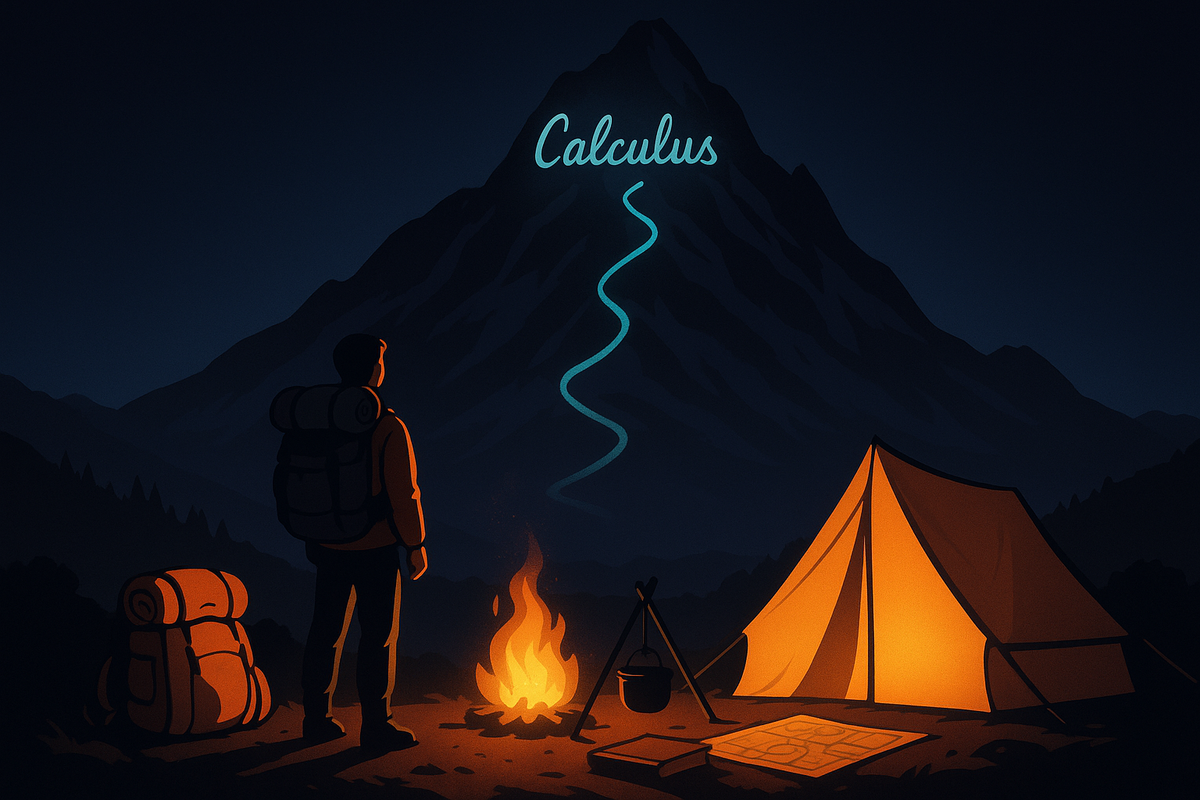
You're standing at the base of a mountain. Calculus is the summit. Precalculus is the training camp where you learn to read terrain, use equipment, and understand what altitude does to your body.
Precalculus is not a subject. It's a preparation.
The name tells you what it is: everything you need before calculus. But that undersells it. Precalculus is where algebra stops being about solving equations and starts being about describing relationships. It's where you stop asking "What is x?" and start asking "How does y behave as x changes?"
That shift—from finding values to understanding behavior—is the conceptual leap calculus requires. Precalculus gives you the language and tools to make it.
The Unlocking Question
Here's the question precalculus teaches you to ask:
What happens to the output when you change the input?
Not "What is the output?" That's arithmetic. Not "What input gives this output?" That's algebra. The precalculus question is dynamic: How does the relationship itself behave?
When you ask that question, you need a vocabulary. You need to talk about functions, domains, ranges, transformations, asymptotes, limits. You need coordinate systems beyond the standard grid. You need ways to describe curves that loop, spiral, or approach infinity.
Precalculus is that vocabulary.
Functions: The Core Object
A function is a rule that takes an input and produces an output.
That definition sounds simple. It is simple. But once you have it, you can build everything else.
A function is denoted f(x), read "f of x." The x is the input. The f(x) is the output. The function itself is the rule connecting them.
Example: f(x) = x². This function takes any number and squares it. Input 3, output 9. Input -5, output 25.
Functions are not equations you solve. They're machines you run. You feed in values, you get values out.
The power of functions is that they let you describe relationships instead of numbers. Once you have a function, you can ask: What inputs are allowed? What outputs are possible? How does the output change as the input increases? What happens at the edges?
These questions drive all of precalculus.
Domain and Range: What's Allowed, What's Possible
The domain is the set of valid inputs. The range is the set of possible outputs.
For f(x) = x², the domain is all real numbers. You can square anything. The range is all non-negative numbers. Squaring always gives zero or positive.
For g(x) = 1/x, the domain is all real numbers except zero. You can't divide by zero. The range is also all non-zero reals. There's no input that makes 1/x equal to zero.
Domain and range tell you the boundaries of the function. They answer: Where does this function live? What can it produce?
Transformations: Modifying the Graph
Every function has a graph—a picture of how the output varies with the input.
Transformations modify that graph in predictable ways.
- f(x) + 2 shifts the graph up by 2.
- f(x - 3) shifts the graph right by 3.
- 2f(x) stretches the graph vertically by a factor of 2.
- -f(x) flips the graph upside down.
The equation tells you the transformation. You don't need to plot points. You can read the shape from the formula.
This is a huge conceptual shift. Instead of treating functions as arbitrary collections of points, you start seeing them as structures you can manipulate. You start thinking in terms of operations on functions, not just operations on numbers.
Composition: Chaining Functions
You can feed the output of one function into another.
Let f(x) = x² and g(x) = x + 1.
The composition f(g(x)) means: apply g first, then apply f.
g(x) = x + 1. So f(g(x)) = f(x + 1) = (x + 1)².
Composition is denoted with a circle: (f ∘ g)(x) = f(g(x)).
Order matters. g(f(x)) = g(x²) = x² + 1. That's different from (x + 1)².
Composition lets you build complex functions from simple ones. It's the arithmetic of functions: instead of adding numbers, you're chaining processes.
Inverse Functions: Running in Reverse
An inverse function reverses the mapping.
If f(x) = 2x, then f takes 3 to 6. The inverse, f⁻¹(x) = x/2, takes 6 back to 3.
Not every function has an inverse. To have an inverse, a function must be one-to-one: each output must come from exactly one input.
f(x) = x² is not one-to-one. Both 3 and -3 give output 9. So there's no unique inverse. (You can fix this by restricting the domain—say, only non-negative inputs.)
Inverses let you "undo" functions. If f represents a process, f⁻¹ represents the reverse process.
Rational Functions and Asymptotes
A rational function is a ratio of polynomials.
Example: f(x) = 1/x.
As x gets large, f(x) gets small. As x approaches zero, f(x) blows up to infinity.
The x-axis is a horizontal asymptote: as x → ∞, f(x) → 0. The y-axis is a vertical asymptote: as x → 0, f(x) → ∞.
Asymptotes are lines the function approaches but never touches. They describe the function's behavior at the edges—what happens as inputs get very large, very small, or approach a forbidden value.
Rational functions are everywhere in science. They model rates, concentrations, probabilities. Understanding their asymptotes means understanding their limits—both literally and conceptually.
Conic Sections: Geometry Meets Algebra
Take a double cone (two cones tip-to-tip). Slice through it with a plane.
- Horizontal slice: circle.
- Tilted slice: ellipse.
- Slice parallel to the edge: parabola.
- Steep slice through both cones: hyperbola.
These are the conic sections. Each has an algebraic equation.
- Circle: x² + y² = r²
- Ellipse: x²/a² + y²/b² = 1
- Parabola: y = ax²
- Hyperbola: x²/a² - y²/b² = 1
Conic sections connect geometry and algebra. They show up in orbital mechanics, optics, antenna design. They're also examples of implicit equations—where y isn't isolated—and parametric curves.
Parametric Equations: Curves That Loop
Most functions are written y = f(x). This means: for each x, there's one y.
But some curves loop back on themselves. A circle, for instance. For some x-values, there are two y-values—one on top, one on bottom.
Parametric equations solve this by introducing a third variable, usually t.
Instead of y = f(x), you write: x = f(t) y = g(t)
As t varies, you trace out a curve in the xy-plane.
Example: A circle of radius 1. x = cos(t) y = sin(t)
As t goes from 0 to 2π, you trace the full circle.
Parametric equations let you describe motion. The parameter t often represents time. The equations describe position as a function of time.
Polar Coordinates: Radius and Angle
Standard coordinates are (x, y): horizontal and vertical positions.
Polar coordinates are (r, θ): distance from the origin and angle from the positive x-axis.
Conversion: x = r cos(θ) y = r sin(θ)
Some curves are simpler in polar form.
Example: A spiral. In Cartesian coordinates, it's messy. In polar coordinates: r = θ. Done.
Polar coordinates are natural for problems with rotational symmetry—planetary orbits, waves radiating from a source, anything circular or spiral.
Limits: The Gateway to Calculus
A limit describes what happens as you get arbitrarily close to something without necessarily reaching it.
Notation: lim (x → a) f(x) = L.
Read: "The limit of f(x) as x approaches a is L."
Meaning: As x gets closer and closer to a, f(x) gets closer and closer to L.
Example: f(x) = (x² - 1)/(x - 1).
At x = 1, this is undefined. You'd be dividing by zero.
But as x approaches 1, f(x) approaches 2.
Factor the numerator: (x - 1)(x + 1)/(x - 1) = x + 1 (for x ≠ 1).
As x → 1, x + 1 → 2.
Limits let you talk about behavior near a point even when the function isn't defined there. They're the foundation of calculus. Derivatives and integrals are both defined using limits.
Asymptotic Behavior: Behavior at the Edges
Asymptotic behavior describes what happens as inputs get very large or very small.
For f(x) = 1/x:
- As x → ∞, f(x) → 0.
- As x → -∞, f(x) → 0.
For g(x) = x²:
- As x → ∞, g(x) → ∞.
- As x → -∞, g(x) → ∞.
Asymptotic behavior tells you the long-term trends. It's about the function's ultimate fate, not its local details.
In science, asymptotic behavior often reveals the dominant forces. For small values, many effects matter. For large values, one effect dominates. Asymptotic analysis isolates that dominant effect.
The Skills vs. The Concepts
A typical precalculus course teaches you to:
- Solve polynomial equations.
- Graph rational functions.
- Compute compositions and inverses.
- Convert between coordinate systems.
- Evaluate limits.
These are skills. They're necessary. But they're not the point.
The point is the conceptual shift: from arithmetic (find the value) to functional thinking (understand the relationship).
When you can look at a function and see its domain, range, asymptotes, symmetries, and behavior at infinity—without plotting a single point—you're thinking functionally.
That's what precalculus trains you to do.
Why "Pre-Calculus"?
Calculus is about rates of change and accumulation.
To compute a rate of change, you need limits. To understand accumulation, you need to sum infinitely many infinitesimal pieces—again, limits.
But limits only make sense if you already understand functions. You need to know what f(x) means, what its graph looks like, where it's defined, how it behaves.
Precalculus gives you that foundation. It's the prerequisite to calculus not because it's "less advanced," but because it builds the conceptual infrastructure calculus assumes.
You don't learn precalculus to memorize formulas. You learn it to internalize a way of thinking.
The Path Forward
Precalculus is often taught as a disconnected collection of topics: polynomials, rational functions, trig identities, conics, exponentials, logs, parametric equations, polar coordinates, limits.
That's not wrong, but it misses the unity.
The unity is this: All of these topics are about understanding functions.
Functions are the core object of calculus. Precalculus teaches you to see functions clearly—their structure, their behavior, their boundaries, their transformations.
Once you see functions clearly, calculus is the natural next step. You ask: How do I measure the steepness of this curve? How do I find the area under it? How do I optimize it?
Those questions are calculus. But you can't ask them until you've internalized what a function is and how it behaves.
That's what precalculus does.
Why It Feels Like a Collection of Random Topics
Here's the honest answer: precalculus courses often are a collection of random topics.
The course exists to prepare students for calculus. Different calculus problems require different tools. So precalculus becomes a grab bag: polynomials (because derivatives of polynomials are easy), rational functions (because limits involve them), trig (because calculus uses trig functions constantly), exponentials (because e^x has unique properties), logs (because they're inverses of exponentials), conics (because... historical reasons, mostly), parametric equations (because motion problems), polar coordinates (because rotational symmetry), limits (because that's the actual start of calculus).
The result is a course that feels fragmented.
But there is a unifying thread: functional thinking. Every topic is training you to look at a mathematical object—an equation, a graph, a relationship—and think: What kind of function is this? What's its domain? How does it behave?
If you learn to ask those questions instinctively, precalculus stops feeling like a random assortment. It becomes a toolkit for understanding relationships.
The Real Preparation
Calculus is hard not because the techniques are hard, but because the concepts are subtle.
A derivative is a limit of a ratio as the denominator approaches zero. An integral is a limit of a sum as the number of terms approaches infinity. These are not intuitive ideas.
Precalculus doesn't teach you derivatives or integrals. But it does teach you to be comfortable with:
- Functions that aren't defined everywhere.
- Behavior near undefined points.
- Infinity as a concept you can reason about.
- Multiple representations of the same relationship (Cartesian, polar, parametric).
- Transformations that preserve or change structure.
These are the conceptual tools you need before you can understand calculus.
What Comes After
After precalculus, you move to calculus. After calculus, you move to differential equations, linear algebra, real analysis, abstract algebra—depending on your path.
But precalculus is the last stage of concrete, visual mathematics before things become abstract. It's the last time you can rely on graphing and geometric intuition before formalism takes over.
That makes it worth savoring. The ideas in precalculus—functions, limits, asymptotes, transformations—are powerful and beautiful in their own right. They're not just stepping stones. They're the foundation of quantitative reasoning.
Understand them deeply, and calculus becomes clear. Rush through them, and calculus becomes a blur of formulas you can't interpret.
Precalculus is where you learn to see structure. Once you see structure, everything else is details.
Part 1 of the Precalculus series.
Previous: Precalculus Explained Next: Domain and Range: What Goes In and What Comes Out
Comments ()