What JWST Can Actually Tell Us About Alien Life
JWST wasn't built to find aliens, but its infrared sensitivity to atmospheric chemistry makes it the first instrument capable of detecting biosignatures on exoplanets at scale. Here's what it can realistically see — and where the limits are.
What JWST Can Actually Tell Us About Alien Life
Series: Technosignatures | Part: 3 of 9
The James Webb Space Telescope hung at Lagrange point 2 for months before it began science operations. When it finally turned its instruments on, astronomers across the world held their breath. What would humanity's most powerful infrared eye see?
The answer has been staggering: galaxies forming mere hundreds of millions of years after the Big Bang, protoplanetary disks with unprecedented detail, exoplanet atmospheres analyzed with clarity no ground telescope could match. But nestled within JWST's remarkable capabilities is a quieter promise—one that touches the oldest human question. Can it tell us if we're alone?
The answer is more subtle than headlines suggest. JWST wasn't built to find aliens. But the physics of what it can see opens doors that weren't there before.
The Atmospheric Spectroscopy Revolution
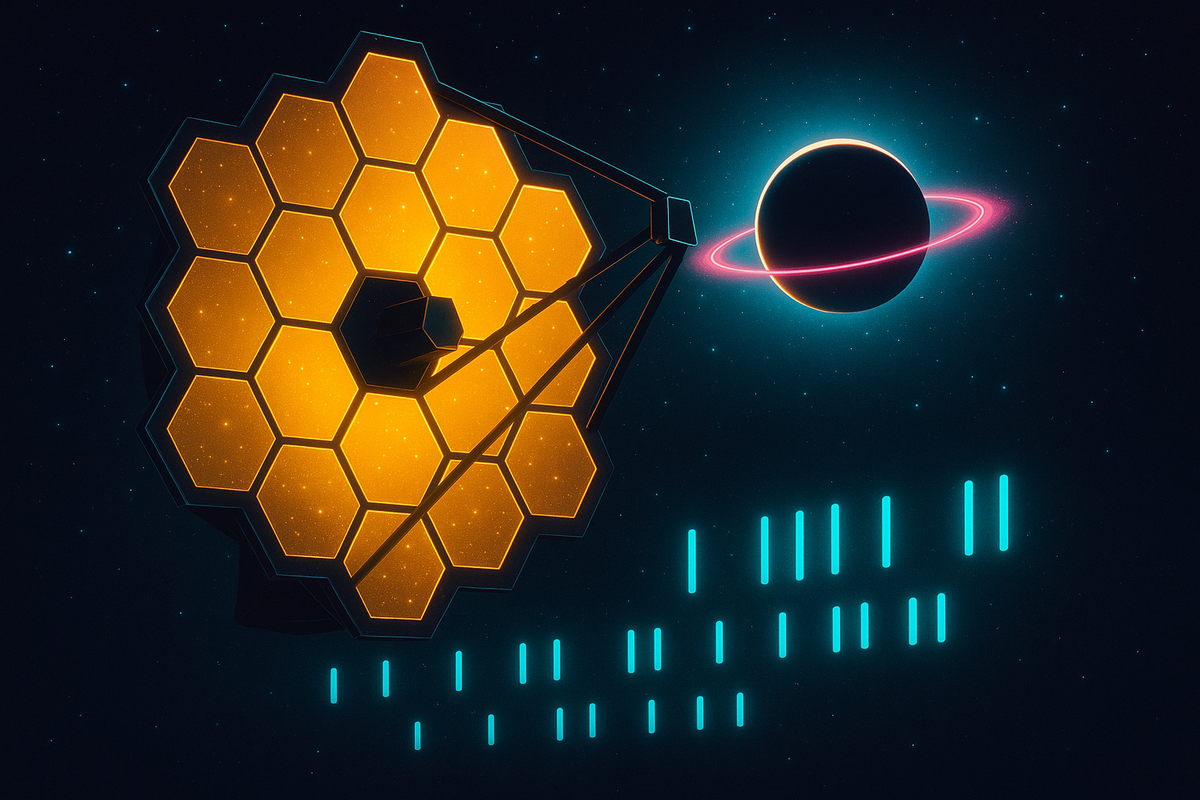
When light from a star passes through a planet's atmosphere on its way to us, molecules in that atmosphere absorb specific wavelengths. The star's light arrives with dark lines in its spectrum—a barcode revealing what gases surround that distant world.
JWST's infrared vision makes it uniquely suited to this work. Many of the molecules we care about—water vapor, methane, carbon dioxide, ammonia—have strong absorption features in the infrared. Ground telescopes fight through Earth's own atmospheric water vapor. JWST, sitting beyond our atmosphere at L2, sees clearly.
This is transmission spectroscopy—light filtered through an alien sky, carrying chemical signatures that wouldn't reach us otherwise. JWST has already delivered the atmospheric composition of WASP-39b, a hot Jupiter 700 light-years away, with precision that would have seemed impossible a decade ago. Carbon dioxide, sulfur dioxide, sodium, potassium—molecules detected not by visiting, but by reading the light.
The technique works best on hot Jupiters and mini-Neptunes with puffy atmospheres. The larger the atmospheric envelope relative to the planet, the more molecules the starlight encounters, the stronger the signal. Earth-sized rocky planets with thin atmospheres present a harder problem. The signal is weaker. The starlight passes through less material. The absorptions are subtler.
But not impossible. Just statistically demanding.
What Counts as a Biosignature?
If we're searching for life, we need to know what life does to a planet's chemistry.
On Earth, the most obvious biosignature is oxygen. Our atmosphere is 21 percent O2—a concentration maintained almost entirely by photosynthesis. Oxygen is reactive. Left alone, it would bind with rocks, dissolve into oceans, oxidize methane. The fact that Earth's atmosphere sustains such a large oxygen reservoir means something is continuously replenishing it.
That something is biology.
Oxygen in an exoplanet's atmosphere, especially if detected alongside water vapor and carbon dioxide, would constitute strong evidence for photosynthetic life. Not definitive—there are abiotic processes that can produce oxygen in small amounts—but compelling.
Another biosignature is methane paired with oxygen. These gases are chemically antagonistic. In equilibrium, they react and destroy each other. If both are present at significant levels simultaneously, something must be producing them continuously. On Earth, that's the combination of photosynthesis (oxygen) and methanogenic bacteria (methane).
Then there's phosphine, a molecule Earth's life produces but that naturally reacts away quickly. The controversial detection of phosphine in Venus's atmosphere ignited debate precisely because no known abiotic process on Venus should produce it in the quantities detected. If it's real, something weird is happening. If that something is biology, it's biology unlike what we know.
These are disequilibrium biosignatures—chemical combinations that persist far from thermodynamic equilibrium, maintained only by active biological processes. They're not proof. They're red flags. They tell you: look closer. Something's going on here.
The Problem of False Positives
The trouble with biosignatures is that planets are complicated.
Oxygen can be produced abiotically through photodissociation—ultraviolet light splitting water vapor into hydrogen (which escapes to space) and oxygen (which remains). On a planet with intense UV radiation and no ozone shield, this could build up oxygen without life. Early in JWST's mission, researchers have already begun modeling how stellar activity, atmospheric escape, and volcanic outgassing could produce biosignature mimics.
Methane alone isn't enough either. Gas giants have methane. Titan has methane. Comets release methane. Methanogenesis is a biological process on Earth, but methane by itself proves nothing.
Even phosphine, once heralded as a slam-dunk biosignature for its reactivity and biological origin on Earth, turned out to be producible by certain volcanic and photochemical pathways on other worlds. The Venus phosphine detection itself has been disputed, with some researchers arguing the spectral lines were misidentified.
This is the epistemological challenge of astrobiology: biological processes aren't the only processes that create disequilibrium. Volcanism, atmospheric photochemistry, tidal heating, stellar wind interactions—these can all drive chemical systems away from equilibrium. The presence of a biosignature gas doesn't guarantee biology. It guarantees something interesting.
The strategy, then, isn't to find a single smoking-gun molecule. It's to find combinations that no plausible abiotic model can explain. Oxygen plus methane plus a clement temperature range plus a long-lived stable star. A suite of indicators that, taken together, point more strongly toward life than toward geology.
JWST's power is that it can give us those combinations—if the planets are cooperative.
JWST's Actual Capabilities for Biosignatures
Let's be precise about what JWST can and cannot do.
JWST can detect molecular features in the atmospheres of transiting exoplanets. It has done so already. Its Near-Infrared Spectrograph (NIRSpec) and Mid-Infrared Instrument (MIRI) cover wavelength ranges where many biosignature gases absorb light. If a planet transits its star—passes between us and the star—JWST can measure the starlight before, during, and after the transit. The difference reveals what the planet's atmosphere absorbs.
JWST is best suited for large planets with thick atmospheres around small, cool stars. The smaller the star, the larger the planet appears relative to it, the stronger the atmospheric signal. This is why so much attention has focused on M-dwarf systems—red dwarfs with rocky planets in their habitable zones. A planet like TRAPPIST-1e, slightly smaller than Earth, orbiting a star only slightly larger than Jupiter, gives a strong enough signal that JWST could, in principle, detect water vapor, CO2, and potentially oxygen if present in large amounts.
JWST struggles with Earth analogs around Sun-like stars. The signal-to-noise ratio drops significantly. An Earth twin transiting a G-type star like our Sun would require many transits—perhaps dozens—to build up sufficient data to confidently detect biosignature gases. JWST's mission lifetime is designed for at least ten years, potentially longer with fuel management, but there are only so many transits available for any given target.
JWST cannot image Earth-sized planets directly. It lacks the angular resolution to separate the light of a rocky planet from its star's glare at interstellar distances. Future missions like the Habitable Worlds Observatory (HWO) will use coronagraphs and starshades for direct imaging, but JWST works via transmission spectroscopy only.
JWST's detections require statistical confidence. One tentative oxygen line isn't enough. Atmospheric science demands multiple transits, cross-checks with different instruments, models ruling out contamination from stellar activity or instrument artifacts. This takes time. Patience. And targets that cooperate.
The reality is that JWST is the beginning of atmospheric biosignature science at scale, not the end. It's proving the techniques work. It's showing us what's possible. But definitive biosignature detections—the kind that would shift the consensus toward "we found life"—will likely require follow-up observations, next-generation telescopes, and the kind of scrutiny that only comes when the stakes are existential.
Technosignatures: Where JWST's Power Shifts
If biosignatures require careful statistical inference and multiple-transit campaigns, technosignatures offer a different game.
Some technological signatures would be bright. Unambiguous. Hard to mistake for anything natural.
Consider industrial pollution. Earth's atmosphere contains chlorofluorocarbons (CFCs)—molecules that do not exist naturally. They're produced by refrigeration, aerosol propellants, industrial solvents. If another civilization went through an industrial phase anything like ours, their atmosphere might bear similar scars. CFCs have strong infrared absorption features. JWST could detect them.
The catch: CFCs are short-lived in atmospheres unless continuously replenished. If an alien civilization banned their CFCs (as we did with the Montreal Protocol), they'd disappear within decades to centuries. JWST could only detect them if the civilization is currently using them—or if their pollution persists on a scale we haven't imagined.
But there's a broader class of technosignatures that JWST is positioned to investigate: atmospheric engineering.
A sufficiently advanced civilization might not just pollute their atmosphere by accident. They might design it. Terraforming, climate control, atmospheric shields against stellar radiation—these could leave chemical fingerprints unlike anything biology alone would produce. High concentrations of gases that serve technological purposes. Unusual isotopic ratios from industrial processes. Molecular combinations that make sense only if someone built them.
JWST can't tell us why an atmosphere looks weird. But it can tell us that it looks weird. And weird, in astrobiology, is worth investigating.
The TRAPPIST-1 System: JWST's Best Shot
No star system has captured more attention as a potential JWST biosignature target than TRAPPIST-1.
Seven Earth-sized planets orbit an ultra-cool red dwarf 40 light-years away. Three of those planets—e, f, and g—sit in the habitable zone, where liquid water could exist on their surfaces. The star is small, the planets are close, the transits are frequent. The signal-to-noise for atmospheric spectroscopy is among the best we'll get for rocky worlds.
JWST has already observed TRAPPIST-1c, finding no evidence of a thick atmosphere—consistent with models suggesting inner planets around M-dwarfs may lose their atmospheres to stellar wind stripping. But TRAPPIST-1e remains a high-priority target. If anywhere will deliver a biosignature detection in the near term, it's there.
The challenge is stellar activity. M-dwarfs flare. They're magnetically active. Flares and starspots can create spectral features that mimic or obscure planetary atmospheric signals. Researchers have to model the star's behavior, subtract its contribution, and isolate what belongs to the planet. This is painstaking work. It requires multiple observations across different times, catching the star in various activity states.
But if the atmospheres are there—if TRAPPIST-1e has water, oxygen, methane, a chemistry out of equilibrium—JWST has the tools to see it. Not in one transit. Not in one paper. But over years of observation, the pattern would emerge.
And if it does, it will be the most important discovery in human history.
What JWST Won't Tell Us
Even if JWST detects oxygen and methane together on a habitable-zone rocky planet, it won't tell us what kind of life produces them.
It won't tell us if that life is microbial or multicellular. Simple or complex. Intelligent or not. It won't tell us if the planet has oceans, continents, forests. It won't tell us if civilizations rise and fall there, or if the life is anaerobic slime clinging to hydrothermal vents beneath a frozen crust.
Atmospheric spectroscopy gives us chemistry. Chemistry gives us clues. But the distance from "clues" to "knowledge" is vast.
That's not a limitation of JWST—it's a limitation of physics. Light carries only so much information. A spectrum tells you what molecules are present, how abundant they are, and (if you're clever with isotope ratios and temperature constraints) some things about where they came from. But it doesn't give you images. It doesn't let you zoom in. It doesn't show you what's making those molecules.
If we detect a biosignature, the next century of astronomy will be spent trying to understand it. We'll build bigger telescopes. We'll launch direct-imaging missions. We'll try to detect the glint of oceans, the seasonal dimming of chlorophyll blooms, the polarization signatures of liquid water clouds. We'll look for radio transmissions, laser pulses, orbital megastructures.
But the first step is finding the target. And that's what JWST is for.
The Timeline Problem
JWST is expected to operate for at least a decade. Possibly longer if systems hold. But a decade is a finite resource.
There are thousands of known exoplanets. Dozens of potentially habitable rocky worlds. Limited observing time. Each atmospheric characterization campaign requires multiple transits, each lasting hours, scheduled around other high-priority science programs. Telescope time is allocated through competitive proposals. Every observation is a trade-off.
This means choices. Which planets do we observe? Which stars? Which atmospheric features do we prioritize? Do we spread our observations across many targets to survey broadly, or do we focus deeply on a few high-probability candidates like TRAPPIST-1e?
The timeline problem is also an interstellar one. Even if we detect a biosignature tomorrow, we can't visit. TRAPPIST-1 is 40 light-years away. With current propulsion, a probe would take tens of thousands of years to arrive. The signal we're receiving left that planet in 1984. If something happened there since—if the biosphere collapsed, if a civilization emerged and extinguished itself—we won't know for another 40 years.
This is the patient game of interstellar science. We gather the data we can. We build the models. We wait.
The Coherence of Detection
In AToM terms, a biosignature detection is a coherence event—a moment where observational data, theoretical models, and the possibility space for life collapse into a higher-order understanding. Before detection, we're uncertain. The entropy is high. We have hypotheses but no confirmation.
A confirmed biosignature reduces that uncertainty. It doesn't answer all questions, but it narrows the state space dramatically. It tells us life exists beyond Earth. That the conditions for its emergence are reproducible. That the universe is not sterile.
That shift—from "maybe" to "yes"—is a coherence increase at civilizational scale. It changes how we understand our position in the cosmos. It changes what questions we ask. It changes what futures we imagine.
JWST is the instrument that could trigger that shift. Not because it's perfect. Not because it was designed for this. But because the physics of light, the chemistry of life, and the geometry of planetary systems have aligned in such a way that we can see.
For the first time in human history, we have the tools to search exoplanet atmospheres for the chemical traces of biology. We can't search everywhere. We can't search exhaustively. But we can search. And that alone is extraordinary.
What Comes After JWST
JWST is not the end of the search. It's the proof of concept.
NASA's Habitable Worlds Observatory (HWO), planned for the 2040s, will use direct imaging to study Earth-like planets around Sun-like stars—the population JWST struggles with. It will carry a coronagraph or starshade to block the star's light, allowing the planet to be seen separately. With enough photons collected over time, HWO could detect biosignature gases, map seasonal changes, even look for signs of continents and oceans via surface reflection patterns.
The European Space Agency's ARIEL mission, launching in the late 2020s, will survey a thousand exoplanet atmospheres, building a statistical understanding of what's common, what's rare, and what's inexplicable. It won't have JWST's sensitivity, but it will have breadth. Patterns emerge from population studies. Anomalies stand out when you have baselines.
Ground-based telescopes like the Extremely Large Telescope (ELT), with a 39-meter primary mirror, will also contribute. Adaptive optics will push through atmospheric turbulence. High-resolution spectrographs will resolve finer features than JWST can. The combination of space and ground, infrared and optical, transmission and direct imaging—this is how comprehensive characterization happens.
But for now, JWST is what we have. And what we have is enough to begin asking the question empirically: do we see signs of life out there?
The answer will unfold over years. Not in a single headline. Not in one dramatic announcement. But in the accumulation of data, the refinement of models, the slow convergence toward clarity.
If life is there, and if it's altered its world's atmosphere in ways we can detect, JWST will be the instrument that saw it first. Not because it was built for that. But because we pointed it in the right direction and let the light tell us what it knows.
This is Part 3 of the Technosignatures series, exploring how science searches for signs of intelligent life beyond Earth.
Previous: Dysonian SETI: Looking for Megastructures Instead of Messages
Next: The Lurker Hypothesis: Could Something Already Be Here?
Further Reading
- Lustig-Yaeger, J., Meadows, V.S., & Lincowski, A.P. (2019). "The Detectability and Characterization of the TRAPPIST-1 Exoplanet Atmospheres with JWST." The Astronomical Journal.
- Seager, S., Bains, W., & Petkowski, J.J. (2016). "Toward a List of Molecules as Potential Biosignature Gases for the Search for Life on Exoplanets and Applications to Terrestrial Biochemistry." Astrobiology.
- Krissansen-Totton, J., et al. (2018). "Disequilibrium Biosignatures Over Earth History and Implications for Detecting Exoplanet Life." Science Advances.
- Schwieterman, E.W., et al. (2018). "Exoplanet Biosignatures: A Review of Remotely Detectable Signs of Life." Astrobiology.
- JWST Transiting Exoplanet Community Early Release Science Program. Multiple publications on atmospheric characterization techniques and early results.
Comments ()