When the Map Warps and Won't Unwarp: Hysteresis in Human Systems
Systems that exceed elastic limits don't return to their original state. Explore hysteresis in trauma, relationships, organizations, and cultures—and why recovery means working with deformation, not erasing it.
When the Map Warps and Won't Unwarp: Hysteresis in Human Systems
Formative Note
This essay represents early thinking by Ryan Collison that contributed to the development of A Theory of Meaning (AToM). The canonical statement of AToM is defined here.
The pressure is gone. Why hasn't the shape returned?
You survived something. The threat ended. The relationship is over. The job is behind you. The danger has passed. Months or years later, you're still braced against it. Your body holds the posture of the old emergency. Your mind runs patterns suited for the old environment. The pressure that bent you was removed, but the bend remains.
This is hysteresis.
Hysteresis is a property of systems that don't return to their original state after the deforming force is removed. A rubber band stretched within its limits snaps back. A metal wire bent past a certain point stays bent. The wire has hysteresis. The rubber band, at low strain, doesn't.
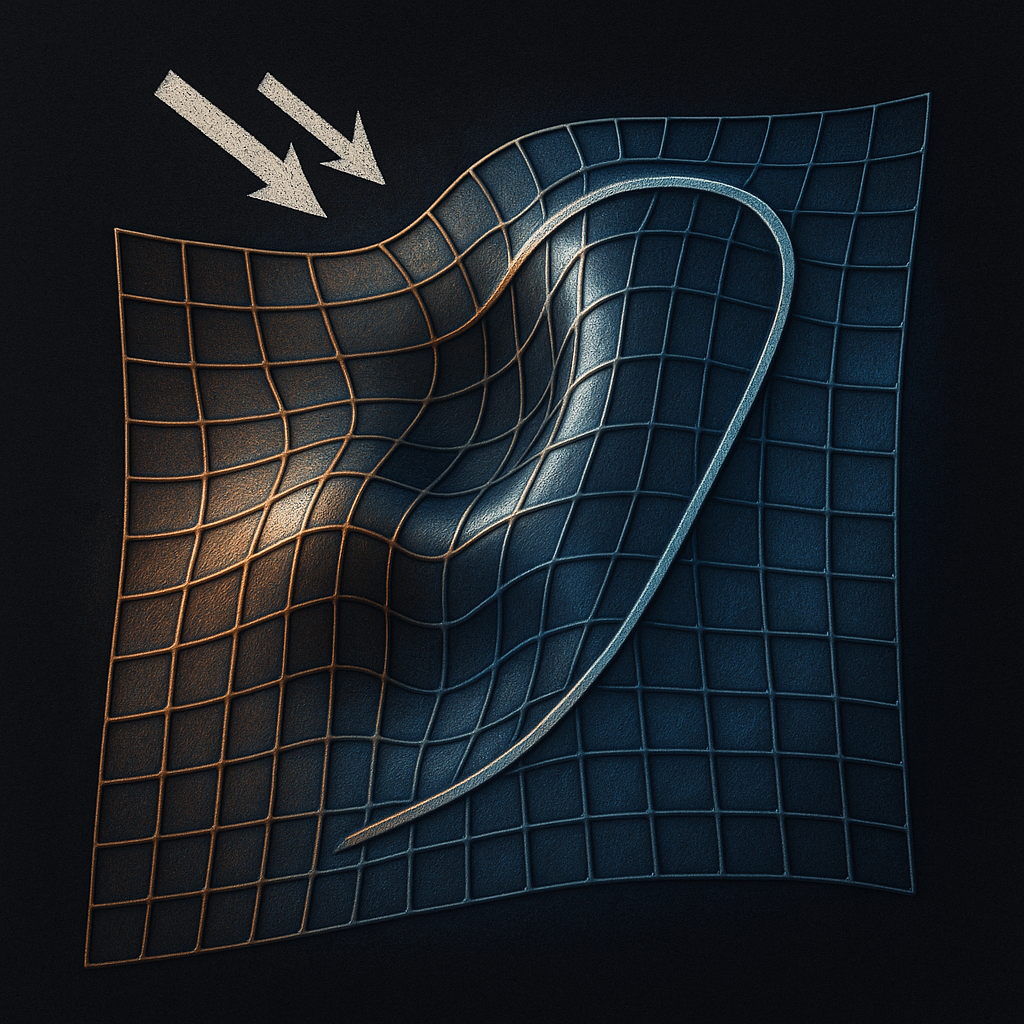
Minds have hysteresis. Relationships have hysteresis. Organizations and cultures have hysteresis. What bends them doesn't always unbend when the pressure releases. The map warps, and sometimes the warp becomes the new shape.
Understanding hysteresis explains why trauma persists beyond danger, why relationship patterns outlast relationships, why organizational dysfunction survives every intervention, why cultural wounds echo across generations. The deformation becomes structure. The temporary becomes permanent. The warp won't unwarp.
The Physics of Memory
Hysteresis appears throughout physics. Magnets exhibit it—once magnetized in a particular direction, they resist remagnetization in another direction even after the magnetizing field is removed. Materials under stress exhibit it—load a beam, unload it, and the beam may not return to its original shape. The history of deformation is encoded in the present state.
The key insight is path dependence. Where you end up depends not just on where you are and what forces are acting, but on how you got here. Two systems experiencing identical current conditions may behave differently because their histories differ. The past is inscribed in the structure.
This is precisely what happens in minds.
Your current state isn't determined only by your current environment. It's shaped by every environment you've moved through, every force that ever acted on you, every deformation your manifold ever underwent. Some of those deformations reversed when the pressure lifted. Some didn't. The ones that didn't are your hysteresis—the historical imprint that shapes present experience.
Why Some Bends Don't Straighten
What determines whether a deformation is reversible or hysteretic?
Magnitude matters. Small deformations—minor stressors, brief perturbations—typically reverse. The manifold bends and springs back. Large deformations—overwhelming experiences, prolonged pressure—may exceed the elastic limit. Past that point, the structure reorganizes. The bend becomes the new baseline.
Duration matters. Brief pressure, even if intense, may not leave permanent marks. The system didn't have time to reorganize around the deformation. Prolonged pressure gives the system time to adapt—to build new structures that accommodate the bent shape, to forget what the original shape was. The adaptation makes the deformation stable.
Developmental timing matters enormously. Young systems are more plastic—they're still forming, and the forces acting on them shape initial structure rather than deforming existing structure. A child's brain under stress doesn't warp and spring back; it develops in the warped shape from the beginning. The hysteresis is total because there's no "before" to return to.
Support matters. A system that faces deformation while connected to other systems may recruit their structure for recovery. The supporting systems provide templates, scaffolding, reference points. A system that faces deformation alone must rely entirely on its own resources—which may have been damaged by the deformation itself.
The Hysteresis of Trauma
Trauma is hysteretic deformation of the belief manifold.
The traumatic experience applied enormous force. The manifold bent sharply—curvature spiked, dimensions collapsed, topology fragmented. Then the experience ended. The pressure released. But the manifold didn't spring back.
Why? Because the deformation exceeded the elastic limit. The manifold reorganized around the new shape. New structures formed to accommodate it. The system adapted to the bent state, and now the bent state is the baseline.
This is why "the danger is over" doesn't help. Someone saying "you're safe now" is pointing at the absent pressure, not at the permanent deformation. Of course the pressure is gone. That's not the problem. The problem is that the map warped, and the warp persists regardless of current conditions.
The traumatized system isn't overreacting to present danger. It's reacting appropriately to the shape of its own manifold. That shape was formed under conditions of danger. It encodes hypervigilance, quick-trigger threat responses, compressed options. These made sense when the manifold was being deformed. They're built in now. The system navigates the map it has, and the map it has is warped.
This is also why insight alone doesn't heal trauma. Understanding perfectly well that the danger has passed doesn't unwarp the manifold. The manifold warped under pressure. It unwarps—if it unwarps at all—through different processes than understanding. Insight happens in the cognitive regions of the manifold. The warp exists in the structural geometry. They're not the same region.
Relational Hysteresis
Relationships leave marks that outlast them.
You loved someone. They hurt you. The relationship ended years ago. You haven't seen them in a decade. But your relational manifold still carries the deformation. You approach new relationships already warped—flinching in advance, protecting preemptively, unable to offer what an unwounded version of you might have offered.
This is relational hysteresis. The pressure of the old relationship is gone. The shape remains.
It shows up in patterns you didn't consciously choose. You find yourself distrusting in ways that don't match the current partner. You find yourself accommodating in ways that kept you safe in the old dynamic but aren't needed now. You find yourself interpreting ambiguous signals through a lens ground by the old experience.
The new partner didn't create this shape. They inherited it. They're navigating a manifold that was deformed by forces they never applied. This is confusing for everyone—the wounded person reacting to something that isn't there, the new partner confronting a ghost they never made.
Healing relational hysteresis requires what we might call counter-deformation. New pressure, applied gently and consistently in the opposite direction. Safe experiences that slowly bend the manifold back—or, more accurately, bend it forward into a new shape that isn't warped by the old wound.
This takes time because hysteretic deformation isn't like elastic recovery. You're not releasing stored tension; you're rebuilding structure. The new shape has to become as stable as the wounded shape, which means it has to be reinforced through repetition, through consistency, through sustained experience that writes a different history into the manifold.
Organizational Hysteresis
Organizations exhibit hysteresis in their processes, cultures, and capabilities.
A company faces a crisis. It adapts—cutting costs, centralizing control, eliminating risk-taking. The crisis passes. The adaptations persist. The cost-cutting culture remains entrenched. The centralized control doesn't relax. The risk-aversion continues. The organization bent under pressure and stayed bent.
Sometimes this is fine. Sometimes the crisis revealed genuine problems that the adaptations address. But often, the adaptations were specific to the crisis and are now maladaptive. The organization is still fighting the last war, still braced against a threat that ended, still warped around conditions that no longer apply.
Organizational transformation often fails because it underestimates hysteresis. Leaders announce new values, new processes, new ways of working. The organization nods, attends the training, produces the reports—and continues operating in its old shape. The pressure of the change initiative is brief. The hysteresis of the existing culture is deep. When the initiative ends, the old shape reasserts.
Changing organizational hysteresis requires sustained counter-pressure. Not a one-time change initiative but persistent force applied over years. Not new processes announced but new processes enforced until they become the path of least resistance. Not culture talked about differently but culture enacted differently, repeatedly, until the new enactment becomes the default.
This is expensive. It requires the organization to expend energy on maintaining a new shape until that shape stabilizes. Most organizations can't or won't sustain this. So the old shape persists.
Cultural Hysteresis
Cultures carry wounds across generations.
An event happens—a war, a genocide, an economic collapse, a betrayal. The generation that experienced it is directly deformed. Then they die. Their children didn't experience the original pressure. But they grew up in a culture that had been warped by it. They inherited the shape.
They pass it on. Now the grandchildren carry deformation from an event that happened before their parents were born. The original pressure is three generations removed. The warp persists.
This is cultural hysteresis. It shows up in collective narratives, in institutional structures, in patterns of relationship between groups. The Irish remember the Famine. Americans remember the Revolution. The trauma of slavery shapes race relations centuries later. The Holocaust shapes Jewish identity across continents and generations.
These aren't just memories. They're manifold deformations. The original events warped the collective belief space, and that warped space was the environment in which subsequent generations developed. They didn't develop and then get warped—they developed warped from the start, shaped by a landscape that was itself shaped by historical pressure.
Cultural healing is generational work. The warp can't be undone by any single intervention because it's built into the structure of how the culture reproduces itself. Children inherit the warped shape because they learn from adults who carry it, who learned from adults who carried it, who were deformed by the original pressure.
Breaking this chain requires sustained counter-experience. Enough people having different-enough experiences that the shape they pass on is different. Enough institutions operating differently that the structural reinforcement shifts. This takes decades. It takes intention. And it's always incomplete, because hysteresis runs deep.
The Energetics of Recovery
Returning a hysteretic system to its original state—or moving it to a new state—requires energy.
This is often misunderstood in therapeutic contexts. People ask: why is healing so hard? Why does it take so long? Why does it require so much effort?
The answer is energetic. The system has settled into a stable configuration—the warped shape. That shape is now the low-energy state. Moving to a different shape requires climbing an energy hill, overcoming the stability of the current configuration, pushing through resistance that the system itself generates.
It's not that the person doesn't want to heal. It's that healing is work. Physical work, in a real sense—the expenditure of energy to reorganize structure. The system has to be pushed out of the warped attractor, held in a new configuration long enough for that configuration to stabilize, and the new shape reinforced until it becomes the low-energy baseline.
This is why safe relationships matter so much for healing. Another person provides energy. They push when you can't push yourself. They hold you in the new configuration when you'd slip back. Their regulated system provides a template that your system can entrain to. Healing in relationship is easier than healing alone because the energetic burden is shared.
It's also why healing is so vulnerable to setback. The new shape isn't as stable as the old shape, not at first. A stressor, a trigger, a difficult experience—any of these can push the system back into the old attractor. The warped shape wants to reassert itself. Until the new shape is deeply stabilized, relapse is always a risk.
Living with Permanence
Not all hysteresis reverses. Some does. Some doesn't.
There are experiences that change you permanently. Deformations that don't unwarp no matter how much time passes, how much work you do, how much counter-pressure you apply. The map bent, and this particular bend is now structural.
This sounds grim. It doesn't have to be.
Living well with permanent deformation isn't about pretending it doesn't exist. It's about building a life around the shape you actually have. Finding paths that work on the warped manifold. Developing capabilities suited to the geometry that is, not the geometry that was or the geometry you wish you had.
Some of what you can do with a warped manifold, you couldn't do with an unwarped one. The warp changed you—not only damaged you but also granted you things. Sensitivity in certain areas. Knowledge you couldn't have acquired otherwise. Capabilities forged under pressure that don't exist in those who weren't pressured.
This doesn't make the warp good. It doesn't justify what caused it. It just acknowledges that the shape you have is the shape you're working with. And that shape, like all shapes, has properties. Some are limiting. Some are enabling.
The goal isn't to return to some pristine pre-deformation state. That state may be gone. The goal is to live well in the shape you actually have. To find the paths through your particular manifold that lead where you want to go. To build around the permanent bends rather than exhausting yourself trying to straighten what won't straighten.
Beyond Recovery
There's a frame that asks: how do we recover from trauma, from relational wounding, from organizational dysfunction, from cultural injury?
Hysteresis suggests a different frame: how do we build lives, relationships, organizations, and cultures that work given the deformations that exist?
Recovery implies returning to a prior state. Hysteresis means the prior state may be inaccessible. We can't undo the history that shaped us. We can only shape the future from here.
This isn't giving up. It's realism. Working with the manifold you have instead of mourning the manifold you don't have. Building forward instead of backward.
The map warped. It won't unwarp completely. That's okay. It can still lead somewhere worth going.
Comments ()